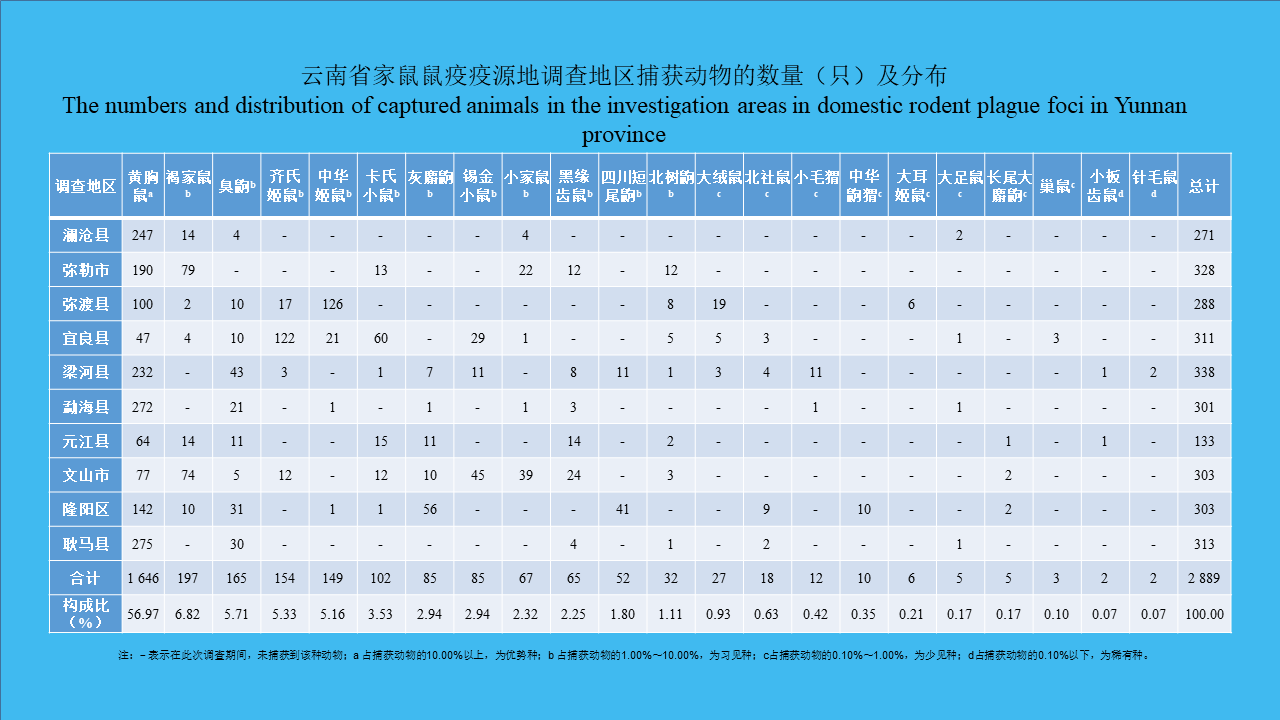
Objective To investigate the community characteristics of small mammals during the quiescent stage of domestic rodent plague foci in Yunnan province of China after 2008 and the reasons for the disparities and changes in community structure, and to provide scientific data support for formulating plague control measures. Methods The stratified sampling method was used to select 10 cities/counties with representative geographical locations and quiescent years of plague in Yunnan province, i.e., Lancang, Midu, Gengma, Yiliang, Lianghe, Menghai, Yuanjiang, Mile, Wenshan, and Longyang, and field investigation was conducted in these areas. The morphological method was used to identify the captured small mammals, Excel 2010 software was used to analyze the sampling data, and the descriptive research method was used to investigate community structure characteristics. Results A total of 2 889 small mammals were captured in these areas and were identified as 22 species in 14 genera, 5 families, and 4 orders. Rattus tanezumi had a composition ratio of 56.97% (1 646/2 889) and was the dominant species; R. norvegicus (6.82%), Suncus murinus (5.71%), Apodemus chevrieri (5.33%), A. draco (5.16%), Mus caroli (3.53%), Crocidura attenuata (2.94%), M. pahari (2.94%), M. musculus (2.32%), R. andamanensis (2.25%), Anourosorex squamipes (1.80%), and Tupaia belangeri (1.11%) were common species; Eothenomys miletus (0.93%), Niviventer confucianus (0.63%), Hylomys suillus (0.42%), Neotetracus sinensis (0.35%), A. latronum (0.21%), R. nitidus (0.17%), C. dracula (0.17%), and Micromys minutus (0.10%) were uncommon species; Bandicota bengalensis (0.07%) and N. fulvescens (0.07%) were rare species. As for the dominant species of small mammals in the 10 areas, only R. tanezumi was the dominant species in Lancang, Menghai, and Gengma; R. tanezumi and another 1-3 species were the dominant species in the other 7 areas, but R. tanezumi was not the first dominant specie in Mile and Yiliang. Conclusion Diverse community structure is observed for small mammals during the quiescent stage of domestic rodent plague foci in Yunnan province, with significant regional differences.
[1] 方喜业,杨瑞馥,刘起勇,等. 中国鼠疫自然疫源地分型研究Ⅱ. 鼠疫自然疫源地分型方法研究[J]. 中华流行病学杂志,2012,33(2):234-238. DOI:10.3760/cma.j.issn.0254-6450. 2012.02.024.Fang XY,Yang RF,Liu QY,et al. A novel method for typing natural plague foci in China Ⅱ. Research on the typing methods for natural plague foci[J]. Chin J Epidemiol,2012,33(2):234-238. DOI:10.3760/cma.j.issn.0254-6450.2012.02.024.(in Chinese)
[2] 方喜业,杨瑞馥,许磊,等. 中国鼠疫自然疫源地分型研究Ⅶ. 中国鼠疫自然疫源地分型生物学特征[J]. 中华流行病学杂志,2012,33(11):1144-1150. DOI:10.3760/cma.j.issn.0254-6450.2012.11.011.Fang XY,Yang RF,Xu L,et al. Ecological-geographic landscapes of natural plague foci in China Ⅶ. Typing of natural plague foci[J]. Chin J Epidemiol,2012,33(11):1144-1150. DOI:10.3760/cma.j.issn.0254-6450.2012.11.011.(in Chinese)
[3] 方喜业. 中国鼠疫自然疫源地[M]. 北京:人民卫生出版社,1990:258-279.Fang XY. Natural focuses of plague in China[M]. Beijing:People's Medical Publishing House,1990:258-279. (in Chinese)
[4] 董兴齐,马永康. 中国家鼠鼠疫及其防治[J]. 中华流行病学杂志,2003,24增刊:8-11.Dong XQ,Ma YK. Rodent plague in China and control[J]. Chin J Epidemiol,2003,24 Suppl:S8-11. (in Chinese)
[5] 苏丽琼,梁云,杨智明,等. 云南省2013年鼠疫监测结果[J]. 中国地方病防治杂志,2014,29增刊:66-69.Su LQ,Liang Y,Yang ZM,et al. The surveillance results of plague in Yunnan province in 2013[J]. Chin J Ctrl Endem Dis,2014,29 Suppl:S66-69. (in Chinese)
[6] 俞东征. 鼠疫动物流行病学[M]. 北京:科学出版社,2009:28-85.Yu DZ. Epizootiology of plague[M]. Beijing:Science Press,2009:28-85. (in Chinese)
[7] 秦长育,许磊,张荣祖,等. 中国鼠疫自然疫源地分型研究Ⅴ. 鼠疫宿主生物学特征[J]. 中华流行病学杂志,2012,33(7):692-697. DOI:10.3760/cma.j.issn.0254-6450.2012.07.011.Qin CY,Xu L,Zhang RZ,et al. Ecological-geographic landscapes of natural plague foci in ChinaⅤ. Biological characteristics of major natural reservoirs of Yesinia pestis[J]. Chin J Epidemiol,2012,33(7):692-697. DOI:10.3760/cma.j.issn.0254-6450.2012.07.011.(in Chinese)
[8] 张家勇,丁俊,白玉银,等. 辽宁省2006-2015年鼠类密度及种群结构分析[J]. 中国媒介生物学及控制杂志,2017,28(1):51-55. DOI:10.11853/j.issn.1003.8280.2017.01.014.Zhang JY,Ding J,Bai YY,et al. Analysis of rodent density and constituent in Liaoning province,China,during 2006-2015[J]. Chin J Vector Biol Control,2017,28(1):51-55. DOI:10.11853/j.issn.1003.8280.2017.01.014.(in Chinese)
[9] 李胜,杨建国,冯建萍,等. 青海省2006-2015年鼠疫流行病学分析[J]. 中国地方病防治杂志,2016,31(10):1095-1096.Li S,Yang JG,Feng JP,et al. Epidemiological analysis on plague in Qinghai province from 2006 to 2015[J]. Chin J Ctrl Endem Dis,2016,31(10):1095-1096. (in Chinese)
[10] 张渝疆,阿布力克木,王诚,等. 新疆维吾尔自治区准噶尔盆地2007-2016年鼠疫流行态势分析[J]. 中华流行病学杂志,2017,38(10):1394-1398. DOI:10.3760/cma.j.issn.0254-6450.2017.10.020.Zhang YJ,Abulikemu,Wang C,et al. Epidemics and risk factors of plague in Junggar Basin,Xinjiang Uygur Autonomous Region,2007-2016[J]. Chin J Epidemiol,2017,38(10):1394-1398. DOI:10.3760/cma.j.issn.0254-6450.2017.10.020.(in Chinese)
[11] 闫东,史献明,王再山,等. 河北省鼠疫疫源地宿主动物种群结构研究[J]. 中华卫生杀虫药械,2016,22(4):381-384. DOI:10.19821/j.1671-2781.2016.04.024.Yan D,Shi XM,Wang ZS,et al. Research on the population structure of plague host animals in plague foci in Hebei province[J]. Chin J Hyg Insect Equip,2016,22(4):381-384. DOI:10.19821/j.1671-2781.2016.04.024.(in Chinese)
[12] 马旭,张涛. 2005-2020年宁夏阿拉善黄鼠鼠疫自然疫源地监测数据分析[J]. 现代预防医学,2022,49(13):2465-2469,2475. DOI:10.20043/j.cnki.MPM.202103786.Ma X,Zhang T. Surveillance data in Spermophilus alaschanicus natural plague foci of Ningxia,2005-2020[J]. Mod Prev Med,2022,49(13):2465-2469,2475. DOI:10.20043/j.cnki.MPM.202103786.(in Chinese)
[13] 黎文鸿,王梦迪,尹家祥. 自然环境改变对鼠疫发生的影响[J]. 中国热带医学,2021,21(10):1013-1016. DOI:10.13604/j.cnki.46-1064/r.2021.10.20.Li WH,Wang MD,Yin JX. Influence of changes in natural environment on plague[J]. China Trop Med,2021,21(10):1013-1016. DOI:10.13604/j.cnki.46-1064/r.2021.10.20.(in Chinese)
[14] Xiang JJ,Hansen A,Liu QY,et al. Impact of meteorological factors on hemorrhagic fever with renal syndrome in 19 cities in China,2005-2014[J]. Sci Total Environ,2018,636:1249-1256. DOI:10.1016/j.scitotenv.2018.04.407.
[15] 李瑞,尹家祥. 生态地理景观要素土壤与鼠疫的关系[J]. 中国人兽共患病学报,2020,36(10):876-880. DOI:10.3969/j.issn.1002-2694.2020.00.125.Li R,Yin JX. Relationship between the soil element in eco-geographical landscape and the occurrence of plague[J]. Chin J Zoonoses,2020,36(10):876-880. DOI:10.3969/j.issn.1002-2694.2020.00.125.(in Chinese)
[16] 杜国义,闫东. 动物间鼠疫流行与主要宿主密度相关性研究[J]. 中国媒介生物学及控制杂志,2019,30(4):442-443,450. DOI:10.11853/j.issn.1003.8280.2019.04.020.Du GY,Yan D. A study of the correlation between plague epidemics among animals and the density of their hosts[J]. Chin J Vector Biol Control,2019,30(4):442-443,450. DOI:10.11853/j.issn.1003.8280.2019.04.020.(in Chinese)
[17] Andreassen HP,Sundell J,Ecke F,et al. Population cycles and outbreaks of small rodents:Ten essential questions we still need to solve[J]. Oecologia,2021,195(3):601-622. DOI:10.1007/S00442-020-04810-W.
[18] 浦恩念,苏超,邵宗体,等. 云南勐海县一起人间鼠疫疫情的调查处置分析[J]. 中国人兽共患病学报,2022,38(5):464-468. DOI:10.3969/j.issn.1002-2694.2022.00.053.Pu EN,Su C,Shao ZT,et al. Investigation and handling of a human plague epidemic outbreak in Menghai county,Yunnan[J]. Chin J Zoonoses,2022,38(5):464-468. DOI:10.3969/j.issn.1002-2694.2022.00.053.(in Chinese)
[19] 张希昆. 对宜良县鼠疫流行及处理过程的反思[J]. 中国地方病防治杂志,1999,14(4):221-222.Zhang XK. Reflection on the epidemic and treatment of plague in Yiliang county[J]. Chin J Ctrl Endem Dis,1999,14(4):221-222. (in Chinese)
[20] 洪劲,雷黎辉,李建荣,等. 2004-2009年宜良县鼠疫监测分析[J]. 中国地方病防治杂志,2011,26(3):209-213.Hong J,Lei LH,Li JR,et al. Observation results of plague in Yiliang county from 2004 to 2009[J]. Chin J Ctrl Endem Dis,2011,26(3):209-213. (in Chinese)
[21] 段彪,洪梅,苏超,等. 云南省家鼠鼠疫疫源地静息期鼠疫指示动物血清流行病学调查[J]. 中国媒介生物学及控制杂志,2017,28(6):583-585. DOI:10.11853/j.issn.1003.8280.2017. 06.016.Duan B,Hong M,Su C,et al. Sero-epidemiological survey of indicator animals in the quiescent stage of domestic rodent-maintained epidemic focus of plague in Yunnan province[J]. Chin J Vector Biol Control,2017,28(6):583-585. DOI:10.11853/j.issn.1003.8280.2017.06.016.(in Chinese)
[22] 石丽媛,杨桂荣,赵春花,等. 2016年云南省景洪市一起人间鼠疫疫情判定及处置[J]. 中国卫生检验杂志,2017,27(10):1502-1504,1507.Shi LY,Yang GR,Zhao CH,et al. Determination and disposal of human plague in Jinghong,Yunnan province,in 2016[J]. Chin J Health Lab Technol,2017,27(10):1502-1504,1507. (in Chinese)


