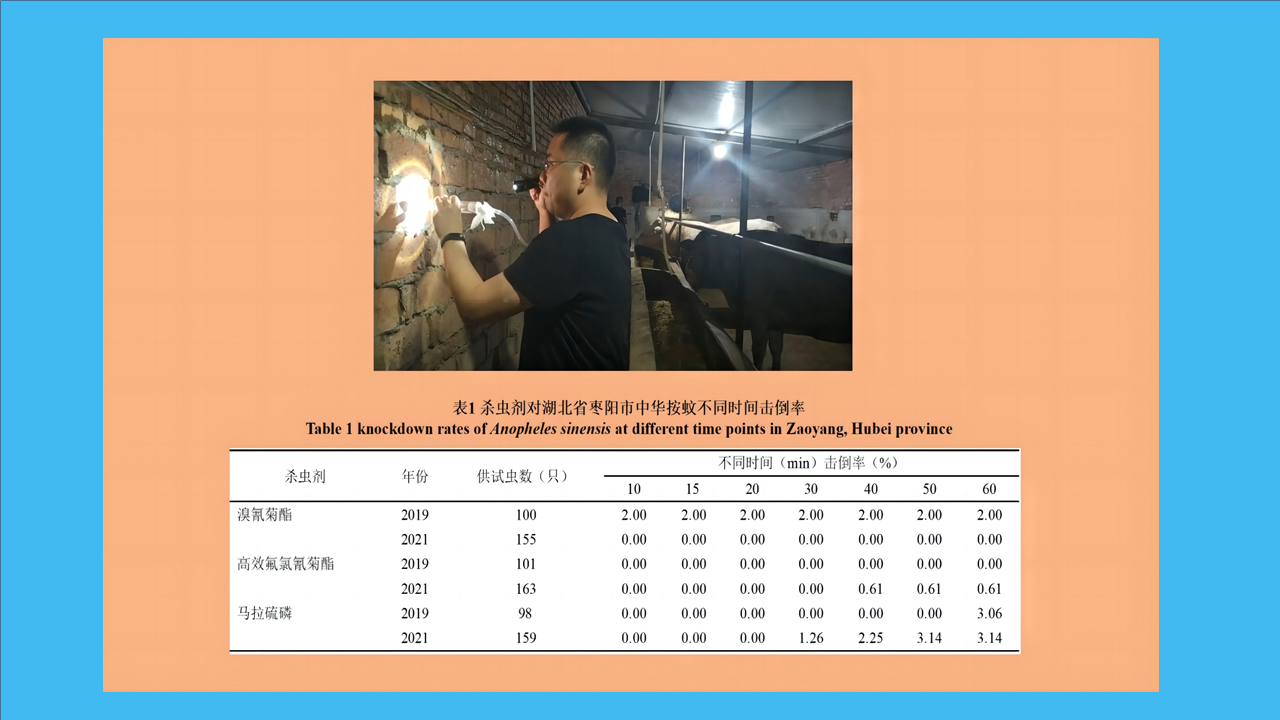
Objective To investigate the susceptibility of wild Anopheles sinensis to insecticides, including deltamethrin, beta-cyfluthrin, and malathion, in Zaoyang, Hubei province, China, and to provide a scientific basis for the local malaria vector control. Methods An. sinensis mosquitoes were captured from cowsheds in Zaoyang of Hubei province in both July 2019 and July 2021. The filter-paper bioassay recommended by the World Health Organization (WHO) was used to determine the susceptibility of An. sinensis to deltamethrin, beta-cyfluthrin, and malathion. For each insecticide, the test procedures were repeated four times (n≈25) in 2019 and six times (n≈25) in 2021. During the measurement, the numbers of knocked down mosquitoes at 10, 15, 20, 30, 40, 50, and 60 min were recorded. After 60 min of exposure, all tested adult An. sinensis mosquitoes were transferred to the holding tubes, and the mortality was recorded 24 h later. The insecticide resistance level was assessed based on the WHO criteria. Excel 2007 software was used for data collation. SPSS 17.0 software and the Chi-square test were used to analyze and compare the differences in 60 min knockdown rate between 2019 and 2021. Results The experimental groups of deltamethrin had 60 min knockdown rates of 2.00% in 2019 and 0 in 2021, with a statistical difference between them (χ2=9.800, P=0.007), and had 24 h mortality rates of 7.74% in 2019 and 15.67% in 2021. The experimental groups of beta-cyfluthrin had 60 min knockdown rates of 0 in 2019 and 0.61% in 2021, with a statistical difference between them (χ2=6.400, P=0.011), and had 24 h mortality rates of 17.04% in 2019 and 4.36% in 2021. The experimental groups of malathion had 60 min knockdown rates of 3.06% in 2019 and 3.14% in 2021, with no statistical difference between them (χ2=8.000, P=0.156), and had 24 h mortality rates of 55.58% in 2019 and 82.24% in 2021. The resistance levels to the three types of insecticides were all "resistant" both in 2019 and 2021. Conclusions An. sinensis in Zaoyang, Hubei province has developed resistance to deltamethrin, beta-cyfluthrin, and malathion. The monitoring of insecticide resistance of An. sinensis should be strengthened. Insecticides should be used reasonably, and comprehensive control measures should be taken.
[1] 刘起勇. 加强媒介按蚊可持续精准控制巩固中国疟疾消除成果[J]. 中国血吸虫病防治杂志,2022,34(2):117-119. DOI:10.16250/j.32.1374.2022069.Liu QY. Sustainable and precise Anopheles control to maintain malaria elimination in China[J]. Chin J Schisto Control,2022,34(2):117-119. DOI:10.16250/j.32.1374.2022069.(in Chinese)
[2] 袁方玉,黄光全,徐博钊. 湖北省连续四年溴氰菊酯浸泡蚊帐防制媒介和控制疟疾流行的效果观察[J]. 中国寄生虫病防治杂志,1995,8(4):241-243.Yuan FY,Huang GQ,Xu BZ. Observation on effectiveness of deltamethrin-impregnated bednets for malaria control in 7 countles of Hubei province during 1990 to 1993[J]. Chin J Parasit Dis Control,1995,8(4):241-243. (in Chinese)
[3] 万伦,张华勋,李凯杰,等. 2018-2020年湖北省传疟媒介监测分析[J]. 中国寄生虫学与寄生虫病杂志,2021,39(5):592-598. DOI:10.12140/j.issn.1000-7423.2021.05.005.Wan L,Zhang HX,Li KJ,et al. Surveillance of malaria-transmitting vectors in Hubei province from 2018 to 2020[J]. Chin J Parasitol Parasit Dis,2021,39(5):592-598. DOI:10.12140/j.issn.1000-7423.2021.05.005.(in Chinese)
[4] 陆宝麟. 中国动物志. 昆虫纲. 第9卷. 双翅目:(蚊科)下卷[M]. 北京:科学出版社, 1997:16-17. Lu BL. Fauna Sinica. Insecta volume 9. Diptera:Culicidae 2[M]. Beijing:Science Press, 1997:16-17. (in Chinese)
[5] World Health Organization (WHO). Test procedures for insecticide resistance monitoring in malaria vector mosquitoes[M]. 2nd ed. Geneva:WHO,2018:1-30.
[6] 汪圣强,杨蒙蒙,朱国鼎,等. "一带一路"倡议下输入性蚊媒传染病的防控[J]. 中国血吸虫病防治杂志,2018,30(1):9-13. DOI:10.16250/j.32.1374.2017208.Wang SQ,Yang MM,Zhu GD,et al. Control of imported mosquito-borne diseases under the Belt and Road Initiative[J]. Chin J Schisto Control,2018,30(1):9-13. DOI:10.16250/j.32.1374.2017208.(in Chinese)
[7] World Health Organization (WHO). Global insecticide use for vector-borne disease control[M]. 4th ed. Geneva:WHO,2009:15-20.
[8] 张小磊,袁志明,胡晓敏. 致倦库蚊对杀虫剂的抗性现状及治理[J]. 中国媒介生物学及控制杂志,2019,30(6):719-724.Zhang XL,Yuan ZM,Hu XM. Current status of insecticide resistance in Culex pipiens quinquefasciatus and management of resistance[J]. Chin J Vector Biol Control,2019,30(6):719-724. (in Chinese)
[9] 涂涛田,肖汉森,孟凤霞,等. 重庆市2019年登革热暴发疫情应急控制后媒介伊蚊抗药性调查[J]. 中国媒介生物学及控制杂志,2022,33(1):44-47. DOI:10.11853/j.issn.1003.8280. 2022.01.008.Tu TT,Xiao HS,Meng FX,et al. An investigation of the insecticide resistance of Aedes vector after emergency control of a dengue fever outbreak in Chongqing,China,2019[J]. Chin J Vector Biol Control,2022,33(1):44-47. DOI:10.11853/j.issn.1003.8280.2022.01.008.(in Chinese)
[10] 赵春春,周欣欣,李文玉,等. 2020年中国13省份登革热媒介白纹伊蚊抗药性监测及分析研究[J]. 中国媒介生物学及控制杂志,2022,33(1):30-37. DOI:10.11853/j.issn.1003.8280. 2022.01.006.Zhao CC,Zhou XX,Li WY,et al. Insecticide resistance surveillance and characteristic analysis of dengue vector Aedes albopictus in 13 provinces of China in 2020[J]. Chin J Vector Biol Control,2022,33(1):30-37. DOI:10.11853/j.issn.1003. 8280.2022.01.006.(in Chinese)
[11] 裴速建,张华勋,李凯杰,等. 湖北省中华按蚊对溴氰菊酯的抗药性监测[J]. 中国媒介生物学及控制杂志,2014,25(1):18-20.Pei SJ,Zhang HX,Li KJ,et al. Monitoring of resistance of Anopheles sinensis to deltamethrin in Hubei province,China[J]. Chin J Vector Biol Control,2014,25(1):18-20. (in Chinese)
[12] 王纯玉,李志,丁俊,等. 辽宁省东港市蚊虫分布及中华按蚊抗药性调查[J]. 中华卫生杀虫药械,2021,27(3):223-225. DOI:10.19821/j.1671-2781.2021.03.009.Wang CY,Li Z,Ding J,et al. Distribution of mosquitoes and insecticide resistance of Anopheles sinensis in Donggang city of Liaoning province[J]. Chin J Hyg Insect Equip,2021,27(3):223-225. DOI:10.19821/j.1671-2781.2021.03.009.(in Chinese)
[13] 杨明磊,李逸明,李凯利,等. 海南岛5种按蚊种群对溴氰菊酯和DDT的敏感性测定及击倒抗性突变检测研究[J]. 寄生虫与医学昆虫学报,2019,26(2):99-104. DOI:10.3969/j.issn.1005-0507.2019.02.005.Yang ML,Li YM,Li KL,et al. Susceptibility of five Anopheles species to deltamethrin and DDT and knockdown resistance mutation detection in Hainan island,China[J]. Acta Parasitol Med Entomol Sin,2019,26(2):99-104. DOI:10.3969/j.issn. 1005-0507.2019.02.005.(in Chinese)
[14] 胡亚博,贺志权,刘颖,等. 河南省濮阳市中华按蚊对杀虫剂敏感性调查[J]. 中国血吸虫病防治杂志,2021,33(5):501-504,509. DOI:10.16250/j.32.1374.2020331.Hu YB,He ZQ,Liu Y,et al. Susceptibility of Anopheles sinensis to insecticides in Puyang city,Henan province[J]. Chin J Schisto Control,2021,33(5):501-504,509. DOI:10.16250/j.32.1374. 2020331.(in Chinese)
[15] 代玉华,程鹏,刘丽娟,等. 山东省部分地区中华按蚊的抗药性监测[J]. 中国媒介生物学及控制杂志,2014,25(3):219-221. DOI:10.11853/j.issn.1003.4692.2014.03.006.Dai YH,Cheng P,Liu LJ,et al. Detection investigation of Anopheles sinensis resistance to four commonly used insecticides in selected areas of Shandong province,China[J]. Chin J Vector Biol Control,2014,25(3):219-221. DOI:10.11853/j.issn.1003. 4692.2014.03.006.(in Chinese)
[16] 李菊林,周华云,曹俊,等. 江苏省疟疾媒介中华按蚊对杀虫剂的敏感性[J]. 中国血吸虫病防治杂志,2011,23(3):296-300. DOI:10.16250/j.32.1374.2011.03.010.Li JL,Zhou HY,Cao J,et al. Sensitivity of Anopheles sinensis to insecticides in Jiangsu province[J]. Chin J Schisto Control,2011,23(3):296-300. DOI:10.16250/j.32.1374.2011.03.010.(in Chinese)
[17] 朱国鼎,高琪,曹俊. 取不易守更难:我国巩固消除疟疾成果面临的挑战[J]. 中国血吸虫病防治杂志,2022,34(2):109-111,114. DOI:10.16250/j.32.1374.2022087.Zhu GD,Gao Q,Cao J. Harder maintained than achieved:Challenges of maintaining malaria-free in China[J]. Chin J Schisto Control,2022,34(2):109-111,114. DOI:10.16250/j.32.1374.2022087.(in Chinese)
[18] 兰子尧,李杨,黄雨婷,等. 输入性疟疾再传播风险评估指标体系的构建[J]. 中国血吸虫病防治杂志,2022,34(2):163-171. DOI:10.16250/j.32.1374.2022023.Lan ZY,Li Y,Huang YT,et al. Construction of a risk assessment indicator system for re-establishment of imported malaria[J]. Chin J Schisto Control,2022,34(2):163-171. DOI:10.16250/j.32.1374.2022023.(in Chinese)
[19] 夏菁,张华勋,林文,等. 湖北省消除疟疾行动计划中期评估报告[J]. 中国热带医学,2018,18(4):308-311. DOI:10.13604/j.cnki.46-1064/r.2018.04.03.Xia J,Zhang HX,Lin W,et al. Mid-term assessment report of malaria elimination action plan in Hubei[J]. China Trop Med,2018,18(4):308-311. DOI:10.13604/j.cnki.46-1064/r.2018. 04.03.(in Chinese)
[20] 夏菁,吴冬妮,朱红,等. 湖北省疟疾控制和消除历程[J]. 中国寄生虫学与寄生虫病杂志,2021,39(5):565-571. DOI:10. 12140/j.issn.1000-7423.2021.05.001.Xia J,Wu DN,Zhu H,et al. Course of malaria control and elimination in Hubei province[J]. Chin J Parasitol Parasit Dis,2021,39(5):565-571. DOI:10.12140/j.issn.1000-7423.2021. 05.001.(in Chinese)
[21] 林康明,杨益超,黎军. 我国主要传疟媒介抗药性研究进展[J]. 中国热带医学,2019,19(6):584-590. DOI:10.13604/j.cnki.46-1064/r.2019.06.21.Lin KM,Yang YC,Li J. Progress of insecticide resistance of the main malaria vectors in China[J]. China Trop Med,2019,19(6):584-590. DOI:10.13604/j.cnki.46-1064/r.2019.06.21.(in Chinese)


