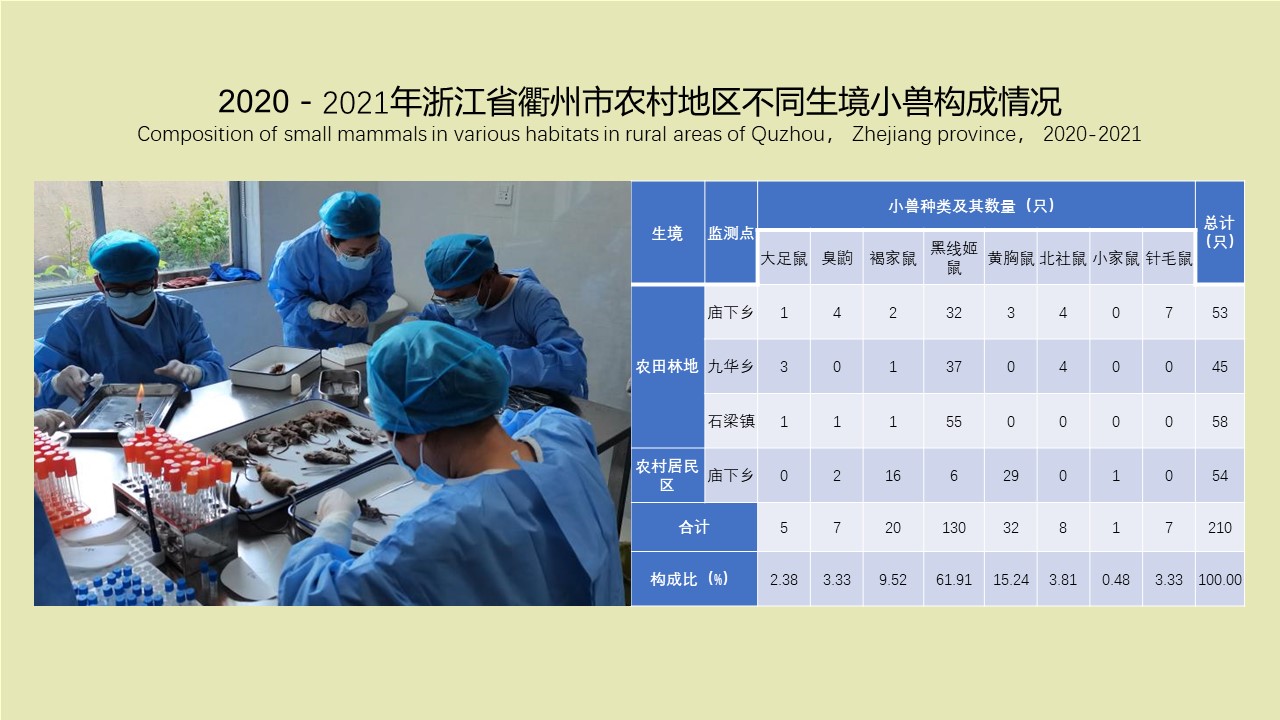
Objective To investigate the small mammal distribution and their infection with pathogens in rural areas of Quzhou, Zhejiang province, China, and to provide a scientific basis for the prevention and control of rodent-borne diseases in Quzhou. Methods From September 2020 to July 2021, the night snap trapping method was used to monitor small mammal species in Kecheng district and Longyou county of Quzhou. The viscera of small mammals, including liver, spleen, kidney, and lung, were collected. Quantitative real-time PCR was used to detect the nucleic acids of severe fever with thrombocytopenia syndrome virus (SFTSV), Orientia tsutsugamushi (Ot), Leptospira, and Hantavirus. Results A total of 210 small mammals were captured during the survey of Quzhou monitoring sites, with a capture rate of 8.44%. March, September, and November were the peak months of small mammal infestation. Apodemus agrarius (130/210, 61.91%) was the dominant species in rural areas of Quzhou, followed by Rattus tanezumi (32/210, 15.24%) and R. norvegicus (20/210, 9.52%). In terms of various habitats, R. tanezumi and R. norvegicus were the dominant species in rural residential areas, and A. agrarius was the dominant species in farmland and forest land. A total of 210 visceral specimens were collected from the small mammals, of which 13 (6.19%) were positive for hantavirus nucleic acid, 7 (3.33%) were positive for Leptospira nucleic acid, and SFTSV and Ot were not detected. There was a statistical difference between the detection rates of 4 pathogens (χ2=24.176, P<0.001). In terms of various small mammal species, hantavirus nucleic acid was detected only from A. agrarius, with a positive rate of 10.00% (13/130); Leptospira nucleic acid was detected from R. norvegicus, A. agrarius, and R. tanezumi, with positive rates of 5.00% (1/20), 3.85% (5/130), and 3.13% (1/32), respectively; there was no statistical difference between the positive rates (χ2=0.114, P=0.945). Some A. agrarius rodents were co-infected with hantavirus and Leptospira. Conclusion A. agrarius, R. tanezumi, and R. norvegicus are the dominant species in rural areas of Quzhou. A. agrarius carries hantavirus and Leptospira; R. tanezumi and R. norvegicus carry Leptospira. It is necessary to strengthen the publicity of prevention and control of rodent-borne diseases and carry out patriotic health campaigns of rodent control and disease prevention to reduce the risk of infection with rodent-borne diseases.
[1] 李贵昌,王玉姣,鲁亮,等. 2019年全国鼠类监测报告[J]. 中国媒介生物学及控制杂志,2020,31(4):389-394. DOI:10.11853/j.issn.1003.8280.2020.04.002. Li GC,Wang YJ,Lu L,et al. National surveillance report on rodents in China,2019[J]. Chin J Vector Biol Control,2020,31(4):389-394. DOI:10.11853/j.issn.1003.8280.2020.04.002.(in Chinese)
[2] 王敏,余樟有,姜宪尘,等. 2001-2012年浙江省衢州市钩端螺旋体病监测分析[J]. 疾病监测,2013,28(9):726-729. DOI:10.3784/j.issn.1003-9961.2013.9.009. Wang M,Yu ZY,Jiang XC,et al. Surveillance of leptospirosis in Quzhou,Zhejiang,2001-2012[J]. Dis Surveill,2013,28(9):726-729. DOI:10.3784/j.issn.1003-9961.2013.9.009.(in Chinese)
[3] 王敏,杨辉,余樟有,等. 浙江省衢州市2006-2020年肾综合征出血热人群流行特征及宿主动物监测研究[J]. 中国媒介生物学及控制志,2022,33(4):480-484,509. DOI:10.11853/j.issn.1003.8280.2022.04.007. Wang M,Yang H,Yu ZY,et al. Epidemiological characteristics of hemorrhagic fever with renal syndrome and surveillance studies of host animal in Quzhou,Zhejiang province,China,2006-2020[J]. Chin J Vector Biol Control,2022,33(4):480-484,509. DOI:10.11853/j.issn.1003.8280.2022.04.007.(in Chinese)
[4] 张蓉,张宁,凌锋,等. 浙江省2005-2020年肾综合征出血热流行趋势分析[J]. 中华流行病学杂志,2021,42(11):2030-2036. DOI:10.3760/cma.j.cn112338-20210528-00435. Zhang R,Zhang N,Ling F,et al. Study on epidemic trend of hemorrhagic fever with renal syndrome in Zhejiang province,2005-2020[J]. Chin J Epidemiol,2021,42(11):2030-2036. DOI:10.3760/cma.j.cn112338-20210528-00435.(in Chinese)
[5] 施旭光,姜理平,孙继民,等. 浙江省钩端螺旋体病10年监测结果分析[J]. 浙江预防医学,2016,28(6):550-552,556. DOI:10.19485/j.cnki.issn1007-0931.2016.06.003. Shi XG,Jiang LP,Sun JM,et al. An analysis on leptospirosis surveillance of ten years in Zhejiang province[J]. Zhejiang Prev Med,2016,28(6):550-552,556. DOI:10.19485/j.cnki.issn 1007-0931.2016.06.003.(in Chinese)
[6] 龚震宇,侯娟,刘起勇,等. 1994-2010年浙江自然疫源性疾病高发区鼠类综合监测和肾综合征出血热疫苗防病效果研究[J]. 中华预防医学杂志,2012,46(10):908-911. DOI:10.3760/cma.j.issn.0253-9624.2012.10.010. Gong ZY,Hou J,Liu QY,et al. Study on comprehensive monitoring of mouse and effect of hemorrhagic fever with renal syndrome vaccine in high prevalence areas of natural focus infectious disease of Zhejiang province in 1994-2010[J]. Chin J Prev Med,2012,46(10):908-911. DOI:10.3760/cma.j.issn.0253-9624.2012.10.010.(in Chinese)
[7] 王金娜,凌锋,孙继民,等. 浙江省鼠密度对肾综合征出血热发病率的影响[J]. 中国媒介生物学及控制杂志,2016,27(3):241-243,247. DOI:10.11853/j.issn.1003.8280.2016.03.007. Wang JN,Ling F,Sun JM,et al. The impact of the rodent density on the incidence of hemorrhagic fever with renal syndrome in Zhejiang province[J]. Chin J Vector Biol Control,2016,27(3):241-243,247. DOI:10.11853/j.issn.1003.8280.2016.03.007.(in Chinese)
[8] 夏仪,殷为申,李颖,等. 上海市长宁区2008-2012年鼠类密度监测结果分析[J]. 中国媒介生物学及控制杂志,2015,26(4):422-423. DOI:10.11853/j.issn.1003.4692.2015.04.026. Xia Y,Yin WS,Li Y,et al. Analysis of the rat density monitoring results in Changning district of Shanghai from 2008 to 2012[J]. Chin J Vector Biol Control,2015,26(4):422-423. DOI:10.11853/j.issn.1003.4692.2015.04.026.(in Chinese)
[9] 陈志清,庞志峰. 金华市2011-2012年鼠间肾综合征出血热监测结果分析[J]. 中国预防医学杂志,2014,15(8):778-780. DOI:10.16506/j.1009-6639.2014.08.014. Chen ZQ,Pang ZF. Analysis of surveillance results of hemorrhagic fever with renal syndrome among rats in Jinhua city from 2011 to 2012[J]. Chin Prev Med,2014,15(8):778-780. DOI:10.16506/j.1009-6639.2014.08.014.(in Chinese)
[10] 曹建海,倪庆翔,张孝和,等. 温州市鼠形动物及蜱媒携带巴贝虫调查结果分析[J]. 中国农村卫生事业管理,2016,36(7):880-882. Cao JH,Ni QX,Zhang XH,et al. Investigation and analysis of Babesia carried by rodents and tick vectors in Wenzhou[J]. Chin Rural Health Serv Administrat,2016,36(7):880-882. (in Chinese)
[11] 赵怡双,吴瑜燕,周海慧,等. 浙江省台州市农村地区鼠形动物自然感染4种病原体的调查[J]. 疾病监测,2021,36(9):894-897. DOI:10.3784/jbjc.202105310292. Zhao YS,Wu YY,Zhou HH,et al. Investigation of natural infection of four pathogens in rodents in rural area of Taizhou,Zhejiang[J]. Dis Surveill,2021,36(9):894-897. DOI:10.3784/jbjc.202105310292.(in Chinese)
[12] 肖方震,陈美宝,韩腾伟,等. 三明市鼠类携带蜱传病原体的混合感染研究[J]. 中国病原生物学杂志,2019,14(7):811-813,818. DOI:10.13350/j.cjpb.190714. Xiao FZ,Chen MB,Han TW,et al. Research on coinfection with multiple tick-borne pathogens in rodents in the Sanming region of Fujian province[J]. J Path Biol,2019,14(7):811-813,818. DOI:10.13350/j.cjpb.190714.(in Chinese)
[13] 赵哲,贺真,龙泳. 我国常见鼠传疾病流行病学特点及防治研究现状[J]. 中华卫生杀虫药械,2021,27(6):578-581. DOI:10.19821/j.1671-2781.2021.06.024. Zhao Z,He Z,Long Y. Research progress on epidemiology and control of main rodent-borne diseases in China[J]. Chin J Hyg Insect Equip,2021,27(6):578-581. DOI:10.19821/j.1671-2781.2021.06.024.(in Chinese)
[14] 罗学辉,黄邵军,陈立锋,等. 余姚市鼠形动物携带汉坦病毒及M基因分析[J]. 预防医学,2016,28(8):789-791,795. DOI:10.19485/j.cnki.issn1007-0931.2016.08.008 Luo XH,Huang SJ,Chen LF,et al. An investigation on the infection status and genotype of Hantavirus carried by rodents in Yuyao city of Zhejiang province[J]. Prev Med,2016,28(8):789-791,795. DOI:10.19485/j.cnki.issn1007-0931.2016.08.008.(in Chinese)
[15] 刘源,杨章女,黄鹏,等. 2005-2017年邻近5省肾综合征出血热病毒演变规律与病原分子进化研究[J]. 现代预防医学,2019,46(16):3009-3013. Liu Y,Yang ZN,Huang P,et al. Study on the spatial-temporal evolution pattern and the co-evolutionary relationship between hosts and pathogens of hemorrhagic fever with renal syndrome in China southeast coastal area from 2005 to 2017[J]. Mod Prev Med,2019,46(16):3009-3013. (in Chinese)
[16] 李晔,蓝玉清,柳付明,等. 中国啮齿目动物体表寄生蜱种类与地理分布回顾[J]. 中国媒介生物学及控制杂志,2019,30(6):682-688. DOI:10.11853/j.issn.1003.8280.2019.06.021. Li Y,Lan YQ,Liu FM,et al. Species and geographical distribution of ecto-parasitic ticks of rodents in China[J]. Chin J Vector Biol Control,2019,30(6):682-688. DOI:10.11853/j.issn.1003.8280.2019.06.021.(in Chinese)
[17] 曹国平,占炳东,钟建跃,等. 2017-2019年浙江省衢州市城区公园蜱分布及携带病原体情况调查[J]. 疾病监测,2021,36(9):879-883. DOI:10.3784/jbjc.202106010314. Cao GP,Zhan BD,Zhong JY,et al. Status of tick distribution and tick-borne pathogens in urban parks of Quzhou,Zhejiang,2017-2019[J]. Dis Surveill,2021,36(9):879-883. DOI:10.3784/jbjc.202106010314.(in Chinese)


