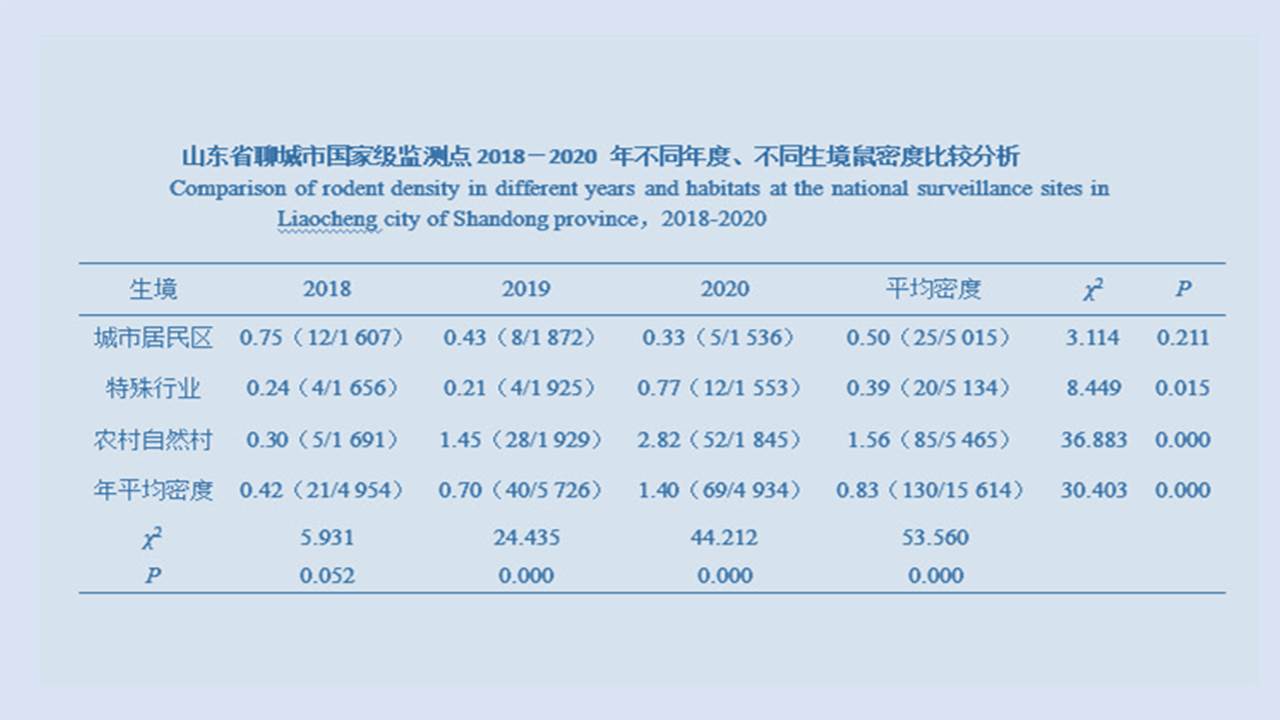
Objective To investigate the species, density, and seasonal variation of rodents in human settlements and surrounding environment at national surveillance sites in Liaocheng city of Shandong province, China, in 2018-2020, and to provide a scientific basis for rodent prevention and control. Methods According to the requirements in the National Vector Surveillance Implementation Scheme developed by Chinese Center for Disease Control and Prevention, the trap-at-night method was used to monitor rodent density once every 2 months (in odd months) during the middle ten days of each month for surveillance, with an interval of no less than 30 days between surveillance. The three habitats of urban residential areas, special industry, and rural residential areas were established as the surveillance sites, and no less than 200 effective traps were placed at each surveillance site. Excel 2007 and SPSS 17.0 softwares were used to perform a statistical analysis of surveillance data, and the Chi-square test was used for comparison of rodent density across different years and habitats. Results The overall rodent density was 0.83% in 2018-2020, and the composition ratios of Mus musculus, Rattus norvegicus, and Apodemus agrarius were 55.38%, 42.31%, and 2.31%, respectively, with the highest rodent density of M. musculus. The mean rodent density in the three years was 0.42%, 0.70%, and 1.40%, respectively, which showed an increasing trend year by year, and there was a statistical difference in rodent density across the years (χ2=30.403, P<0.001). The rodent density was 0.50% in urban residential areas, 0.39% in special industries, and 1.56% in rural natural villages, suggesting that rural natural villages had a significantly higher rodent density than urban residential areas and special industries, and there was a statistical difference in rodent density (χ2=28.124, P<0.001; χ2=36.680, P<0.001). Inconsistency was observed in the trend of seasonal variation of rodent density in the three years, with two peaks in May and November of 2018, one peak in July 2019, and one peak in March 2020. The peak of rodent density was observed in July and November in urban residential areas, the peak of rodent density was observed in May and September in special industries, and the peak of rodent density was observed in May in rural natural villages. The peak density of M. musculus was observed in May, the density of R. norvegicus basically showed an increasing trend from month to month, and the peak density of A. agrarius was observed in November. Conclusion M. musculus is the dominant species of rodents at the national surveillance sites in Liaocheng city of Shandong province, followed by R. norvegicus. Rural natural villages will be the focus of rodent prevention and control in the future, and it is recommended to take the comprehensive long-acting prevention and control measures according to their breeding, perching habits, and seasonal variation.
[1] 吴海霞,鲁亮,孟凤霞,等. 2006-2015年我国鼠类监测报告[J]. 中国媒介生物学及控制杂志,2017,28(6):517-522.DOI:10.11853/j.issn.1003.8280.2017.06.001. Wu HX,Lu L,Meng FX,et al. Reports on national surveillance of rodents in China,2006-2015[J]. Chin J Vector Biol Control,2017,28(6):517-522. DOI:10.11853/j.issn.1003.8280.2017. 06.001.(in Chinese)
[2] 中国疾病预防控制中心.全国病媒生物监测实施方案[Z]. 北京:中国疾病预防控制中心,2016. Chinese Center for Disease Control and Prevention.National vector surveillance implementation plan[Z]. Beijing:Chinese Center for Disease Control and Prevention,2016.(in Chinese)
[3] 王学军,孙钦同,韩英男,等. 2010-2018年山东省国家级鼠类监测点监测报告[J]. 中国媒介生物学及控制杂志,2020,31(3):300-304. DOI:10.11853/j.issn.1003.8280.2020.03.011. Wang XJ,Sun QT,Han YN,et al. Surveillance report of national rodent surveillance sites in Shandong province,China,2010-2018[J]. Chin J Vector Biol Control,2020,31(3):300-304. DOI:10.11853/j.issn.1003.8280.2020.03.011.(in Chinese)
[4] 李治平,吴照,刘旭红,等. 甘肃省2018年病媒生物监测报告[J]. 中国媒介生物学及控制杂志,2019,30(6):639-642. DOI:10.11853/j.issn.1003.8280.2019.06.010. Li ZP,Wu Z,Liu XH,et al. A vector surveillance report of Gansu province,China,2018[J]. Chin J Vector Biol Control,2019,30(6):639-642. DOI:10.11853/j.issn.1003.8280.2019.06.010.(in Chinese)
[5] 于治远,李凯,李晓,等. 2019年日照市重要病媒生物监测分析[J]. 预防医学论坛,2020,26(9):714-717. DOI:10.16406/j.pmt.issn.1672-9153.2020.09.024. Yu ZY,Li K,Li X,et al. Analysis on monitoring data of important vectors,Rizhao city,2019[J]. Prev Med Trib,2020,26(9):714-717. DOI:10.16406/j.pmt.issn.1672-9153.2020.09.024.(in Chinese)
[6] 庞松涛,李广帅,雷晓岗,等. 2018年西安市鼠类种群及密度监测分析[J]. 中华卫生杀虫药械,2020,26(3):250-252. DOI:10.19821/j.1671-2781.2020.03.017. Pang ST,Li GS,Lei XG,et al. Monitoring results of rodent population and density in Xi'an in 2018[J]. Chin J Hyg Insect Equip,2020,26(3):250-252. DOI:10.19821/j.1671-2781. 2020.03.017.(in Chinese)
[7] 张雨,郑方,谢秀美,等. 2011-2018年上海市奉贤区鼠类监测资料分析[J]. 中华卫生杀虫药械,2021,27(1):26-29. DOI:10.19821/j.1671-2781.2021.01.007. Zhang Y,Zheng F,Xie XM,et al. Analysis of rodent surveillance data in Fengxian district of Shanghai from 2011 to 2018[J]. Chin J Hyg Insect Equip,2021,27(1):26-29. DOI:10.19821/j.1671-2781.2021.01.007.(in Chinese)
[8] 赵奇,高丽君,唐振强,等. 河南省鼠密度监测及季节消长[J]. 中华卫生杀虫药械,2015,21(4):390-392. DOI:10.19821/j.1671-2781.2015.04.021. Zhao Q,Gao LJ,Tang ZQ,et al. Seasonal fluctuation of the rodent density in Henan province[J]. Chin J Hyg Insect Equip,2015,21(4):390-392. DOI:10.19821/j.1671-2781.2015.04.021.(in Chinese)
[9] 唐振强,樊金星,刘吉起. 河南省2019年病媒生物监测报告[J]. 中国媒介生物学及控制杂志,2020,31(6):706-709. DOI:10.11853/j.issn.1003.8280.2020.06.017. Tang ZQ,Fan JX,Liu JQ. A surveillance report of vectors in Henan province,China,2019[J]. Chin J Vector Biol Control,2020,31(6):706-709. DOI:10.11853/j.issn.1003.8280.2020. 06.017.(in Chinese)
[10] 张家林. 安徽省鼠类密度及种群结构分析[J]. 中华卫生杀虫药械,2021,27(2):132-135. DOI:10.19821/j.1671-2781.2021. 02.011. Zhang JL. Analysis of rodent density and constituent in Anhui province[J]. Chin J Hyg Insect Equip,2021,27(2):132-135. DOI:10.19821/j.1671-2781.2021.02.011.(in Chinese)
[11] 李贵昌,王玉姣,鲁亮,等. 2019年全国鼠类监测报告[J]. 中国媒介生物学及控制杂志,2020,31(4):389-394. DOI:10.11853/j.issn.1003.8280.2020.04.002. Li GC,Wang YJ,Lu L,et al. National surveillance report on rodents in China,2019[J]. Chin J Vector Biol Control,2020,31(4):389-394. DOI:10.11853/j.issn.1003.8280.2020.04.002.(in Chinese)
[12] 李广帅,庞松涛,雷晓岗,等. 西安市2015-2018年鼠类监测结果分析[J]. 中国媒介生物学及控制杂志,2020,31(3):373-375. DOI:10.11853/j.issn.1003.8280.2020.03.027. Li GS,Pang ST,Lei XG,et al. An analysis of the rodent surveillance results in Xi'an,China,2015-2018[J]. Chin J Vector Biol Control,2020,31(3):373-375. DOI:10.11853/j.issn.1003.8280.2020.03.027.(in Chinese)
[13] 司晓艳,白国辉,宋利桃,等. 内蒙古自治区人居环境2017-2019年鼠类监测数据分析[J]. 中国媒介生物学及控制杂志,2021,32(5):586-589. DOI:10.11853/j.issn.1003.8280.2021. 05.015. Si XY,Bai GH,Song LT,et al. An analysis of rodent surveillance data in human settlements of Inner Mongolia,China,in 2017-2019[J]. Chin J Vector Biol Control,2021,32(5):586-589. DOI:10.11853/j.issn.1003.8280.2021.05.015.(in Chinese)


