生物学与生态学

2015-2024年宁夏黄河东部鼠疫自然疫源地长爪沙鼠鼠体寄生蚤特征分析

  • 周庚 ,
  • 刘岩 ,
  • 田涛 ,
  • 卢世堂 ,
  • 卢世勇 ,
  • 张涛 *
展开
  • 宁夏回族自治区疾病预防控制中心鼠疫预防控制科, 宁夏回族自治区预防医学科学院, 宁夏 银川 750011

张涛,E-mail:

ZHANG Tao, E-mail:

周庚,男,主管医师,预防医学专业,现主要从事鼠疫防治工作,E-mail:

收稿日期: 2025-03-04

  网络出版日期: 2025-08-26

版权

版权所有,未经授权,不得转载。

Characteristics of parasitic fleas on Meriones unguiculatus in the natural plague foci in areas east of the Yellow River in Ningxia Hui Autonomous Region, 2015-2024

  • Geng ZHOU ,
  • Yan LIU ,
  • Tao TIAN ,
  • Shi-tang LU ,
  • Shi-yong LU ,
  • Tao ZHANG *
Expand
  • Plague Prevention and Control Department, Ningxia Hui Autonomous Region Center for Disease Control and Prevention, Ningxia Hui Autonomous Region Academy of Preventive Medical Sciences, Yinchuan, Ningxia 750011, China

Received date: 2025-03-04

  Online published: 2025-08-26

Copyright

All rights reserved. Unauthorized reproduction is prohibited.

摘要

目的: 分析宁夏回族自治区(宁夏)黄河东部长爪沙鼠鼠疫自然疫源地2015-2024年长爪沙鼠鼠体寄生蚤种类构成和变化规律,为宁夏动物间鼠疫早期预警提供数据支撑。方法: 用Excel 2019汇总2015-2024年长爪沙鼠鼠体蚤数量、种类,分析鼠体蚤群落结构特点;分析长爪沙鼠鼠体蚤的蚤指数、染蚤率月度分布规律;采用Mann-Whitney U秩和检验,检验动物鼠疫流行年份与非流行年份的长爪沙鼠染蚤率、蚤指数差异;采用Spearman秩相关分析,分析长爪沙鼠染蚤率与蚤指数的相关性;应用单因素二元logistic回归,分析长爪沙鼠染蚤率和蚤指数对动物鼠疫流行的影响。结果: 2015-2024年共获蚤13 028匹,隶属于5科9属13种,鼠体蚤优势种为同形客蚤(9 795/13 028,75.18%)和秃病蚤(2 495/13 028,19.15%),全年均有分布,常见种为叶状切唇蚤(486/13 028,3.73%),只在9-11月有分布;2015-2024年鼠体寄生蚤染蚤率和蚤指数年际变化趋势整体均呈现上升趋势;动物鼠疫流行年份与非流行年份的染蚤率差异有统计学意义(Z=-2.526,P=0.012),且流行年份染蚤率高于非流行年份,动物鼠疫流行与非流行年份的蚤指数差异无统计学意义(Z=-1.323,P=0.186);Spearman秩相关分析显示染蚤率与蚤指数呈正相关(ρ=0.901,P < 0.001);二元logistic回归分析显示长爪沙鼠鼠体染蚤率与动物间鼠疫流行的关联有统计学意义(OR=1.17,95%置信区间:1.04~1.32,P=0.008),而长爪沙鼠鼠体蚤指数与动物间鼠疫流行的关联无统计学意义(OR=0.09,95%置信区间:0.01~1.08,P=0.057)。结论: 宁夏黄河东部长爪沙鼠鼠疫自然疫源地长爪沙鼠鼠体蚤群落结构及其季节动态与动物鼠疫流行密切相关,染蚤率可作为区域性鼠疫流行风险预警的关键指标。

本文引用格式

周庚 , 刘岩 , 田涛 , 卢世堂 , 卢世勇 , 张涛 . 2015-2024年宁夏黄河东部鼠疫自然疫源地长爪沙鼠鼠体寄生蚤特征分析[J]. 中国媒介生物学及控制杂志, 2025 , 36(4) : 495 -499 . DOI: 10.11853/j.issn.1003.8280.2025.04.010

Abstract

Objective: To analyze the species composition and temporal dynamics of fleas parasitizing Meriones unguiculatus in the natural plague foci of M. unguiculatus in areas east of the Yellow River in Ningxia Hui Autonomous Region, China from 2015 to 2024, so as to provide data support for early warning of animal plague in this region. Methods: Data on the number and species of parasitic fleas on M. unguiculatus from 2015 to 2024 were compiled using Excel 2019. The flea community structure and the monthly distribution of the flea index and infestation rate of fleas on M. unguiculatus were analyzed. The flea infestation rate and flea index between plague epizootic and non-epizootic years were compared by using the Mann-Whitney U test. The relationship between the flea infestation rate and flea index was evaluated through Spearman's rank correlation analysis and the influence of the flea infestation rate and flea index on plague epizootics were assessed through the binary logistic regression analysis. Results: From 2015 to 2024, a total of 13 028 fleas were collected, belonging to 13 species of 9 genera in 5 families. Xenopsylla conformis (9 795/13 028, 75.18%) and Nosopsyllus laeviceps (2 495/13 028, 19.15%) were the dominant flea species with year-round distribution, while Coptopsylla lamellifer (486/13 028, 3.73%) was a common species found only from September to November. From 2015 to 2024, the flea infestation rate and flea index exhibited fluctuating upward trends. The flea infestation rate was significantly higher in plague epizootic years than in non-epizootic years (Z=-2.526, P=0.012). No significant difference was observed in the flea index between plague epizootic years and non-epizootic years (Z=-1.323, P=0.186). The Spearman's rank correlation analysis indicated a strong positive correlation between the flea infestation rate and flea index (ρ=0.901, P < 0.001). The binary logistic regression analysis showed that the flea infestation rate of M. unguiculatus was significantly associated with plague epizootics (OR=1.17, 95% confidence interval: 1.04-1.32, P=0.008), while the flea index of M. unguiculatus had no significant association with animal plague epizootics (OR=0.09, 95% confidence interval: 0.01-1.08, P=0.057). Conclusions: The community structure and seasonal dynamics of fleas on M. unguiculatus are closely linked to plague epizootics in the natural plague foci of M. unguiculatus in areas east of the Yellow River in Ningxia Hui Autonomous Region. The flea infestation rate may serve as a key indicator for early warning of regional plague risk.

宁夏回族自治区(宁夏)黄河东部长爪沙鼠(Meriones unguiculatus)鼠疫自然疫源地面积3 756 km2,分布于盐池县、灵武市、平罗县、兴庆区,与内蒙古自治区(内蒙古)鄂尔多斯市鄂托克前旗、鄂托克旗接壤。有记录以来,该区域人间鼠疫流行11年次,最后1例本地病例发生在1931年,2021、2022年先后报告了2例输入性腺鼠疫病例。自1969年以来,该区域发生鼠间鼠疫流行18年次,共检出鼠疫耶尔森菌(Yersinia pestis,鼠疫菌)348株,最近1次鼠间鼠疫发生在2023年5月的灵武市[1]。由于长爪沙鼠鼠疫疫源地宿主动物和媒介蚤类的多样性,使动物鼠疫可以在多种动物间传播,动物疫情频发、流行范围广,且这些地区的动物疫情将长期存在[2]。宁夏长爪沙鼠鼠疫自然疫源地的调查研究多见于宿主动物,而对于媒介蚤研究很少。为探索长爪沙鼠鼠疫自然疫源地主要宿主动物长爪沙鼠的鼠体蚤与动物间鼠疫流行的关系,实现动物鼠疫早期预警,避免人间鼠疫发生,本研究收集2015-2024年宁夏黄河东部长爪沙鼠鼠体蚤每月监测数量、染蚤率、蚤指数等,分析鼠体蚤与动物鼠疫流行的关系。

1 材料与方法

1.1 资料来源

收集2015-2024年长爪沙鼠鼠体蚤相关监测资料,数据来源于国家鼠疫监测管理信息系统。

1.2 长爪沙鼠捕获方法和鼠体蚤获取方法

每年4、5、10、11月采用样方法调查,24 h弓形夹法捕获长爪沙鼠,其余月份采用逐日捕鼠法捕获长爪沙鼠。捕获的长爪沙鼠按照《全国鼠疫监测方案》(2005版)[3]要求单只装袋,在检蚤室用乙醚麻醉后,牙刷梳蚤,用10 cm眼科镊子夹取放进盛有蒸馏水的小瓶,在光学显微镜下分组鉴定计数,计算染蚤率和蚤指数;按同一寄主、同一蚤种、同一地点分组(1~20只/组)进行鼠疫细菌学检测。
$\text { 染蚤率 }=\text { 带蚤鼠数/检蚤总鼠数 } \times 100 \%$
$ \text { 蚤指数=获虫总数/检蚤总鼠数 } $

1.3 统计学分析

用Excel 2019统计鼠体蚤数据,将长爪沙鼠鼠体蚤构成比≥10%的种类定为优势种,1%≤构成比 < 10%为常见种,构成比 < l%为稀有种[4];用SPPS 25.0对监测数据进行分析。对符合正态分布的数据采用独立样本t检验;不符合正态分布的数据采用Mann-Whitney U秩和检验;采用Spearman秩相关分析进行染蚤率与蚤指数的相关性分析,应用单因素二元logistic回归分析染蚤率和蚤指数对动物鼠疫流行的影响。

2 结果

2.1 长爪沙鼠寄生蚤群落结构

2015-2024年共捕获16 219只长爪沙鼠,染蚤鼠数4 482只,染蚤率27.63%,获蚤13 028匹,总蚤指数0.80。捕获蚤隶属于5科9属13种,其中同形客蚤(Xenopsylla conformis)和秃病蚤(Nosopsyllus laeviceps)为优势种,分别占75.18%(9 795/13 028)和19.15%(2 495/13 028);叶状切唇蚤(Coptopsylla lamellifer)为常见种,占3.73%(486/13 028);捕获的其他蚤种包括二齿新蚤(Neopsylla bidentatiformis,97/13 028,0.74%)、角尖眼蚤(Ophthalmopsylla praefecta,79/13 028,0.61%)、盔状新蚤(Ne. galea,19/13 028,0.15%)、吻短纤蚤(Rhadinopsylla dives,16/13 028,0.12%)、方形黄鼠蚤(Citellophilus tesquorum,10/13 028,0.08%)、前凹眼蚤(O. jettmari,7/13 028,0.05%)、迟钝中蚤(Mesopsylla hebes,7/13 028,0.05%)、阿巴盖新蚤(Ne. abagaitui,7/13 028,0.05%)、弱纤蚤(R. tenella,7/13 028,0.05%)、无棘鬃额蚤(Frontopsylla aspiniformis,3/13 028,0.02%)。

2.2 鼠疫细菌学检测结果

2015-2024年共发生2次动物鼠疫流行,分别在2022年4月、2023年5月;共检出鼠疫菌3株,其中从鼠体分离鼠疫菌2株,从寄生蚤(同形客蚤1组6匹)分离1株。

2.3 长爪沙鼠寄生蚤蚤指数和染蚤率年际变化趋势

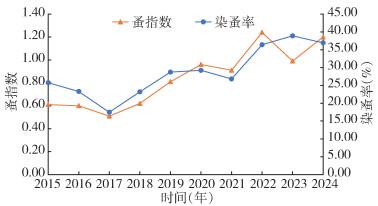
染蚤率波动范围为17.47%~38.90%,整体呈现上升趋势,2017年最低,为17.47%,2023年最高,为38.90%;蚤指数波动范围为0.51~1.24,与染蚤率趋势基本一致,呈现整体波动上升趋势,但2023年蚤指数下降(0.99),2017年最低,为0.51,2022年最高,为1.24。见图 1
图1 2015-2024年宁夏回族自治区黄河东部长爪沙鼠鼠疫自然疫源地长爪沙鼠寄生蚤蚤指数和染蚤率年际变化

Fig. 1 Annual changes in flea index and infestation rate of parasitic fleas on Meriones unguiculatus in the M. unguiculatus plague foci in areas east of the Yellow River in Ningxia Hui Autonomous Region, China, 2015-2024

2.4 长爪沙鼠寄生蚤蚤指数和染蚤率月度变化趋势

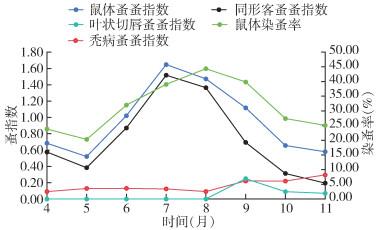
鼠体蚤指数和鼠体染蚤率月度变化趋势基本一致,蚤指数月度变化范围为0.52~1.65,4-5月蚤指数略有下降,5-7月蚤指数逐渐增高,7-11月逐渐降低,其中5月最低,为0.52,7月最高,为1.65;染蚤率变化范围为20.31%~44.37%,5月最低,为20.31%,8月最高,为44.37%。对主要染疫蚤同形客蚤和秃病蚤进行分析,同形客蚤蚤指数与鼠体蚤总蚤指数变化趋势一致;秃病蚤从4月到11月蚤指数逐渐增高,11月超过同形客蚤;常见蚤种叶状切唇蚤只在9-11月监测到,具有明显的季节分布规律。见图 2
图2 2015-2024年宁夏回族自治区黄河东部长爪沙鼠鼠体蚤蚤指数和染蚤率月度变化趋势

Fig. 2 Monthly changes in flea index and infestation rate of parasitic fleas on Meriones unguiculatus in areas east of the Yellow River in Ningxia Hui Autonomous Region, 2015-2024

2.5 鼠体染蚤率与蚤指数的相关性

用Shapiro-Wilk检验对2015-2024年每月染蚤率和蚤指数进行正态性检验,经检验染蚤率P < 0.001,蚤指数P < 0.001,不服从正态分布,采用Spearman秩相关分析,染蚤率和蚤指数呈正相关,且有统计学意义(ρ=0.901,P < 0.001)。

2.6 动物鼠疫流行与非流行年份染蚤率比较

将2022、2023年2个动物鼠疫流行年份染蚤率按照监测月份统计,分析流行年份(所有动物鼠疫流行年份的监测月份)与非流行年份(所有非动物鼠疫流行年份的监测月份)的染蚤率。非流行年份(n=64)染蚤率[以P50P25P75)表示]为29.06%(20.06%,35.70%),流行年份(n=16)染蚤率为35.90%(26.98%,55.40%)。经Shapiro-Wilk正态性检验,P=0.012,流行与非流行年份染蚤率数据不服从正态分布,采用Mann-Whitney U秩和检验,流行年份和非流行年份染蚤率差异有统计学意义(Z=-2.526,P=0.012),且流行年份染蚤率高于非流行年份。

2.7 动物鼠疫流行与非流行年份的蚤指数比较

经Shapiro-Wilk正态性检验,P < 0.001,流行与非流行年份的蚤指数数据不服从正态分布,采用Mann-Whitney U秩和检验,流行年份和非流行年份蚤指数差异无统计学意义(Z=-1.323,P=0.186)。

2.8 染蚤率和蚤指数对动物鼠疫流行的影响分析

单因素二元logistic回归分析显示,染蚤率与动物鼠疫流行有正相关关系且有统计学意义(OR=1.17,95%置信区间:1.04~1.32,P=0.008);蚤指数与动物鼠疫流行的相关关系无统计学意义(OR=0.09,95%置信区间:0.01~1.08,P=0.057)。见表 1
表1 2015-2024年宁夏回族自治区黄河东部长爪沙鼠鼠疫自然疫源地长爪沙鼠鼠体染蚤率和蚤指数对动物鼠疫流行的二元logistic回归分析

Tab. 1 Binary logistic regression analysis of association of flea infestation rate and flea index of parasitic fleas on Meriones unguiculatus with plague epizootics in M. unguiculatus plague foci in areas east of the Yellow River in Ningxia Hui Autonomous Region, 2015-2024

协变量 回归系数 标准误 Wald χ2 自由度 P OR 95%置信区间
下限 上限
染蚤率 0.158 0.059 7.100 1 0.008 1.17 1.04 1.32
蚤指数 -2.433 1.278 3.622 1 0.057 0.09 0.01 1.08

注:OR比值比。

3 讨论

宁夏长爪沙鼠鼠疫自然疫源地位于半荒漠草原生态区,长爪沙鼠和蚤类的生存与繁殖受降水量的影响明显,降水量及地表湿度可能直接影响到鼠洞洞穴微小气候,进而进一步影响到巢蚤发育。长爪沙鼠鼠疫自然疫源地的流行受多种因素影响,鼠间鼠疫的流行存在明显的周期性和季节性特征。需通过综合防控措施降低疫情风险,保障公共卫生安全。鼠疫的自然疫源性及其活跃状态,决定了鼠疫防治工作的长期性与艰巨性。

3.1 鼠体蚤群落结构与鼠疫传播媒介的生态意义

2015-2024年的长期监测数据显示,长爪沙鼠寄生蚤以同形客蚤和秃病蚤为优势种,两者合计占捕获蚤总数的比例 > 94.00%,提示其在鼠疫传播链中的核心媒介作用。同形客蚤的蚤指数与鼠体蚤蚤指数波动趋势一致,而秃病蚤从4月到11月占比逐渐增高,在11月的占比反超同形客蚤,这与刘纪有和李新民[5]的研究结果不同,可能与秃病蚤对低温环境的适应性有关。叶状切唇蚤仅在9-11月出现,与孙庆[6]报道的8月开始出现不同,这可能源于同一时期内蒙古的温度较低,所以该蚤在内蒙古出现的月份要早于宁夏。掌握宁夏长爪沙鼠鼠疫自然疫源地主要宿主鼠体寄生蚤群落结构与鼠疫传播媒介的生态意义对制定鼠疫相关政策至关重要[7]

3.2 长爪沙鼠蚤指数、染蚤率与动物鼠疫流行的关联

2015-2024年长爪沙鼠鼠体蚤指数与染蚤率呈正相关(ρ=0.901),这与刘岩等[8]的分析结果一致,但两者对鼠疫流行的预测效力有明显差异。二元logistic回归显示染蚤率是鼠疫流行的风险因子(P=0.008),而蚤指数与鼠疫流行的关联不显著(P=0.057)。理论上动物鼠疫流行时染蚤率和蚤指数应该均升高,但鼠体蚤游离的情况可能会影响蚤指数的值,而染蚤率的值则相对没有蚤指数敏感,所以最终只有染蚤率呈现一定的相关性,支持将染蚤率作为优先监测预警指标,这与白学礼等[9]的研究结果不一致。动物鼠疫流行年份(2022、2023年)的长爪沙鼠染蚤率高于非流行年份(P=0.012),但蚤指数差异无统计学意义,进一步验证染蚤率的预警价值。值得注意的是,2次流行均发生于鼠体染蚤率和蚤指数上升初期(4-5月),而非全年染蚤率和蚤指数峰值期(分别为8和7月),提示长爪沙鼠鼠疫动物疫情发生和流行不仅仅取决于鼠体染蚤率和蚤指数。已有研究表明,长爪沙鼠种群密度与蚤指数可能存在非线性关系[10],春季宿主繁殖导致的种群密度增加与蚤类活跃度上升导致动物鼠疫流行[11]
本研究未量化宿主种群密度、气候因子(如降水、气温)等对蚤类动态的贡献。未来需构建多变量模型,整合气象数据与宿主迁移轨迹,解析鼠疫流行的多因素驱动机制[12]。建议4-5月(蚤指数上升初期)和8月(染蚤率峰值期)加强蚤类监测;在蚤类监测工作中,如何更准确获得体表寄生蚤的数据,减少鼠体蚤过多游离导致数据不准确的问题,需要在监测工作中探索方法,加强质量控制;重点关注同形客蚤与秃病蚤染蚤率,作为动物间鼠疫监测早期预警指标。

利益冲突  无

1
王鑫, 王健, 宋志忠, 等. 中国鼠疫生态结构[M]. 北京: 人民卫生出版社, 2023: 634- 635.

Wang X, Wang J, Song ZZ, et al. Ecological structure of plague in China[M]. Beijing: People's Medical Publishing House, 2023: 634- 635.

2
宋驰, 张文斌, 周晓磊. 我国人间鼠疫疫情形势及防控现状[J]. 中国地方病防治, 2024, 39(4): 286-287, 329.

Song C, Zhang WB, Zhou XL. Current situation of human plague epidemics and prevention strategies in China[J]. Chin J Ctrl Endem Dis, 2024, 39(4): 286-287, 329.

3
中国疾病预防控制中心. 全国鼠疫监测方案[EB/OL]. (2005-07-26)[2025-03-04]. https://www.chinacdc.cn/jkyj/crb2/jl/sy/jswj_sy/202409/W020240906481586936060.pdf.

Chinese Center for Disease Control and Prevention. National plague surveillance program[EB/OL]. (2005-07-26)[2025-03-04]. https://www.chinacdc.cn/jkyj/crb2/jl/sy/jswj_sy/202409/W020240906481586936060.pdf. (in Chinese)

4
邵宗体, 李兴能, 段兴德, 等. 云南省禄劝彝族苗族自治县小型兽类体表寄生蚤种群结构及分布[J]. 中国媒介生物学及控制杂志, 2025, 36(1): 122- 128.

Shao ZT, Li XN, Duan XD, et al. Population structure and distribution of ectoparasitic fleas on small mammals in Luquan Yi and Miao Autonomous County, Yunnan Province[J]. Chin J Vector Biol Control, 2025, 36(1): 122- 128.

5
刘纪有, 李新民. 秃病蚤在沙鼠疫源地中的媒介地位和作用[J]. 地方病通报, 1992, 7(4): 40- 44.

DOI

Liu JY, Li XM. The vectorial position and effect of Nosopsyllus laeviceps kuzenkovi in the natural plague foci of gerbil[J]. Endem Dis Bull, 1992, 7(4): 40- 44.

DOI

6
孙庆. 叶状切唇蚤突高亚种鼠疫流行病学意义[J]. 内蒙古地方病防治研究, 1994, 19(2): 51.

Sun Q. Epidemiological significance of Ctenophthalmus assimilis subsp. tugaoyensis in plague transmission[J]. Inner Mongolia J Endem Dis Control Res, 1994, 19(2): 51.

7
冯一兰, 李建云, 张大禹, 等. 鄂尔多斯鼠疫疫源地2014-2022年鼠体蚤空间分布分析[J]. 中国媒介生物学及控制杂志, 2023, 34(5): 703- 707.

DOI

Feng YL, Li JY, Zhang DY, et al. Spatial distribution of rodent fleas in the plague foci of Ordos, China, 2014-2022[J]. Chin J Vector Biol Control, 2023, 34(5): 703- 707.

DOI

8
刘岩, 张涛, 周庚, 等. 宁夏2010-2019年长爪沙鼠疫源地监测结果分析[J]. 中国地方病防治, 2021, 36(1): 32- 33.

Liu Y, Zhang T, Zhou G, et al. Analysis of surveillance results in Meriones unguiculatus plague foci in Ningxia from 2010 to 2019[J]. Chin J Ctrl Endem Dis, 2021, 36(1): 32- 33.

9
白学礼, 卢世堂, 毛川涛, 等. 1981-2007年宁夏鼠疫监测与防治对策[J]. 地方病通报, 2009, 24(3): 36- 39.

DOI

Bai XL, Lu ST, Mao CT, et al. Analysis of plague surveillence and control strategy in Ningxia from 1981 to 2007[J]. Endem Dis Bull, 2009, 24(3): 36- 39.

DOI

10
李轲, 王振旭, 张璐, 等. 内蒙古自治区锡林郭勒盟2012-2021年气象因素和鼠体蚤指数对长爪沙鼠种群密度的影响[J]. 中国媒介生物学及控制杂志, 2024, 35(2): 212- 217.

DOI

Li K, Wang ZX, Zhang L, et al. The impact of meteorological factors and flea index on the density of Meriones unguiculatus in Xilingol League, Inner Mongolia Autonomous Region, China, 2012-2021[J]. Chin J Vector Biol Control, 2024, 35(2): 212- 217.

DOI

11
郭彦虎, 张涛. 宁夏沙鼠动物间鼠疫春季流行因素分析[J]. 宁夏医科大学学报, 2015, 37(2): 196- 198.

DOI

Guo YH, Zhang T. Analysis of spring epidemic factors of Meriones plague in Ningxia[J]. J Ningxia Med Univ, 2015, 37(2): 196- 198.

DOI

12
牛艳芬, 刘合智, 张懿晖, 等. 河北省长爪沙鼠鼠疫疫源地鼠体蚤与气象因素关系分析[J]. 中国媒介生物学及控制杂志, 2021, 32(1): 41- 44.

DOI

Niu YF, Liu HZ, Zhang YH, et al. An analysis of the relationship between rodent fleas and meteorological factors in Meriones unguiculatus plague foci in Hebei Province, China[J]. Chin J Vector Biol Control, 2021, 32(1): 41- 44.

DOI

文章导航

/