

1 材料与方法
1.1 资料来源
2011-2024年四川省所有喜马拉雅旱獭鼠疫监测点调查和监测资料,监测点包括:甘孜州德格、巴塘、理塘、雅江、新龙、色达、炉霍、甘孜、白玉、得荣、道孚、稻城、乡城县和阿坝藏族羌族自治州(阿坝州)阿坝、壤塘、红原、若尔盖县,共17个省级鼠疫监测点。其中,德格县为国家级鼠疫监测点,巴塘、理塘、雅江、新龙县为现疫疫源县。
1.2 方法
收集2011-2024年四川省喜马拉雅旱獭鼠疫自然疫源地内监测数据,计算喜马拉雅旱獭密度、夜行鼠捕获率、媒介染蚤率、病原学和血清学阳性率。
1.2.1 宿主监测
2011-2024年每年6-9月开展喜马拉雅旱獭和野外夜行鼠调查。喜马拉雅旱獭数量调查采用路线法进行,按监测区各类生境面积0.20%~0.50%比例分层抽取样方。野外夜行鼠数量调查采用夹夜法,以白面油饼或花生为诱饵,以月为单位,选择有代表性的2~3种生境,每月布放不少于200夹次,计算獭密度和捕获率。
1.2.2 媒介监测
对捕获的喜马拉雅旱獭进行梳检,收集蚤进行分类鉴定、计算獭染蚤率和蚤指数;每月挖喜马拉雅旱獭有效巢(洞干)5~10个,收集蚤鉴定蚤种类、计算巢穴染蚤率和蚤指数。
根据四川省监测方案,省级监测点未开展媒介昆虫种群调查工作。
1.2.3 实验室检测
收集喜马拉雅旱獭活体/自毙尸体和其他鼠类肝、脾、血清开展鼠疫菌病原学检测;收集旱獭、牧犬(Canis lupus familiaris)、藏系绵羊(Ovis aries)等疫源地内动物血清,开展血清学检测;对收集的动物组织材料做反向间接血凝试验(reverse indirect hemagglutination assay,RIHA);梳检获得的蚤全部分类研磨后进行鼠疫菌病原学检测。病原学培养:赫氏消化液龙胆紫溶血培养基。血清学实验方法:间接血凝试验(indirect hemagglutination assay,IHA)和RIHA。试剂来源:均为中国疾病预防控制中心鼠布基地下发的检测试剂,试剂厂家为兰州生物制品研究所,试剂批号:20240301。
1.3 统计学分析
应用Excel 2010和R 4.4.1软件对数据进行整理和绘图。应用描述流行病学方法对各监测指标进行分析。应用Joinpoint Regression Program 3.4.3软件对鼠密度、捕获率、染蚤率等进行时间趋势检验,计算年度变化百分比(annual percentage change,APC)和平均年度变化百分比(average annual percentage change,AAPC),若APC > 0,说明结果在该时间段内呈上升趋势,反之则呈下降趋势;若AAPC > 0,说明结果在整个时间段内呈上升趋势,反之则呈下降趋势;若APC=AAPC,则趋势曲线无连接点,表示整体呈单调递增或者单调递减趋势。P < 0.05为差异有统计学意义。
2 结果
2.1 宿主调查
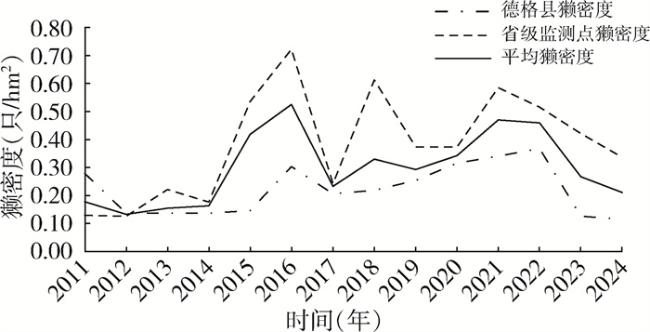
2011-2024年共踏查高山草甸、高寒草甸、林区等生境面积共71 933 hm2,见獭18 116只,獭密度0.25只/hm2,年獭密度在0.13~0.53只/hm2,年度变化整体呈上升趋势,无明显转折点(AAPC=6.99%,P=0.034);国家级监测点(德格县)最高獭密度为0.37只/hm2(2022年),年度变化整体呈上升趋势趋势,无统计学意义(AAPC=3.69%,P=0.212);省级监测点最高獭密度为0.72只/hm2(2016年),年度变化整体呈上升趋势趋势,无明显转折点(AAPC=8.71%,P=0.040)。见图 1。
2.2 野外夜行鼠调查
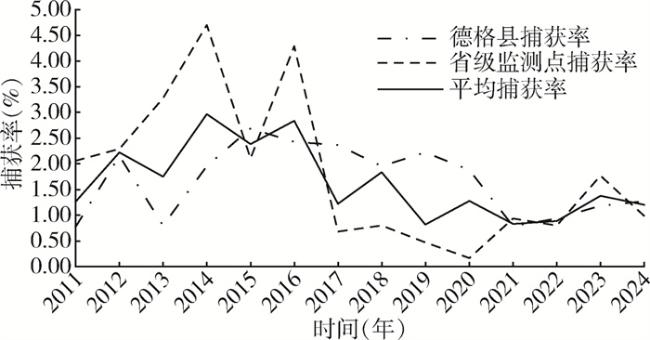
2011-2024年共布夹67 943个,捕获夜行鼠979只,捕获率1.44%,年捕获率为0.82%~2.97%,年度变化整体呈下降趋势(AAPC=-5.73%,P=0.036)。德格县最高捕获率为2.69%(2015年),年度变化整体呈下降趋势,无统计学意义(AAPC=-3.46%,P=0.303);省级监测点最高捕获率为4.69%(2014年),整体变化趋势无统计学意义(AAPC=-0.68%,P=0.958)。见图 2。
捕获的鼠类经鉴定有藏仓鼠(Urocricetus kamensis)、小家鼠(Mus musculus)、高原鼠兔(Ochotona curzoniae)、根田鼠(Alexandromys oeconomus)、北社鼠(Niviventer confucianus)、高原松田鼠(Neodon irene)、大林姬鼠(Apodemus peninsulae)、大耳姬鼠(A. latronum)、高山姬鼠(A. chevrieri)和川西鼠兔(O. gloveri)等10余种,德格县以藏仓鼠和小家鼠为主,分别占37.15%和27.26%,省级监测点以藏仓鼠和大耳姬鼠为主,分别占53.43%和35.31%。
2.3 媒介种类构成调查
德格县对捕获的1 833只喜马拉雅旱獭单只装袋,处死后毛刷梳蚤,共获染蚤旱獭849只,染蚤率为46.32%,年染蚤率为25.87%~60.43%,年度变化呈下降趋势,但无统计学意义(AAPC=-2.04%,P=0.140);获蚤5 693匹,蚤指数为3.11,年蚤指数为1.03~5.88,年度变化整体呈下降趋势,但无统计学意义(AAPC=-0.42%,P=0.893)。
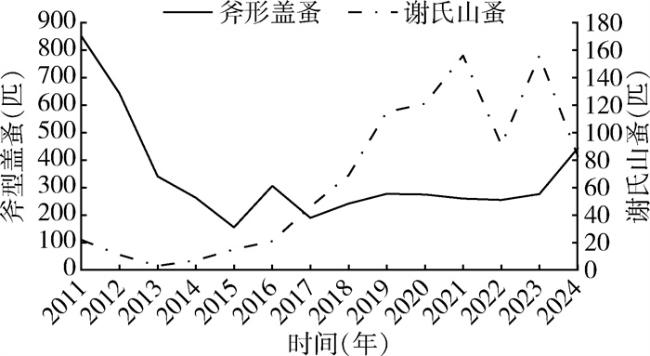
对捕获的5 693匹蚤进行种类鉴定,共有2种,分别是斧型盖蚤(Callopsylla dolabris)和谢氏山蚤(Oropsylla silantiewi),分别占83.89%和16.11%。斧型盖蚤检出数量在2011-2017年呈明显下降趋势后,维持在相对稳定水平,谢氏山蚤检出数量呈上升趋势。从2类蚤的构成来看,斧型盖蚤占明显优势,但是构成比有所降低、而谢氏山蚤构成比呈增加趋势。见图 3。
2.4 洞干蚤调查
用探蚤棒进行洞干探蚤,每洞探3次以上。2011-2024年,德格县共探洞1 802个,均未获蚤。
2.5 实验室检测结果
2.5.1 细菌学检测
2011-2024年,对疫源地采集的9 008份宿主(包括喜马拉雅旱獭、各种鼠类、狐狸、獾)的活体和自毙材料进行细菌学检测,在其中65份自毙旱獭组织材料中检出鼠疫菌,检出率为0.72%。德格县检测了2 521份材料,2015年检出1份阳性,检出率为0.04%;省级监测点检测了5 836份材料,检出64份阳性,检出率为10.97%;从年份来看,除2013、2024年外每年均有阳性标本检出。从监测区域来看,2014年后,四川省分离到鼠疫菌的区域已从甘孜州317国道的北路地区转向318国道沿线的南路地区,主要集中在雅江县(分菌率48.13%)和巴塘县(分菌率21.70%)。从时间段来看,分菌时间主要集中在5-8月,占整体分菌数的84.38%。共对65组916匹谢氏山蚤和274组4 781匹斧形盖蚤进行细菌学检测,均未检出鼠疫菌。
2.5.2 血清学检测
2011-2024年,对疫源地采集的21 465份动物材料进行血清学IHA(微量法)检测,在其中64份牧犬、2份旱獭、1份藏系绵羊(疑似外地输入)标本中检出鼠疫F1抗体阳性,阳性率为0.31%。德格县检测了牧犬和旱獭血清共2 425份,牧犬阳性血清16份、旱獭阳性血清1份,检出率0.70%。
3 讨论
鼠密度反映宿主动物数量变化、活动和分布情况,与动物间、人间鼠疫流行和防控工作等密切相关[8]。四川省喜马拉雅旱獭鼠疫自然疫源地是青藏高原喜马拉雅旱獭鼠疫自然疫源地的新版块[9-10]。从分析结果来看,国家级监测点旱獭密度变化不大,主要原因为:(1)与国家级鼠疫监测点监测期间连续动物疫情处置有关。(2)宿主动物生态结构稳定,区域未出现明显外部因素干扰(如生境破坏、民生工程等)。(3)监测区域明确,监测点位稳定,未经历大变动[11-12]。而省级监测点出现上升变化趋势,其原因可能为:(1)与监测方式有关,四川省省级监测点均以疫源地检索为主,监测区域选择更倾向于区域密度高、对人群危害度大的地区监测,且1~2年就会出现变化。(2)大多数省级监测点未发现疫情,未开展过区域灭獭,生境未受到破坏[13-14]。监测结果按照监测方案要求与临近疫源地调查比较,鼠密度高,四川省喜马拉雅旱獭鼠疫自然疫源地存在鼠间疫情传播的风险较大,波及人间的风险不容忽视。
从捕获鼠种和实验室检测来看,疫情未在夜行鼠中流行。究其原因可能是:其一,主要储存宿主的数量、密度很大程度上决定了鼠疫存在的可能性[15],该疫源地喜马拉雅旱獭作为主要宿主动物与蚤类媒介生物已形成较为稳定的传播循环;其二,捕获数量减少,使防控对象简单化,在一定程度上减少了夜行鼠与蚤类的直接接触机会;其三,鼠疫菌遗传变异影响毒力和传播能力,旱獭型菌株与小型鼠类菌株遗传变异的敏感性不同,从而影响易感性,降低了夜行鼠感染风险。
蚤是鼠疫传播的重要媒介[16]。2011-2024年该疫源地捕获蚤种主要以斧型盖蚤和谢氏山蚤为主,2种蚤在监测期内出现波动,可能是多种因素综合作用的结果,如鼠疫防控措施的成效、环境变化、鼠类和蚤类种群的变化以及鼠类行为的改变等。宿主动物染蚤率高,动物间传播鼠疫风险就越大,尽管蚤类中均未检出鼠疫菌,但仍需加强主要媒介种类的生态学监测和实验室病原学检测工作。
2011-2024年,喜马拉雅旱獭监测结果提示该疫源地内动物间鼠疫流行一直处于活跃状态,与既往研究结果[17]一致,动物间疫情由宿主动物传播到人的威胁性仍然很大。从监测方式来看,旱獭疫源地在监测活体动物的同时,要重视自毙动物收集,尤其是自毙旱獭收集。从动物类型来看,不仅要收集主要的宿主动物,对疫源地内其他宿主动物也要开展监测,才能更好地发现疫情风险。
从动物疫情地理分布来看,该疫源地疫情目前局限在甘孜州境内,但疫点离国道和省道的距离在0~10 km。按照动物疫情发现的时间分析,2011-2013年主要以德格和巴塘县为主;2014-2024年主要以雅江和巴塘县为主,提示疫点存在迁移、扩大的现象,且有向川内腹地扩展的趋势。以上结果说明因喜马拉雅旱獭动物疫情引发人间疫情的风险不容忽视。
综上所述,本次研究首次分析了四川省喜马拉雅旱獭鼠疫自然疫源地鼠疫监测结果,监测数据分析显示,2011-2024年四川省喜马拉雅旱獭鼠疫自然疫源地宿主动物种类稳定。虽然已有12年未发生人间疫情,但一直存在动物间鼠疫的流行,且疫情出现靠近国道、省道的趋势。应加大监测力度,加强省际信息沟通,及时发现疫情,防止人间疫情发生。四川省喜马拉雅旱獭分布面积大,部分省级监测点开展监测内容单一,难以以动物监测结果研判人间疫情风险,做到端口前移,应进一步规范和扩大监测项目,服务人间疫情防控。


