
实验研究

热蒸汽和热吹风对臭虫成虫的致死效果研究

  • 邓婷 , 1, 2 ,
  • 孟凤霞 2 ,
  • 于京营 2 ,
  • 刘起勇 2 ,
  • 鲁亮 2 ,
  • 杨丽萍 , 1, * ,
  • 任东升 , 2, *
展开
  • 1. 山东大学齐鲁医学院公共卫生学院媒介生物控制学系, 山东 济南 250012
  • 2. 中国疾病预防控制中心传染病预防控制所媒介生物控制室, 传染病溯源预警与智能决策全国重点实验室, 世界卫生组织媒介生物监测与管理合作中心, 北京 102206

任东升,E-mail:

YANG Li-ping, E-mail:

杨丽萍,E-mail:

REN Dong-sheng, E-mail:

邓婷,女,在读硕士,主要从事媒介生物控制学研究,E-mail:

收稿日期: 2025-02-11

  网络出版日期: 2025-07-01

基金资助

中国疾病预防控制中心传染病预防控制所自主课题(10039008)

版权

版权所有,未经授权,不得转载。

Lethal effects of hot steam and hot air on adult bed bugs

  • Ting DENG , 1, 2 ,
  • Feng-xia MENG 2 ,
  • Jing-ying YU 2 ,
  • Qi-yong LIU 2 ,
  • Liang LU 2 ,
  • Li-ping YANG , 1, * ,
  • Dong-sheng REN , 2, *
Expand
  • 1. Department of Vector Control, School of Public Health, Cheeloo College of Medicine, Shandong University, Jinan, Shandong 250012, China
  • 2. Department of Vector Biology and Control, National Key Laboratory of Intelligent Tracking and Forecasting for Infectious Diseases, National Institute for Communicable Disease Control and Prevention, Chinese Center for Disease Control and Prevention, WHO Collaborating Centre for Vector Surveillance and Management, Beijing 102206, China

Received date: 2025-02-11

  Online published: 2025-07-01

Supported by

Independent Project of National Institute for Communicable Disease Control and Prevention, China CDC(10039008)

Copyright

All rights reserved. Unauthorized reproduction is prohibited.

摘要

目的: 通过对热蒸汽和热吹风杀灭臭虫成虫效果的定量研究,比较2种方法杀灭臭虫成虫的差异。方法: 采用生物测定法测定热蒸汽和热吹风在50、55、60 ℃对臭虫成虫的致死时间;测定热蒸汽和热吹风处理1、2、3 s对臭虫成虫的致死温度。应用概率单位回归法计算致死中时间(LTime50)、99%致死时间(LTime99)、致死中温度(LTemp50)和99%致死温度(LTemp99)。结果: 热蒸汽在50、55 ℃时对臭虫成虫的LTime50分别为10.6和4.7 s,LTime99分别为28.3和28.0 s,60 ℃的热蒸汽2 s即可杀死全部臭虫;热吹风在50、55、60 ℃时对臭虫成虫的LTime50分别为32.9、13.3和3.6 s,LTime99分别为92.7、57.3和17.8 s。热蒸汽处理1、2、3 s时对臭虫成虫的LTemp50分别为69.7、57.7和55.5 ℃,LTemp99分别为100.4、60.7和61.3 ℃,热吹风处理1、2、3 s时对臭虫成虫的LTemp50分别为102.3、82.7和70.7 ℃,LTemp99分别为150.7、140.0和103.8 ℃。结论: 50、55、60 ℃的热蒸汽和热吹风均可杀死臭虫成虫,相同温度下热蒸汽杀灭臭虫速度更快;热蒸汽1、2、3 s的处理时间均可快速杀死臭虫,可用于臭虫成虫的快速处理。热吹风杀灭臭虫成虫速度较慢,所需温度更高, > 100 ℃处理3 s也不能100%致死臭虫。

本文引用格式

邓婷 , 孟凤霞 , 于京营 , 刘起勇 , 鲁亮 , 杨丽萍 , 任东升 . 热蒸汽和热吹风对臭虫成虫的致死效果研究[J]. 中国媒介生物学及控制杂志, 2025 , 36(3) : 305 -311 . DOI: 10.11853/j.issn.1003.8280.2025.03.002

Abstract

Objective: To compare the differences between hot steam and hot air in eradicating adult bed bugs through a quantitative study on the efficacy of the two heat treatment methods. Methods: The lethal time of adult bed bugs under hot steam and hot air at 50, 55, and 60 ℃, and the lethal temperature for adult bed bugs with exposure times of 1, 2, and 3 s under hot steam and hot air were measured by bioassay. Probit regression analysis was used to calculate lethal time of 50% (LTime50), lethal time of 99% (LTime99), lethal temperature of 50% (LTemp50), and lethal temperature of 99% (LTemp99). Results: The LTime50 for killing adult bed bugs with hot steam at 50 and 55 ℃ were 10.6 and 4.7 s, respectively, and the LTime99 were 28.3 and 28.0 s, respectively. All adult bed bugs were killed by hot steam at 60 ℃ within 2 s. The LTime50 for killing adult bed bugs with hot air at 50, 55, and 60 ℃ were 32.9, 13.3, and 3.6 s, respectively, and the LTime99 were 92.7, 57.3, and 17.8 s, respectively. The LTemp50 for adult bed bugs treated by hot steam for 1, 2, and 3 s were 69.7, 57.7, and 55.5 ℃, respectively, and the LTemp99 were 100.4, 60.7, and 61.3 ℃, respectively. The LTemp50 for adult bed bugs treated by hot air for 1, 2, and 3 s were 102.3, 82.7, and 70.7 ℃, respectively, and the LTemp99 were 150.7, 140.0, and 103.8 ℃, respectively. Conclusions: Both hot steam and hot air at 50, 55, and 60℃ can kill adult bed bugs. At the same temperature, hot steam is faster in killing bed bugs. Hot steam quickly kills bed bugs within the treatment times of 1, 2, and 3 s, and can be used for the rapid treatment of adult bed bugs. Hot air is slower in killing adult bed bugs and requires a higher temperature. Even under the conditions of a temperature higher than 100℃ for 3 s, hot air cannot cause 100% mortality of bed bugs.

臭虫(bedbugs)隶属半翅目(Hemiptera)臭虫科(Cimicidae)臭虫属(Cimex),是吸食人血的无翅昆虫[1]。目前全世界已知臭虫科6亚科24属110种,在我国与人类有密切关系的主要是温带臭虫(C. lectularius)和热带臭虫(C. hemipterus)2种[2]。在过去25年中,全球各地超过50个国家报告了臭虫的再猖獗[3]。在我国,有关臭虫侵害的报告也越来越多[4-6],其多发于职工宿舍、学生宿舍、火车和军队等人员密集、人口流动性较大的地方[7-9]。作为全球性的卫生害虫,臭虫长期以来对人类的生活和健康造成严重威胁,它们不仅叮咬人类,导致皮肤出现瘙痒、肿胀等症状,还可能引起哮喘、荨麻疹和强烈的过敏反应[10],对公共卫生构成潜在风险。随着臭虫的死灰复燃,其防治问题愈发凸显。化学防治是臭虫防治的常用手段之一,然而杀虫剂的大量不规范使用不仅导致臭虫产生高抗药性[11],还会导致中毒事件的发生[12],因此臭虫防治应采取综合防治措施[13]
利用高温防治臭虫在欧美国家已成为主流控制方法[14]。热蒸汽和热空气处理是2种主要的热处理方式。热蒸汽被广泛用于臭虫的控制,Ramos等[15]的研究表明,热蒸汽和杀虫剂喷雾处理臭虫的效果之间没有显著差异,热蒸汽处理比杀虫剂喷雾更快地减少了臭虫种群。Pereira等[16]研究热空气灭臭虫,结果显示臭虫成虫从41 ℃开始100%死亡,暴露时间为100 min,而当温度达到49 ℃时,这一时间减少到1 min,Kells[17]认为臭虫在50 ℃处理时1 min内会死亡。然而,这些阈值是通过快速暴露于高温空气确定的,不能体现自然状况。Chebbah等[18]模拟臭虫自然栖息地相似的环境条件,覆盖毯子的臭虫需在60 ℃的环境下持续暴露120 min,才可实现整个群体的全部死亡。既往研究显示,热蒸汽一般使用热蒸汽机对感染臭虫的物品进行快速处理,加热空气的方法一般用于臭虫的长时间处理,综合考量处理效果,建议优先使用热蒸汽处理臭虫。为了解2种热处理方法对臭虫致死能力的差异,我们测定热蒸汽和热吹风2种热处理方式杀灭臭虫的致死中时间(lethal time 50,LTime50)和致死中温度(lethal temperature 50,LTemp50),对2种热处理方式杀灭臭虫的效果开展定量比较研究,为热处理灭臭虫的现场应用提供数据支持。

1 材料与方法

1.1 试虫来源

中国疾病预防控制中心传染病预防控制所媒介生物控制室长期饲养的热带臭虫。臭虫采用小白鼠血供血饲养,饲养温度控制在28.0~28.5 ℃,相对湿度控制在70%~80%,光周期为L∶D= 14 h∶10 h。选取3~5日龄未吸血的成虫供试,以确保所用试虫生理状态相对一致,有足够活性。

1.2 本实验使用的主要仪器

本实验使用的主要仪器有:热蒸汽机(佛山市三水好域机电设备有限公司,型号:MD7900,最大功率4 kw,蒸汽压力6.5 bar,最高温度165 ℃);热吹风机(广东华能达电器有限公司,型号:康夫KF-8946,最大功率2.4 kw);单通道K型热电偶测温仪[德图仪器国际贸易(上海)有限公司,型号:testo 925-K型,精确度为±(0.5 ℃+3%读数),使用前校准];光照培养箱(三洋电机株式会社,型号:MLR-351-H);高精度智能温控器(昆山伊斯科特电子科技有限公司,型号:MiKO MK-SM5);智能湿度控制器(广州西法电子有限公司,型号:HC-05B)。

1.3 方法

1.3.1 热蒸汽机/热吹风机的热源出口温度稳定性和均一性测试

固定支架,将热蒸汽机/热吹风机的出风口固定在稳定的平台上确保热蒸汽机/热吹风机在测量过程中不会发生位移,调整其出风口角度,使其垂直朝向预定的测量平面方向。测量平面为一水平玻璃板(长宽均为20 cm,厚度5 mm)。在测量平面上,以出风口中心对应的点为中心点,将热电偶测温仪的探头固定在测量点上,当吹风机稳定运行后持续采集10 s中心点的温度,每秒记录1次,计算其平均温度。
同一平面温度均一性测量:在距离出风口5、15和20 cm的测量平面,以出风口中心对应的点即中心点及距离中心点上下左右各1 cm处为测量点,即每个测量平面测量5个点的温度,将热电偶测温仪的探头依次固定在测量点上,当吹风机稳定运行后,依次记录5个点的温度,每个点持续采集10 s,每秒记录1次,计算其平均温度。
测量过程中,热蒸汽机/热吹风机出口风速不宜过大,以风速不把臭虫从胶带吹下/吹伤为准。本实验热蒸汽机设定在1/3档位,热吹风机设定为1档风速、1档温度。实验环境温度23.0~25.0 ℃,湿度50%~70%。

1.3.2 臭虫LTime50和LTime99的测定

选择生命体征良好的臭虫腹面向上粘贴在载玻片上,每张载玻片粘10只臭虫,每处理组重复3次。通过预实验确定热源出口在不同温度下的的位置(即热源出口到玻璃板温度分别是50、55和60 ℃的距离),以及各温度下臭虫死亡率分别≤90%和≥10%的时间,根据此时间范围划分时间梯度,评估实验室条件下臭虫在不同温度下的LTime50和LTime99
分别使用热吹风机、热蒸汽机对臭虫进行不同时间梯度的处理,每个时间重复3次,并设置对照组。各处理结束后立即记录臭虫的死亡情况,并将试虫转移至温度为28.0~28.5 ℃,湿度70%~80%,光周期L∶D=14 h∶10 h的光照培养箱中,24 h后再次对各试验组的臭虫死亡数量进行观察与记录。臭虫成虫死亡的判定标准:使用镊子轻触臭虫,身体无反应、6足不活动即判定为死亡。若对照组试虫死亡率 > 5.00%则予以校正,对照组试虫死亡率 > 20.00%则实验无效,实验重做。

1.3.3 臭虫LTemp50和LTemp99的测定

本试验是研究高温对臭虫的速杀效果。选择1、2和3 s作为臭虫高温速杀的时间长度,通过实验确定距热源出风口不同距离的温度范围,确定臭虫成虫死亡率分别为≤90%和≥10%的温度,根据此温度范围划分温度梯度,测定实验室条件下臭虫成虫在1、2和3 s条件下的LTemp50和LTemp99。试虫选择和试验结果的观察记录方法、操作同1.3.2。

1.4 数据统计分析

采用Excel 2019软件记录数据,运用SPSS 27.0计算热蒸汽机和热吹风机不同距离出口温度的平均值、标准差及95%置信区间(confidence interval, CI),应用概率单位回归法计算死亡率为50%和99%的致死时间和致死温度及其95%CI

2 结果

2.1 不同试验温度下热蒸汽机/热吹风机的热源出口稳定性和均一性测量结果
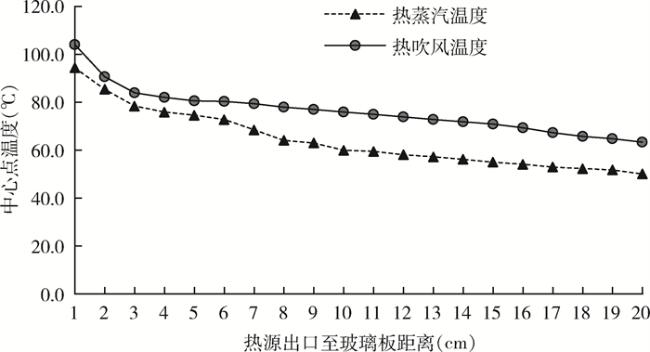
热蒸汽机/热吹风机的出口温度随距离远近的变化见图 1。热蒸汽机/热吹风机的出口温度随着距离的增加,温度逐步下降。热蒸汽机不同距离温度变化标准差的平均值为0.2 ℃,标准差的变异系数为0.26。热吹风机不同距离温度变化标准差的平均值为0.5 ℃,标准差的变异系数为0.77,见表 1。确定热蒸汽机达到实验温度约50、55和60 ℃时距离热蒸汽机热出汽口的距离分别为20、15、10 cm,热吹风机距离热出气口的距离分别为30、24、21 cm。
图1 热蒸汽机/热吹风机热源温度随距离的变化

Fig. 1 Variation of temperature of hot source from hot steam engine/hot air blower with distance

表1 热蒸汽机热汽和热吹风机热气温度均一性

Tab. 1 Measurement of temperature uniformity of hot steam from hot steam engine and hot air from hot air blower

热源 距离(cm) 中心点温度中值(℃) 中心点最高温度(℃) 中心点最低温度(℃) 平均温度±标准差(℃) 95%置信区间(℃)
热蒸汽机 5 74.8 75.2 74.2 74.3±0.4 73.8~74.8
15 54.8 55.0 54.6 54.9±0.3 54.5~55.2
20 51.1 51.6 50.6 50.6±0.4 50.1~51.0
热吹风机 5 75.3 75.7 75.1 79.4±4.9 73.3~85.5
15 71.4 71.7 70.8 70.3±2.2 67.5~73.1
20 63.5 63.7 63.3 62.5±0.9 61.4~63.7

2.2 臭虫致死时间(LTime50和LTime99)的测定结果

50 ℃左右时,热蒸汽的LTime50为10.6 s,远低于热吹风机相近温度下的32.9 s,55和60 ℃左右时热蒸汽机对臭虫成虫的杀灭时间(4.7 s和 < 2 s)也均短于热吹风机(13.3 s和3.6 s),相近温度下,热吹风机对臭虫成虫的LTime50是热蒸汽机的3倍左右。见表 2
表2 热蒸汽和热吹风不同温度处理对臭虫成虫的致死时间

Tab. 2 The lethal time of adult bed bugs exposed to different temperatures of hot steam and hot air

热源 距离a(cm) 平均温度±标准差(℃) 试虫数量(只) LTime50及95%CI(s) LTime99及95%CI(s)
热蒸汽机 20 50.1±0.3 180 10.6(9.5~11.8) 28.3(22.7~40.4)
15 55.0±0.2 390 4.7(3.4~6.6) 28.0(14.1~301.0)
10 60.0±0.1 90 - -
热吹风机 30 50.3±0.1 180 32.9(29.3~36.4) 92.7(74.3~134.2)
24 55.2±0.1 210 13.3(11.4~15.2) 57.3(43.8~87.7)
21 60.2±0.2 180 3.6(2.5~5.3) 17.8(9.6~128.5)

注:a指测试点距热出源出口距离;- 用60.0 ℃的热蒸汽处理臭虫成虫,其2 s死亡率为100%,无法求出致死中时间(LTime50)和99%致死时间(LTime99),计为 < 2 s;CI置信区间。

2.3 臭虫致死温度(LTemp50和LTemp99)的测定结果

热蒸汽机仅在94.4 ℃时,处理1 s臭虫成虫死亡率可达100%,在85.4 ℃时,处理1 s不能使臭虫成虫全部死亡;热吹风机在104.1 ℃时,处理1 s的死亡率为50.11%。处理2 s,热蒸汽机在60.0 ℃时的死亡率为100%;热吹风机处理2 s时所有测试温度均未能使臭虫全部死亡,在最高温度104.1 ℃的死亡率为73.33%。处理3 s时,热蒸汽机对臭虫成虫的杀灭效果与2 s差异不大,在58.1 ℃的死亡率为100%;热吹风机在90.6 ℃的死亡率达100%,但在更高温度下,104.1 ℃处理3 s时的死亡率为97.67%。见表 34
表3 热蒸汽机不同处理时间对臭虫成虫的杀灭效果

Tab. 3 The killing effect of hot steam treatment for different times on adult bed bugs

处理时长(s) 距离a(cm) 平均温度±标准差(℃) 95%置信区间(℃) 总虫数(只) 死虫数(只) 死亡率(%)
1 1 94.4±0.1 94.3~94.5 30 30 100.00
2 85.4±0.2 85.3~85.6 60 53 88.33
3 78.4±0.2 78.3~78.5 90 72 80.00
4 75.9±0.2 75.7~76.0 30 19 63.33
5 74.6±0.3 74.4~74.8 30 18 60.00
6 72.8±0.2 72.6~72.9 30 16 53.33
8 64.1±0.1 64.0~64.2 60 28 46.67
9 63.0±0.2 62.8~63.1 30 8 26.67
10 60.0±0.1 59.9~60.1 60 6 10.00
12 58.1±0.2 58.0~58.2 30 2 6.67
14 56.2±0.2 56.0~56.3 30 3 10.00
20 50.1±0.3 49.9~50.3 30 0 0.00
2 10 60.0±0.1 59.9~60.1 30 30 100.00
11 59.0±0.1 58.8~59.2 30 25 83.33
12 58.1±0.2 58.0~58.2 30 16 53.33
13 57.2±0.3 56.9~57.4 30 11 36.67
14 56.2±0.2 56.0~56.3 30 4 13.33
20 50.1±0.3 49.9~50.3 30 0 0.00
3 10 60.0±0.1 59.9~60.1 30 30 100.00
12 58.1±0.2 58.0~58.2 30 30 100.00
13 57.2±0.3 56.9~57.4 30 26 86.67
15 55.0±0.2 54.9~55.2 30 16 53.33
16 54.1±0.2 54.0~54.3 30 11 36.67
17 53.0±0.2 52.9~53.2 30 5 16.67
18 52.3±0.3 52.1~52.5 30 4 13.33
20 50.1±0.3 49.9~50.3 30 0 0.00

注:a指测试点距热出汽口距离。

表4 热吹风机不同处理时间对臭虫成虫的杀灭效果

Tab. 4 The killing effect of hot air treatment for different times on adult bed bugs

处理时长(s) 距离a(cm) 平均温度±标准差(℃) 95%置信区间(℃) 总虫数(只) 死虫数(只) 死亡率(%)
1 1 104.1±1.7 102.8~105.3 90 46 51.11
2 90.6±0.4 90.3~90.9 60 18 30.00
3 83.9±1.3 83.0~84.8 60 11 18.33
4 82.0±0.5 81.7~82.3 30 1 3.33
5 80.6±0.5 80.2~80.9 30 1 3.33
6 80.3±0.7 79.8~80.8 30 0 0.00
2 1 104.1±1.7 102.8~105.3 30 22 73.33
2 90.6±0.4 90.3~90.9 30 24 80.00
3 83.9±1.3 83.0~84.8 30 18 60.00
6 80.3±0.7 79.8~80.8 30 15 50.00
10 75.9±0.5 75.6~76.2 30 7 23.33
20 63.3±0.3 63.1~63.5 30 3 10.00
3 1 104.1±1.7 102.8~105.3 30 29 96.67
2 90.6±0.4 90.3~90.9 30 30 100.00
3 83.9±1.3 83.0~84.8 30 28 93.33
4 82.0±0.5 81.7~82.3 30 27 90.00
6 80.3±0.7 79.8~80.8 30 21 70.00
9 77.0±0.2 76.9~77.2 30 17 56.67
12 73.9±0.4 73.6~74.2 30 15 50.00
15 70.9±0.1 70.8~71.0 30 14 46.67
18 65.8±0.2 65.7~65.9 30 12 40.00
20 63.3±0.3 63.1~63.5 30 10 33.33
21 60.2±0.2 60.0~60.3 30 4 13.33

注:a指测试点距热出气口距离。

热蒸汽机在60.7 ℃处理2 s可以快速杀死99.00%的臭虫;热吹风机要在2 s杀死99.00%的臭虫,需要140.0 ℃,处理3 s仍需要103.8 ℃。见表 5
表5 热蒸汽和热吹风速杀臭虫成虫的致死温度

Tab. 5 The lethal temperature for killing adult bed bugs with hot steam and hot air

热源 时间(s) 试虫数量(只) LTemp50及95%CI(℃) LTemp99及95%CI(℃)
热蒸汽机 1 480 69.7(67.5~71.9) 100.4(93.4~112.5)
2 150 57.7(57.4~58.0) 60.7(60.0~61.9)
3 300 55.5(54.2~56.9) 61.3(58.9~70.0)
热吹风机 1 240 102.3(96.2~119.4) 150.7(125.7~286.5)
2 180 82.7(72.8~93.7) 140.0(111.9~426.9)
3 330 70.7(67.6~73.4) 103.8(95.1~121.8)

注:LTemp50致死中温度;LTemp99 99%致死温度;CI置信区间。

3 讨论

高温控温处理作为一种物理防治方法,具有安全、高效、可持续、环境友好等优点。高温控温处理技术在历史上很早就被人们用来控制害虫[19]。我国早在1960年就有报道用热蒸汽灭臭虫,比开水烫省时、省力、省燃料、效果好[20]
本研究通过用热蒸汽机和热吹风机杀灭臭虫成虫并进行定量比较,明确了2种热处理方式在杀灭臭虫成虫方面的效果差异。从实验结果来看,热蒸汽在约50、55、60 ℃下对臭虫成虫的LTime50均短于热吹风,在约50 ℃时,热蒸汽的LTime50是10.6 s,热吹风是32.9 s;在约55 ℃时,热蒸汽的LTime50是4.7 s,热吹风是13.3 s。这充分表明,在相同温度条件下,热蒸汽杀灭臭虫成虫的速度更快。相对于热蒸汽,使用热吹风灭臭虫成虫,需要更高的温度和更长的时间。
在致死温度的测定中,热蒸汽同样展现出优势,如用60.7 ℃的热蒸汽处理臭虫成虫2 s即可快速杀死99.00%臭虫成虫。而热吹风要达到相同的致死效果,2 s需要在140.0 ℃,3 s也需要在103.8 ℃,这已经超过了本实验所用普通吹风机的最高温度,因此在实际应用中,热吹风机难以短时间内实现对臭虫成虫的100%致死,即使有高温热吹风机,也会带来很多安全隐患。
热蒸汽是一种便捷的灭臭虫方法,其巨大优势在于它能杀死各发育阶段臭虫,包括虫卵(大多数杀虫剂不具备杀卵作用)[21]。由于蒸汽仅由加热的水组成,很多人更喜欢这种臭虫处理方法而不是杀虫剂,特别是对于寝具。然而,热蒸汽的使用过程中需要非常细心,确保处理对象的所有部位都能被处理,才能全面控制臭虫成虫。此外,热蒸汽灭臭虫成虫也有局限性,例如热蒸汽处理没有持效性,有些应避免高湿度的点位(如电源插座等)也不适合用热蒸汽处理。
市场上有许多不同品牌和类型的蒸汽机,虽然都可以杀灭臭虫[22],但其杀灭的效率和使用的方便性有很大的差异[15]。推荐采用设备必须能够产生低蒸汽流量和高温度的蒸汽。有些商业机型采用“干蒸汽”技术,杀灭臭虫成虫效果更好[15]。所谓“干蒸汽”,是干饱和蒸汽的简称,在相同压力和温度下,干饱和蒸汽的熵值大于湿饱和蒸汽,即相同体积的热蒸汽,含有更高的热能,更少的水分。此外,商业机型的蒸汽机可以在加水过程中持续运行,而普通蒸汽机在加水后需要经历冷却和重新加热的停机时间,因此,商业机型的蒸汽机具有更高的灭臭虫效率。
热吹风产生的热空气,虽然温度很高,却不适合臭虫成虫的快速处理,这是因为热空气始终处于气态,而水蒸汽在一定条件下可能会发生相变,在相变过程中,会有大量的热量释放,这些热量会传递到周围环境或与之接触的物体上,当蒸汽接触臭虫体表时,释放大量潜热(约2 260 J/g水),热空气仅通过温度差异导致的热传导或对流传递热量,没有相变带来的额外能量释放,导致臭虫杀灭速度差异显著。例如,在55 ℃的实验中,热蒸汽处理4.7 s后,臭虫死亡率达到了50.00%,而热吹风处理13.3 s才能达到相同的死亡率。
热空气一般适用于长时间(几个小时)的“局部处理”或“全屋热处理”[23]。受虫害的家具、床垫、手提箱、箱子和其他家用物品可以放置并用加热室、绝缘帐篷、实用拖车或货运集装箱进行处理,加热可以通过电力或丙烷气体提供,其与热吹风的效果相似,均是通过热传递使臭虫所处环境温度升高,从而影响臭虫的生理状态。受虫害的亚麻布和织物可以在干衣机中处理[24]。整个房间的处理,需要居民做好准备,一些物品(例如,加压罐、乐器、药品、室内植物等)可能会被热量损坏,在开始处理之前必须移除。
使用热处理的一个优点是,臭虫不太可能对热产生抗性,相比其他处理方法产生抗性的可能性要低[25]。有研究表明,成虫比卵的致死温度更高[26],因此我们选择臭虫成虫作为研究对象。不同品系的臭虫,对热的抗性有差异,但这种差异较小,在1 ℃左右[25]。本研究通过实验室饲养的热带臭虫进行热蒸汽和热吹风对其杀灭效果的研究,虽然不同实验室的测试结果会有差异,但臭虫对热的抗性小,这种差异不会太大,试验结果有借鉴意义。
此外,在确定不同热处理器距出风口不同距离的温度时,本研究发现热蒸汽机的出口温度随着距离的增加,温度逐步下降,其标准差的变异系数较小,说明标准差相对温度平均值的变化较小,温度随出口距离的变远平稳下降。而热吹风机的出口温度随着距离的增加,温度波折下降。其标准差的变异系数远大于热蒸汽机的标准差平均值和变异系数,说明热吹风机的出风口温度不均一,这种不均一随距离的增加而降低。在实际应用中要注意处理对象距出风口的距离,特别是热吹风机。
综上所述,热蒸汽和热吹风方法具有独特的优势和适用场景。热蒸汽可以用于臭虫成虫的快速处理,在短时间内就能实现较高的致死率,且对环境友好,可用于臭虫的快速处理;热吹风3 s内不能100%杀死臭虫,不能用于臭虫的快速处理,可以用于长时间(几个小时)的“局部处理”或“全屋热处理”。本研究结果为热处理灭臭虫成虫的现场应用提供了重要的数据支持,有助于在实际防治工作中更合理地选择和应用热处理方法,提高臭虫成虫防治的效率和效果。

利益冲突  无

1
Delaunay P, Blanc V, Del Giudice P, et al. Bedbugs and infectious diseases[J]. Clin Infect Dis, 2011, 52(2): 200- 210.

DOI

2
Akhoundi M, Sereno D, Durand R, et al. Bed bugs (Hemiptera, Cimicidae): Overview of classification, evolution and dispersion[J]. Int J Environ Res Public Health, 2020, 17(12): 4576.

DOI

3
Doggett SL, Lee CY. Historical and contemporary control options against bed bugs, Cimex spp.[J]. Annu Rev Entomol, 2023, 68, 169- 190.

DOI

4
许荣满. 臭虫危害的复燃和防治[J]. 中华卫生杀虫药械, 2010, 16(5): 398- 399.

DOI

Xu RM. Bed bug resurgence and control[J]. Chin J Hyg Insect Equip, 2010, 16(5): 398- 399.

DOI

5
任东升, 吴海霞, 修朋程, 等. 2019年全国臭虫监测报告[J]. 中国媒介生物学及控制杂志, 2020, 31(4): 423- 425.

DOI

Ren DS, Wu HX, Xiu PC, et al. National surveillance report on bed bugs in China, 2019[J]. Chin J Vector Biol Control, 2020, 31(4): 423- 425.

DOI

6
刘锐, 范明秋, 姚隽一, 等. 上海市臭虫侵害及处置情况调查分析[J]. 上海预防医学, 2024, 36(5): 453- 457.

DOI

Liu R, Fan MQ, Yao JY, et al. Investigation of infestation and disposal of bedbugs in Shanghai[J]. Shanghai J Prev Med, 2024, 36(5): 453- 457.

DOI

7
王磊, 王常禄, 许益镌, 等. 臭虫的再猖獗、生物学及防治研究进展[J]. 昆虫学报, 2016, 59(9): 1021- 1032.

DOI

Wang L, Wang CL, Xu YJ, et al. Current research on the resurgence, biology and control of bed bugs[J]. Acta Entomol Sin, 2016, 59(9): 1021- 1032.

DOI

8
Wang CL, Wen XJ. Bed bug infestations and control practices in China: Implications for fighting the global bed bug resurgence[J]. Insects, 2011, 2(2): 83- 95.

DOI

9
李兴文, 马涛, 王蓬, 等. 深圳地区臭虫侵害调查研究[J]. 中华卫生杀虫药械, 2013, 19(3): 236-238, 241.

DOI

Li XW, Ma T, Wang P, et al. Bug hazard investigation in Shenzhen[J]. Chin J Hyg Insect Equip, 2013, 19(3): 236-238, 241.

DOI

10
Goddard J, deShazo R. Bed bugs (Cimex lectularius) and clinical consequences of their bites[J]. JAMA, 2009, 301(13): 1358- 1366.

DOI

11
贾孝凯, 高春花, 周丹丹, 等. 温带臭虫对常用杀虫剂半数致死剂量的测定[J]. 中国媒介生物学及控制杂志, 2020, 31(1): 46- 48.

DOI

Jia XK, Gao CH, Zhou DD, et al. Measurement of the median lethal dose of several common insecticides against Cimex lectularius[J]. Chin J Vector Biol Control, 2020, 31(1): 46- 48.

DOI

12
Laborde-Castérot H, Vodovar D, De Zevallos AO, et al. Trends in poisoning associated with the use of insecticides for bed bug infestations: A 20-year retrospective study in France[J]. Sci Rep, 2024, 14(1): 16868.

DOI

13
王德森, 夏艳卫, 张竟声, 等. 我国臭虫防治中存在的问题及解决对策[J]. 中国媒介生物学及控制杂志, 2020, 31(4): 502- 507.

DOI

Wang DS, Xia YW, Zhang JS, et al. Problems and strategies in bed bug prevention and control in China[J]. Chin J Vector Biol Control, 2020, 31(4): 502- 507.

DOI

14
Kells SA, Goblirsch MJ. Temperature and time requirements for controlling bed bugs (Cimex lectularius) under commercial heat treatment conditions[J]. Insects, 2011, 2(3): 412- 422.

DOI

15
Ramos RS, Cooper R, Dasgupta T, et al. Comparative efficacy of superheated dry steam application and insecticide spray against common bed bugs under simulated field conditions[J]. J Econ Entomol, 2023, 116(1): 12- 18.

DOI

16
Pereira RM, Koehler PG, Pfiester M, et al. Lethal effects of heat and use of localized heat treatment for control of bed bug infestations[J]. J Econ Entomol, 2009, 102(3): 1182- 1188.

DOI

17
Kells SA. Control of bed bugs in residences: Information for pest control companies[D]. Minnesota: University of Minnesota, 2010.

18
Chebbah D, Elissa N, Nicolas P, et al. Effectiveness of heat treatment in rapid control of bed bugs in environmental conditions resembling their natural habitats[J]. Int J Environ Health Res, 2024, 34(2): 1147- 1155.

DOI

19
吕建华, 张豫麒, 康宇龙. 高温控温处理防治害虫的研究及应用进展[J]. 植物保护, 2022, 48(1): 1-6, 43.

DOI

Lyu JH, Zhang YQ, Kang YL. Advances in the research and application of controlled heat treatment in insect pest control[J]. Plant Prot, 2022, 48(1): 1-6, 43.

DOI

20
章志亮. 用蒸气消灭臭虫[J]. 中级医刊, 1960(5): 20.

Zhang ZL. Steam treatment for bed bug eradication[J]. Intermed Med J, 1960(5): 20.

21
Deku G, Combey R, Doggett SL, et al. Assessment of tropical bed bug (Hemiptera: Cimicidae), infestations in Cape Coast, Ghana: Household control practices and efficacy of commercial insecticides and long-lasting insecticidal nets against field bed bugs[J]. J Med Entomol, 2021, 58(4): 1788- 1797.

DOI

22
Wang DS, Wang CL, Wang GH, et al. Efficacy of three different steamers for control of bed bugs (Cimex lectularius L.)[J]. Pest Manag Sci, 2018, 74(9): 2030- 2037.

DOI

23
Todd DB. Evaluation of alternative control methods for eliminating insecticide-resistant bed bugs (Cimex lectularius L.)[D]. Blacksburg: Virginia Tech, 2023.

24
Naylor RA, Boase CJ. Practical solutions for treating laundry infested with Cimex lectularius (Hemiptera: Cimicidae)[J]. J Econ Entomol, 2010, 103(1): 136- 139.

DOI

25
Ashbrook AR, Scharf ME, Bennett GW, et al. Bed bugs (Cimex lectularius L.) exhibit limited ability to develop heat resistance[J]. PLoS One, 2019, 14(2): e0211677.

DOI

26
How YF, Lee CY. Effects of temperature and humidity on the survival and water loss of Cimex hemipterus (Hemiptera: Cimicidae)[J]. J Med Entomol, 2010, 47(6): 987- 995.

DOI

文章导航

/