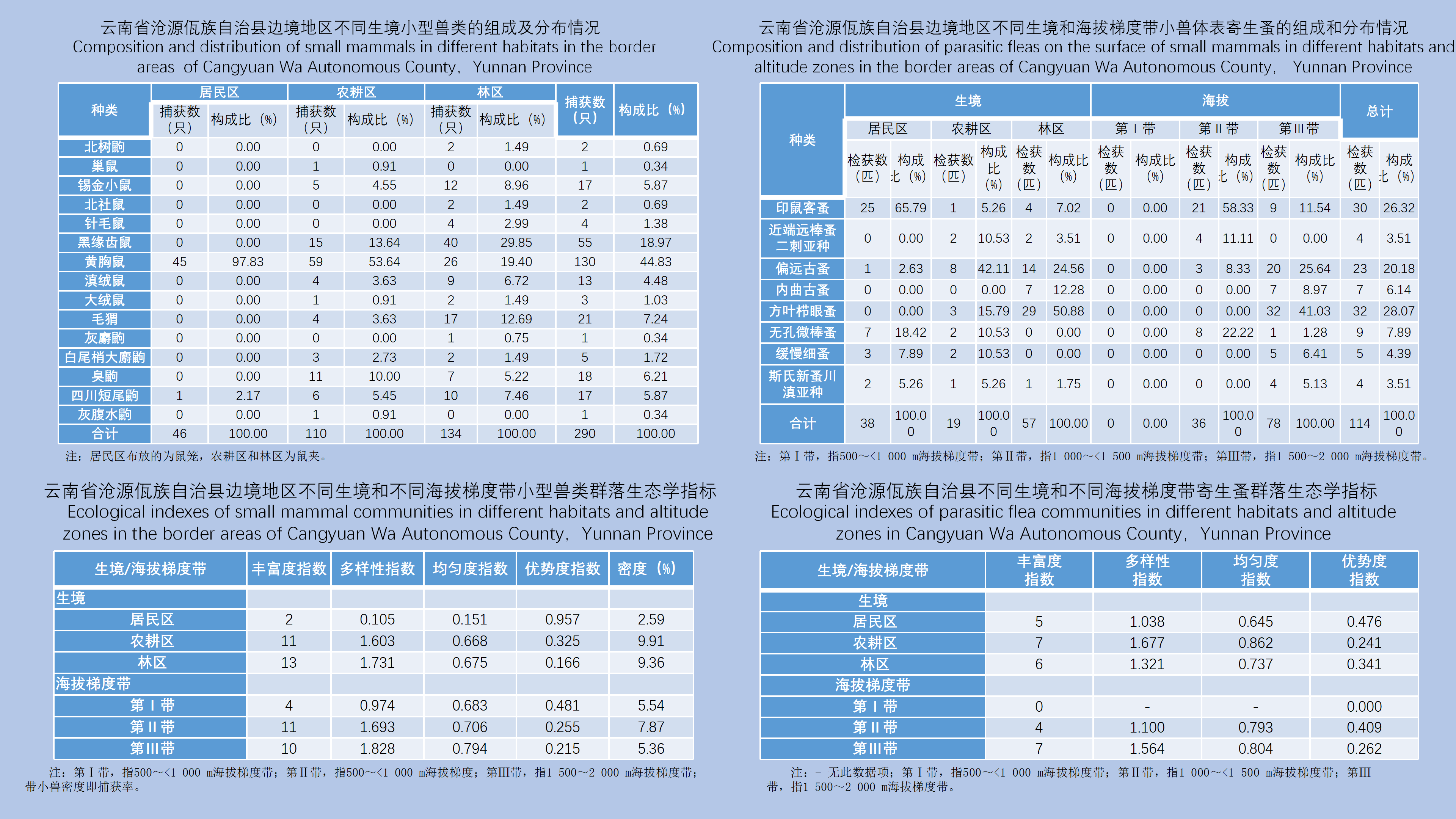
目的 了解云南省沧源佤族自治县(沧源县)边境地区小型兽类(小兽)及寄生蚤的物种构成和数量分布情况,为媒介生物传染病监测和防控提供数据支持。方法 在沧源县3个边境乡镇的居民区、农耕区和林区采用笼夜法和夹线法调查小兽,收集小兽体表寄生蚤,计算小兽种类构成比、捕获率、染蚤率、蚤指数及物种多样性指标,统计分析小兽及其体表寄生蚤的群落结构和分布格局。率的比较采用χ2检验。结果 共捕获小兽290只,隶属于3目5科12属15种,黄胸鼠(44.83%)、黑缘齿鼠(18.97%)为优势种。居民区、农耕区、林区捕获率分别为2.59%、9.91%、9.36%,不同生境捕获率差异有统计学意义(χ2=82.122,P<0.001)。小兽捕获率在海拔梯度第Ⅰ带(500~<1 000 m)、第Ⅱ带(1 000~<1 500 m)、第Ⅲ带(1 500~2 000 m)分别为5.54%、7.87%、5.36%,不同海拔梯度带捕获率差异有统计学意义(χ2=10.160,P=0.006)。小兽体表共捡获寄生蚤114匹,隶属于4科7属8种,平均蚤指数为0.39,方叶栉眼蚤(28.07%)、印鼠客蚤(26.32%)、偏远古蚤(20.18%)为优势种。居民区、农耕区、林区染蚤率分别为41.30%、10.00%、11.94%,不同生境染蚤率差异有统计学意义(χ2=26.688,P<0.001)。小兽的物种丰富度、多样性指数和均匀度指数均为林区>农耕区>居民区,优势度指数则相反。林区与农耕区小兽群落相似性系数较高(0.75)。寄生蚤丰富度指数、多样性指数和均匀度指数均随着海拔的升高而增加。居民区和农耕区小兽寄生蚤群落相似性系数较高(0.83)。结论 云南省沧源县边境地区家鼠鼠疫主要宿主和媒介蚤分布广泛,部分地区小型兽类捕获率及其体表蚤指数较高,建议持续开展相关监测和及时采取预防性控制措施(灭鼠、灭蚤),以降低鼠源疾病风险。
詹泽敏, 邵宗体, 段兴德, 李玉琼, 吴鹤松, 曹荣季, 番仁华, 李思雨, 田光强, 张艳, 陈军
. 云南省沧源县边境地区小型兽类及其寄生蚤群落结构和分布格局[J]. 中国媒介生物学及控制杂志, 2025
, 36(2)
: 207
-214
.
DOI: 10.11853/j.issn.1003.8280.2025.02.012
Objective To investigate the species composition and population distribution of small mammals and parasitic fleas in the border areas of Cangyuan Wa Autonomous County (Cangyuan County), Yunnan Province, China, so as to provide data support for the surveillance, prevention, and control of vector-borne infectious diseases. Methods The cage night method and the clamp line method were used to investigate small mammals in the residential, agricultural, and forest areas of three border towns in Cangyuan County. Parasitic fleas on the bodies of small mammals were collected for the investigation of composition ratio of small mammals, capture rate, flea infection rate, flea index, and species diversity indicators. The community structures and distribution patterns of small mammals and parasitic fleas were analyzed. A comparison of rates was performed using the Chi-square test. Results A total of 290 small mammals were captured, belonging to 15 species of 12 genera of 5 families of 3 orders, with Rattus tanezumi (44.83%) and R. andamanensis (18.97%) as the dominant species. The capture rates in residential, agricultural, and forest areas were 2.59%, 9.91%, and 9.36%, respectively. The differences in capture rates among different habitats were statistically significant (χ2=82.122, P<0.001). The capture rates of small mammals in altitude zone Ⅰ (500-<1 000 m), zone Ⅱ (1 000-<1 500 m), and zone Ⅲ (1 500-2 000 m) were 5.54%, 7.87%, and 5.36%, respectively. The differences in capture rates among altitude zones were statistically significant (χ2=10.160, P<0.006). A total of 114 parasitic fleas were collected, belonging to 8 species of 7 genera of 4 families. The average flea index were 0.39. Ctenophthalmus quadratus (28.07%), Xenopsylla cheopis (26.32%), and Palaeopsylla remota (20.18%) were the dominant flea species. The flea infection rates in residential, agricultural, and forest areas were 41.30%, 10.00%, and 11.94%, respectively. The differences in flea infection rates among different habitats were statistically significant (χ2=26.688, P<0.001). The species richness index, diversity index, and evenness index of small mammals were all in the order of forest area>agricultural area > residential area, while the dominance index showed the opposite order. The similarity coefficient of small mammal communities was relatively high between forest and agricultural areas (0.75). The richness index, diversity index, and evenness index of parasitic fleas all increased with increasing altitude. The similarity coefficient of small mammal parasitic flea communities was relatively high between residential and agricultural areas (0.83). Conclusions The main hosts and vector fleas of commensal rodent plague are widely distributed in the border areas of Cangyuan County, Yunnan Province. The capture rate of small mammals and their body flea index are high in some areas. It is recommended to carry out continuous monitoring and promptly implement preventive control measures (e.g., rodent and flea control) to reduce the risk of rodent-borne diseases.
[1] Zhou Y,Li YH,Zhang C,et al. Investigation report on the outbreak of rodent plague in Cangyuan[J]. Med Pharm Yunnan,1993,14(3):178-179. (in Chinese) 周燕,李玉和,张成,等. 沧源鼠间鼠疫暴发流行调查报告[J]. 云南医药,1993,14(3):178-179.
[2] Zhao WH,Guo M,Su LQ,et al. Epidemic situation and control status of plague in Lincang,Yunnan Province from 1990 to 2014[J]. Bull Dis Control Prev,2016,31(2):5-7. DOI:10.13215/j.cnki.jbyfkztb.1510009.(in Chinese) 赵文红,郭牧,苏丽琼,等. 1990-2014年云南省临沧市鼠疫流行概述及控制现状[J]. 疾病预防控制通报,2016,31(2):5-7. DOI:10.13215/j.cnki.jbyfkztb.1510009.
[3] Pu EN,Duan XD,Feng ZG,et al. Species composition and distribution of small mammals and their parasitic fleas in the border area of Menglian County,Yunnan Province,China[J]. Chin J Vector Biol Control,2022,33(3):366-370. DOI:10.11853/j.issn.1003.8280.2022.03.010.(in Chinese) 浦恩念,段兴德,冯志刚,等. 云南省孟连县边境地区小型兽类及其寄生蚤种类组成和分布调查[J]. 中国媒介生物学及控制杂志,2022,33(3):366-370. DOI:10.11853/j.issn.1003.8280.2022.03.010.
[4] Yu DZ. Animal epidemiology of plague[M]. Beijing:Science Press,2009:112-139. (in Chinese) 俞东征. 鼠疫动物流行病学[M]. 北京:科学出版社,2009:112-139.
[5] Emergency Office of the Ministry of Health,Chinese Center for Disease Control and Prevention. Plague prevention and control emergency manual[M]. Beijing:Peking University Medical Press,2009:58-70. (in Chinese) 卫生部卫生应急办公室,中国疾病预防控制中心. 鼠疫防控应急手册(2009年版)[M]. 北京:北京大学医学出版社,2009:58-70.
[6] Xie BQ,Zeng JF. The siphonaptera of Yunnan[M]. Kunming:Yunnan Science and Technology Press,2000:67-272. (in Chinese) 解宝琦,曾静凡. 云南蚤类志[M]. 昆明:云南科技出版社,2000:67-272.
[7] Shao ZT,Pu EN,Wang GL,et al. The community structures and species diversity of host animals and ectoparasite fleas in the season of animal plague prevalence in Lijiang plague natural foci[J]. Chin J Ctrl Endem Dis,2021,36(2):104-107. (in Chinese) 邵宗体,浦恩念,王国良,等. 丽江野鼠鼠疫流行季节宿主动物及其寄生蚤群落结构与物种多样性[J]. 中国地方病防治,2021,36(2):104-107.
[8] Feng W,Zhao CZ,Yue R,et al. Bird community diversity and similarity in Zhangye National Wetland Park of Gansu Province in winter and spring[J]. Chin J Ecol,2017,36(8):2224-2231. DOI:10.13292/j.1000-4890.201708.027.(in Chinese) 冯威,赵成章,岳冉,等. 张掖国家湿地公园冬春季鸟类群落多样性和相似性分析[J]. 生态学杂志,2017,36(8):2224-2231. DOI:10.13292/j.1000-4890.201708.027.
[9] Cao RJ. Community ecology study on small animals and their parasitic fleas in the lower reaches of Jinsha River in Yunnan Province[D]. Dali:Dali University,2023. DOI:10.27811/d.cnki.gdixy.2023.000491.(in Chinese) 曹荣季. 云南省金沙江下游地区鼠形动物及其寄生蚤群落生态学研究[D]. 大理:大理大学,2023. DOI:10.27811/d.cnki.gdixy.2023.000491.
[10] Huang TH,Liu L,Du CH,et al. The relationship between the distribution of small mammals,vectors and plague in different landscapes in southwest Yunnan[J]. Chin J Vector Biol Control,2016,27(2):112-116. DOI:10.11853/j.issn.1003.8280.2016.02.005.(in Chinese) 黄涛华,刘霖,杜春红,等. 滇西南不同景观小型兽类及其媒介分布与鼠疫关系[J]. 中国媒介生物学及控制杂志,2016,27(2):112-116. DOI:10.11853/j.issn.1003.8280.2016.02.005.
[11] Duan XD,Zhang XK,Tang YZ. Epidemiological investigation and control of plague animals in Cangyuan County[J]. Chin J Ctrl Endem Dis,1993,8(5):298. (in Chinese) 段兴德,张希昆,唐玉珍. 沧源县鼠疫动物流行病学调查与控制[J]. 中国地方病防治杂志,1993,8(5):298.
[12] Lu SG,Rao DQ,Li YJ,et al. Comprehensive investigation report on Daqing Mountain of Gengma,Wocan Mountain of Cangyuan,and the Biological Corridor Belt[R]. Lincang:Lincang Prefecture Administrative Office and Nangunhe National Nature Reserve Administration,2000:12. (in Chinese) 陆树刚,饶定齐,李永杰,等. 耿马大青山、沧源窝坎大山及生物走廊带综合考察报告[R]. 临沧:临沧地区行政公署林业局和南滚河国家级自然保护区管理局,2000:12.
[13] Li QY. Occurrence,growth and decline of Rattus nitidus in farmland and rodent control measures[J]. Plant Prot,2001,27(6):42-43. DOI:10.3969/j.issn.0529-1542.2001.06.019.(in Chinese) 李秋阳. 农田大足鼠的发生消长规律与灭鼠对策[J]. 植物保护,2001,27(6):42-43. DOI:10.3969/j.issn.0529-1542.2001.06.019.
[14] Li QY,Zhao XL. Investigation of farmland rodent in Cangyuan County of Yunnan[J]. Plant Prot,2012,38(6):147-150. DOI:10.3969/j.issn.0529-1542.2012.06.033.(in Chinese) 李秋阳,赵秀兰. 云南沧源县农田鼠害调查[J]. 植物保护,2012,38(6):147-150. DOI:10.3969/j.issn.0529-1542.2012.06.033.
[15] Xu XJ,Lyu JW,Xie ZL,et al. Effects of habitat complexity on species diversity of small mammals in pastures and forest interlaced regions[J]. Acta Ecol Sin,2009,29(6):2945-2952. DOI:10.3321/j.issn:1000-0933.2009.06.022.(in Chinese) 徐兴军,吕建伟,谢振丽,等. 寒温带牧林交错区生境复杂度对啮齿类物种多样性的影响[J]. 生态学报,2009,29(6):2945-2952. DOI:10.3321/j.issn:1000-0933.2009.06.022.
[16] Guo XG,Gong ZD,Qian TJ,et al. The comparison between flea communities on ten species of small mammals in the foci of human plague in Yunnan China[J]. Insect Sci,2000,7(2):169-177. DOI:10.1111/j.1744-7917.2000.tb00356.x.
[17] Gong ZD,Wu HY,Duan XD,et al. The species diversity and distribution trends of small mammals in Hengduan Mountains,Yunnan[J]. Biodiversity Sci,2001,9(1):73-79. DOI:10.17520/biods.2001011.(in Chinese) 龚正达,吴厚永,段兴德,等. 云南横断山区小型兽类物种多样性与地理分布趋势[J]. 生物多样性,2001,9(1):73-79. DOI:10.17520/biods.2001011.
[18] Li D,Gong ZD. Research advance on the fauna and diversity of small mammals in Yunnan Province[J]. Chin J Vector Biol Control,2011,22(1):89-93,97. (in Chinese) 李栋,龚正达. 云南省小型兽类区系与多样性的研究概况[J]. 中国媒介生物学及控制杂志,2011,22(1):89-93,97.
[19] Shao ZT,Gao ZH,Pu EN,et al. The community structures and species diversity of small mammals and their ectoparasite fleas in the border area between Panzhihua City and Huaping County,Yunnan[J]. China Trop Med,2022,22(3):201-205,223. DOI:10.13604/j.cnki.46-1064/r.2022.03.02.(in Chinese) 邵宗体,高子厚,浦恩念,等. 云南华坪县与攀枝花市交界地小型兽类及其寄生蚤群落结构分析[J]. 中国热带医学,2022,22(3):201-205,223. DOI:10.13604/j.cnki.46-1064/r.2022.03.02.
[20] Ju JK,Li D,Gong ZD,et al. Flea species diversity,spatial distribution and the relations to human plague in Yunnan southwest mountain farmland[J]. Acta Parasitol Med Entomol Sin,2021,28(3):165-176,183. DOI:10.3969/j.issn.1005-0507.2021.03.006.(in Chinese) 琚俊科,李栋,龚正达,等. 滇西南山地农耕区蚤类物种多样性空间分布特征与鼠疫关系[J]. 寄生虫与医学昆虫学报,2021,28(3):165-176,183. DOI:10.3969/j.issn.1005-0507.2021.03.006.
[21] Pu EN,Su C,Shao ZT,et al. Investigation and handling of a human plague epidemic outbreak in Menghai County,Yunnan[J]. Chin J Zoonoses,2022,38(5):464-468. DOI:10.3969/j.issn.1002-2694.2022.00.053.(in Chinese) 浦恩念,苏超,邵宗体,等. 云南勐海县一起人间鼠疫疫情的调查处置分析[J]. 中国人兽共患病学报,2022,38(5):464-468. DOI:10.3969/j.issn.1002-2694.2022.00.053.
[22] Hong M,Liu ZX,Yang GR,et al. Characteristics of diversity of fleas communities on small animals of Shangri-La County,Yunnan Province[J]. Mod Prev Med,2015,42(8):1483-1488. (in Chinese) 洪梅,刘正祥,杨桂荣,等. 香格里拉县小型兽类寄生蚤群落多样性特征[J]. 现代预防医学,2015,42(8):1483-1488.
[23] Wu L,Yin JX. An overview of the relationship between fleas and environmental factors[J]. Chin J Vector Biol Control,2021,32(6):779-782. DOI:10.11853/j.issn.1003.8280.2021.06.023.(in Chinese) 武丽,尹家祥. 蚤类与环境因素关系概述[J]. 中国媒介生物学及控制杂志,2021,32(6):779-782. DOI:10.11853/j.issn.1003.8280.2021.06.023.
[24] Cai WF,Luo JL,Su LQ,et al. Community diversity characteristics of small mammals in plage natural focus of Jianchuan County,Yunnan,2008-2017[J]. China Trop Med,2019,19(5):440-443. DOI:10.13604/j.cnki.46-1064/r.2019.05.09.(in Chinese) 蔡文凤,罗剑龙,苏丽琼,等. 云南省剑川县2008-2017年鼠疫疫源地不同生境小型兽类群落多样性特征[J]. 中国热带医学,2019,19(5):440-443. DOI:10.13604/j.cnki.46-1064/r.2019.05.09.
[25] Peng ER,Wang S,Hao LS,et al. Approaches to basic farmland and plowland protection in Yunnan Province[J]. Resources & Industries,2009,11(4):59-63. DOI:10.3969/j.issn.1673-2464.2009.04.013.(in Chinese) 彭尔瑞,王穗,郝莉莎,等. 云南耕地与基本农田保护现状分析及对策研究[J]. 资源与产业,2009,11(4):59-63. DOI:10.3969/j.issn.1673-2464.2009.04.013.
[26] Tang L,Zhang CG,Shao ZT,et al. The community structures and species diversity of fleas in Yulong plague focus,Yunnan Province[J]. Chin J Vector Biol Control,2017,28(3):201-204,215. DOI:10.11853/j.issn.1003.8280.2017.03.002.(in Chinese) 汤丽,张长国,邵宗体,等. 云南省玉龙鼠疫疫源地蚤类群落结构与物种多样性[J]. 中国媒介生物学及控制杂志,2017,28(3):201-204,215. DOI:10.11853/j.issn.1003.8280.2017.03.002.


