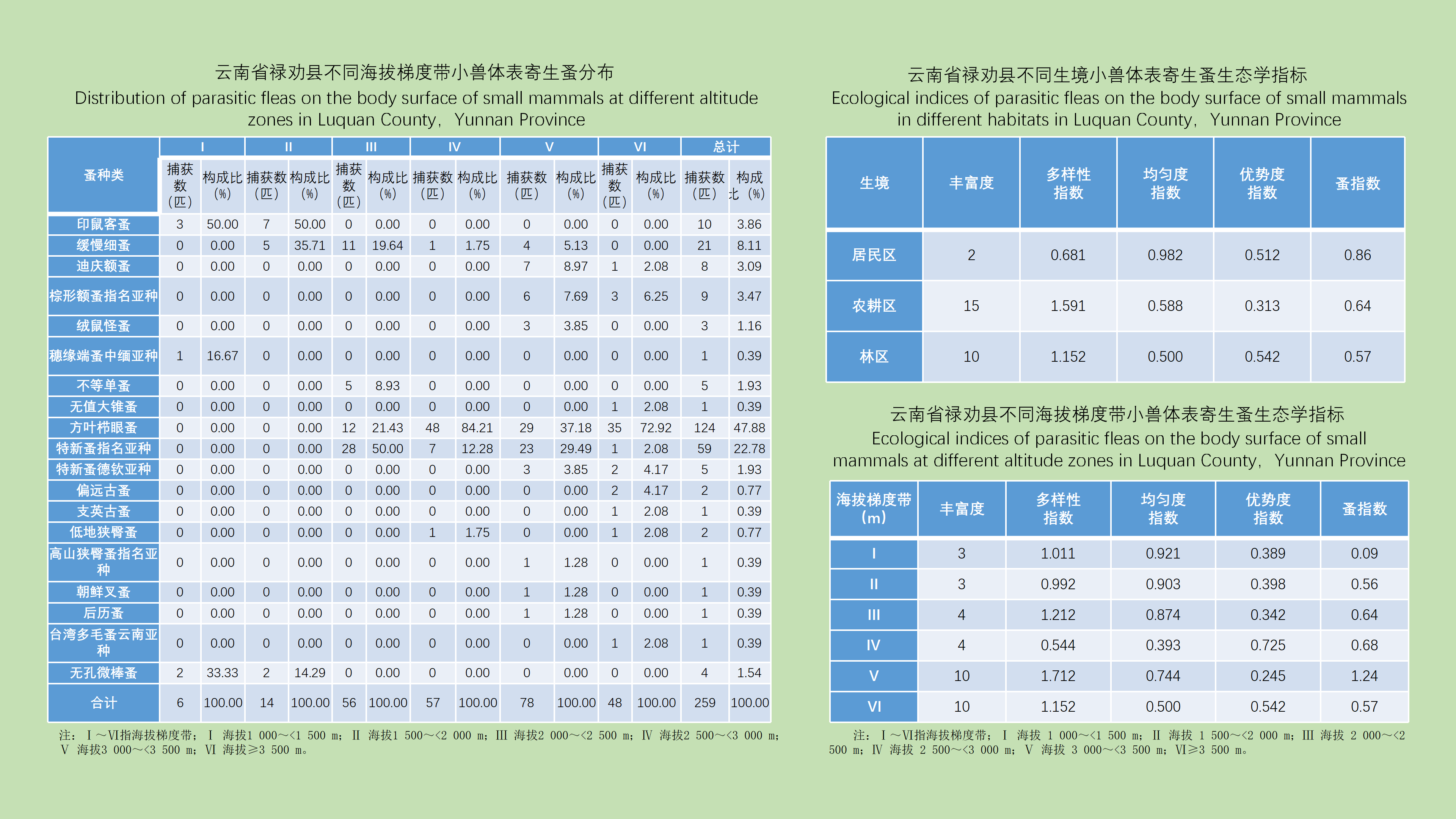
Objective To investigate the composition and distribution of parasitic fleas of small mammals in Luquan Yi and Miao Autonomous County, Yunnan Province, China, identify the community structure and distribution of fleas, so as to provide basic data for exploring whether there are plague, endemic typhus, and other flea-borne diseases in Luquan County. Methods In Luquan County, an altitude range of 1 000 to 3 700 meters was divided into 6 vertical gradient zones at intervals of 500 meters. Three different habitats in residential areas, farming areas, and forest areas at varying altitudes were selected for the sampling of parasitic fleas of small mammals. Species were identified through morphological classification. The data were statistically analyzed using community ecology methods. Excel 2010 and SPSS 21.0 softwares were used for data collection and analysis, and rates were compared using the Chi-square test. Results A total of 259 parasitic fleas were captured from 408 small mammals, belonging to 19 species, 15 genera, and 6 families. The average flea infestation rate was 25.49%, with significant differences between the different small mammal species groups (χ2=52.116, P<0.01). The flea index of small mammals was 0.63. The dominant species were Ctenophthalmus quadratus and Neopsylla specialis specialis. The distribution of dominant flea species varied across different habitats and altitudes. Among the three habitats, the flea infestation rate and flea index of small mammals in residential areas were the highest. The flea infestation rate of small mammals in forest areas ranked second, with the flea index ranking third. The rate of flea infestation in farming areas was the lowest, with the flea index ranking second. There was no significant difference in the flea infestation rate on the body surface of small mammals in different habitats (χ2= 3.052, P=0.217). In different altitude zones, the flea infestation rates on the body surface of small mammals ranged from 7.69% to 44.44%, with significant differences observed between the different altitude zones (χ2=22.914, P<0.001) and a flea index ranging from 0.09 to 1.24. The species richness and quantity distribution of parasitic fleas on the body surface of small mammals increased gradually with the increase in altitude. The diversity index ranged from 0.544 to 1.712, gradually increasing and then decreasing with the increase in altitude within zones Ⅰ to Ⅲ; the index decreased to the lowest level within altitude zone Ⅳ, increased to the highest level in altitude zone Ⅴ, and gradually decreased in altitude zone Ⅵ. The trends in evenness and diversity were consistent, while the trend in the dominance was opposite, exhibiting a distribution pattern changing with the habitat heterogeneity at different altitudes. The diversity index of the three habitats ranged from 0.681 to 1.591, with the highest in farming areas, followed by forest areas, and then residential areas. The trends in richness and diversity index were consistent, and other indices varied by altitudes. Conclusions In Luquan County, the species richness and diversity of parasitic fleas on the body surface of small mammals are relatively high. Two major vectors of both domestic rodent and wild rodent plagues in Yunnan, Xenopsylla cheopis and N. specialis specialis, and various other natural zoonotic vector fleas exist, which provide vector conditions for the existence and epidemic transmission of plague and other epidemic diseases in natural foci. Therefore, the surveillance, prevention, and control of rodent-borne diseases such as plague should be strengthened.
[1] Yang GR, Gao ZH, Dong Y, et al. Zoonoses in Yunnan[M]. Kunming:Yunnan Science and Technology Press, 2020:74, 313-316. (in Chinese) 杨光荣, 高子厚, 董毅, 等. 云南人兽共患病[M]. 昆明:云南科技出版社, 2020:74, 313-316.
[2] Liu ZX, Cai WF, Shao ZT, et al. Plague epidemiology in natural plague foci in Yulong, Yunnan, 2005-2017[J]. Dis Surveill, 2019, 34(3):237-240. DOI:10.3784/j.issn.1003-9961.2019.03.012.(in Chinese) 刘正祥, 蔡文凤, 邵宗体, 等. 2005-2017年云南省玉龙鼠疫自然疫源地鼠疫流行病学分析[J]. 疾病监测, 2019, 34(3):237-240. DOI:10.3784/j.issn.1003-9961.2019.03.012.
[3] Shi LY, Yang GR, Zhao CH, et al. Determination and disposal of human plague in Jinghong, Yunnan Province, in 2016[J]. Chin J Health Lab Technol, 2017, 27(10):1502-1504, 1507. (in Chinese) 石丽媛, 杨桂荣, 赵春花, 等. 2016年云南省景洪市一起人间鼠疫疫情判定及处置[J]. 中国卫生检验杂志, 2017, 27(10):1502-1504, 1507.
[4] Pu EN, Su C, Shao ZT, et al. Investigation and handling of a human plague epidemic outbreak in Menghai County, Yunnan[J]. Chin J Zoonoses, 2022, 38(5):464-468. DOI:10.3969/j.issn.1002-2694.2022.00.053.(in Chinese) 浦恩念, 苏超, 邵宗体, 等. 云南勐海县一起人间鼠疫疫情的调查处置分析[J]. 中国人兽共患病学报, 2022, 38(5):464-468. DOI:10.3969/j.issn.1002-2694.2022.00.053.
[5] Lu HC, Du H, Yang H, et al. Investigation results of the first outbreak of plague in Guizhou Province[J]. Chin J Ctrl Endem Dis, 2004, 19(4):236-238. DOI:10.3969/j.issn.1001-1889.2004.04.014.(in Chinese) 陆洪潮, 杜晖, 杨华, 等. 贵州省首次鼠疫暴发流行的调查结果[J]. 中国地方病防治杂志, 2004, 19(4):236-238. DOI:10.3969/j.issn.1001-1889.2004.04.014.
[6] Yu DZ. Animal epidemiology of plague[M]. Beijing:Science Press, 2009:112-139. (in Chinese) 俞东征. 鼠疫动物流行病学[M]. 北京:科学出版社, 2009:112-139.
[7] Emergency Office of the Ministry of Health of the People's Republic of China, Chinese Center for Disease Control and Prevention. Emergency manual for plague prevention and control[M]. Beijing:Peking University Medical Press, 2009:58-83. (in Chinese) 卫生部卫生应急办公室, 中国疾病预防控制中心. 鼠疫防控应急手册[M]. 北京:北京大学医学出版社, 2009:58-83.
[8] Xie BQ, Zeng JF. The Siphonaptera of Yunnan[M]. Kunming:Yunnan Science and Technology Press, 2000:88-385. (in Chinese) 解宝琦, 曾静凡. 云南蚤类志[M]. 昆明:云南科技出版社, 2000:88-385.
[9] Li YQ, Mao MJ, Duan XD, et al. Community structure and species diversity of small mammals in Luquan County, Yunnan Province[J]. Chin J Vector Biol Control, 2023, 34(3):383-388. DOI:10.11853/j.issn.1003.8280.2023.03.017.(in Chinese) 李玉琼, 毛美娟, 段兴德, 等. 云南省禄劝县小型兽类群落结构和物种多样性[J]. 中国媒介生物学及控制杂志, 2023, 34(3):383-388. DOI:10.11853/j.issn.1003.8280.2023.03.017.
[10] Shao ZT, Pu EN, Wang GL, et al. The community structures and species diversity of host animals and ectoparasite fleas in the season of animal plague prevalence in Lijiang plague natural foci[J]. Chin J Ctrl Endem Dis, 2021, 36(2):104-107. (in Chinese) 邵宗体, 浦恩念, 王国良, 等. 丽江野鼠鼠疫流行季节宿主动物及其寄生蚤群落结构与物种多样性[J]. 中国地方病防治, 2021, 36(2):104-107.
[11] Hong J, Li JR, Deng ZJ, et al. Surveillance of plague in Kunming City from 2003 to 2009[J]. China Trop Med, 2011, 11(5):556-558. DOI:10.13604/j.cnki.46-1064/r.2011.05.006.(in Chinese) 洪劲, 李建荣, 邓智杰, 等. 2003-2009年昆明市鼠疫监测分析[J]. 中国热带医学, 2011, 11(5):556-558. DOI:10.13604/j.cnki.46-1064/r.2011.05.006.
[12] Yang K, Zhang JP, Wu ML, et al. Effects of habitat on flea community and life history[J]. Chin J Vector Biol Control, 2011, 22(1):86-88. (in Chinese) 杨孔, 张建漂, 吴梦玲, 等. 生境对蚤类群落及其生活史的影响[J]. 中国媒介生物学及控制杂志, 2011, 22(1):86-88.
[13] Wu YYY, Zhang CG, Shao ZT, et al.Seasonal diversity of ectoparasite fleas on small mammals in Yulong plague focus[J].Mod Prev Med, 2017, 44(19):3593-3596, 3615.(in Chinese) 吴洋妍妍, 张长国, 邵宗体, 等.玉龙鼠疫自然疫源地小型兽类体外寄生蚤的季节多样性[J].现代预防医学, 2017, 44(19):3593-3596, 3615.
[14] Han ZW, Ma L, Cao CW, et al.The structure and diversity of insect community in Taihu wetland[J]. Acta Ecologica Sinica, 2013, 33(14):4387-4397. DOI:10.5846/stxb201204020463.(in Chinese) 韩争伟, 马玲, 曹传旺, 等.太湖湿地昆虫群落结构及多样性[J].生态学报, 2013, 33(14):4387-4397. DOI:10.5846/stxb201204020463.
[15] Gong ZD, Wu HY, Duan XD, et al. The species diversity and distribution trends of small mammals in Hengduan mountains, Yunnan[J]. Biodiv Sci, 2001, 9(1):73-79. DOI:10.17520/biods.2001011.(in Chinese) 龚正达, 吴厚永, 段兴德, 等. 云南横断山区小型兽类物种多样性与地理分布趋势[J]. 生物多样性, 2001, 9(1):73-79. DOI:10.17520/biods.2001011.
[16] Quan SY, Yue RP, Zhang LY, et al. The composition and spatial distribution of small mammals in the Hengduan mountains of Yunnan, China[J]. Chin J Vector Biol Control, 2010, 21(1):16-22. (in Chinese) 权寿瑛, 岳仁苹, 张丽云, 等. 云南省横断山区小型兽类的组成及空间分布[J]. 中国媒介生物学及控制杂志, 2010, 21(1):16-22.
[17] Gong ZD, Wu HY, Duan XD, et al. The relationship between the geographical distribution trends of flea species diversity and the important environmental factor in the Hengduan mountains, Yunnan[J]. Biodiv Sci, 2001, 9(4):319-328. DOI:10.3321/j.issn:1005-0094.2001.04.001.(in Chinese) 龚正达, 吴厚永, 段兴德, 等. 云南横断山区蚤类物种多样性的地理分布趋势与重要环境因素的关系[J]. 生物多样性, 2001, 9(4):319-328. DOI:10.3321/j.issn:1005-0094.2001.04.001.
[18] Gong ZD, Yu X, Liu QY, et al. Ecological-geographic landscapes of natural plague foci in China Ⅵ. Biological characteristics of natural vectors of Yesinia pestis[J]. Chin J Epidemiol, 2012, 33(8):818-822. DOI:10.3760/cma.j.issn.0254-6450.2012.08.014.(in Chinese) 龚正达, 于心, 刘起勇, 等. 中国鼠疫自然疫源地分型研究Ⅵ. 鼠疫媒介生物学特征[J]. 中华流行病学杂志, 2012, 33(8):818-822. DOI:10.3760/cma.j.issn.0254-6450.2012.08.014.
[19] Zhang XK. Reflections on the epidemic and treatment of plague in Yiliang County[J]. Chin J Ctrl Endem Dis, 1999, 14(4):221-222. (in Chinese) 张希昆. 对宜良县鼠疫流行及处理过程的反思[J]. 中国地方病防治杂志, 1999, 14(4):221-222.
[20] Wang LM, Xue M, Li FZ, et al. Analysis on the first detection of Yersinia pestis in Sichuan Province[J]. Chin J Endemiol, 2000, 19(2):159. DOI:10.3760/cma.j.issn.1000-4955.2000.02.039.(in Chinese) 汪立茂, 薛梅, 李富忠, 等. 四川省首次检出鼠疫菌情况分析[J]. 中国地方病学杂志, 2000, 19(2):159. DOI:10.3760/cma.j.issn.1000-4955.2000.02.039.
[21] Qi T, Ma L, Wang LM, et al. Study on plague natural foci survey from 2013-2014 in Panzhihua City[J]. Chin J Vector Biol Control, 2015, 26(2):192-193, 205. DOI:10.11853/j.issn.1003.4692.2015.02.022.(in Chinese) 祁腾, 马丽, 汪立茂, 等. 攀枝花市2013-2014年鼠疫疫源地调查分析[J]. 中国媒介生物学及控制杂志, 2015, 26(2):192-193, 205. DOI:10.11853/j.issn.1003.4692.2015.02.022.
[22] Gong XJ, Chen GC, Huang HW, et al. Analysis of plague focus investigation in a part of large hydroelectric development area in Guizhou[J]. J Med Pest Control, 2007, 23(3):223-226. DOI:10.3969/j.issn.1003-6245.2007.03.038.(in Chinese) 龚晓俊, 陈贵春, 黄红武, 等. 贵州省部分大型水电建设工程地区鼠疫疫源调查结果分析[J]. 医学动物防制, 2007, 23(3):223-226. DOI:10.3969/j.issn.1003-6245.2007.03.038.


