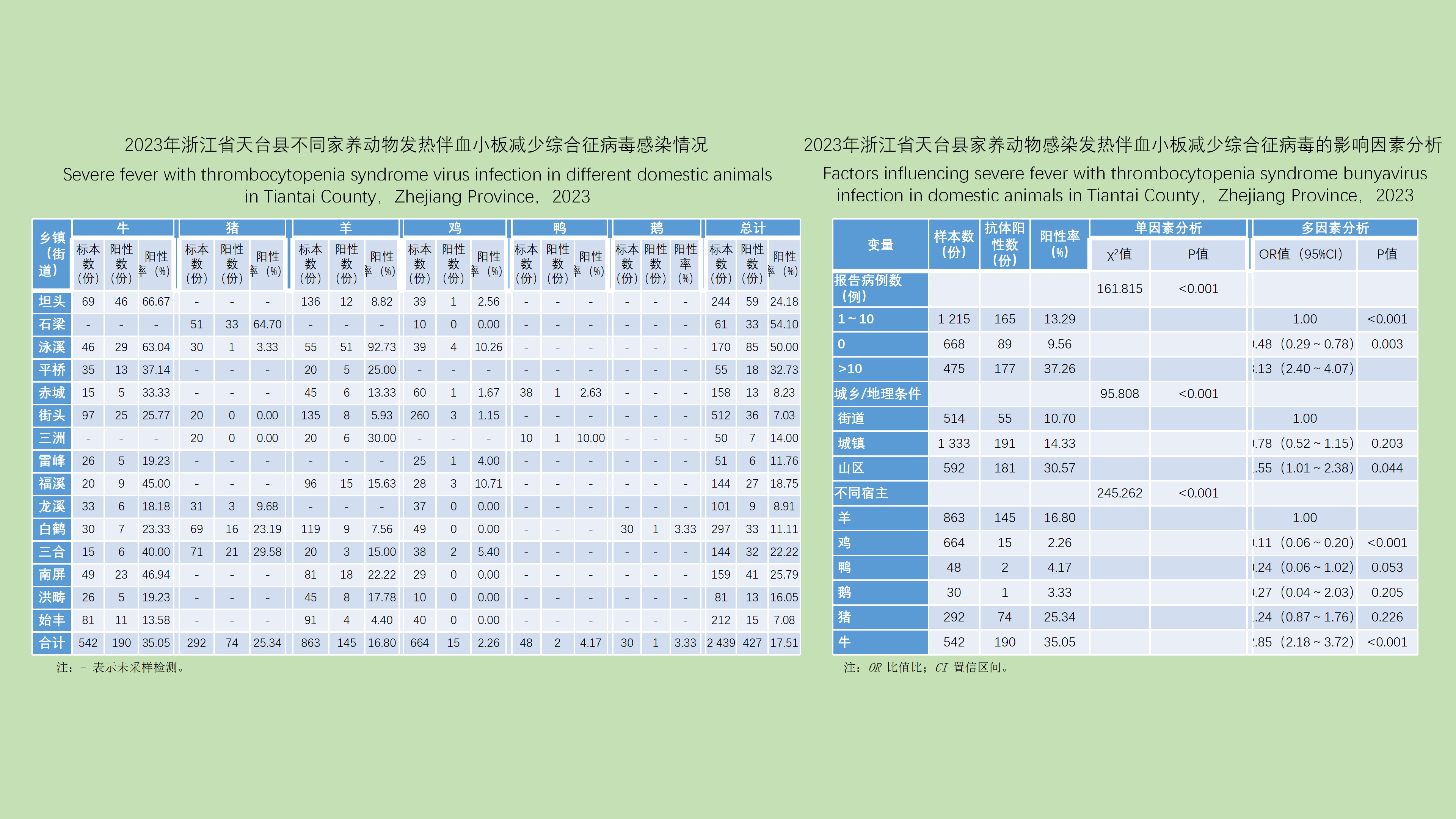
Objective To investigate the infection status and epidemic characteristics of Severe fever with thrombocytopenia syndrome (SFTS) virus (SFTSV) in different domestic animals in Tiantai County, Zhejiang Province, China, so as to provide basis for SFTS prevention and control. Methods Serum samples were collected from pigs, cattle, sheep, chickens, ducks, and geese for double-antigen sandwich enzyme-linked immunosorbent assay of total SFTSV antibody. Multivariable logistic regression model was used to analyze the associations of SFTSV infection with the factors. Results In 2023, a total of 2 439 serum samples were collected from the six animal species, and the total positive rate was 17.51% (427/2 439). The infection rates of SFTSV in cattle, pigs, sheep, ducks, geese, and chickens were 35.05% (190/542), 25.34% (74/292), 16.80% (145/863), 4.17% (2/48), 3.33% (1/30), and 2.26% (15/664), respectively. Multivariable analysis showed that the positive rate of total SFTSV antibody in domestic animals in areas with more than 10 cases (37.26%) was higher than those in areas with 1-10 cases (13.29%) and 0 cases (9.56%), the positive rate of SFTSV antibody in mountain area (30.57%) was higher than those in towns (14.33%) and subdistricts (10.70%), and the positive rate of SFTSV antibody was higher in cattle (35.05%) than in sheep (16.80%) and in chickens (2.26%)(all P<0.05). Conclusions SFTSV infection was detected in different domestic animals and townships of Tiantai County in Zhejiang Province, but with various positive rates, suggesting that comprehensive measures such as animal management, tick control, and personal protection publicity can be implemented before peak season of SFTS in key areas in Tiantai County to effectively reduce the incidence of the disease.
[1] Shi ZL, Qian H, Ma SL, et al. The progress of pathogenesis and diagnosis for SFTSV[J]. Electr J Emerg Infect Dis, 2018, 3(3):140-142. DOI:10.3877/j.issn.2096-2738.2018.03.005.(in Chinese) 施泽纶, 乾虎, 马世良, 等. 新型布尼亚病毒病原学和诊断学进展[J]. 新发传染病电子杂志, 2018, 3(3):140-142. DOI:10.3877/j.issn.2096-2738.2018.03.005.
[2] Park SC, Park JY, Choi JY, et al. Experimental infection of dogs with Severe fever with thrombocytopenia syndrome virus:Pathogenicity and potential for intraspecies transmission[J]. Transbound Emerg Dis, 2022, 69(5):3090-3096. DOI:10.1111/tbed.14372.
[3] Chen C, Li P, Li KF, et al. Animals as amplification hosts in the spread of Severe fever with thrombocytopenia syndrome virus:A systematic review and meta-analysis[J]. Int J Infect Dis, 2019, 79:77-84. DOI:10.1016/j.ijid.2018.11.017.
[4] Liu Q, He B, Huang SY, et al. Severe fever with thrombocytopenia syndrome, an emerging tick-borne zoonosis[J]. Lancet Infect Dis, 2014, 14(8):763-772. DOI:10.1016/S1473-3099(14)70718-2.
[5] Zhang L, Zhang YJ, Ding GQ, et al. First confirmation of new bunyavirus-infected patients in Zhejiang Province and molecular identification of the isolated virus[J]. Chin J Microbiol Immunol, 2011, 31(12):1107-1111. DOI:10.3760/cma.j.issn.0254-5101.2011.12.012.(in Chinese) 张磊, 张严峻, 丁钢强, 等. 浙江省首次发现新型布尼亚病毒感染病例及分离病毒分子鉴定[J]. 中华微生物学和免疫学杂志, 2011, 31(12):1107-1111. DOI:10.3760/cma.j.issn.0254-5101.2011.12.012.
[6] Li LJ, Ren H. Infectious diseases[M]. Beijing:People ' s Medical Publishing House, 2018:137-141. (in Chinese) 李兰娟, 任红. 传染病学[M]. 北京:人民卫生出版社, 2018:137-141.
[7] Wang QJ, Li SB, Ye L, et al. Vector biological monitoring and strategy to prevent and control Severe fever with thrombocytopenia syndrome bunyavirus (SFTSV) in Daishan County Zhoushan islands 2011-2018[J]. Shanghai J Prev Med, 2020, 32(6):521-526. DOI:10.19428/j.cnki.sjpm.2020.20074.(in Chinese) 王秋景, 李世波, 叶凌, 等. 2011-2018年舟山海岛岱山县新型布尼亚病毒相关病媒生物监测及防控策略研究[J]. 上海预防医学, 2020, 32(6):521-526. DOI:10.19428/j.cnki.sjpm.2020.20074.
[8] Zhang WJ, Yao H, Gao HX. Epidemiological characteristics of severe fever with thrombocytopenia syndrome and influencing factors of Bunyavirus infection in Weihai, Shandong Province[J]. J Public Health Prev Med, 2022, 33(5):36-39. DOI:10.3969/j.issn.1006-2483.2022.05.008.(in Chinese) 张文杰, 姚慧, 高红霞. 山东威海地区发热伴血小板减少综合征流行病学特征及新型布尼亚病毒感染的影响因素[J]. 公共卫生与预防医学, 2022, 33(5):36-39. DOI:10.3969/j.issn.1006-2483.2022.05.008.
[9] Ge JH, Pang WL, Sun JM, et al. Epidemiological characteristics of severe fever with thrombocytopenia syndrome and its inapparent infection in Tiantai County, Zhejiang Province[J]. Chin J Zoonoses, 2017, 33(9):848-852. DOI:10.3969/j.issn.1002-2694.2017.09.018.(in Chinese) 葛君华, 庞卫龙, 孙继民, 等. 浙江省天台县发热伴血小板减少综合征流行特征及隐性感染状况调查[J]. 中国人兽共患病学报, 2017, 33(9):848-852. DOI:10.3969/j.issn.1002-2694.2017.09.018.
[10] Pang WL, Liu Y, Ge JH, et al. Epidemiological characteristics analysis on severe fever with thrombocytopenia syndrome in Tiantai County of Zhejiang Province, 2012-2018[J]. Shanghai J Prev Med, 2019, 31(6):500-504. DOI:10.19428/j.cnki.sjpm.2019.19354.(in Chinese) 庞卫龙, 刘营, 葛君华, 等. 2012-2018年浙江省天台县发热伴血小板减少综合征流行特征分析[J]. 上海预防医学, 2019, 31(6):500-504. DOI:10.19428/j.cnki.sjpm.2019.19354.
[11] Yin XX, Li YG, Xin YQ, et al. Seroepidemiologic distribution for infection of Severe fever with thrombocytopenia syndrome bunyavirus among domestic animals in Pulandian District of Dalian City, 2017[J]. Chin J Public Health, 2019, 35(2):243-245. DOI:10.11847/zgggws1121666.(in Chinese) 尹兴鑫, 李永刚, 辛永勤, 等. 普兰店地区家养动物新布尼亚病毒抗体流行病学特征分析[J]. 中国公共卫生, 2019, 35(2):243-245. DOI:10.11847/zgggws1121666.
[12] Liu ZD, Yin HY, Jiang YF, et al. Survey on antibody of new Bunyavirus among healthy people and domestic animals, Laizhou City, 2011[J]. Prev Med Trib, 2014, 20(4):274-276. DOI:10.16406/j.pmt.issn.1672-9153.2014.04.005.(in Chinese) 刘宗东, 尹海英, 姜玉芳, 等. 2011年莱州市部分健康人群和家养动物新布尼亚病毒抗体调查[J]. 预防医学论坛, 2014, 20(4):274-276. DOI:10.16406/j.pmt.issn.1672-9153.2014.04.005.
[13] Hu HY, Lu YH, Xu ZM, et al. Investigation on the antibody level of Severe fever with thrombocytopenia syndrome bunyavirus in common livestock in Tiantai County[J]. Chin J Health Lab Technol, 2021, 31(22):2773-2776. (in Chinese) 胡海燕, 陆英骅, 许照美, 等. 天台县常见家畜新布尼亚病毒抗体水平调查[J]. 中国卫生检验杂志, 2021, 31(22):2773-2776.
[14] Chen G, Chen T, Shu SN, et al. Expert consensus on diagnosis and treatment of severe fever with thrombocytopenia syndrome[J]. Infect Dis Inform, 2022, 35(5):385-393. DOI:10.3969/j.issn.1007-8134.2022.05.001.(in Chinese) 陈广, 陈韬, 舒赛男, 等. 重症发热伴血小板减少综合征诊治专家共识[J]. 传染病信息, 2022, 35(5):385-393. DOI:10.3969/j.issn.1007-8134.2022.05.001.
[15] Xu RR, Li J, Zhu CL. Advances in Severe fever with thrombocytopenia syndrome bunyavirus infection[J]. J Intern Inten Med, 2019, 25(3):177-180. DOI:10.11768/nkjwzzzz20190301.(in Chinese) 徐瑞瑞, 李军, 朱传龙. 新型布尼亚病毒感染研究进展[J]. 内科急危重症杂志, 2019, 25(3):177-180. DOI:10.11768/nkjwzzzz20190301.
[16] Xing XS. Study on epidemiological characteristics and transmission for severe fever with thrombocytopenia syndrome[D]. Wuhan:Huazhong University of Science and Technology, 2016. (in Chinese) 邢学森. 发热伴血小板减少综合征流行特征和传播途径研究[D]. 武汉:华中科技大学, 2016.
[17] Li JL, Hu YF, Weng J, et al. Epidemiological characteristics of severe fever with thrombocytopenia syndrome in Taizhou[J]. Prev Med, 2019, 12(31):1267-1268, 1272. DOI:10.19485/j.cnki.issn2096-5087.2019.12.019.(in Chinese) 李江麟, 胡雅飞, 翁坚, 等. 台州市发热伴血小板减少综合征流行特征分析[J]. 预防医学, 2019, 12(31):1267-1268, 1272. DOI:10.19485/j.cnki.issn2096-5087.2019.12.019.
[18] Bao QY, Xu Y, Liu JN. Analysis of the preventive and control effects of health education on tick disease and human infection with the Severe fever with thrombocytopenia syndrome bunyavirus [J]. Chin J Control Endem Dis, 2021, 36(1):50-51. (in Chinese) 包群燕, 徐彦, 刘剑纳. 健康教育对蜱虫病及人感染新型布尼亚病毒病感染的预防控制效果分析[J]. 中国地方病防治, 2021, 36(1):50-51.


