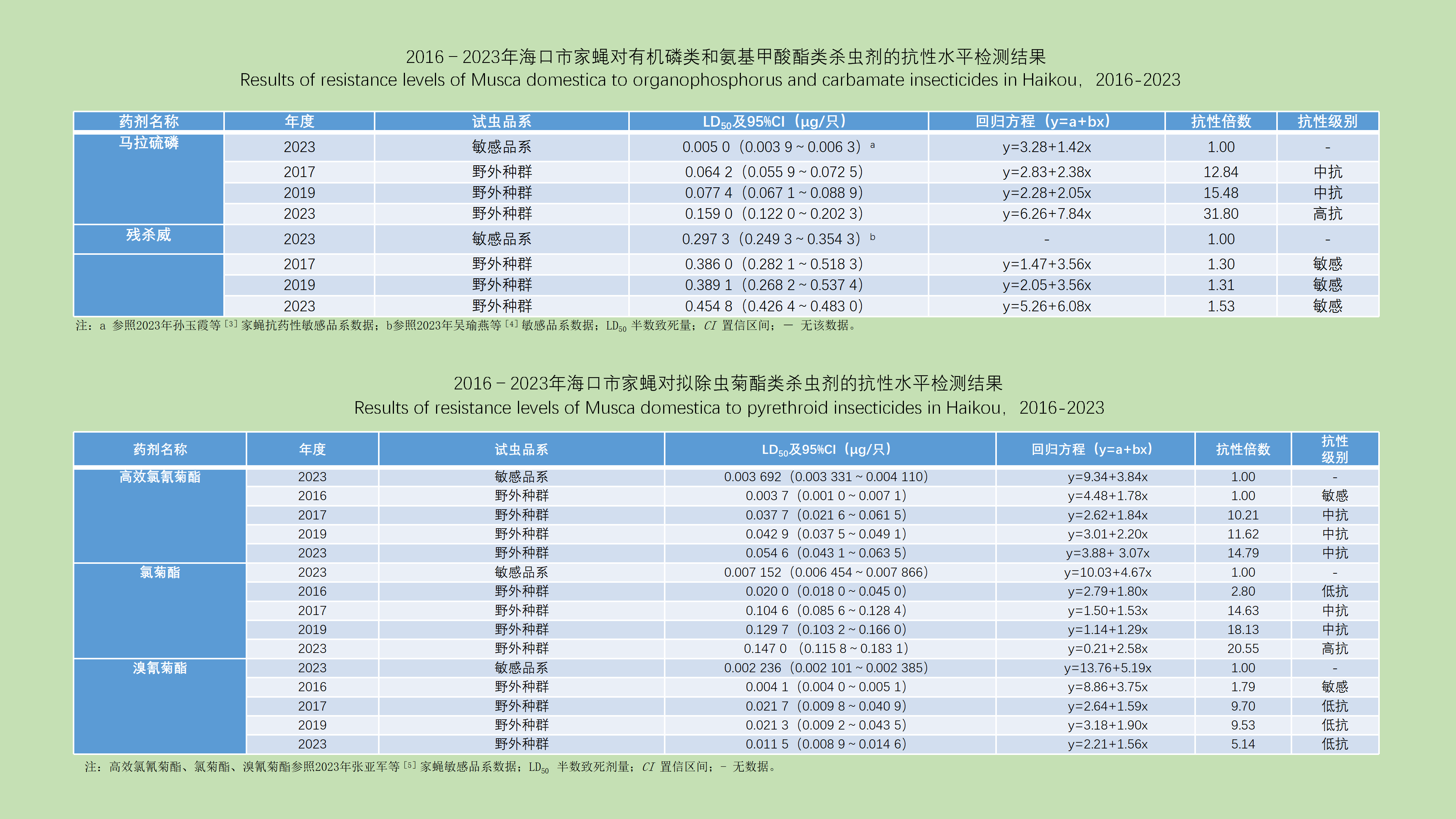
Objectives To investigate the resistance tendency of Musca domestica to several commonly used hygienic insecticides in Haikou, Hainan Province, China, so as to provide a basis for the scientific use and standardized guidance of hygienic insecticides use. Methods M. domestica were collected in four habitats of farmers' market, external environment of restaurants, park and public green belt, and urban residential area in Haikou. The topical application method was used to determine the resistance levels of M. domestica to five commonly used hygienic insecticides in pyrethroids, organophosphates, and carbamates. A Probit regresion analysis was performed using SPSS 26.0 software to calculate the median lethal dose (LD50), regression equation, 95% confidence interval, and resistance ratio. Results In 2017, 2019, and 2023, the LD50 values of malathion for field M. domestica populations were 0.064 2, 0.077 4, and 0.159 0 μg/inds, and the resistance ratios were 12.84, 15.48, and 31.80, respectively, showing an increasing trend in the resistance level year by year; the LD50 values of propoxur were 0.386 0, 0.389 1, and 0.454 8 μg/inds, and the resistance ratios were 1.30, 1.31, and 1.53, respectively, showing that the resistance level continued to remain sensitive. In 2016, 2017, 2019, and 2023, the LD50 values of beta-cypermethrin for M. domestica were 0.003 7, 0.037 7, 0.042 9, and 0.054 6 μg/inds, and the resistance ratios were 1.00, 10.21, 11.62, and 14.79, respectively; the LD50 values of permethrin were 0.020 0, 0.104 6, 0.129 7, and 0.147 0 μg/inds, and the resistance ratios were 2.80, 14.63, 18.13, and 20.55, respectively. The resistance levels to beta-cypermethrin and permethrin showed an increasing trend year by year; the LD50 values of deltamethrin were 0.004 1, 0.021 7, 0.021 3, and 0.011 5 μg/inds, and the resistance ratios were 1.79, 9.70, 9.53, and 5.14, respectively, showing a trend of first rising and then falling. Conclusions From 2016 to 2023, M. domestica in Haikou developed different resistance tendency to four hygienic insecticides including malathion, beta-cypermethrim, permethrin and deltamethrin, except propoxur to which the resistance level remained sensitive. Appropriate hygienic insecticides should be selected according to the resistance of M. domestica in the control process.
[1] Ministry of Health of the People's Republic of China, Standardization Administration of the People's Republic of China. GB/T 26350-2010Test methods of fly resistance to insecticides-The bioassay methods forMusca domestica[S]. Beijing:Standards Press of China, 2011. (in Chinese) 中华人民共和国卫生部, 中国国家标准化管理委员会. GB/T 26350-2010蝇类抗药性检测方法 家蝇生物测定法[S]. 北京:中国标准出版社, 2011.
[2] Liu HX, Leng PE, Liu Y, et al. Insecticide resistance tendency of Aedes albopictus and Musca domestica in Shanghai, China from 2015-2019[J]. Chin J Vector Biol Control, 2020, 31(2):137-142. DOI:10.11853/j.issn.1003.8280.2020.02.004.(in Chinese) 刘洪霞, 冷培恩, 刘曜, 等. 上海地区2015-2019年白纹伊蚊和家蝇的抗药性发展动态[J]. 中国媒介生物学及控制杂志, 2020, 31(2):137-142. DOI:10.11853/j.issn.1003.8280.2020.02.004.
[3] Sun YX, Su HY, Liang CW, et al. Resistance of Musca domestica to five insecticides in Dezhou City in 2022[J]. Chin J Hyg Insect Equip, 2023, 29(3):213-215. DOI:10.19821/j.1671-2781.2023.03.006.(in Chinese) 孙玉霞, 苏厚谊, 梁朝伟, 等. 2022年德州市家蝇对5种杀虫剂的抗性调查[J]. 中华卫生杀虫药械, 2023, 29(3):213-215. DOI:10.19821/j.1671-2781.2023.03.006.
[4] Wu YY, Liu QM, Wang JN, et al. Resistance of Musca domestica to commonly used insecticides in Zhejiang Province, China, 2021[J]. Chin J Vector Biol Control, 2023, 34(1):26-30. DOI:10.11853/j.issn.1003.8280.2023.01.005.(in Chinese) 吴瑜燕, 刘钦梅, 王金娜, 等. 2021年浙江省家蝇对常见卫生杀虫剂的抗药性研究[J]. 中国媒介生物学及控制杂志, 2023, 34(1):26-30. DOI:10.11853/j.issn.1003.8280.2023.01.005.
[5] Zhang YJ, Zhao CC, Feng XM, et al. Establishment of baseline sensitivity of laboratory strains of houseflies to commonly used insecticides[J]. Chin J Vector Biol Control, 2023, 34(6):719-722. DOI:10.11853/j.issn.1003.8280.2023.06.002.(in Chinese) 张亚军, 赵春春, 冯星明, 等. 实验室品系家蝇对常用杀虫剂敏感基线的建立[J]. 中国媒介生物学及控制杂志, 2023, 34(6):719-722. DOI:10.11853/j.issn.1003.8280.2023.06.002.
[6] Zhou LC, Bao JY, Chen XM, et al. Study on the trend of insecticide resistance of Musca domestica in Wuhan[J]. Chin J Vector Biol Control, 2017, 28(5):502-504. DOI:10.11853/j.issn.1003.8280.2017.05.026.(in Chinese) 周良才, 包继永, 陈晓敏, 等. 武汉市家蝇对常用卫生杀虫剂抗药性发展趋势研究[J]. 中国媒介生物学及控制杂志, 2017, 28(5):502-504. DOI:10.11853/j.issn.1003.8280.2017.05.026.
[7] Jiang GQ, He XJ, Li J. Resistance of Musca domestica to commonly used insecticides in Shaoxing City, China in 2017[J]. Chin J Vector Biol Control, 2018, 29(3):307-308. DOI: 10.11853/j.issn.1003.8280.2018.03.024.(in Chinese) 蒋国钦, 何学军, 李金. 浙江省绍兴市2017年家蝇对5种常用杀虫剂的抗药性研究[J].中国媒介生物学及控制杂志, 2018, 29(3):307-308. DOI: 10.11853/j.issn.1003.8280.2018.03.024.
[8] Han XL, Ma LH, Huang G, et al. Analysis on resistance trend of Musca domestica to different types of insecticides in Hebei Province, China, during 2012-2016.[J]. Chin J Vector Biol Control, 2017, 28(4):364-367. DOI: 10.11853/j.issn.1003.8280.2017.04.015.(in Chinese) 韩晓莉, 马丽华, 黄钢, 等. 2012-2016年河北省家蝇对不同类型杀虫剂的抗药性趋势分析[J]. 中国媒介生物学及控制杂志, 2017, 28(4):364-367. DOI: 10.11853/j.issn.1003.8280.2017.04.015.
[9] Lin CY, Yang XY, Chen XW, et al. Analysis on population density and seasonality of flies in Haikou City from 2011 to 2016[J]. Chin J Vector Biol Control, 2017, 28(3):291-293. DOI:10.11853/j.issn.1003.8280.2017.03.025.(in Chinese) 林春燕, 杨新艳, 陈学文, 等. 海口市2011-2016年蝇类种群密度及季节消长分析[J]. 中国媒介生物学及控制杂志, 2017, 28(3):291-293. DOI:10.11853/j.issn.1003.8280.2017.03.025.
[10] Zhang YJ, Wang YG, Zhao N, et al. Long-term trends in housefly (Musca domestica L.) insecticide resistance in China[J]. Pestic Biochem Physiol, 2024, 201:105880. DOI:10.1016/j.pestbp.2024.105880.
[11] Gao Y, Wu Y, Du GJ, et al. An investigation of resistance of Musca domestica to commonly used public health insecticides in Chengde, Hebei Province, China, 2020[J]. Chin J Vector Biol Control, 2022, 33(3):434-437. DOI:10.11853/j.issn.1003.8280.2022.03.023.(in Chinese) 高杨, 武英, 杜国君, 等. 河北省承德市2020年家蝇对常用卫生杀虫剂的抗药性调查[J]. 中国媒介生物学及控制杂志, 2022, 33(3):434-437. DOI:10.11853/j.issn.1003.8280.2022.03.023.
[12] MA YT. Resistance of Musca domestica to common hygienic insecticides in Jinnan District, Tianjin, China[J]. Chin J Vector Biol Control, 2019, 30(2):221-223. DOI: 10.11853/j.issn.1003.8280.2019.02.026.(in Chinese) 马玉涛. 天津市津南区家蝇对常用卫生杀虫剂的抗药性研究[J]. 中国媒介生物学及控制杂志, 2019, 30(2):221-223. DOI: 10.11853/j.issn.1003.8280.2019.02.026.
[13] Pan J, Zhou YH, Li M, et al. Frequency dynamics of pyrethroid resistance alleles in a field-derived house fly colony in absence of insecticide selection[J]. Acta Parasitol Med Entomol Sin, 2015, 22(3):176-180. DOI:10.3969/j.issn.1005-0507.2015.03.006.(in Chinese) 潘婧, 周云辉, 李梅, 等. 在无杀虫剂选择下家蝇拟除虫菊酯抗性等位基因频率的变化[J]. 寄生虫与医学昆虫学报, 2015, 22(3):176-180. DOI:10.3969/j.issn.1005-0507.2015.03.006.
[14] Wang ZG, Hai XP, Xu YH, et al. Stability of two kinds of pyrethroids resistance in housefly (Diptera:Muscidae)[J]. Chin J Vector Biol Control, 2006, 17(4):286-287. DOI:10.3969/j.issn.1003-4692.2006.04.009.(in Chinese) 王志钢, 海秀平, 许永红, 等. 家蝇对两种拟除虫菊酯类杀虫剂抗性的稳定性[J]. 中国媒介生物学及控制杂志, 2006, 17(4):286-287. DOI:10.3969/j.issn.1003-4692.2006.04.009.
[15] Ma Z, Zhou XJ, Li J, et al. An investigation of the resistance of Musca domestica to six commonly used insecticides in Beijing, China, in 2017[J]. Chin J Vector Biol Control, 2019, 30(1):69-71. DOI: 10.11853/j.issn.1003.8280.2019.01.015.(in Chinese) 马卓, 周小洁, 李静, 等.北京地区2017年家蝇种群对6种常用杀虫剂的抗药性调查[J].中国媒介生物学及控制杂志, 2019, 30(1):69-71. DOI: 10.11853/j.issn.1003.8280.2019.01.015.
[16] Liang W, Yang KB, Jiang LD, et al. Resistance of adult Culex quinquefasciatus and Musca domestica to commonly used insecticides in Dazu District, Chongqing, 2023[J]. Shanghai J Pre Med, 2024, 36(6):563-565. DOI:10.19428/j.cnki.sjpm.2024.23597.(in Chinese) 梁维, 杨克波, 蒋立丹, 等. 2023年重庆市大足区致倦库蚊成蚊和家蝇成蝇常见杀虫剂的抗药性[J].上海预防医学, 2024, 36(6):563-565. DOI:10.19428/j.cnki.sjpm.2024.23597.
[17] Shan C, Zhang Y, Ma Z, et al. Inheritance of propoxur resistance in a near-isogenic line of Musca domestica (Diptera:Muscidae)[J]. J Econ Entomol, 2016, 109(2):873-878. DOI:10.1093/jee/tow001.
[18] Barnes EH, Dobson RJ, Barger IA. Worm control and anthelmintic resistance:Adventures with a model[J]. Parasitol Today, 1995, 11(2):56-63. DOI:10.1016/0169-4758(95)80117-0.
[19] Yang C, Pan J, Li M, et al. Occurrence and evolutionary origin of insecticide resistance-conferring mutations in carboxylesterase (MdαE7) in Chinese house fly populations from five provinces[J]. Acta Parasitol Med Entomol Sin, 2023, 30(2):88-94. DOI:10.3969/j.issn.1005-0507.2023.02.006.(in Chinese) 杨婵, 潘婧, 李梅, 等. 家蝇羧酸酯酶MdαE7抗药性相关基因突变检测及其进化起源分析[J]. 寄生虫与医学昆虫学报, 2023, 30(2):88-94. DOI:10.3969/j.issn.1005-0507.2023.02.006.
[20] Feng XC, Liu NN. Functional analyses of house fly carboxylesterases involved in insecticide resistance[J]. Front Physiol, 2020, 11:595009. DOI:10.3389/fphys.2020.595009.
[21] Zhang Y, Li J, Ma Z, et al. Multiple mutations and overexpression of the MdαE7 carboxylesterase gene associated with male-linked malathion resistance in housefly, Musca domestica (Diptera:Muscidae)[J]. Sci Rep, 2018, 8(1):224. DOI:10.1038/s41598-017-17325-x.


