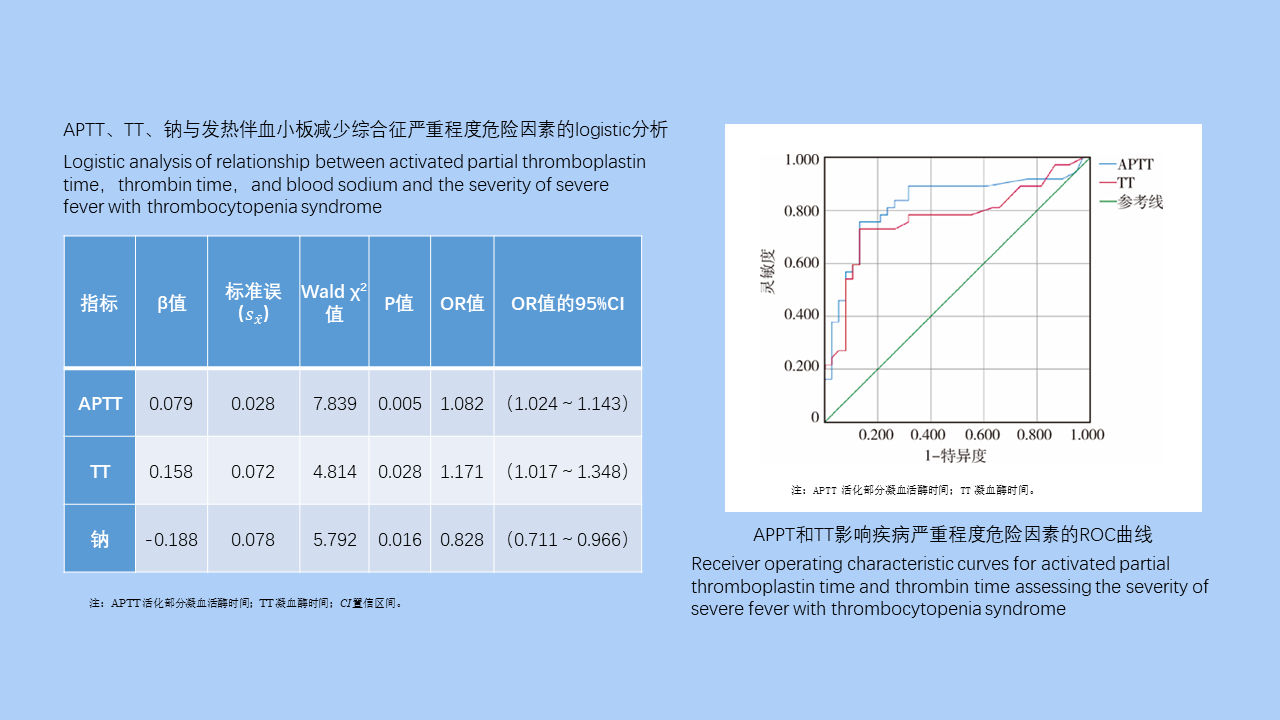
目的 分析发热伴血小板减少综合征(SFTS)不同严重程度患者的临床特征,及影响其严重程度的危险因素,为临床诊疗及预防该病提供参考依据。方法 收集2013年3月—2019年11月山东省泰安市市区所有医院感染性疾病科及重症医学科住院诊治的75例SFTS实验室确诊病例入院时的临床病例资料。根据相关标准将患者分为普通组和危重组,比较2组患者临床特征及相关指标差异,计量资料使用独立t检验和Mann-Whitney U检验分析。计数资料采用χ2检验或Fisher确切概率检验分析。使用二元logistic回归和受试者工作特征曲线(ROC)法进行影响因素分析。结果 危重组与普通组比较,患者的年龄、住院时间,出现畏寒、出血症状、呼吸困难、神经系统症状,谷丙转氨酶(ALT)、谷草转氨酶(AST)、乳酸脱氢酶(LDH)、肌酸激酶同工酶(CKMB)、凝血酶原时间(PT)、活化部分凝血活酶时间(APTT)、凝血酶时间(TT)、肌酐、总蛋白、白蛋白、血钾、血钠、血氯、血钙等20个异常指标差异有统计学意义(均P<0.05);多因素logistic回归分析显示,APTT、TT 2个异常指标与SFTS严重程度有显著性关系(χ2=7.839,P=0.005;χ2=4.814,P=0.028),OR值分别为1.082(1.024~1.143)和1.171(1.017~1.348);ROC诊断曲线分析显示,APTT、TT的曲线下面积(AUC)值分别为0.826和0.771(均P<0.001)。结论 APTT、TT延长是影响疾病严重程度的主要危险因素,针对存在以上危险因素的患者,应早期识别、干预及治疗,从而降低患者死亡率。
Objective To investigate the clinical features of patients with severe fever with thrombocytopenia syndrome (SFTS) of different severity levels and risk factors affecting the severity of SFTS, so as to provide a reference for the clinical diagnosis and treatment and prevention of the disease. Methods The clinical data of 75 patients with laboratory-confirmed SFTS hospitalized in the department of infectious diseases and department of intensive care medicine of every hospital were collected in Tai'an, Shandong Province, China from March 2013 to November 2019. According to the specific criteria, these patients were divided into non-critical group and critical group. Clinical features and clinical indicators were compared between the two groups. Continuous data were compared using the independent t test and Mann-Whitney U test. Categorical data were compared using the Chi-square test or Fisher's exact test. Risk factors were determined by using binary logistic regression analysis and receiver operating characteristic (ROC) curves method. Results The critical group differed significantly from the non-critical group in terms of 20 indexes, including age, the length of hospital stay, chills, bleeding symptoms, dyspnea, nervous system symptoms, alanine aminotransferase, aspartate aminotransferase, lactate dehydrogenase, creatine kinase-MB, prothrombin time, activated partial thromboplastin time (APTT), thrombin time (TT), creatinine, total protein, albumin, potassium, sodium, chlorine, and calcium (all P<0.05). Multivariable logistic regression analysis detected statistical significance in APTT [odds ratio (OR)=1.082 (1.024~1.143), χ2=7.839, P=0.005] and TT[OR=1.171 (1.017~1.348), χ2=4.814, P=0.028]. The areas under the ROC curves for APTT and TT were 0.826 and 0.771, respectively (both P<0.001). Conclusions Prolonged APTT and TT are main risk factors affecting the severity of SFTS. For patients at risk, early identification, intervention, and treatment can help reduce their mortality.
[1] Wang YF, Han SQ, Ran RX,et al. A longitudinal sampling study of transcriptomic and epigenetic profiles in patients with thrombocytopenia syndrome[J]. Nat Commun,2021,12(1):5629. DOI:10.1038/s41467-021-25804-z.
[2] Ministry of Health of the People's Republic of China. Diagnosis and treatment of server fever with thrombocytopenia syndrome (Excerpt)[J]. Chin Commun Doct,2010,26(40):3. (in Chinese)中华人民共和国卫生部. 发热伴血小板减少综合征诊疗方案(节选)[J]. 中国社区医师,2010,26(40):3.
[3] Chen G, Chen T, Shu SN,et al. Expert consensus on diagnosis and treatment of severe fever with thrombocytopenia syndrome[J]. Chin J Clin Infect Dis,2022,15(4):253-263. DOI:10.3760/cma.j.issn.1674-2397.2022.04.003.(in Chinese)陈广,陈韬,舒赛男,等. 重症发热伴血小板减少综合征诊治专家共识[J]. 中华临床感染病杂志,2022,15(4):253-263. DOI:10.3760/cma.j.issn.1674-2397.2022.04.003.
[4] Ma T, Xu Q, Li C,et al. Epidemiological characteristics of severe fever with thrombocytopenia syndrome in Nanjing,China from 2010 to 2016[J]. Mod Prev Med,2017,44(16):2890-2894. (in Chinese)马涛,徐庆,李晨,等. 2010—2016年南京市发热伴血小板减少综合征流行特征分析[J]. 现代预防医学,2017,44(16):2890-2894.
[5] Li W. Epidemiological and clinical characteristics of severe fever associated with thrombocytopenia syndrome[J]. J Pathog Biol,2017,12(9):901-904. DOI:10.13350/j.cjpb.170923.(in Chinese)李文. 发热伴血小板减少综合征流行病学特点与临床特征分析[J]. 中国病原生物学杂志,2017,12(9):901-904. DOI:10.13350/j.cjpb.170923.
[6] Liang AH, Li XW, Zhang XF. Analysis on epidemiological characteristics of severe fever with thrombocytopenia syndrome in Daiyue District,Tai'an City,2011-2014[J]. Prev Med Trib,2016,22(5):385-387. DOI:10.16406/j.pmt.issn.1672-9153.2016.05.022.(in Chinese)梁爱红,李心伟,张宪芬. 2011—2014年泰安市岱岳区发热伴血小板减少综合征流行特征分析[J]. 预防医学论坛,2016,22(5):385-387. DOI:10.16406/j.pmt.issn.1672-9153.2016.05.022.
[7] Chen GS, Hu LF, Xu XH,et al. The clinical characteristics and prognostic influence indicators of severe fever with thrombocytopenia syndrome infected by new Bunia virus[J]. China Med Equip,2017,14(5):94-97. DOI:10.3969/J.ISSN.1672-8270.2017.05.025.(in Chinese)陈国胜,胡立芬,许夕海,等. 新型布尼亚病毒感染致发热伴血小板减少综合征临床特点及预后影响指标[J]. 中国医学装备,2017,14(5):94-97. DOI:10.3969/J.ISSN.1672-8270. 2017. 05.025.
[8] Zhang HB, Liu XW, Ni XY,et al. Clinical analysis of 59 cases with fever and thrombocytopenia syndrome in elderly patients with multiple organ dysfunction syndrome[J]. Chin J Exp Clin Infect Dis (Electron Ed),2017,11(1):69-72. DOI:10.3877/cma.j.issn.1674-1358.2017.01.015.(in Chinese)张海滨,刘小伟,倪秀莹,等. 59例老年发热伴血小板减少综合征并发多器官功能障碍患者的临床分析[J]. 中华实验和临床感染病杂志(电子版),2017,11(1):69-72. DOI:10.3877/cma.j.issn.1674-1358.2017.01.015.
[9] Gong L, Zhu JR, Zhang Y,et al. Epidemiological and clinical features of severe fever with thrombocytopenia syndrome cases,Anhui[J]. Mod Prev Med,2019,46(15):2696-2700. (in Chinese)龚磊,朱敬蕊,张勇,等. 安徽省发热伴血小板减少综合征病例的流行病学与临床特征分析[J]. 现代预防医学,2019,46(15):2696-2700.
[10] Kato H, Yamagishi T, Shimada T,et al. Epidemiological and clinical features of severe fever with thrombocytopenia syndrome in Japan,2013-2014[J]. PLoS One,2016,11(10):e0165207. DOI:10.1371/journal.pone.0165207.
[11] Jin C, Liang MF, Ning JY,et al. Pathogenesis of emerging severe fever with thrombocytopenia syndrome virus in C57/BL6 mouse model[J]. Proc Natl Acad Sci USA,2012,109(25):10053-10058. DOI:10.1073/pnas.1120246109.
[12] Li DX. Fever with thormbocytopenia associated with a novel Bunyavirus in China[J]. Chin J Exp Clin Virol,2011,25(2):81-84. DOI:10.3760/cma.j.issn.1003-9279.2011.02.001.(in Chinese)李德新. 发热伴血小板减少综合征布尼亚病毒概述[J]. 中华实验和临床病毒学杂志,2011,25(2):81-84. DOI:10.3760/cma.j.issn.1003-9279.2011.02.001.
[13] Li CJ, Liu QH, Quan CS,et al. Study on clinical characteristics of severe fever with thrombocytopenia syndrome[J]. J Med Inf,2023,36(6):172-175. DOI:10.3969/j.issn.1006-1959.2023.06.039.(in Chinese)李春晶,刘庆华,全传松,等. 重症发热伴血小板减少综合征临床特征研究[J]. 医学信息,2023,36(6):172-175. DOI:10.3969/j.issn.1006-1959.2023.06.039.
[14] Wang L, Zou ZQ, Hou CG,et al. Score risk model for predicting severe fever with thrombocytopenia syndrome mortality[J]. BMC Infect Dis,2017,17(1):42.


