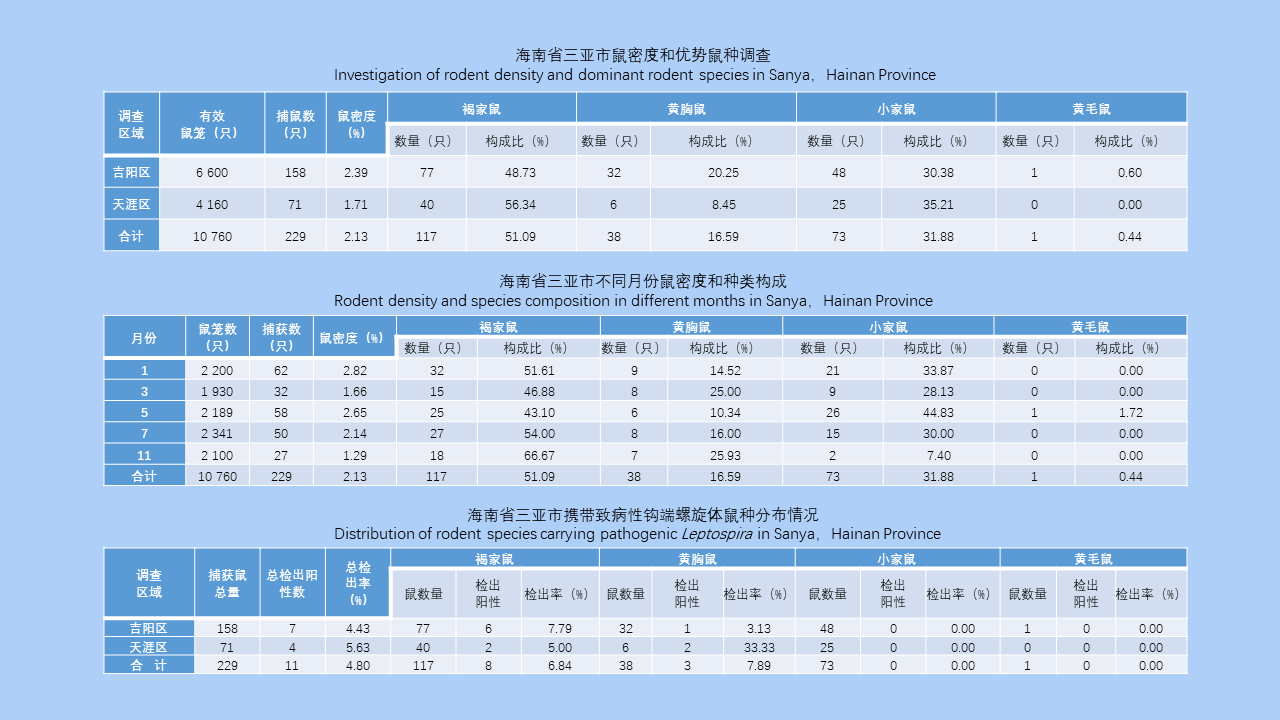
目的 了解海南省三亚市鼠类分布及其病原体感染情况,为鼠传疾病预警、开展精准防控和制定措施提供科学依据。方法 采用笼夜法,用油条作为诱饵,分别在三亚市天涯区和吉阳区的居民区、酒店、农村、野外等生境以晚放晨收方式捕获鼠类,对鼠种进行形态学鉴定后进行无菌解剖。采集鼠类肝、肾、脾、肺等脏器分别提取DNA、RNA,利用Taqman探针反转录荧光定量PCR方法分别检测致病性钩端螺旋体(钩体)、恙虫病东方体、汉坦病毒、大别班达病毒等4种病原体。数据结果采用Excel 2021 和 SPSS 26.0 软件统计处理数据,用χ2检验和Fisher精确概率法进行组间分析。结果 共布放有效鼠笼10 760只,捕获鼠类229只,鼠密度为2.13%;天涯区鼠密度为1.71%(71/4 160),吉阳区鼠密度为2.39%(158/6 600),不同地区鼠密度差异有统计学意义(χ2=5.785,P=0.016)。优势鼠种构成比从高至低依次为褐家鼠、小家鼠、黄胸鼠和黄毛鼠,分别为51.09%、31.88%、16.59%和0.44%;鼠密度高峰值分布在1、5和7月。229只鼠中共检测不同脏器标本240份,16份检出致病性钩体,阳性标本率为6.70%(16/240);其中检出阳性鼠肾标本占18.52%(5/27),鼠脾标本占8.33%(2/24),鼠肝标本占7.50%(3/40),鼠肺标本占4.03%(6/149);11只检出病原体阳性鼠中,有4只在不同脏器中均能检出,鼠阳性率为4.80%(11/229),黄胸鼠检出率最高,为7.89%(4/38),其次是褐家鼠占6.84%(8/117),小家鼠和黄毛鼠检出率为0。1月鼠感染率最高,3月检出率为0,不同月份鼠感染率差异有统计学意义(P<0.001);汉坦病毒、大别班达病毒和恙虫病东方体均未检出。结论 海南省三亚市有致病性钩端螺旋体传播的风险且鼠密度较高,需采取针对性的防控措施以防止钩体病传播。
莫丽娟, 徐金平, 李冬梅, 黄丽菊, 陈人强, 吴南卫, 刘颖, 刘武汉, 叶淑颖, 曾雪霞, 孙定炜
. 海南省三亚市鼠类及鼠传病原体监测分析[J]. 中国媒介生物学及控制杂志, 2024
, 35(4)
: 469
-473
.
DOI: 10.11853/j.issn.1003.8280.2024.04.015
Objective To investigate the distribution of rodents and their pathogen infections in Sanya, Hainan Province, China, so as to provide a scientific basis for pre-warning, accurate prevention and control, and strategy development against rodent-borne diseases. Methods Rodents were captured in habitats such as residential areas, hotels, rural areas, and wild areas in Tianya and Jiyang districts of Sanya by deploying cages in the evening and harvesting in the morning (cage trapping using fried dough sticks as a bait). The rodents were morphologically identified, and aseptic dissection was performed. DNA and RNA were extracted from the liver, kidney, spleen, lung of the rodents. Taqman probe-based reverse transcription fluorescence quantitative PCR was used to detect pathogenic Leptospira, Orientia tsutsugamushi, Hantavirus, and Dabie bandavirus. The data were statistically processed using Excel 2021 and SPSS 26.0 softwares and analyzed by Chi-square test and Fisher's exact test between groups. Results A total of 10 760 effective cages were deployed, and 229 rodents were captured, with a rodent density of 2.13%. The rodent density was 1.71% (71/4 160) in Tianya District and 2.39% (158/6 600) in Jiyang District, with a significant difference between the two districts (χ2=5.785, P=0.016). The dominant species composition ratios were 51.09%, 31.88%, 16.59%, and 0.44% for Rattus norvegicus, Mus musculus, R. tanezumi, and R. losea, respectively. The peak rodent density was observed in January, May, and July. A total of 240 viscera samples from 229 rodents were tested, with pathogenic Leptospira detected in 16 samples (positive sample rate of 6.70% [16/240]). Specifically, positive rates for the kidney, spleen, liver, and lung of rodents were 18.52% (5/27), 8.33% (2/24), 7.50% (3/40), and 4.03% (6/149), respectively. Among the 11 rodents which tested positive for pathogens, with a positive rate of 4.8% (11/229), 4 were found to be positive for all the four organs. The highest detection rate of pathogens was found in R. tanezumi (7.89%, 4/38), followed by R. norvegicus (6.84%, 8/117), and M. musculus and R. losea (0 for both). The rodent infection rate was the highest in January, and the detection rate was 0 in March. There were significant differences in the rodent infection rate between months (P<0.001). None of Hantavirus, Dabie bandavirus, and Orientia tsutsugamushi was detected. Conclusions There is a relatively high risk of transmission of pathogenic Leptospira in Sanya, Hainan Province, and the rodent density is high. It is necessary to take targeted prevention and control measures to prevent the transmission of pathogenic Leptospira.
[1] World Health Organization. Global vector control response 2017-2030[R]. Geneva:WHO,2017.
[2] Liu QY, Xu WB, Lu S,et al. Landscape of emerging and re-emerging infectious diseases in China:Impact of ecology,climate,and behavior[J]. Front Med,2018,12(1):3-22. DOI:10.1007/s11684-017-0605-9.
[3] Liu QY, Meng FX, Lu L, et al. Exploring the path to sustainable control of vector organisms in China[J]. Chin J Vector Biol Control, 2006, 17(4): 261-264. DOI:10.3969/j.issn.1003-4692.2006.04.001. (in Chinese)刘起勇,孟凤霞,鲁亮,等. 探索中国病媒生物可持续控制之路[J]. 中国媒介生物学及控制杂志,2006,17(4):261-264. DOI:10.3969/j.issn.1003-4692.2006.04.001.
[4] Liu QY. Epidemic profile of vector-borne diseases and vector control strategies in the new era[J]. Chin J Vector Biol Control,2019,30(1):1-6,11. DOI:10.11853/j.issn. 1003. 8280. 2019. 01.001.(in Chinese)刘起勇. 新时代媒介生物传染病形势及防控对策[J]. 中国媒介生物学及控制杂志,2019,30(1):1-6,11. DOI:10.11853/j.issn.1003.8280.2019.01.001.
[5] National Vector Surveillance System,Chinese Center for Disease Control and Prevention. National surveillance report on rodent-borne pathogens of disease vectors in 2021[J]. Chin J Vector Biol Control,2023,34(1):1-8. DOI:10.11853/j.issn. 1003. 8280.2023.01.001.(in Chinese)全国重要病媒生物监测网. 2021年全国病媒生物鼠传病原监测报告[J]. 中国媒介生物学及控制杂志,2023,34(1):1-8. DOI:10.11853/j.issn.1003.8280.2023.01.001.
[6] Xiao FZ, Chen MB, Han TW,et al. Research on coinfection with multiple tick-borne pathogens in rodents in the Sanming region of Fujian Province[J]. J Pathogen Biol,2019,14(7):811-813,818. DOI:10.13350/j.cjpb.190714.(in Chinese)肖方震,陈美宝,韩腾伟,等. 三明市鼠类携带蜱传病原体的混合感染研究[J]. 中国病原生物学杂志,2019,14(7):811-813,818. DOI:10.13350/j.cjpb.190714.
[7] Wu J, Wang D, Wang SL,et al. Leptospira detection among patients with fever in Hainan Province,China[J]. Chin J Zoonoses,2017,33(3):276-279. DOI:10.3969/j.issn.1002-2694.2017.03.016.(in Chinese)吴捷,王丹,王少玲,等. 海南省不明原因发热病人中钩端螺旋体病的实验检测结果分析[J]. 中国人兽共患病学报,2017,33(3):276-279. DOI:10.3969/j.issn.1002-2694.2017.03.016.
[8] Zhou MH, Chu HL. Handbook for classification and identification of main vectors[M]. Suzhou:Soochow University Press,2019:89-120.(in Chinese)周明浩,褚宏亮. 常见病媒生物分类鉴定手册[M]. 苏州:苏州大学出版社,2019:89-120.
[9] Zhan DC, Long ZM, Liu GY, et al. Preliminary survey of vector mosquitoes in the Sanya area of Hainan Island [J]. J Med Pest Control, 2000, 16(7): 354-356. (in Chinese)詹道成,龙芝美,刘光宇,等. 海南岛三亚地区媒介蚊虫的初步调查[J]. 医学动物防制,2000,16(7):354-356.
[10] Su XY, Chen Y, Zeng XJ,et al. Investigation on crowd infection of epidemic hemorrhagic fever in part of Hainan[J]. China Trop Med,2018,18(4):397-398. DOI:10.13604/j.cnki.46-1064/r.2018.04.23.(in Chinese). 苏新元,陈言,曾祥洁,等. 海南省部分地区流行性出血热人群感染状况调查[J]. 中国热带医学,2018,18(4):397-398. DOI:10.13604/j.cnki.46-1064/r.2018.04.23.
[11] Pan ZA, He QY,et al. Geographical epidemiological study of leptospirosis in Hainan Province II. Epidemiological characteristics of leptospirosis[J]. Hainan Med J,1995,6(3):5. DOI:CNKI: SUN:HAIN.0.1995-03-002.(in Chinese)潘祖安,何启亚,等.海南省钩端螺旋体病地理流行病学研究Ⅱ.钩端螺旋体病流行病学特征[J].海南医学,1995,6(3):5. DOI:CNKI:SUN:HAIN.0.1995-03-002.
[12] Wu HX, Liu XB, Liu QY. Current status and challenges of vector-borne disease control in our country[J].Cap J Public Health,2018,12(1):4-6. DOI:10.16760/j.carol carroll nki SDGGWS. 2018.01.002.(in Chinese)吴海霞,刘小波,刘起勇. 我国病媒生物防控现状及面临的问题[J].首都公共卫生,2018,12(1):4-6. DOI:10.16760/j.cnki.sdggws.2018.01.002.
[13] Pan ZA, He QY. Serologic epidemiology of leptospirosis in Hainan Province[J]. Chin J Epidemiol,1995,16(6):369-371.(in Chinese)潘祖安,何启亚.海南省钩端螺旋体病血清学流行病学调查[J].中华流行病学杂志,1995,16(6):369-371.
[14] Yan J, Cheng DQ, Zhu P,et al. Invasion and damage to mouse fibroblasts and the internal organs of infected Guinea pigs by Leptospiral lipopolysaccharides[J]. Chin J Zoonoses,1996,12(4):15-17. (in Chinese)严杰,程东庆,朱平,等. 钩端螺旋体脂多糖对小鼠成纤维细胞和豚鼠脏器组织的侵入及损害[J]. 中国人兽共患病杂志,1996,12(4):15-17.


