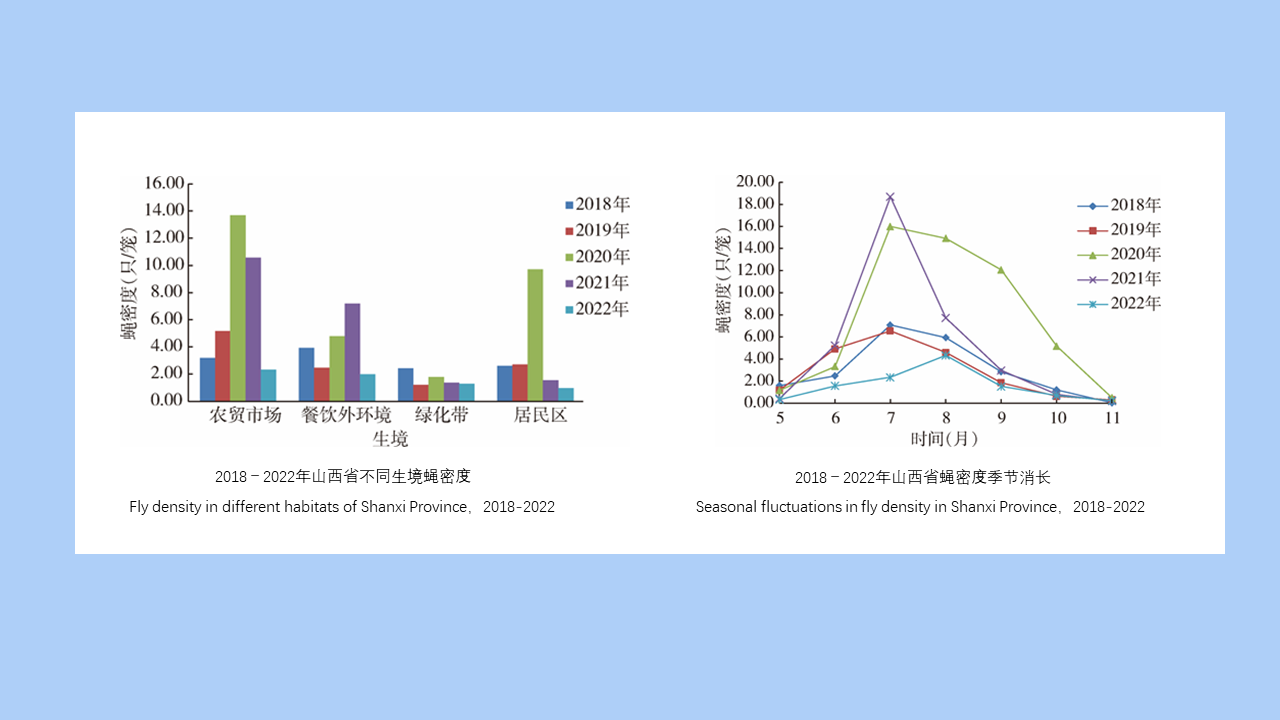
目的 掌握山西省不同地区蝇类种群、密度及季节消长情况,为蝇类及其传播疾病的风险评估和防控提供科学依据。方法 收集整理2018—2022年山西省3个国家级监测点5—11月蝇密度监测数据,分析不同年份、不同生境蝇密度差异以及季节消长规律。使用Excel 2010软件对监测数据进行汇总,使用SPSS 26.0对不同年份、地区和生境间蝇密度差异进行单因素方差分析。结果 2018—2022年共布放诱蝇笼1 609笼,捕蝇6 400只,平均蝇密度为3.98只/笼,2020年蝇密度最高,为7.72只/笼,其次是2021年,为5.01只/笼,2022年密度最低,为1.62只/笼。优势种为家蝇和麻蝇科蝇种,占比分别为81.94%和7.94%;蝇密度季节消长趋势呈现单峰型,7—8月为蝇密度高峰期。3个国家级监测点中,晋中市蝇密度最高,为6.98只/笼,太原市蝇密度最低,为1.39只/笼,不同地区间蝇密度差异有统计学意义(F=10.895,P<0.001)。在不同生境中,农贸市场蝇密度最高,为6.92只/笼,其次是餐饮外环境,为4.10只/笼,绿化带密度最低,为1.60只/笼,不同生境间蝇密度差异有统计学意义(F=4.626,P=0.003)。结论 山西省人居及周边环境中家蝇为优势蝇种,农贸市场和餐饮外环境为蝇类活动重点场所,建议在蝇类活动高峰期前采取防制措施,降低蝇密度,减少蝇类传染病的发生。
Objective To investigate the species, density, and seasonal fluctuations of flies in different regions of Shanxi Province, China, so as to provide a scientific basis for the risk assessment and prevention and control of flies and fly-borne diseases. Methods Fly density data during May to November at three national surveillance sites in Shanxi Province from 2018 to 2022 were collected to characterize fly density by year and habitat and fly seasonality. Excel 2010 software was used for data collation. SPSS 26.0 software was used to perform one-way analysis of variance to analyze the difference in fly density between different years, regions, and habitats. Results From 2018 to 2022, a total of 1 609 fly traps were deployed, and 6 400 flies were caught. The average density of flies was 3.98 flies/trap. Fly density was highest in 2020 (7.72 flies/trap), followed by 2021 (5.01 flies/trap), and lowest in 2022 (1.62 flies/trap). The dominant species were Musca domestica and Sarcophagidae flies, accounting for 81.94% and 7.94%, respectively. Fly density showed a single peak during July to August. Among the three national surveillance sites, the density of flies in Jinzhong was highest (6.98 flies/trap), while that in Taiyuan was lowest (1.39 flies/trap). There was a significant difference in fly density between different areas (F=10.895, P<0.001). In terms of habitats, farmers' markets had the highest fly density (6.92 flies/trap), followed by restaurant surroundings (4.10 flies/trap), and green belts had the lowest density (1.60 flies/trap), showing a significant difference between different habitats (F=4.626, P=0.003). Conclusions Musca domestica is the dominant fly species in human settlements and surrounding environments in Shanxi Province, and farmers' markets and restaurant surroundings are key places of activity for flies. It is recommended to take control measures before the peak of fly activity to reduce the density of flies and the occurrence of fly-borne infectious diseases.
[1] Chen D, Zhang RL, Liu J,et al. Advances in the study of pathogens carried by flies [J]. J Pathog Biol,2016,11(8):765-768,Annex 1-2. DOI:10.13350/j.cjpb.160821.(in Chinese)陈丹,张瑞玲,刘婧,等. 蝇类携带病原体研究进展[J]. 中国病原生物学杂志,2016,11(8):765-768,附页1-2. DOI:10.13350/j.cjpb.160821.
[2] Cao XM, Song FL, Yao LS,et al. Detection of fly-borne pathogenic bacteria and parasite eggs collected from ports[J]. Chin J Hyg Insect Equip,2016,22(2):148-152. DOI:10.19821/j.1671-2781.2016.02.014.(in Chinese)曹晓梅,宋锋林,姚李四,等. 口岸蝇类携带致病菌及寄生虫卵的检测分析[J]. 中华卫生杀虫药械,2016,22(2):148-152. DOI:10.19821/j.1671-2781.2016.02.014.
[3] Leng PE, Liu HX, Zeng XP,et al. Analysis of national criteria for vector density control [J]. Shanghai J Prev Med,2017,29(12):910-914. DOI:10.19428/j.cnki.sjpm.20180122.001.(in Chinese)冷培恩,刘洪霞,曾晓芃,等. 《病媒生物密度控制水平》国家标准解析[J]. 上海预防医学,2017,29(12):910-914. DOI:10.19428/j.cnki.sjpm.20180122.001.
[4] Wang XS, Wu HX, Yue YJ,et al. National vectors surveillance report on flies in China,2018[J]. Chin J Vector Biol Control,2019,30(2):139-141,150. DOI:10.11853/j.issn. 1003. 8280. 2019.02.005.(in Chinese)王雪霜,吴海霞,岳玉娟,等. 2018年全国蝇类监测报告[J]. 中国媒介生物学及控制杂志,2019,30(2):139-141,150. DOI:10.11853/j.issn.1003.8280.2019.02.005.
[5] Wang XS, Wu HX, Liu QY. National surveillance report on flies in China,2019[J]. Chin J Vector Biol Control,2020,31(4):407-411. DOI:10.11853/j.issn.1003.8280.2020.04.005.(in Chinese)王雪霜,吴海霞,刘起勇. 2019年全国蝇类监测报告[J]. 中国媒介生物学及控制杂志,2020,31(4):407-411. DOI:10.11853/j.issn.1003.8280.2020.04.005.
[6] Wang CY, Bai YY, Zhang JY,et al. An analysis of surveillance results for flies in Liaoning Province,China,2018-2021[J]. Chin J Vector Biol Control,2023,34(2):233-237. DOI:10.11853/j.issn.1003.8280.2023.02.015.(in Chinese)王纯玉,白玉银,张家勇,等. 辽宁省2018—2021年蝇类监测结果分析[J]. 中国媒介生物学及控制杂志,2023,34(2):233-237. DOI:10.11853/j.issn.1003.8280.2023.02.015.
[7] Han JH, Wu BY, Liu QY,et al. Study on the trapping effect of different fly baits [J]. Chin J Hyg Insect Equip,2016,22(1):30-33. DOI:10.19821/j.1671-2781.2016.01.009.(in Chinese)韩俊华,吴炳耀,刘倩颖,等. 不同饵料诱蝇效果的比较研究[J]. 中华卫生杀虫药械,2016,22(1):30-33. DOI:10.19821/j.1671-2781.2016.01.009.
[8] Wu HX, Lu L, Meng FX,et al. Reports on national surveillance of flies in China,2006-2015[J]. Chin J Vector Biol Control,2018,29(1):5-10. DOI:10.11853/j.issn. 1003. 8280. 2018. 01. 002.(in Chinese)吴海霞,鲁亮,孟凤霞,等. 2006—2015年我国蝇类监测报告[J]. 中国媒介生物学及控制杂志,2018,29(1):5-10. DOI:10.11853/j.issn.1003.8280.2018.01.002.
[9] Song BD, Zhang Y, Min Y,et al. Ecological surveillance result of flies and resistance of Musca domestica to commonly used insecticides in Nanjing,China,2022[J]. Chin J Vector Biol Control,2023,34(5):637-641. DOI:10.11853/j.issn. 1003. 8280.2023.05.010.(in Chinese)宋丙栋,张艳,闵玥,等. 南京市2022年蝇类生态学监测及家蝇对常用杀虫剂的抗药性调查[J]. 中国媒介生物学及控制杂志,2023,34(5):637-641. DOI:10.11853/j.issn. 1003. 8280. 2023.05.010.
[10] Jia DS, Wu GH. Control of flies (Ⅱ):Ecological habits and common species of flies [J]. Chin J Hyg Insect Equip,2008,14(2):128-132. DOI:10.3969/j.issn.1671-2781.2008.02.018.(in Chinese)贾德胜,吴光华. 蝇类防治(二):蝇类的生态习性与常见种类[J]. 中华卫生杀虫药械,2008,14(2):128-132. DOI:10.3969/j.issn.1671-2781.2008.02.018.
[11] Chen SQ, Cao W, Wang ZQ,et al. Discussion on consolidated measures for wiping out pests in national sanitary city[J]. Chin J Hyg Insect Equip,2012,18(5):447-448. DOI:10.19821/j.1671-2781.2012.05.026.(in Chinese)陈士强,曹玮,王泽清,等. 国家卫生城市有害生物防治工作巩固措施探讨[J]. 中华卫生杀虫药械,2012,18(5):447-448. DOI:10.19821/j.1671-2781.2012.05.026.
[12] Peng J, Lei J, Wu JH. Study on the effect of meteorological factors on flies density[J]. J Med Pest Control,2017,33(6):600-602. DOI:10.7629/yxdwfz201706003.(in Chinese)彭捷,雷静,吴建华. 气象因子对蝇密度的影响研究[J]. 医学动物防制,2017,33(6):600-602. DOI:10.7629/yxdwfz201706003.
[13] Sontigun N, Sukontason KL, Klong-Klaew T,et al. Bionomics of the oriental latrine fly Chrysomya megacephala (Fabricius) (Diptera:Calliphoridae):Temporal fluctuation and reproductive potential[J]. Parasit Vectors,2018,11(1):415. DOI:10.1186/s13071-018-2986-2.
[14] Yu XL, Liu J, Liu P. Monitoring and seasonal fluctuation of flies in Neijiang from 2017 to 2019[J]. Chin J Hyg Insect Equip,2021,27(2):136-138. DOI:10.19821/j.1671-2781.2021.02.012.(in Chinese)于雪岚,刘鹃,刘鹏. 2017—2019年内江市蝇密度监测及季节消长分析[J]. 中华卫生杀虫药械,2021,27(2):136-138. DOI:10.19821/j.1671-2781.2021.02.012.
[15] Ma Z, Wei XQ, Que R,et al. Surveillance and analysis of fly density and seasonal fluctuation in Dongcheng District of Beijing,China,2014-2019[J]. Chin J Vector Biol Control,2020,31(6):690-694. DOI:10.11853/j.issn.1003.8280.2020.06.013.(in Chinese)马卓,魏绪强,阙燃,等. 北京市东城区2014—2019年蝇密度监测及季节消长分析[J]. 中国媒介生物学及控制杂志,2020,31(6):690-694. DOI:10.11853/j.issn.1003.8280.2020.06.013.
[16] Guo T, Zhu HL, Du LL,et al. Behaviour research and prevention of flies in food residue treatment[J]. Environ Sanit Eng,2008,16(5):52-54. DOI:10.3969/j.issn.1005-8206.2008.05.016.(in Chinese)郭涛,朱华伦,杜蕾蕾,等. 餐厨垃圾处理中苍蝇的习性研究及防治[J]. 环境卫生工程,2008,16(5):52-54. DOI:10.3969/j.issn.1005-8206.2008.05.016.


