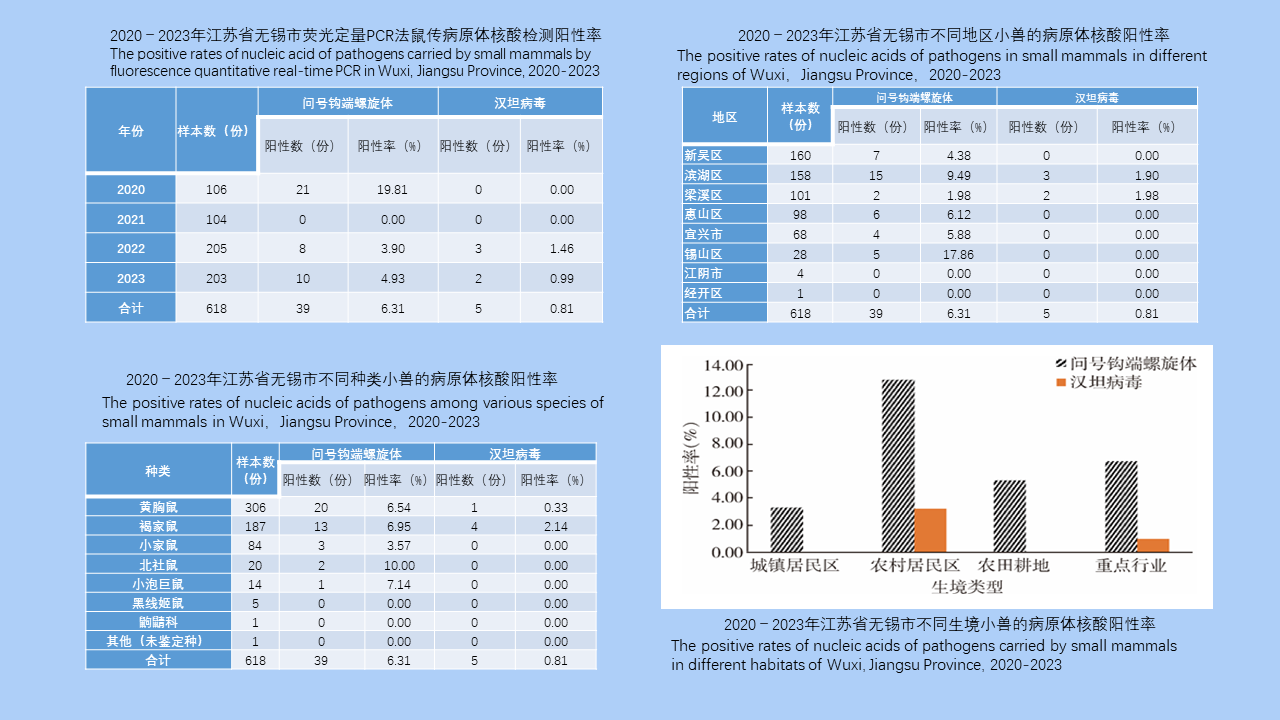
Objective To grasp the basic knowledge of pathogens carried by small mammals in Wuxi, 2020-2023, so as to get a basis for the prevention and control of rodent-borne diseases. Methods Small mammals were captured with rodent cages, sticky boards and night-snap trapping metheds in various habitats of Wuxi. The habitats included urban residential areas, rural residential areas, key industries (such as restaurants, supermarkets, food factories, hotels, express companies), and farmlands. After species identification, the collected small mammals were dissected to obtain the liver, spleen, lung, and kidney tissues to detect the nucleic acids of Leptospira interrogans, Rickettsia typhi, Anaplasma phagocytophilum, Bartonella, Orienta tsutsugamushi, Francisella tularensi, Hantavirus and Dabie bandavirus by TaqMan quantitative real-time polymerase chain reaction (qPCR) or reverse transcription-qPCR. Excel 2013 and R 3.6.2 softwares were used for data collation and statistical analysis. Positive rates were compared using Chi-square test or Fisher's exact test. Results A total of 618 small mammals were collected from 2020 to 2023, of which 6.31% (39/618) were positive for L. interrogans, 0.81% (5/618) were positive for Hantavirus (all Seoul virus), and none was positive for R. typhi, A. phagocytophilum, Bartonella, O. tsutsugamushi, F. tularensis and Dabie bandavirus. There was significant difference in the positive rate of L. interrogans between different years (χ2=42.352,P<0.001), with the positive rate 19.81% in 2020, which was significantly higher than those in the other years. There was no significant difference in the positive rate of Hantavirus between different years (χ2=1.920,P=0.591). Niviventer confucianus, Leopoldamys edwardsi, Rattus norvegicus, and Ra. tanezumi had high infection rates of L. interrogans (all>6.00%). Hantavirus infection was present in Ra. norvegicus (2.14%) and Ra. tanezumi (0.33%). The rate of coinfection with L. interrogans and Hantavirus in Ra. norvegicus was 0.16%. By region, the positive rate of L. interrogans in Xishan District was highest (17.86%). By habitat, the positive rate of rodent-borne pathogens in rural residential areas was relatively high (16.13%). Conclusions The infection rates of L. interrogans and Hantavirus (Seoul virus) are high in small mammals in Wuxi. It is necessary to strengthen surveillance, the prevention and control of rodents and related pathogens, to reduce the incidence of human cases.
[1] Zheng JN, Wang Y, Qiu JL. A review of research on rodent-borne diseases and rodent hosts[J]. Chin J Vector Biol Control,2007,18(5):427-429. DOI:10.3969/j.issn.1003-4692.2007.05.029.(in Chinese)郑剑宁,王燕,裘炯良. 鼠传疾病与鼠类宿主研究概况[J]. 中国媒介生物学及控制杂志,2007,18(5):427-429. DOI:10.3969/j.issn.1003-4692.2007.05.029.
[2] Li S, Li X, Wang XM,et al. Plague surveillance in Beijing,2011-2020[J]. Dis Surveill,2023,38(10):1174-1177. DOI:10.3784/jbjc.202306160283.(in Chinese)李爽,李旭,王小梅,等. 2011—2020年北京市鼠疫监测情况分析[J]. 疾病监测,2023,38(10):1174-1177. DOI:10.3784/jbjc.202306160283.
[3] Du SS, Deng XF, Huang XX,et al. Epidemiological characteristics of hemorrhagic fever with renal syndrome in Yunnan,2004-2021[J]. Dis Surveill,2023,38(11):1357-1362. DOI:10.3784/jbjc.202305040193.(in Chinese)杜珊珊,邓雪飞,黄晓霞,等. 2004—2021年云南省肾综合征出血热流行特征分析[J]. 疾病监测,2023,38(11):1357-1362. DOI:10.3784/jbjc.202305040193.
[4] Yu BB, Yang H, Yang QJ,et al. Epidemiological analysis of leptospirosis in Yunnan Province,China,from 2011 to 2021[J]. Chin J Zoonoses,2023,39(2):135-139. DOI:10.3969/j.issn.1002-2694.2022.00.191.(in Chinese)于彬彬,杨慧,杨秋菊,等. 2011—2021年云南省钩端螺旋体病流行病学分析[J]. 中国人兽共患病学报,2023,39(2):135-139. DOI:10.3969/j.issn.1002-2694.2022.00.191.
[5] Yu XH, Zhang XH, Ni QX,et al. Research advances in epidemiology of the rodent-borne diseases[J]. Chin J Vector Biol Control,2015,26(6):634-636. DOI:10.11853/j.issn. 1003. 4692.2015.06.026.(in Chinese)余向华,张孝和,倪庆翔,等. 鼠传疾病流行病学研究进展[J]. 中国媒介生物学及控制杂志,2015,26(6):634-636. DOI:10.11853/j.issn.1003.4692.2015.06.026.
[6] Zhou MH, Chu HL. Handbook for classification and identification of main vectors[M]. Suzhou:Soochow University Press,2019:89-120. (in Chinese)周明浩,褚宏亮. 常见病媒生物分类鉴定手册[M]. 苏州:苏州大学出版社,2019:89-120.
[7] Li GC, Wang YJ, Lu L,et al. National surveillance report on rodents in China,2019[J]. Chin J Vector Biol Control,2020,31(4):389-394. DOI:10.11853/j.issn.1003.8280.2020.04.002.(in Chinese)李贵昌,王玉姣,鲁亮,等. 2019年全国鼠类监测报告[J]. 中国媒介生物学及控制杂志,2020,31(4):389-394. DOI:10.11853/j.issn.1003.8280.2020.04.002.
[8] Hou YX, Wang J, Ma C,et al. Rodent monitoring in Gaoliu Science Park of Hefei in 2022[J]. Chin J Hyg Insect Equip,2023,29(4):309-311. DOI:10.19821/j.1671-2781.2023.04.005.(in Chinese)侯银续,汪静,马超,等. 2022年合肥市高刘镇科技园区鼠类监测分析[J]. 中华卫生杀虫药械,2023,29(4):309-311. DOI:10.19821/j.1671-2781.2023.04.005.
[9] Zheng DY, Zhu L, Liang WQ,et al. Rodent and pathogen surveillance results in Zunyi,Guizhou Province,China,2022[J]. Chin J Vector Biol Control,2023,34(4):501-507. DOI:10.11853/j.issn.1003.8280.2023.04.011.(in Chinese)郑德阳,朱琳,梁文琴,等. 贵州省遵义市2022年度鼠类及其病原学监测结果分析[J]. 中国媒介生物学及控制杂志,2023,34(4):501-507. DOI:10.11853/j.issn.1003.8280.2023.04.011.
[10] Yao L, Tian X, Zhang J,et al. A survey on the incidence characteristics and knowledge level of prevention and treatment among 102 cases of hemorrhagic fever with renal syndrome[J]. Chin J Ctrl Endem Dis,2023,38(6):503-504. (in Chinese)姚岚,田兴,张娟,等. 102例肾综合征出血热发病特征及防治知识知晓现状调查研究[J]. 中国地方病防治,2023,38(6):503-504.
[11] Shen Y, Ma YL, Chen JP. Survey on virus-carrying status of rats with HFRS in Wuxi[J]. Mod Prev Med,2009,36(22):4347,4350. (in Chinese)沈元,马玉林,陈继平. 无锡市肾综合征出血热鼠间带毒情况调查[J]. 现代预防医学,2009,36(22):4347,4350.
[12] Ren FL, Fu Y, Liu GT,et al. Epidemiologic investigation of rodent-borne pathogens and rodents in suburban areas of Huzhou,Zhejiang[J]. Chin J Zoonoses,2023,39(2):200-204. DOI:10.3969/j.issn.1002-2694.2022.00.186.(in Chinese)任飞林,付云,刘光涛,等. 湖州城郊啮齿动物及鼠传病原体流行分布[J]. 中国人兽共患病学报,2023,39(2):200-204. DOI:10.3969/j.issn.1002-2694.2022.00.186.
[13] Zhong JY, Wang JN, Yang H,et al. An investigation of small mammal distribution and their infection with pathogens in rural areas of Quzhou,Zhejiang Province,China[J]. Chin J Vector Biol Control,2022,33(6):805-808,827. DOI:10.11853/j.issn.1003.8280.2022.06.007.(in Chinese)钟建跃,王金娜,杨辉,等. 浙江省衢州市农村地区2020—2021年小兽分布及其病原体携带情况调查[J]. 中国媒介生物学及控制杂志,2022,33(6):805-808,827. DOI:10.11853/j.issn.1003.8280.2022.06.007.
[14] Ma M, He X, Li MY,et al. An investigation of pathogen infections in small mammals in Ningbo,Zhejiang Province,China[J]. Chin J Vector Biol Control,2024,35(1):104-018. DOI:10.11853/j.issn.1003.8280.2024.01.019.(in Chinese)马敏,何昕,李梦颖,等. 浙江省宁波市小型兽类感染病原体调查[J]. 中国媒介生物学及控制杂志,2024,35(1):104-018. DOI:10.11853/j.issn.1003.8280.2024.01.019.
[15] Zhao YS, Wu YY, Zhou HH,et al. Investigation of natural infection of four pathogens in rodents in rural area of Taizhou,Zhejiang[J]. Dis Surveill,2021,36(9):894-897. DOI:10.3784/jbjc.202105310292.(in Chinese)赵怡双,吴瑜燕,周海慧,等. 浙江省台州市农村地区鼠形动物自然感染4种病原体的调查[J]. 疾病监测,2021,36(9):894-897. DOI:10.3784/jbjc.202105310292.
[16] Han YN, Liu Y, Sun QT,et al. An investigation of rodent-borne pathogens in small mammals in some areas of Shandong Province,China[J]. Chin J Vector Biol Control,2022,33(6):800-804. DOI:10.11853/j.issn.1003.8280.2022.06.006.(in Chinese)韩英男,刘言,孙钦同,等. 山东省部分地区2020—2021年小兽携带鼠传病原体的调查[J]. 中国媒介生物学及控制杂志,2022,33(6):800-804. DOI:10.11853/j.issn. 1003. 8280. 2022. 06.006.
[17] Telfer S, Lambin X, Birtles R,et al. Species interactions in a parasite community drive infection risk in a wildlife population[J]. Science,2010,330(6001):243-246. DOI:10.1126/science.1190333.
[18] Lu Y, Peng LY, Ou JX,et al. The prevention and control effects of six rodent control techniques in Shenzhen agricultural areas[J]. China Plant Prot,2023,43(11):70-72. DOI:10.3969/j.issn.1672-6820.2023.11.012.(in Chinese)鲁勇,彭李亚,欧继喜,等. 6种灭鼠技术对深圳农区鼠害的防控效果[J]. 中国植保导刊,2023,43(11):70-72. DOI:10.3969/j.issn.1672-6820.2023.11.012.


