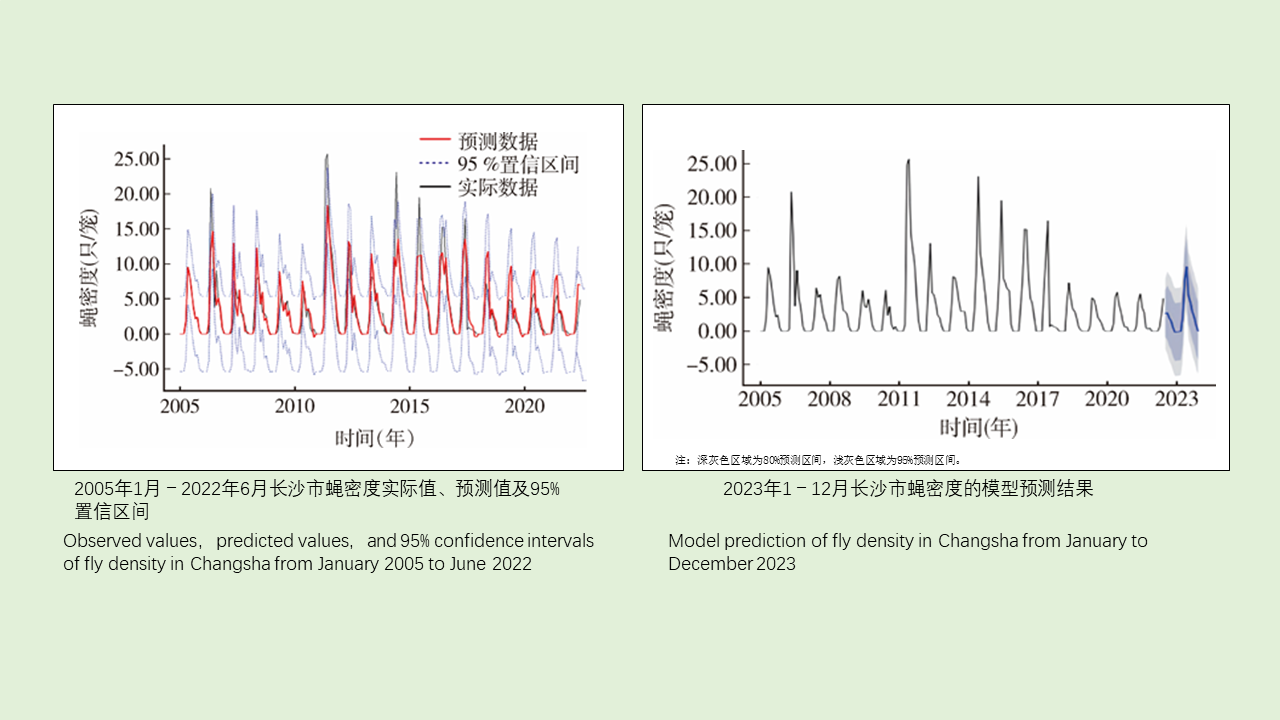
目的 构建长沙市蝇密度自回归积分移动平均模型(ARIMA),并对2023年1-12月蝇密度进行预测。方法 应用R 4.3.0软件对2005年1月-2022年6月的蝇密度数据构建ARIMA模型,将2022年7-12月预测值与真实值进行比较,进行模型预测效果评价,进而对2023年1-12月蝇密度进行预测。结果 采用ARIMA模型对2005年1月-2022年6月蝇密度监测数据构建,选取最佳模型为ARIMA(1,0,0)(0,1,1)12,其赤池信息准则(AIC)值及贝叶斯信息准则(BIC)值均最低,分别为986.50及996.37;模型残差序列为白噪声,模型有效;预测2022年7-12月的蝇密度与实际密度基本一致,实际监测值均落入了预测值的95%置信区间内,均方根误差(RMSE)为0.649,平均绝对误差(MAE)为0.522,可用于短期蝇密度预测。利用该模型预测2023年1-12月蝇密度,其密度平均值为2.89只/笼,低于2005-2022年平均密度(3.22只/笼),高于2022年平均密度(1.20只/笼)。结论 ARIMA(1,0,0)(0,1,1)12模型对长沙市蝇密度数据的拟合效果较好,可用于蝇密度的短期预测,为预防控制蝇类危害事件及蝇传疾病提供依据。
Objective To construct an autoregressive integrated moving average model (ARIMA) of fly density in Changsha, China and to predict the fly density from January to December 2023.Methods Using the R 4.3.0, an ARIMA model was constituted with the fly density data from January 2005 to June 2022. The predicted values were compared with the observed data of July to December 2022 to evaluate the prediction effect of the model. The fly density from January to December 2023 was predicted.Results The ARIMA (1,0,0)(0,1,1)12 model was optimal with the fly density data from January 2005 to June 2022. The model showed the lowest Akashi information criterion value and Bayesian information criterion value, which were 986.50 and 996.37, respectively. The residual sequence was a white noise sequence, suggesting that the model was valid. The predicted values of fly density from July to December 2022 were basically consistent with the observed values, with the observed values falling into the 95% confidence interval of the predicted values. The root mean square error was 0.649 and the mean absolute error was 0.522. Therefore, the model can be used for short-term prediction of fly density. This model was used to predict the fly density from January to December 2023. The mean density was 2.89 flies/cage in 2023, which was lower than the mean density in 2005-2022 (3.22 flies/cage) but higher than the mean density in 2022 (1.20 flies/cage).Conclusions The ARIMA (1,0,0)(0,1,1)12 model shows high goodness of fit for the fly density data in Changsha, and can be used for the short-term prediction of fly density. The predicted data can be used as a basis for the prevention and control of fly hazard events and fly-borne diseases.
[1] Su C,Lin MZ. Population surveillance of filth fly in Xiamen city in 2014[J]. China Trop Med,2016,16(1):95-96. DOI:10.13604/j.cnki.46-1064/r.2016.01.27.(in Chinese) 苏畅,林敏珍. 厦门市2014年苍蝇密度监测资料分析[J]. 中国热带医学,2016,16(1):95-96. DOI:10.13604/j.cnki.46-1064/r.2016.01.27.
[2] Ministry of Health of the People’s Republic of China. National vector surveillance program(Trial)[Z]. Beijing:Chinese Center for Disease Control and Prevention,2005. (in Chinese) 中华人民共和国卫生部.全国病媒生物监测方案(试行)[Z]. 北京:中国疾病预防控制中心,2005.
[3] Zhu ZX,Zhu XX,Zhan YC,et al. Development and comparison of predictive models for sexually transmitted diseases-AIDS,gonorrhea,and syphilis in China,2011-2021[J]. Front Public Health,2022,10:966813. DOI:10.3389/fpubh.2022.966813.
[4] Siamba S,Otieno S,Koech J. Application of ARIMA,and hybrid ARIMA models in predicting and forecasting tuberculosis incidences among children in Homa bay and Turkana counties,Kenya[J]. PLoS Digital Health,2023,2(2):e0000084. DOI:10.1371/journal.pdig.0000084.
[5] Pan YY,Wu HX,Guo J,et al. Population density prediction of Adeds albopictus in Guangzhou based on autoregressive integrated moving average model[J]. Chin J Vector Biol Control,2018,29(6):545-549. DOI:10.11853/j.issn.1003.8280.2018. 06.001.(in Chinese) 潘衍宇,吴海霞,国佳,等. 基于R语言自回归积分移动平均模型的广州市白纹伊蚊密度预测研究[J]. 中国媒介生物学及控制杂志,2018,29(6):545-549. DOI:10.11853/j.issn.1003. 8280.2018.06.001.
[6] Gao W,Huang G,Han XL. Application of Bayes analysis in Japanese encephalitis prediction based on multiple seasonal autoregressive integrated moving average model[J]. Chin J Vector Biol Control,2018,29(6):557-563. DOI:10.11853/j.issn.1003.8280.2018.06.003.(in Chinese) 高文,黄钢,韩晓莉. 基于蚊密度差分自回归移动平均模型预测流行性乙型脑炎的贝叶斯判别分析研究[J]. 中国媒介生物学及控制杂志,2018,29(6):557-563. DOI:10.11853/j.issn. 1003.8280.2018.06.003.
[7] Sun QT,Han YN,Liu Y,et al. Application of autoregressive integrated moving average model in predicting the trend of rodent density in Shandong province,China[J]. Chin J Vector Biol Control,2021,32(6):744-748. DOI:10.11853/j.issn.1003. 8280.2021.06.018.(in Chinese) 孙钦同,韩英男,刘言,等. 应用自回归移动平均(ARIMA)模型预测山东省鼠密度趋势[J]. 中国媒介生物学及控制杂志,2021,32(6):744-748. DOI:10.11853/j.issn.1003.8280.2021. 06.018.
[8] Peng L,He J,Xiao S,et al. Analysis on the fly density monitoring in Changsha city from 2006 to 2015[J]. Chin J Vector Biol Control,2017,28(5):496-498. DOI:10.11853/j.issn.1003. 8280.2017.05.024.(in Chinese) 彭莱,何俊,肖珊,等. 长沙市2006-2015年蝇类密度监测结果分析[J]. 中国媒介生物学及控制杂志,2017,28(5):496-498. DOI:10.11853/j.issn.1003.8280.2017.05.024.
[9] Brockwell,Tian Z. Time series:Theory and methods[M]. Beijing:Higher Education Press,2001:214-246. (in Chinese) 布洛克威尔,田铮. 时间序列的理论与方法[M]. 北京:高等教育出版社,2001:214-246.
[10] Mao XQ,Xiong XQ,Tu QF,et al. Analysis on the time series and prediction model in forecasting the incidence of hepatitis B in Jiangxi[J]. Chin Prev Med,2013,14(6):435-438. DOI:10.16506/j.1009-6639.2013.06.012.(in Chinese) 毛向群,熊小庆,涂秋凤,等. 江西省乙型肝炎发病趋势的时间序列和预测模型分析[J]. 中国预防医学杂志,2013,14(6):435-438. DOI:10.16506/j.1009-6639.2013.06.012.
[11] Wang BG,Qu B,Guo HQ,et al. Research on mathematical models for predicting infectious diseases[J]. Chin J Health Stat,2007,24(5):536-540. (in Chinese) 王丙刚,曲波,郭海强,等. 传染病预测的数学模型研究[J]. 中国卫生统计,2007,24(5):536-540.
[12] Wang Y. Time series analysis with R[M]. Beijing:China Renmin University Press,2015:83-106. (in Chinese) 王燕. 应用时间序列分析:基于R[M]. 北京:中国人民大学出版社,2015:83-106.
[13] Yi DH,Wang Y. Applied time series analysis[M]. 5th ed. Beijing:China Renmin University Press,2019:2-3. (in Chinese) 易丹辉,王燕. 应用时间序列分析[M]. 5版. 北京:中国人民大学出版社,2019:2-3.
[14] ShenYG. Analysis of influenza surveillance results in Shengzhou and ARIMA model prediction[D]. Hangzhou:Zhejiang University,2017:20-24. (in Chinese) 沈钰刚. 嵊州市流感样病例监测结果及ARIMA模型预测[D]. 杭州:浙江大学,2017:20-24.
[15] Zhang SX,Qiu Q,Wang Y. Study on the national monthly reported severe cases of hand-foot-mouth disease forecasted by autoregressive integrated moving average model[J]. Chin J Virol,2017,33(1):77-81. DOI:10.13242/j.cnki.bingduxuebao.003097.(in Chinese) 张顺先,邱琪,王英. 我国手足口病重症患者数自回归移动平均模型预测研究[J]. 病毒学报,2017,33(1):77-81. DOI:10.13242/j.cnki.bingduxuebao.003097.
[16] Wang L,Yao WQ. Using time series models to analyze and predict the epidemic trend of hand-foot-mouth disease in Liaoning[J]. Chin J Health Stat,2016,33(5):847-849. (in Chinese) 王伶,姚文清. 利用时间序列模型分析预测辽宁手足口病疫情趋势[J]. 中国卫生统计,2016,33(5):847-849.
[17] Yun L,Wang FC,Zhang QF. Application of autoregressive integrated moving average model in prediction of the distribution characteristics of mosquito density in Tangshan,Hebei province,China[J]. Chin J Vector Biol Control,2020,31(1):21-26. DOI:10.11853/j.issn.1003.8280.2020.01.005.(in Chinese) 运玲,王福才,张秋芬. 差分自回归移动平均模型在蚊密度分布特征预测中的应用[J]. 中国媒介生物学及控制杂志,2020,31(1):21-26. DOI:10.11853/j.issn.1003.8280.2020.01.005.
[18] Sun CY,Yang XJ. Establish and application of multiply ARIMA model[J]. J North China Inst Sci Technol,2008,5(2):85-89. DOI:10.3969/j.issn.1672-7169.2008.02.025.(in Chinese) 孙彩云,杨晓静. 乘积ARIMA模型的建立及应用[J]. 华北科技学院学报,2008,5(2):85-89. DOI:10.3969/j.issn.1672-7169.2008.02.025.


