

ISSN 1003-8280 CN 10-1522/R 中国疾病预防控制中心 主办
收稿日期: 2023-02-24
网络出版日期: 2023-08-17
基金资助
杭州市医药卫生科技项目(A20230110);杭州市医药卫生科技项目(Z20210043);杭州市医学重点学科项目;杭州市科技发展计划项目(20190101A12)
An analysis of ecological surveillance results of dengue vector Aedes albopictus in Hangzhou, Zhejiang Province, China, 2017-2021
Received date: 2023-02-24
Online published: 2023-08-17
Supported by
General Projects of Medical and Health Science and Technology Plan of Hangzhou(A20230110);General Projects of Medical and Health Science and Technology Plan of Hangzhou(Z20210043);Hangzhou Medical Key Discipline Project;Hangzhou Science and Technology Development Plan Project(20190101A12)
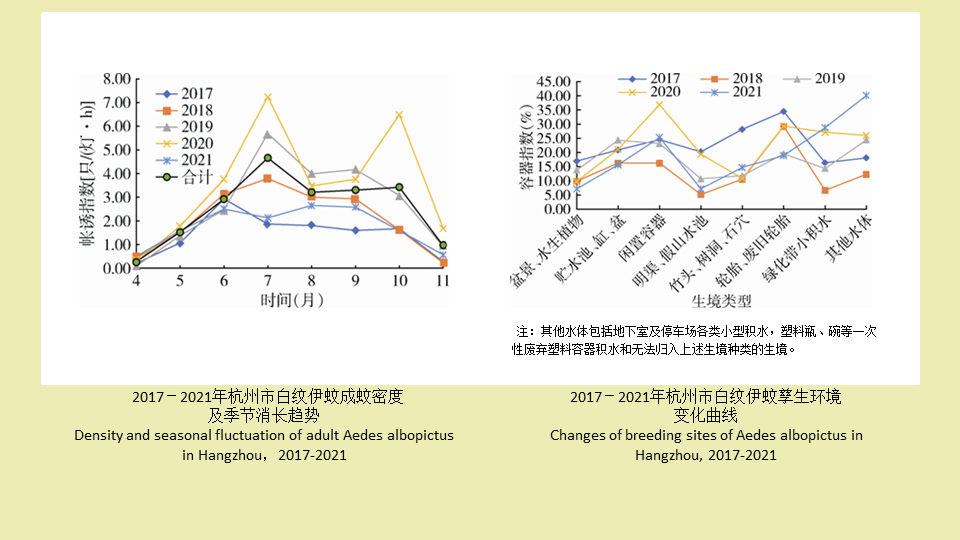
目的: 了解杭州市2017-2021年媒介伊蚊在不同生境下的密度分布及季节消长规律,为有效防控登革热、风险评估和预警提供科学依据。方法: 按照《全国病媒生物监测实施方案》和《浙江省病媒生物监测工作方案》对杭州市15个县(市、区)开展伊蚊监测。成蚊监测采用双层叠帐法,幼蚊监测采用布雷图指数(BI)法,监测时间为4-11月。收集全市15个县(市、区)的蚊虫监测数据,使用Excel 2019软件对监测数据进行汇总分析,计算帐诱指数、BI及容器指数(CI),分类资料比较采用χ2检验,计量资料比较采用单因素方差分析。结果: 2017-2021年杭州市双层叠帐法监测白纹伊蚊密度为2.54只/(顶·h),未捕获到埃及伊蚊。2017年成蚊密度最低,2020年成蚊密度最高,不同年份间帐诱指数蚊密度差异有统计学意义(F=5.117,P=0.017)。季节分布总体呈双峰分布,蚊密度高峰主要在7和10月。2017-2021年平均BI值为9.18,BI高峰期为5-10月,CI显示,各类水体均有白纹伊蚊幼蚊分布,同一年不同水体间幼蚊密度差异均有统计学意义(均P < 0.001),不同年份同一类水体间幼蚊密度差异亦均有统计学意义(均P < 0.001)。结论: 杭州市白纹伊蚊密度较高,存在登革热暴发和区域流行风险,建议各县(市、区)根据蚊虫密度变化、分布及季节消长规律,及时采取蚊虫控制措施。
金彬彬, 韦凌娅, 金慧, 曹阳, 王英红, 孔庆鑫 . 杭州市2017-2021年登革热媒介白纹伊蚊生态学监测结果分析[J]. 中国媒介生物学及控制杂志, 2023 , 34(4) : 491 -496 . DOI: 10.11853/j.issn.1003.8280.2023.04.009
Objective: To investigate the density distribution of Aedes mosquitoes in different habitats and seasonal fluctuation in Hangzhou, Zhejiang Province, China from 2017 to 2021, so as to provide a scientific basis for effective prevention and control, risk assessment, and early warning of dengue fever. Methods: According to the National Vector Surveillance Implementation Plan and the Zhejiang Provincial Vector Surveillance Plan, Aedes mosquitoes were monitored in 15 districts (counties and cities) in Hangzhou. Adult mosquitoes were monitored using the double-layered mosquito net method, and larvae were monitored using the Breteau index (BI) method. The surveillance time was set during April to November. The mosquito surveillance data of the 15 districts (counties and cities) were collected. Excel 2019 software was used for data analysis. The net trap index, BI, and container index (CI) were calculated. Categorical data were compared using the Chi-squared test. One-way analysis of variance was used for quantitative data. Results: From 2017 to 2021, the density of Ae. albopictus in Hangzhou by the double-layered mosquito net method was 2.54 mosquitoes/net·h, and no Ae. aegypti mosquitoes were captured. The density of adult mosquitoes was lowest in 2017 and highest in 2020. There was a statistical difference in the net trap index between different years (F=5.117, P=0.017). The seasonal distribution generally presented a bimodal pattern, with the peaks of mosquito densities mainly in July and October. The average BI from 2017 to 2021 was 9.18, and the peak period of the BI was during May to October. The CI showed that Ae. albopictus larvae were distributed in all kinds of water bodies. The CI differed statistically between different water bodies in the same year (all P < 0.001) and between different years in the same water body (all P < 0.001). Conclusions: Ae. albopictus density was high in Hangzhou, indicating a risk of dengue fever outbreaks and regional epidemics. It is recommended that the counties (cities, districts) take timely mosquito control measures according to the density, distribution, and seasonal fluctuation of mosquitoes.
| 1 | Bhatt S, Gething PW, Brady OJ, et al. The global distribution and burden of dengue[J]. Nature, 2013, 496 (7446):504-507. |
| 2 | Brady OJ, Gething PW, Bhatt S, et al. Refining the global spatial limits of dengue virus transmission by evidence-based consensus[J]. PLoS Negl Trop Dis, 2012, 6 (8):e1760. |
| 3 | 邹钦. 广东省2014年登革热疫情防控实践与思考[J]. 中华卫生杀虫药械, 2015, 21 (6):630-632. |
| 3 | Zou Q. Practice and thinking for dengue fever epidemic prevention and control of Guangdong province in 2014[J]. Chin J Hyg Insect Equip, 2015, 21 (6):630-632. |
| 4 | 李晓宁. 广州2014年登革热流行特征及气候、蚊媒对广州登革热发病的影响[D]. 广州: 广东药学院, 2015. |
| 4 | Li XN. The epidemic characteristics of dengue fever in Guangzhou, 2014 and the effects of climate, density of mosquito in the occurrence of dengue fever in Guangzhou[D]. Guangzhou: Guangdong Pharmaceutical University, 2015. (in Chinese) |
| 5 | 陈珺芳, 王哲, 孙昼, 等. 杭州市登革热核心区蚊媒应急处置效果分析[J]. 预防医学, 2019, 31 (10):1078-1080. |
| 5 | Chen JF, Wang Z, Sun Z, et al. Effects of emergency mosquito control in dengue fever core area in Hangzhou[J]. Prev Med, 2019, 31 (10):1078-1080. |
| 6 | 刘起勇. 媒介伊蚊可持续控制策略及关键技术[J]. 新发传染病电子杂志, 2018, 3 (2):75-79. |
| 6 | Liu QY. The sustainable control strategy and key technology of Aedes vector[J]. Electron J Emerg Infect Dis, 2018, 3 (2):75-79. |
| 7 | 刘起勇. 气候变化对中国媒介生物传染病的影响及应对: 重大研究发现及未来研究建议[J]. 中国媒介生物学及控制杂志, 2021, 32 (1):1-11. |
| 7 | Liu QY. Impact of climate change on vector-borne diseases and related response strategies in China: Major research findings and recommendations for future research[J]. Chin J Vector Biol Control, 2021, 32 (1):1-11. |
| 8 | 李天奇, 刘钦梅, 吴瑜燕, 等. 浙江省登革热重点地区2020年白纹伊蚊幼蚊种群密度监测分析[J]. 中国媒介生物学及控制杂志, 2022, 33 (1):21-24, 37. |
| 8 | Li TQ, Liu QM, Wu YY, et al. Surveillance of the population density of Aedes albopictus larvae in dengue prone and risk areas of Zhejiang province, China, 2020[J]. Chin J Vector Biol Control, 2022, 33 (1):21-24, 37. |
| 9 | 刘牧文, 孙昼, 考庆君, 等. 2017-2019年浙江省杭州市登革热流行特征和时空聚集性分析[J]. 疾病监测, 2022, 37 (4):481-486. |
| 9 | Liu MW, Sun Z, Kao QJ, et al. Spatiotemporal distribution of dengue fever in Hangzhou, Zhejiang, 2017-2019[J]. Dis Surveill, 2022, 37 (4):481-486. |
| 10 | 郭玉红, 吴海霞, 刘小波, 等. 2018年全国媒介蚊虫监测报告[J]. 中国媒介生物学及控制杂志, 2019, 30 (2):128-133. |
| 10 | Guo YH, Wu HX, Liu XB, et al. National vectors surveillance report on mosquitoes in China, 2018[J]. Chin J Vector Biol Control, 2019, 30 (2):128-133. |
| 11 | 曹阳, 韦凌娅, 邵汉文, 等. 2019年杭州市蚊虫监测及生态学特征[J]. 中国媒介生物学及控制杂志, 2021, 32 (6):691-695. |
| 11 | Cao Y, Wei LY, Shao HW, et al. Mosquito surveillance and bionomics in Hangzhou, Zhejiang province, China, 2019[J]. Chin J Vector Biol Control, 2021, 32 (6):691-695. |
| 12 | 王金娜, 王晓林, 侯娟, 等. 浙江省"无四害村"建设经验及标准探讨[J]. 中国媒介生物学及控制杂志, 2021, 32 (5):613-617. |
| 12 | Wang JN, Wang XL, Hou J, et al. A discussion on the construction experience and standard of "four pests-free villages" in Zhejiang province, China[J]. Chin J Vector Biol Control, 2021, 32 (5):613-617. |
| 13 | 朱海博, 叶慧锋, 陈明, 等. 浙江省青田县"无蚊村"建设的效果评价[J]. 中国媒介生物学及控制杂志, 2021, 32 (3):365-368. |
| 13 | Zhu HB, Ye HF, Chen M, et al. Effectiveness evaluation of "mosquito-free village" construction in Qingtian county, Zhejiang province, China[J]. Chin J Vector Biol Control, 2021, 32 (3):365-368. |
| 14 | 樊景春, 刘起勇. 气候变化对登革热传播媒介影响研究进展[J]. 中华流行病学杂志, 2013, 34 (7):745-749. |
| 14 | Fan JC, Liu QY. Research progress on the effect of climate change on dengue vector[J]. Chin J Epidemiol, 2013, 34 (7):745-749. |
| 15 | 赵宁, 郭玉红, 吴海霞, 等. 2019年全国媒介蚊虫监测报告[J]. 中国媒介生物学及控制杂志, 2020, 31 (4):395-400. |
| 15 | Zhao N, Guo YH, Wu HX, et al. National vector surveillance report on mosquitoes in China, 2019[J]. Chin J Vector Biol Control, 2020, 31 (4):395-400. |
| 16 | 马敏, 杨思嘉, 马晓, 等. 宁波市白纹伊蚊越冬卵调查[J]. 预防医学, 2019, 31 (4):397-399, 404. |
| 16 | Ma M, Yang SJ, Ma X, et al. Investigation on hibernating eggs of Aedes albopictus in Ningbo[J]. Prev Med, 2019, 31 (4):397-399, 404. |
/
| 〈 |
|
〉 |
中国媒介生物学及控制杂志 © 2021 版权所有
地址:北京昌平区昌百路155号 电话:010-58900731
Email:bingmei@icdc.cn
网址:http://www.bmsw.net.cn
技术支持:010-62662699
总访问:
今日访问:
当前在线:
