

ISSN 1003-8280 CN 10-1522/R 中国疾病预防控制中心 主办
王静静、徐劲秋为共同第一作者
刘洪霞,E-mail:liuhongxia@scdc.sh.cn
LIU Hong-xia: liuhongxia@scdc.sh.cn
冷培恩,E-mail:peienleng@scdc.sh.cn
LENG Pei-en, E-mail: peienleng@scdc.sh.cn
收稿日期: 2023-02-16
网络出版日期: 2023-08-17
An analysis of fly ecological surveillance results in Shanghai, China, 2016-2021
Received date: 2023-02-16
Online published: 2023-08-17
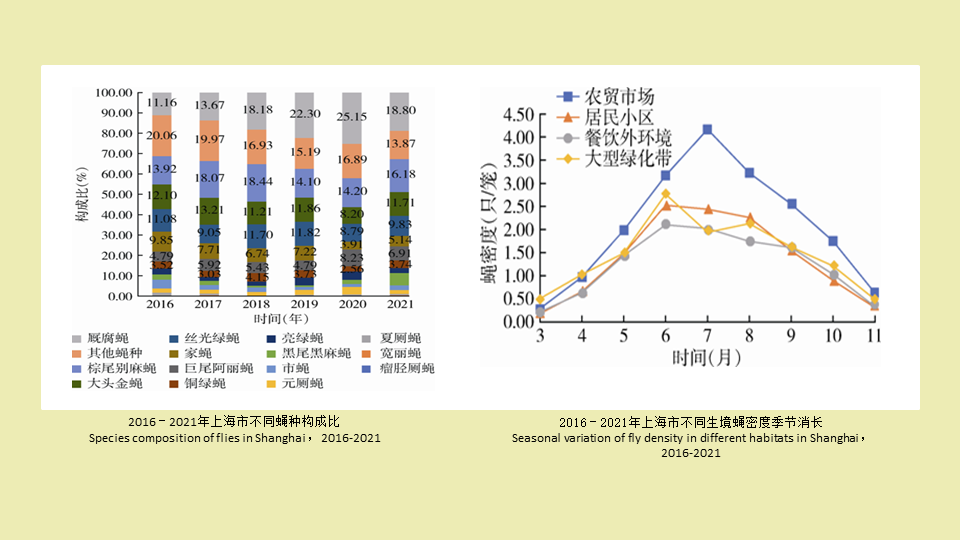
目的: 掌握上海市蝇的种类、密度、分布规律及其消长趋势,及时开展蝇类传播疾病风险评估和预测预警,为蝇类防制提供科学依据。方法: 采用笼诱法,在农贸市场、居民小区、餐饮外环境和大型绿化带开展监测;使用Excel 2019和SPSS 20.0软件,对上海市2016-2021年每年3-11月每旬各监测点蝇类监测数据进行汇总整理及统计分析。结果: 2016-2021年共捕蝇18 052只,平均密度为1.52只/笼,鉴定蝇种有5科9属14种,以厩腐蝇、棕尾别麻蝇、大头金蝇、丝光绿蝇和家蝇为优势种;厩腐蝇密度最高,为0.28只/笼,其次为棕尾别麻蝇,为0.24只/笼;除棕尾别麻蝇在大型绿化带中密度略高于厩腐蝇外,其他生境中均以厩腐蝇密度最高,二者在农贸市场的密度差异有统计学意义(t=-2.674,P=0.023);家蝇占比整体呈逐年下降趋势,厩腐蝇占比上升;蝇密度2018年最高,为1.82只/笼,2016年最低,为1.04只/笼;蝇密度高峰期为6-8月,月平均密度分别为2.65、2.49和2.28只/笼;2016-2021年,不同生境蝇密度依次是农贸市场 > 大型绿化带 > 居民小区 > 餐饮外环境。结论: 上海市蝇种丰富,以厩腐蝇密度最高,每年蝇密度高峰期在6-8月,农贸市场是蝇类防制的重点场所,蝇密度自2019年下降后再次升高,提示应持续加强蝇类综合防制。
王静静, 徐劲秋, 朱江, 刘洪霞, 冷培恩 . 上海市2016-2021年蝇类生态学监测结果分析[J]. 中国媒介生物学及控制杂志, 2023 , 34(4) : 457 -461 . DOI: 10.11853/j.issn.1003.8280.2023.04.003
Objective: To analyze the species, density, distribution, and variation of flies in Shanghai, China, to carry out risk assessment, prediction, and early warning of fly-borne diseases in a timely manner, so as to provide scientific reference for fly control. Methods: Using the cage trap method, fly traps were placed in farmers' markets, residential areas, external environment of restaurants, and large green belts. Fly surveillance data were collected every ten days from March to November in 2016-2021 in Shanghai. The data were processed and analyzed using Excel 2019 and SPSS 20.0. Results: From 2016 to 2021, 18 052 flies were caught with an average density of 1.52 flies/cage. The identified fly species belonged to 5 families, 9 genera, and 14 species. The dominant species were Muscina stabulans, Boettcherisca peregrina, Chrysomya megacephala, Lucilia sericata, and Musca domestica. M. stabulans showed the highest density of 0.28 flies/cage, followed by B. peregrina (0.24 flies/cage). In large green belts, the density of B. peregrina was higher than that of M. stabulans, and in all other habitats, the density of M. stabulans was the highest. There was a significant difference in density between B. peregrina and M. stabulans in the farmers' market (t=-2.674, P=0.023). The proportion of Mu. domestica decreased year by year, and the proportion of M. stabulans increased. The fly density was the highest in 2018 (1.82 flies/cage) and the lowest in 2016 (1.04 flies/cage). Fly density peaked from June to August, with the monthly average densities of 2.65, 2.49, and 2.28 flies/cage, respectively. In 2016-2021, the fly density in different habitats was in the order of farmers' markets > large green belts > residential areas > external environment of restaurants. Conclusions: The fly species are diverse in Shanghai. M. stabulans has the highest density. Fly density peaks from June to August, and farmer's market is a key place for targeted fly control. Fly density rose again after decline in 2019, suggesting that comprehensive control of flies should be continuously strengthened.
Key words: Fly species; Species composition; Fly density; Seasonal variation
| 1 | 王静静, 冷培恩. 角蝇及其防制[J]. 中国热带医学, 2022, 22 (6):529-534. |
| 1 | Wang JJ, Leng PE. Horn fly and its control[J]. China Trop Med, 2022, 22 (6):529-534. |
| 2 | 冷培恩, 王明福, 莫建初, 等. 蝇类防制工作进展与发展展望[J]. 中国媒介生物学及控制杂志, 2015, 26 (3):217-222, 227. |
| 2 | Leng PE, Wang MF, Mo JC, et al. Progress and perspective of flies control[J]. Chin J Vector Biol Control, 2015, 26 (3):217-222, 227. |
| 3 | Wolfe MK, Dentz HN, Achando B, et al. Adapting and evaluating a rapid, low-cost method to enumerate flies in the household setting[J]. Am J Trop Med Hyg, 2017, 96 (2):449-456. |
| 4 | 冷培恩, 蒋先进, 高强. 厩螫蝇及其防治[J]. 中华卫生杀虫药械, 2019, 25 (2):97-101. |
| 4 | Leng PE, Jiang XJ, Gao Q. Biology and control of stable fly[J]. Chin J Hyg Insect Equip, 2019, 25 (2):97-101. |
| 5 | 上海市卫生和计划生育委员会. 上海市传染病监测方案(2016版)[Z]. 上海: 上海市卫生和计划生育委员会, 2016: 867-885. |
| 5 | Shanghai Municipal Health and Family Planning Commission. "Shanghai infectious disease surveillance program" (2016 edition)[Z]. Shanghai: Shanghai Municipal Health and Family Planning Commission, 2016: 867-885. (in Chinese) |
| 6 | 冷培恩, 刘洪霞, 吴寰宇, 等. 上海市病媒生物控制30年回顾[J]. 上海预防医学, 2019, 31 (2):125-133. |
| 6 | Leng PE, Liu HX, Wu HY, et al. Thirty-year review of vector control in Shanghai[J]. Shanghai J Prev Med, 2019, 31 (2):125-133. |
| 7 | 冷培恩, 徐劲秋, 朱江, 等. 两种方法监测蝇密度结果分析Ⅱ. 1992-1997年数据分析[J]. 中国媒介生物学及控制杂志, 1999, 10 (6):423-426. |
| 7 | Leng PE, Xu JQ, Zhu J, et al. Results analysis of two monitoring methods on the flies population density[J]. Chin J Vector Biol Control, 1999, 10 (6):423-426. |
| 8 | 上海市人大常委会. 上海市生活垃圾管理条例[J]. 上海预防医学, 2019, 31 (8):669. |
| 8 | Shanghai Municipal People's Congress. Regulations of Shanghai municipality on the management of household garbage[J]. Shanghai J Prev Med, 2019, 31 (8):669. |
| 9 | 戈斌, 朱伟, 张海兵, 等. 实施垃圾分类后上海市奉贤区居民区湿垃圾收集桶内蝇类孳生的影响因素[J]. 环境与职业医学, 2020, 37 (5):480-485. |
| 9 | Ge B, Zhu W, Zhang HB, et al. Risk factors of fly breeding in household food waste collection bins after waste sorting in Fengxian district, Shanghai[J]. J Environ Occup Med, 2020, 37 (5):480-485. |
| 10 | 陈士强, 王泽清, 邱祥志, 等. 垃圾容器蝇类孳生及其化学防治的研究[J]. 中华卫生杀虫药械, 2013, 19 (1):51-52, 55. |
| 10 | Chen SQ, Wang ZQ, Qiu XZ, et al. Flies breeding and its chemical control in refuse container[J]. Chin J Hyg Insect Equip, 2013, 19 (1):51-52, 55. |
| 11 | 陆宝麟, 吴厚永. 中国重要医学昆虫分类与鉴别[M]. 郑州: 河南科学技术出版社, 2003: 3-428. |
| 11 | Lu BL, Wu HY. Classification and identification of important medical insects of China[M]. Zhengzhou: Henan Science and Technology Press, 2003: 3-428. |
| 12 | 王飞, 张富强, 颜传均, 等. 2006-2010年上海市虹口区蝇类监测结果分析[J]. 中国媒介生物学及控制杂志, 2011, 22 (5):480-483. |
| 12 | Wang F, Zhang FQ, Yan CJ, et al. Analysis of fly density monitoring results in Hongkou district from 2006 to 2010[J]. Chin J Vector Biol Control, 2011, 22 (5):480-483. |
| 13 | 吴海霞, 鲁亮, 孟凤霞, 等. 2006-2015年我国蝇类监测报告[J]. 中国媒介生物学及控制杂志, 2018, 29 (1):5-10. |
| 13 | Wu HX, Lu L, Meng FX, et al. Reports on national surveillance of flies in China, 2006-2015[J]. Chin J Vector Biol Control, 2018, 29 (1):5-10. |
| 14 | 王雪霜, 吴海霞, 岳玉娟, 等. 2018年全国蝇类监测报告[J]. 中国媒介生物学及控制杂志, 2019, 30 (2):139-141, 150. |
| 14 | Wang XS, Wu HX, Yue YJ, et al. National vectors surveillance report on flies in China, 2018[J]. Chin J Vector Biol Control, 2019, 30 (2):139-141, 150. |
/
| 〈 |
|
〉 |
中国媒介生物学及控制杂志 © 2021 版权所有
地址:北京昌平区昌百路155号 电话:010-58900731
Email:bingmei@icdc.cn
网址:http://www.bmsw.net.cn
技术支持:010-62662699
总访问:
今日访问:
当前在线:
