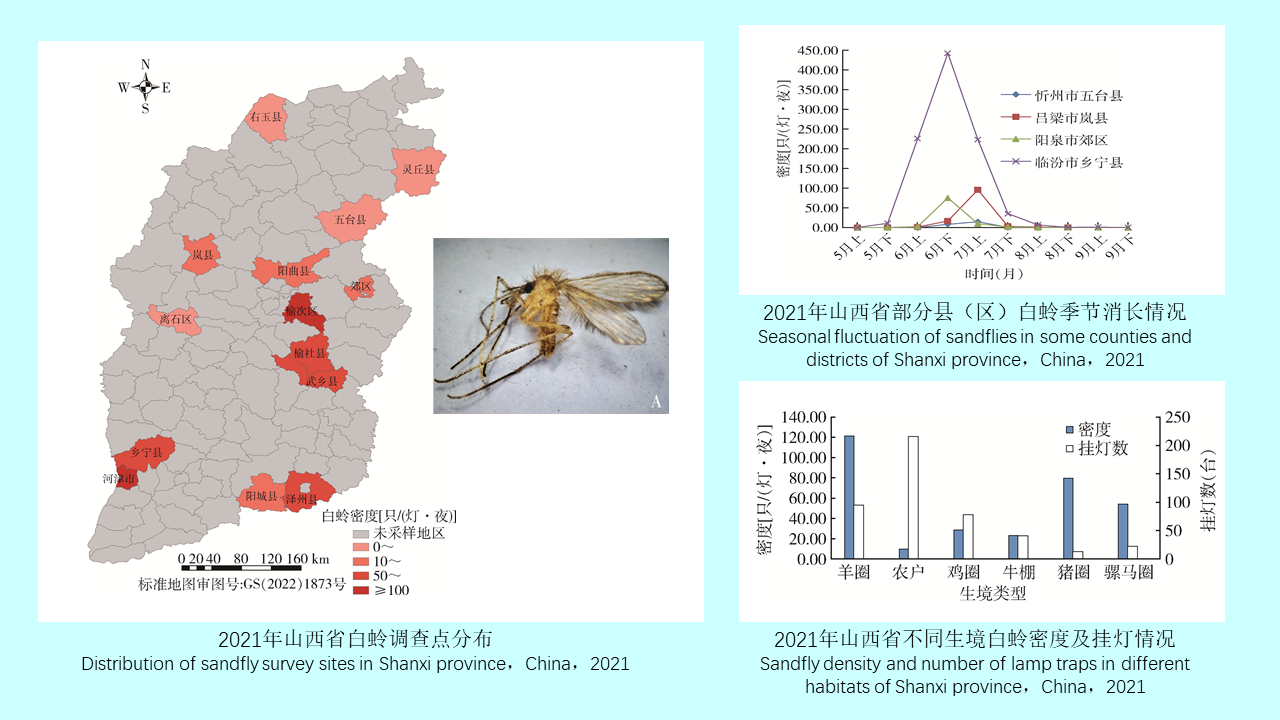
目的 了解山西省不同地区白蛉的蛉种、分布、密度及季节消长情况,为黑热病流行风险评估及防控方案制定提供科学依据。方法 2021年5-9月在山西省11个市的14个县(市、区)不同生境采用诱蛉灯诱捕白蛉。随机挑选不同地区未吸血雌蛉,采用形态学及分子生物学方法进行蛉种鉴定。应用Excel 2010软件建立数据库并对不同生境、不同月份的白蛉捕获情况进行分析, ArcGIS 10.7软件绘制白蛉调查分布图。结果 共捕获白蛉19 006只,平均密度为40.87只/(灯·夜)。全年白蛉季节消长规律呈单峰分布,5月上半月首次捕获到白蛉,6月下半月至7月上半月密度达到峰值,之后密度迅速下降。捕获生境包括农户、羊圈、牛棚、鸡圈、猪圈和骡马圈6种环境类型,羊圈密度最高,为121.39只/(灯·夜),农户密度最低,为9.63只/(灯·夜)。形态学鉴定的432只白蛉中,1只为鳞喙司蛉,其余均为中华白蛉;随机挑选110只白蛉进行分子生物学鉴定,其中4只为鳞喙司蛉,其余106只为中华白蛉,中华白蛉为绝对优势蛉种。结论 山西省11个市的14个县(市、区)均有白蛉分布,黑热病的主要媒介中华白蛉是山西省优势蛉种,主要分布在农村地区,尤其是牲畜及禽类养殖场所。畜圈等重点场所应加强环境治理及灭蛉工作,降低黑热病传播风险。
Objective To investigate the species, distribution, density, and seasonal fluctuation of sandflies in different areas of Shanxi province, China, and to provide a scientific basis for the risk assessment and control of kala-azar.Methods From May to September in 2021, sandflies were captured with light trapping in different habitats in 14 counties/cities/districts of 11 prefectures of Shanxi province. The non-bloodsucking female sandflies were randomly selected from different areas and identified by morphological and molecular biological methods. Excel 2010 software was used to construct the database, followed by analysis of sandfly catches by habitat or month. The distribution of sandflies was mapped using ArcGIS 10.7.Results A total of 19 006 sandflies were captured, with an average density of 40.87 sandflies/light·night. The seasonal fluctuation of sandflies throughout the year showed a single-peak distribution. Sandflies were first caught in the first half of May, and the density peaked during the second half of June to the first half of July, after which the density decreased rapidly. Sandflies were captured in six environmental types: farmyards, sheep pens, cattle sheds, chicken pens, pig pens, and mule/horse sheds. Sheep pens had the highest density of 121.39 sandflies/light·night, and farmyards had the lowest density of 9.63 sandflies/light·night. Of the 432 sandflies identified by morphology, one was Sergentomyia squamirostris, and the rest were Phlebotomus chinensis. Another 110 sandflies were randomly selected for molecular biological identification: four were S. squamirostris, and the remaining 106 were P. chinensis. P. chinensis was the absolute dominant species.Conclusions Sandflies distributed in all the 14 counties/cities/districts of the 11 cities of Shanxi province. P. chinensis was the dominant species of sandflies in Shanxi province, which was the main vector for kala-azar transmission. They were mainly distributed in rural areas, especially in livestock/poultry-raising places, where environmental management and sandfly control should be strengthened to reduce the risk of kala-azar transmission.
[1] 熊光华,金长发,管立人. 中国的白蛉[M]. 北京:科学出版社,2016:23-60.Xiong GH,Jin CF,Guan LR. Chinese sandflies[M]. Beijing:Science Press,2016:23-60. (in Chinese)
[2] 李朝品. 医学节肢动物学[M]. 北京:人民卫生出版社,2009:409-470.Li CP. Medical arthropodology[M]. Beijing:People's Medical Publishing House,2009:409-470. (in Chinese)
[3] 王兆俊,熊光华,管立人. 新中国黑热病流行病学与防治成就[J]. 中华流行病学杂志,2000,21(1):51-54. DOI:10.3760/j.issn:0254-6450.2000.01.017.Wang ZJ,Xiong GH,Guan LR. Achievement on the epidemiology and control of kala-azar in China[J]. Chin J Epidemiol,2000,21(1):51-54. DOI:10.3760/j.issn:0254-6450.2000.01.017.(in Chinese)
[4] 路应连. 山西省黑热病流行概况[J]. 山西医学院学报,1983,14(2):6-8.Lu YL. Epidemic situation of kala-azar in Shanxi province[J]. J Shanxi Med Univ,1983,14(2):6-8. (in Chinese)
[5] 路应连,武玉晓,张杰. 山西省11个县市的白蛉分布调查[J]. 山西医学院学报,1983(1):7-8.Lu YL,Wu YX,Zhang J. A survey on the distirbution of sandflies in 11 counties in Shanxi province[J]. J Shanxi Med Univ,1983,(1):7-8. (in Chinese)
[6] 郑玉华,白永飞,帖萍,等. 2010-2019年山西省人群内脏利什曼病流行特征分析[J]. 中国寄生虫学与寄生虫病杂志,2021,39(3):352-358. DOI:10.12140/j.issn.1000-7423.2021. 03.009.Zheng YH,Bai YF,Tie P,et al. Epidemiological characteristics of visceral leishmaniasis in Shanxi province,2010-2019[J]. Chin J Parasitol Parasit Dis,2021,39(3):352-358. DOI:10.12140/j.issn.1000-7423.2021.03.009.(in Chinese)
[7] 周正斌,李元元,张仪,等. 2019年我国内脏利什曼病疫情分析[J]. 中国寄生虫学与寄生虫病杂志,2020,38(5):602-607. DOI:10.12140/j.issn.1000-7423.2020.05.012.Zhou ZB,Li YY,Zhang Y,et al. Prevalence of visceral leishmaniasis in China in 2019[J]. Chin J Parasitol Parasit Dis,2020,38(5):602-607. DOI:10.12140/j.issn.1000-7423.2020. 05.012.(in Chinese)
[8] 周正斌,李元元,张仪,等. 2015-2018年我国内脏利什曼病疫情分析[J]. 中国寄生虫学与寄生虫病杂志,2020,38(3):339-345. DOI:10.12140/j.issn.1000-7423.2020.03.013.Zhou ZB,Li YY,Zhang Y,et al. Prevalence of visceral leishmaniasis in China during 2015-2018[J]. Chin J Parasitol Parasit Dis,2020,38(3):339-345. DOI:10.12140/j.issn.1000-7423.2020.03.013.(in Chinese)
[9] 代培芳,田晓东,赵俊英,等. 3种不同器械在山西省不同地区诱捕白蛉效果比较研究[J]. 中国媒介生物学及控制杂志,2020,31(2):212-214,218. DOI:10.11853/j.issn.1003.8280. 2020.02.019.Dai PF,Tian XD,Zhao JY,et al. The effectiveness comparative study of three different devices in trapping sandflies in different areas of Shanxi province,China[J]. Chin J Vector Biol Control,2020,31(2):212-214,218. DOI:10.11853/j.issn.1003.8280. 2020.02.019.(in Chinese)
[10] 周正斌,田晓东,李元元,等. 四种诱蛉灯监测白蛉效果的比较[J]. 实用医技杂志,2021,28(12):1387-1390. DOI:10.19522/j.cnki.1671-5098.2021.12.001.Zhou ZB,Tian XD,Li YY,et al. Comparative performance of four different light-traps in a visceral leishmaniasis endemic focus in Shanxi province[J]. J Pract Med Tech,2021,28(12):1387-1390. DOI:10.19522/j.cnki.1671-5098.2021.12.001.(in Chinese)
[11] 路应连. 山西省的白蛉调查[J]. 中国寄生虫学与寄生虫病杂志,1983,1(4):61.Lu YL. Investigation of sandflies in Shanxi province[J]. Chin J Parasitol Parasit Dis,1983,1(4):61. (in Chinese)
[12] 陈翰明,陈辉莹,高景鹏,等. 我国黄土高原延伸地带利什曼病流行区的传播媒介小生境调查[J]. 中国媒介生物学及控制杂志,2019,30(6):597-602. DOI:10.11853/j.issn.1003.8280. 2019.06.001.Chen HM,Chen HY,Gao JP,et al. Ecological niches of sandfly (Diptera:Psychodidae) in the extension region of Loess Plateau,China:An endemic focus of visceral leishmaniasis[J]. Chin J Vector Biol Control,2019,30(6):597-602. DOI:10.11853/j.issn.1003.8280.2019.06.001.(in Chinese)
[13] 谷增齐,武恕星,崔法曾,等. 河南省三门峡市黑热病媒介白蛉生态调查分析[J]. 中国媒介生物学及控制杂志,2021,32(5):590-593. DOI:10.11853/j.issn.1003.8280.2021.05.016.Gu ZQ,Wu SX,Cui FZ,et al. A bionomic investigation and analysis of sandflies,the vectors of kala-azar,in Sanmenxia,Henan province,China[J]. Chin J Vector Biol Control,2021,32(5):590-593. DOI:10.11853/j.issn.1003.8280.2021.05.016.(in Chinese)


