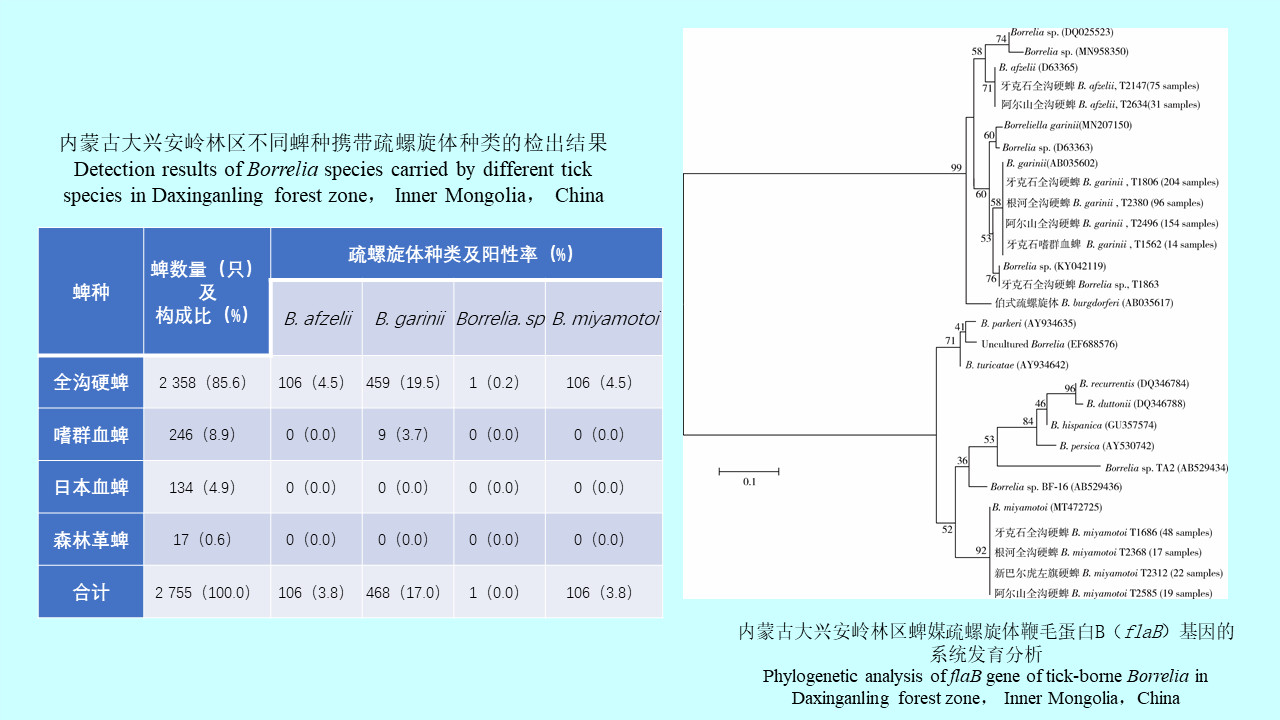
Objective To investigate the community structure of ticks and the background of Borrelia carried by ticks in Daxinganling forest zone, Inner Mongolia Autonomous Region (Inner Mongolia), China. Methods Free tick were collected in spring and summer from 2019 to 2021, and the tick species were identified by morphological and molecular biological methods. The salivary glands of ticks were anatomically harvested for DNA extraction. The quantitative polymerase chain reaction (qPCR) of 16S rRNA was used as preliminary screening of Borrelia, and for positive specimens, the target gene flaB of Borrelia was detected by PCR and confirmed by sequencing. After sequencing of amplified sequences, the basic local alignment search tool (BLAST) was used for homology analysis, and then the phylogenetic tree was constructed by MEGA 7.0 software. Results A total of 2 755 adult ticks were collected, belonging to 4 species from 3 genera. Ixodes persulcatus was the dominant tick species in this area, accounting for 85.6% of the total number of collected ticks. PCR results showed that the positive rate of Borrelia was 24.7%, and the positive rates of B. recurrentis and B. burgdorferi were 3.8% and 20.9%, respectively. In the collected ticks, B. burgdorferi was detected in both I. persulcatus and Haemaphysalis concinna, while B. recurrentis was found only in I. persulcatus. BLAST and phylogenetic analysis results showed that some sequences derived from I. persulcatus were identified to share a high homology (97.5%-100%) with those from B. afzelii (CP003882), B. garinii (CP003866), B. miyamotoi (AB900798), and Borrelia sp. (LC170020); the sequence derived from Ha. concinna was also clustered with that from B. garinii (CP003866). The species and carrying rate of Borrelia were different among different tick species. Among the ticks collected, only I. persulcatus had the co-infection of two species of Borrelia. Conclusions In this area, the tick-borne Borrelia species, mainly B. burgdorferi and B. recurrentis, are widely found in ticks, and the carrying rate is high. Therefore, it is necessary to strengthen the targeted prevention and control of tick-borne diseases.
[1] Egyed L,Élő P,Sréter-Lancz Z,et al. Seasonal activity and tick-borne pathogen infection rates of Ixodes ricinus ticks in Hungary[J]. Ticks Tick-borne Dis,2012,3(2):90-94. DOI:10.1016/j.ttbdis.2012.01.002.
[2] Wright WF,Riedel DJ,Talwani R,et al. Diagnosis and management of Lyme disease[J]. Am Fam Physician,2012,85(11):1086-1093.
[3] Burgdorfer WA,Barbour AG,Hayes SF,et al. Lyme disease:A tick-borne spirochetosis?[J]. Science,1982,216(4552):1317-1319. DOI:10.1126/science.7043737.
[4] Barbour AG,Hayes SF. Biology of Borrelia species[J]. Microbiol Rev,1986,50(4):381-400. DOI:10.1128/mr.50.4.381-400. 1986.
[5] Raileanu C,Moutailler S,Pavel I,et al. Borrelia diversity and Co-infection with other tick borne pathogens in ticks[J]. Front Cell Infect Microbiol,2017,7:36. DOI:10.3389/fcimb.2017.00036.
[6] Wu Q,Liu ZJ,Li YQ,et al. Genome sequence of Borrelia garinii strain SZ,isolated in China[J]. Genome Announc,2014,2(4):e00010-14. DOI:10.1128/genomeA.00010-14.
[7] 乌兰图雅,殷旭红,崔云虹,等. 内蒙古中西部草原蜱媒病原体多样性及基因型分析[J]. 中国寄生虫学与寄生虫病杂志,2021,39(1):27-34,42. DOI:10.12140/j.issn.1000-7423.2021. 01.004.Wulantuya,Yin XH,Cui YH,et al. Diversity and genotype analysis of tick-borne pathogens in grasslands in the central and western part of Inner Mongolia[J]. Chin J Parasitol Parasit Dis,2021,39(1):27-34,42. DOI:10.12140/j.issn.1000-7423.2021. 01.004.(in Chinese)
[8] 郝琴. 莱姆病的流行现状及防制措施[J]. 中国媒介生物学及控制杂志,2020,31(6):639-642. DOI:10.11853/j.issn.1003. 8280.2020.06.002.Hao Q. Epidemic situation and control measures of Lyme disease[J]. Chin J Vector Biol Control,2020,31(6):639-642. DOI:10.11853/j.issn.1003.8280.2020.06.002.(in Chinese)
[9] Fukunaga M,Takahashi Y,Tsuruta Y,et al. Genetic and phenotypic analysis of Borrelia miyamotoi sp. nov.,isolated from the Ixodid tick Ixodes persulcatus,the vector for Lyme disease in Japan[J]. Int J Syst Bacteriol,1995,45(4):804-810. DOI:10. 1099/00207713-45-4-804.
[10] Platonov AE,Karan LS,Kolyasnikova NM,et al. Humans infected with relapsing fever spirochete Borrelia miyamotoi,Russia[J]. Emerg Infect Dis,2011,17(10):1816-1823. DOI:10.3201/eid1710.101474.
[11] Takano A,Fujita H,Kadosaka T,et al. Construction of a DNA database for ticks collected in Japan:Application of molecular identification based on the mitochondrial 16S rDNA gene[J]. Med Entomol Zool,2014,65(1):13-21. DOI:10.7601/mez. 65.13.
[12] Hovius JWR,de Wever B,Sohne M,et al. A case of meningoencephalitis by the relapsing fever spirochaete Borrelia miyamotoi in Europe[J]. Lancet,2013,382(9892):658. DOI:10.1016/S0140-6736(13)61644-X.
[13] Kaneko M. A case of relapsing fever (the first case of domestic infection by Borrelia miyamotoi in Japan)[J]. J Jpn Soc Emerg Med,2015,18:63-67. DOI:10.11240/jsem.18.63.
[14] Gaowa,Wulantuya,Sato K,et al. Surveillance of Borrelia miyamotoi-carrying ticks and genomic analysis of isolates in Inner Mongolia,China[J]. Parasit Vectors,2021,14(1):368. DOI:10.1186/s13071-021-04809-z.
[15] 刘丹,乌兰图雅,殷旭红,等. 内蒙古地区2015-2019年不同寄生蜱的种群分布及病原体多样性分析[J]. 现代预防医学,2021,48(8):1345-1349,1398.Liu D,Wulantuya,Yin XH,et al. Analysis on the spieces distribution and pathogen diversity of different parasitic ticks from 2015 to 2019 in Inner Mongolia,China[J]. Mod Prev Med,2021,48(8):1345-1349,1398. (in Chinese)
[16] Barbour AG. Isolation and cultivation of Lyme disease spirochetes[J]. Yale J Biol Med,1984,57(4):521-525.
[17] Takano A,Toyomane K,Konnai S,et al. Tick surveillance for relapsing fever spirochete Borrelia miyamotoi in Hokkaido,Japan[J]. PLoS One,2014,9(8):e104532. DOI:10.1371/journal.pone.0104532.
[18] Takano A,Fujita H,Kadosaka T,et al. Characterization of reptile-associated Borrelia sp. in the vector tick,Amblyomma geoemydae,and its association with Lyme disease and relapsing fever Borrelia spp.[J]. Environ Microbiol Rep,2011,3(5):632-637. DOI:10.1111/j.1758-2229.2011.00280.x.
[19] 乌兰图雅,高娃,殷旭红,等. 内蒙古自治区巴彦淖尔地区鼠类携带疏螺旋体调查研究[J]. 中国媒介生物学及控制杂志,2018,29(3):239-241. DOI:10.11853/j.issn.1003.8280.2018. 03.005.Wulantuya,Gaowa,Yin XH,et al. Survey on Borrelia bacteria in rodents from Bayannur,Inner Mongolia Autonomous Region,China[J]. Chin J Vector Biol Control,2018,29(3):239-241. DOI:10.11853/j.issn.1003.8280.2018.03.005.(in Chinese)
[20] 汤芳,周磊,蒋兰芬,等. 内蒙古奇乾地区媒介蜱携带伯氏疏螺旋体的调查研究[J]. 传染病信息,2018,31(1):31-33.Tang F,Zhou L,Jiang LF,et al. Investigation on Borrelia burgdorferii in ticks collected in Qiqian region of Inner Mongolia[J]. Infect Dis Info,2018,31(1):31-33. (in Chinese)
[21] 潘玉平,杨吉飞,牛庆丽,等. 黑龙江省全沟硬蜱携带伯氏疏螺旋体广义种和斑点热群立克次体的研究[J]. 中国兽医科学,2017,47(1):31-37. DOI:10.16656/j.issn.1673-4696.2017. 01.005.Pan YP,Yang JF,Niu QL,et al. Study on Borrelia burgdorferi sensu lato and spotted fever group Rickettsia in Ixodes persulcatus in Heilongjiang province[J]. Chin Vet Sci,2017,47(1):31-37. DOI:10.16656/j.issn.1673-4696.2017.01.005.(in Chinese)
[22] Cochez C,Heyman P,Heylen D,et al. The presence of Borrelia miyamotoi,a relapsing fever Spirochaete,in questing Ixodes ricinus in Belgium and in the Netherlands[J]. Zoonoses Public Health,2015,62(5):331-333. DOI:10.1111/zph.12154.
[23] 杜娈英,陈晓宁,孙毅,等. 莱姆病宿主动物和媒介生物学研究进展[J]. 承德医学院学报,2004,21(4):335-336. DOI:10.15921/j.cnki.cyxb.2004.04.038.Du LY,Chen XN,Sun Y,et al. Advances in host animal and vector biology of Lyme disease[J]. J Chengde Med Coll,2004,21(4):335-336. DOI:10.15921/j.cnki.cyxb.2004.04.038.(in Chinese)
[24] 韩欣霖,赵华,杨佳儒,等. 宫本疏螺旋体:一种新发现的复发热螺旋体[J]. 中国病原生物学杂志,2015,10(11):1060-1062. DOI:10.13350/j.cjpb.151124.Han XL,Zhao H,Yang JR,et al. Borrelia miyamotoi:A newly discovered species of spirochete that causes relapsing fever[J]. J Pathog Biol,2015,10(11):1060-1062. DOI:10.13350/j.cjpb. 151124.(in Chinese)
[25] Krause PJ,Hendrickson JE,Steeves TK,et al. Blood transfusion transmission of the tick-borne relapsing fever spirochete Borrelia miyamotoi in mice[J]. Transfusion,2015,55(3):593-597. DOI:10.1111/trf.12879.
[26] Krause PJ,Fish D,Narasimhan S,et al. Borrelia miyamotoi infection in nature and in humans[J]. Clin Microbiol Infect,2015,21(7):631-639. DOI:10.1016/j.cmi.2015.02.006.


