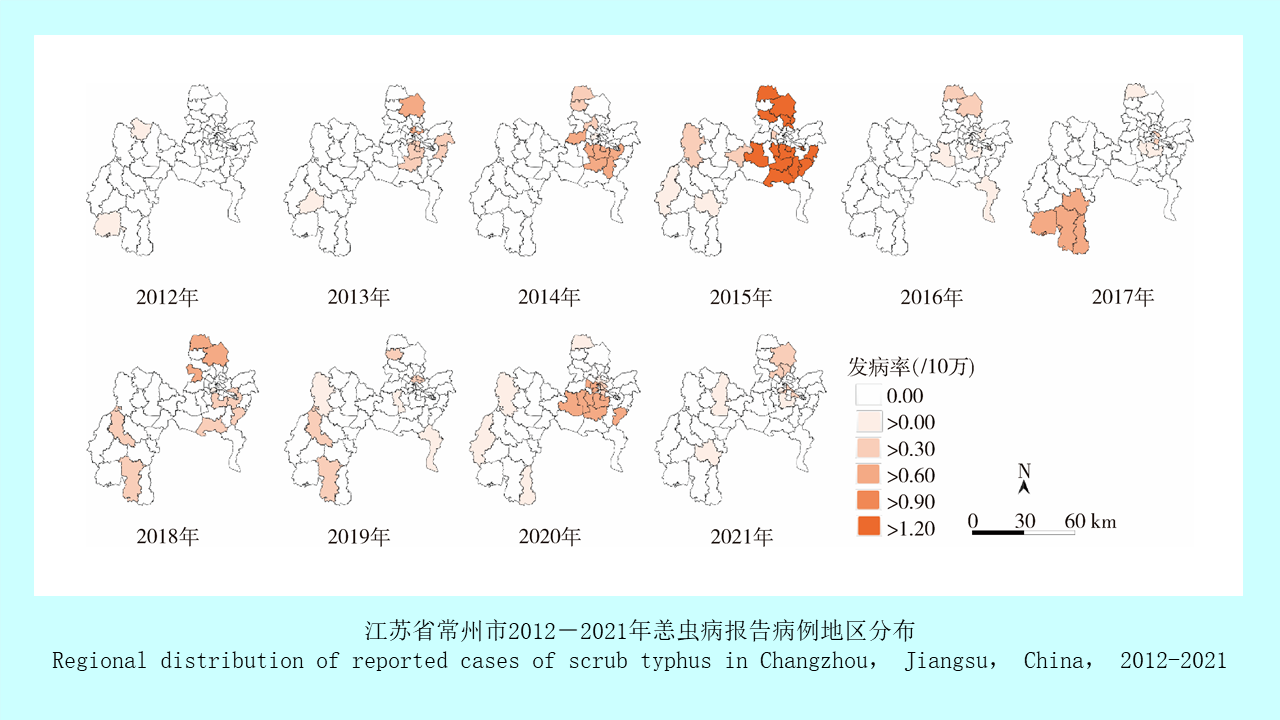
目的 了解江苏省常州市恙虫病历年发病水平、趋势及流行特征,为恙虫病防控提供依据。方法 在“中国疾病预防控制信息系统”中收集、整理常州市2012年1月1日-2021年12月31日恙虫病报告数据,采用描述性流行病学方法分析发病情况,描述恙虫病的地区、时间和人群分布特征。结果 2012-2021年,常州市共报告恙虫病病例149例,年报告发病率中位数为0.28/10万,2015年报告发病率最高,为0.74/10万,2012年最低,为0.04/10万。常州市各区(市)均有病例报告,前3位分别是武进区(60例,占40.27%)、新北区(34例,占22.82%)和溧阳市(20例,占13.42%)。疫情高峰为每年的10-11月,发病人群以农民、家务及待业人员为主,病例集中在45~69岁年龄组。结论 应加强恙虫病监测,对医务人员进行培训提高对恙虫病的诊断水平,开展高危人群健康教育以预防、控制恙虫病的发生与流行。
Objective To investigate the level, trend, and epidemiological characteristics of scrub typhus in Changzhou, China, and to provide a basis for prevention and control of the disease.Methods The reported data of scrub typhus in Changzhou from January 1, 2012 to December 31, 2021 were collected from the China Information System for Disease Control and Prevention. We analyzed the incidence of the disease and described the regional, temporal, and population distribution characteristics of scrub typhus using descriptive epidemiology method.Results From 2012 to 2021, a total of 149 cases were reported in Changzhou, with a median annual reported incidence rate of 0.28/100 000, with the highest reported incidence rate of 0.74/100 000 in 2015 and the lowest rate of 0.04/100 000 in 2012. Cases were reported in all districts of Changzhou, with the top three being Wujin district (60, 40.27%), Xinbei district (34, 22.82%), and Liyang city (20, 13.42%). Most cases were reported between October and November in farmers, household workers, and unemployed persons, and in persons aged 45-69 years.Conclusions Scrub typhus surveillance should be strengthened, medical personnel should be trained to improve the diagnosis of scrub typhus, and health education for high-risk populations should be carried out, in order to prevent and control the occurrence and prevalence of scrub typhus.
[1] 黎家灿,王敦清,陈兴保. 中国恙螨:恙虫病媒介和病原体研究[M]. 广州:广东科技出版社,1997:3,34.Li JC,Wang DQ,Chen XB. Trombiculid mites of China:Studies on vector and pathogen of tsutsugamushi disease[M]. Guangzhou:Guangdong Science and Technology Press,1997:3,34. (in Chinese)
[2] Guan XG,Wei YH,Jiang BG,et al. Clinical characteristics and risk factors for severe scrub typhus in pediatric and elderly patients[J]. PLoS Negl Trop Dis,2022,16(4):e0010357. DOI:10.1371/journal.pntd.0010357.
[3] 李文,李贵昌,刘小波,等. 恙虫病流行特征及影响因素研究进展[J]. 中国媒介生物学及控制杂志,2020,31(6):738-743. DOI:10.11853/j.issn.1003.8280.2020.06.025.Li W,Li GC,Liu XB,et al. Research progress in epidemiological characteristics and influencing factors of scrub typhus[J]. Chin J Vector Biol Control,2020,31(6):738-743. DOI:10.11853/j.issn.1003.8280.2020.06.025.(in Chinese)
[4] Ding FY,Wang Q,Hao MM,et al. Climate drives the spatiotemporal dynamics of scrub typhus in China[J]. Global Change Biol,2022,28(22):6618-6628. DOI:10.1111/gcb. 16395.
[5] 常州市统计局,国家统计局常州调查队. 常州统计年鉴2021[M]. 北京:中国统计出版社,2021:36-37.Changzhou Bureau of Statistics,Survey Office of the National Bureau of Statistics in Changzhou. Changzhou statistical yearbook 2021[M]. Beijing:China Statistics Press,2021:36-37. (in Chinese)
[6] Luce-Fedrow A,Lehman ML,Kelly DJ,et al. A review of scrub typhus (Orientia tsutsugamushi and related organisms):Then,now,and tomorrow[J]. Trop Med Infect Dis,2018,3(1):8. DOI:10.3390/tropicalmed3010008.
[7] 刘起勇,刘小波,常楠,等. 2012-2021年我国媒介生物及相关传染病监测控制进展及成效[J]. 中国媒介生物学及控制杂志,2022,33(5):613-621,654. DOI:10.11853/j.issn.1003. 8280.2022.05.001.Liu QY,Liu XB,Chang N,et al. Advances and achievements in the surveillance and control of vectors and vector-borne diseases in China,2012-2021[J]. Chin J Vector Biol Control,2022,33(5):613-621,654. DOI:10.11853/j.issn.1003.8280.2022.05. 001.(in Chinese)
[8] 杨晓卫,张建国. 市三院最近一月,收治6例"恙虫病"[N/OL]. 常州晚报,(2011-12-14)[2022-11-06]. https://epaper.cz001.com.cn/site1/czwb/html/2011-12/14/content_483559.htm.Yang XW,Zhang JG. Six cases of "scrub typhus" were admitted to the third municipal hospital in the recent month[N/OL]. Changzhou Evening News.(2011-12-14)[2022-11-06]. https://epaper.cz001.com.cn/site1/czwb/html/2011-12/14/content_483559.htm.(in Chinese)
[9] 马涛,周沁易,丰罗菊,等. 2011-2020年南京市恙虫病流行特征与空间聚集性分析[J]. 中华地方病学杂志,2022,41(5):356-361. DOI:10.3760/cma.j.cn231583-20210705-00226.Ma T,Zhou QY,Feng LJ,et al. Epidemiological characteristics and spatial clustering of scrub typhus in Nanjing from 2011 to 2020[J]. Chin J Endemiol,2022,41(5):356-361. DOI:10.3760/cma.j.cn231583-20210705-00226.(in Chinese)
[10] 张育富,刘大鹏,褚宏亮. 江苏省2008-2017年恙虫病流行特征和时空聚集性分析[J]. 中国媒介生物学及控制杂志,2019,30(3):237-243. DOI:10.11853/j.issn.1003.8280.2019.03.002.Zhang YF,Liu DP,Chu HL. An analysis of epidemiological characteristics and spatiotemporal clustering of scrub typhus in Jiangsu province,China,during 2008-2017[J]. Chin J Vector Biol Control,2019,30(3):237-243. DOI:10.11853/j.issn.1003. 8280.2019.03.002.(in Chinese)
[11] 薛元龙,龚建华,陈浩萍,等. 秸秆机械化还田存在的问题与对策[J]. 江苏农机化,2014(4):39-40. DOI:10.16271/j.cnki.jsnjh.2014.04.008.Xue YL,Gong JH,Chen HP,et al. Problems and countermeasures of straw mechanized field return[J]. Jiangsu Agric Mech,2014(4):39-40. DOI:10.16271/j.cnki.jsnjh.2014. 04.008.(in Chinese)
[12] Yang JR,Luo LS,Chen TG,et al. Efficacy and safety of antibiotics for treatment of scrub typhus:A network meta-analysis[J]. JAMA Netw Open,2020,3(8):e2014487. DOI:10.1001/jamanetworkopen.2020.14487.
[13] 栗绍刚,郭东星,李静宜,等. 恙虫病临床诊治特点及预防[J]. 寄生虫与医学昆虫学报,2019,26(2):118-123. DOI:10.3969/j.issn.1005-0507.2019.02.008.Li SG,Guo DX,Li JY,et al. Clinical diagnosis,treatment and prevention of scrub typhus[J]. Acta Parasitol Med Entomol Sin,2019,26(2):118-123. DOI:10.3969/j.issn.1005-0507.2019. 02.008.(in Chinese)
[14] 岳玉娟,王玉姣,李贵昌,等. 2006-2018年中国大陆恙虫病高发区流行病学特征分析[J]. 疾病监测,2020,35(4):301-306. DOI:10.3784/j.issn.1003-9961.2020.04.007.Yue YJ,Wang YJ,Li GC,et al. Epidemiological characteristics of scrub typhus in high-incidence areas in the mainland of China,2006-2018[J]. Dis Surveill,2020,35(4):301-306. DOI:10.3784/j.issn.1003-9961.2020.04.007.(in Chinese)
[15] 李贵昌,王玉姣,岳玉娟,等. 我国恙虫病夏季型和秋季型疫区划分研究[J]. 中国媒介生物学及控制杂志,2019,30(3):233-236. DOI:10.11853/j.issn.1003.8280.2019.03.001.Li GC,Wang YJ,Yue YJ,et al. Division of epidemic areas for summer-and autumn-type scrub typhus in China[J]. Chin J Vector Biol Control,2019,30(3):233-236. DOI:10.11853/j.issn.1003.8280.2019.03.001.(in Chinese)


