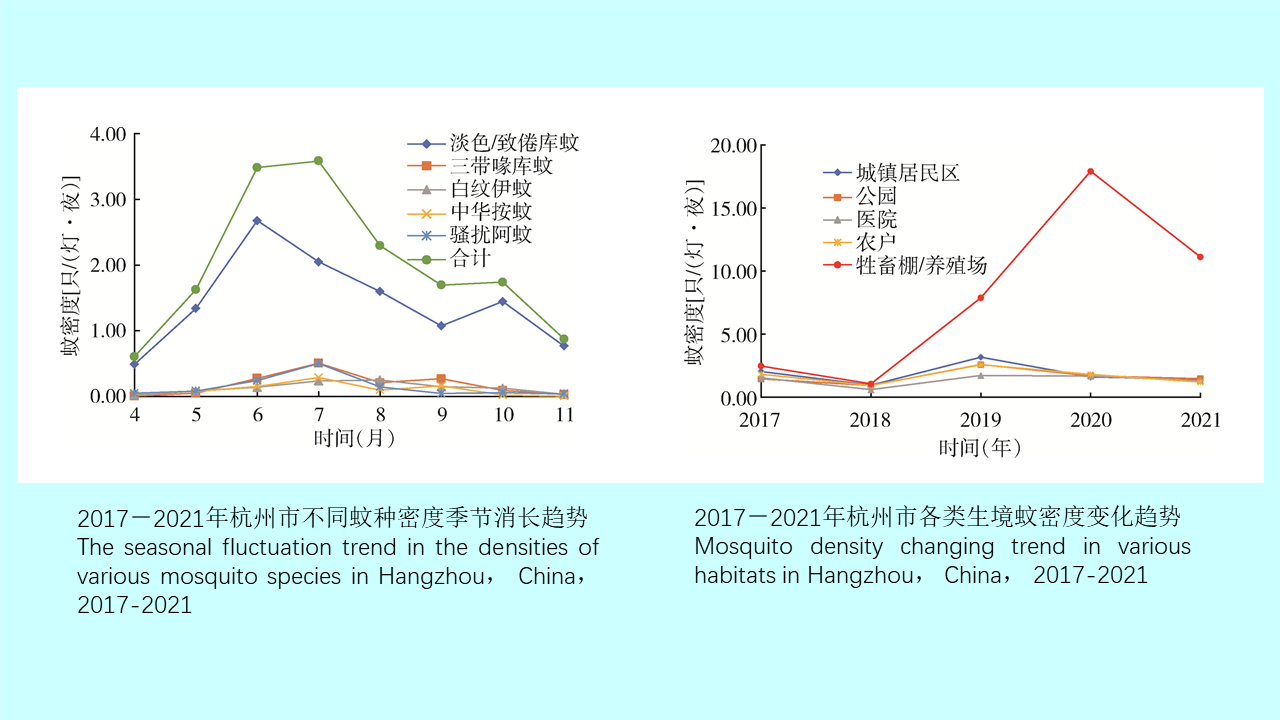
目的 了解杭州市2017-2021年媒介蚊虫密度及季节消长规律,为媒介控制和蚊媒传染病防制提供科学依据。方法 采用诱蚊灯法,按照《全国病媒生物监测实施方案》和《浙江省病媒生物监测工作方案》,每年4-11月对杭州市15个区(市、县)开展监测。使用Excel 2016软件对监测数据进行汇总,使用SPSS 21.0软件进行统计学分析,不同年份间蚊虫构成比差异进行卡方检验、不同生境间蚊密度差异进行单因素方差分析。结果 2017-2021年杭州市蚊密度为1.99只/(灯·夜),捕获的蚊虫以淡色/致倦库蚊为主,占71.90%;蚊虫密度季节消长趋势总体呈双峰型,7和10月为密度高峰。淡色/致倦库蚊、三带喙库蚊、白纹伊蚊、中华按蚊和骚扰阿蚊5类蚊种在不同年份间差异均有统计学意义(均P<0.001)。在不同的生境中,牲畜棚/养殖场平均蚊密度最高,达4.92只/(灯·夜);医院的平均蚊密度最低,为1.35只/(灯·夜);其中中华按蚊、骚扰阿蚊在不同生境中的密度差异均有统计学意义(F=3.581,P=0.023;F=5.431,P=0.004)。各类生境中均以淡色/致倦库蚊为优势蚊种,其次是三带喙库蚊、骚扰阿蚊、白纹伊蚊和中华按蚊,5类蚊虫均以牲畜棚/养殖场的密度最高。结论 杭州市蚊密度总体处于较低水平,以淡色/致倦库蚊为优势蚊种,在今后的工作中应重点加强牲畜棚/养殖场的蚊虫防制工作,建议各区(市、县)根据蚊媒密度变化、分布及季节消长规律采取针对性的蚊媒防制措施。
Objective To investigate the density and seasonal fluctuations of vector mosquitoes in Hangzhou, Zhejiang province, China from 2017 to 2021, and to provide a scientific basis for vector control and mosquito-borne disease prevention.Methods The light trap method was used to investigate 15 districts/counties/cities in Hangzhou from April to November, 2017-2021, in accordance with the "National Vector Surveillance Program" and "Zhejiang Province Vector Surveillance Program". Excel 2016 software was used to summarize the monitoring data, and SPSS 21.0 software was used for statistical analysis. The Chi-square test was used for the difference of mosquito composition ratio in different years, and one-way ANOVA was used for the difference of mosquito density in different habitats.Results From 2017 to 2021, the mosquito density in Hangzhou was 1.99 mosquitoes/light·night, and Culex pipiens pallens/quinquefasciatus (71.90%) was the dominant species. The seasonal fluctuation trend of mosquito density generally showed a bimodal curve, peaking in July and October. There were statistical differences in densities of Cx. pipiens pallens/quinquefasciatus, Cx. tritaeniorhynchus, Aedes albopictus, Anopheles sinensis, and Armigeres subalbatus between different years (all P<0.001). In terms of various habitats, livestock barns/farms had the highest mean mosquito density (4.92 mosquitoes/light·night), and hospitals had the lowest (1.35 mosquitoes/light·night). There were statistical differences in densities of An. sinensis and Ar. subalbatus between various habitats (F=3.581, P=0.023; F=5.431, P=0.004). Cx. pipiens pallens/quinquefasciatus was the dominant mosquito species in various habitats, followed by Cx. tritaeniorhynchus, Ar. subalbatus, Ae. albopictus, and An. sinensis. Livestock barns/farms had the highest mosquito densities in terms of any of the above five species.Conclusions The mosquito density in Hangzhou is generally at a low level. Cx. pipiens pallens/quinquefasciatus is the dominant species. In future mosquito control, livestock barns/farms should be highlighted for special attention. Local districts/cities/counties should take targeted mosquito control measures based on their density changes, distribution, and seasonal fluctuations.
[1] Song XM,Zhong ZW,Gao L,et al. Metabolic interactions between disease-transmitting vectors and their microbiota[J]. Trends Parasitol,2022,38(8):697-708. DOI:10.1016/j.pt. 2022.05.002.
[2] Arnoldi I,Mancini G,Fumagalli M,et al. A salivary factor binds a cuticular protein and modulates biting by inducing morphological changes in the mosquito labrum[J]. Curr Biol,2022,32(16):3493-3504.e11. DOI:10.1016/j.cub.2022.06.049.
[3] World Health Organization. Global vector control response 2017-2030[R]. Geneva:WHO,2017:7-13.
[4] 刘起勇. 新时代媒介生物传染病形势及防控对策[J]. 中国媒介生物学及控制杂志,2019,30(1):1-6,11. DOI:10.11853/j.issn.1003.8280.2019.01.001.Liu QY. Epidemic profile of vector-borne diseases and vector control strategies in the new era[J]. Chin J Vector Biol Control,2019,30(1):1-6,11. DOI:10.11853/j.issn.1003.8280.2019. 01.001.(in Chinese)
[5] 仲洁,何隆华. 气象因素对蚊虫密度影响研究进展[J]. 中国媒介生物学及控制杂志,2015,26(1):95-99. DOI:10.11853/j.issn.1003.4692.2015.01.028.Zhong J,He LH. Advances in research on impacts of meteorological factors on mosquito density[J]. Chin J Vector Biol Control,2015,26(1):95-99. DOI:10.11853/j.issn.1003.4692. 2015.01.028.(in Chinese)
[6] 郭玉红,刘京利,鲁亮,等. 诱蚊灯法与人工小时法捕蚊效果比较研究[J]. 中国媒介生物学及控制杂志,2012,23(6):529-532.Guo YH,Liu JL,Lu L,et al. Comparative study on mosquito-trapping effects of lamp trapping method and labor hour method[J]. Chin J Vector Biol Control,2012,23(6):529-532. (in Chinese)
[7] 郭玉红,吴海霞,刘小波,等. 2018年全国媒介蚊虫监测报告[J]. 中国媒介生物学及控制杂志,2019,30(2):128-133. DOI:10.11853/j.issn.1003.8280.2019.02.003.Guo YH,Wu HX,Liu XB,et al. National vectors surveillance report on mosquitoes in China,2018[J]. Chin J Vector Biol Control,2019,30(2):128-133. DOI:10.11853/j.issn.1003. 8280.2019.02.003.(in Chinese)
[8] 赵宁,郭玉红,吴海霞,等. 2019年全国媒介蚊虫监测报告[J]. 中国媒介生物学及控制杂志,2020,31(4):395-400. DOI:10.11853/j.issn.1003.8280.2020.04.003.Zhao N,Guo YH,Wu HX,et al. National vector surveillance report on mosquitoes in China,2019[J]. Chin J Vector Biol Control,2020,31(4):395-400. DOI:10.11853/j.issn.1003. 8280.2020.04.003.(in Chinese)
[9] 谢博,冯磊,顾盈培,等. 气候因素对浦东新区蚊虫密度影响的效应分析[J]. 中国媒介生物学及控制杂志,2019,30(4):430-433. DOI:10.11853/j.issn.1003.8280.2019.04.017.Xie B,Feng L,Gu YP,et al. An analysis of the effect of climatic factors on mosquito density in Pudong New Area,Shanghai,China[J]. Chin J Vector Biol Control,2019,30(4):430-433. DOI:10.11853/j.issn.1003.8280.2019.04.017.(in Chinese)
[10] 曹阳,韦凌娅,邵汉文,等. 2019年杭州市蚊虫监测及生态学特征[J]. 中国媒介生物学及控制杂志,2021,32(6):691-695. DOI:10.11853/j.issn.1003.8280.2021.06.007.Cao Y,Wei LY,Shao HW,et al. Mosquito surveillance and bionomics in Hangzhou,Zhejiang province,China,2019[J]. Chin J Vector Biol Control,2021,32(6):691-695. DOI:10. 11853/j.issn.1003.8280.2021.06.007.(in Chinese)
[11] Govella NJ,Chaki PP,Mpangile JM,et al. Monitoring mosquitoes in urban Dar es Salaam:Evaluation of resting boxes,window exit traps,CDC lighttraps,Ifakara tent traps and human landing catches[J]. Parasit Vectors,2011,4(1):40. DOI:10.1186/1756-3305-4-40.
[12] Yang WQ,Zhao SY,Xie YG,et al. Armigeres subalbatus is a potential vector for Zika virus but not dengue virus[J]. Infect Dis Poverty,2022,11(1):62. DOI:10.1186/s40249-022-00990-0.
[13] 运玲,王福才,张岭. 河北省唐山市2010-2020年蚊虫种群密度与季节消长监测分析[J]. 中国媒介生物学及控制杂志,2022,33(3):351-355. DOI:10.11853/j.issn.1003.8280.2022. 03.007.Yun L,Wang FC,Zhang L. Surveillance and analysis of mosquito population density and seasonal fluctuation in Tangshan,Hebei province,China,2010-2020[J]. Chin J Vector Biol Control,2022,33(3):351-355. DOI:10.11853/j.issn.1003.8280.2022. 03.007.(in Chinese)
[14] 丁俊,王纯玉,白玉银,等. 辽宁省2014-2018年蚊虫密度与季节消长监测分析[J]. 中国媒介生物学及控制杂志,2021,32(2):169-172. DOI:10.11853/j.issn.1003.8280.2021.02.010.Ding J,Wang CY,Bai YY,et al. Surveillance and analysis of mosquito density and seasonal fluctuation in Liaoning province,China,2014-2018[J]. Chin J Vector Biol Control,2021,32(2):169-172. DOI:10.11853/j.issn.1003.8280.2021.02.010.(in Chinese)


