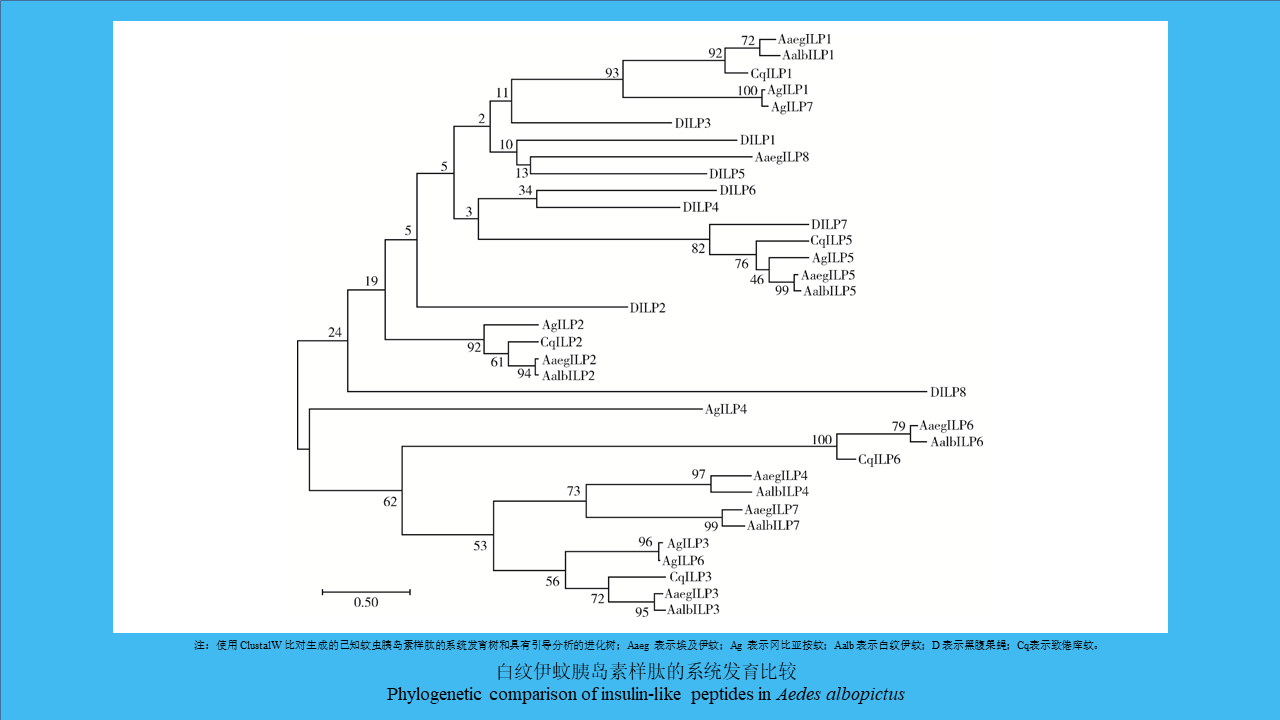
Objective To identify the insulin-like peptide (ILP) genes from the whole genome of Aedes albopictus, and to analyze the gene structure and its expression profiles at various developmental stages and in different tissues. Methods The ILP gene family was identified by homology comparison in the whole genome database of Ae. albopictus on the Vectorbase website. Signal peptide prediction was performed by SignalP 6.0 software. The structural features of ILP genes were analyzed by MEGA 11.0 software. The phylogenetic tree was constructed by the maximum likelihood method. Quantitative real-time PCR (qRT-PCR) was used to detect the changes in ILP gene expression at different mosquito developmental stages (eggs, fourth instar larvae, pupae, and adults) and in different tissues (head, fat body, midgut, thorax, and ovary) of female mosquitoes before and after blood feeding. SPSS 20.0 software was used for statistical analysis. The Tukey’s HSD test was used to analyze the expression of AalbILPs at different developmental stages, and the t-test was used to compare the expression of AalbILPs in different tissues before and after blood feeding. Results Seven AalbILP open reading frame sequences were identified from the whole genome of Ae. albopictus. The seven AalbILP sequences had the conserved characteristics of the insulin superfamily, and the propeptide consisted of continuous signal peptides, B, C, and A chains; AalbILP6 had a truncated C chain and carboxy-terminal extension, similar to the insulin growth factor in vertebrates. The clustering evolutionary tree demonstrated that AalbILP1, 2, 3, and 5 were most conservative among mosquitoes, followed by AalbILP6, and both AalbILP4 and 7 were unique to Aedes. The results of qRT-PCR showed that AalbILP1, 2, 3, and 5 were expressed at different developmental stages. Compared with other developmental stages, AalbILP5 was the highest expressed in male adult mosquitoes (1.358 3±0.576 9; qegg=6.572, qlarva=5.771, qpupa=5.409, qfemale=3.115, all P<0.05). AalbILP 3 and 4 were specifically expressed in the head of the whole mosquito, and AalbILP6 was principal expressed in the ovaries of female adult mosquitoes. AalbILP7 is a pseudogene and is not transcribed. Compared to the non-blood mosquitoes, the expression level of AalbILP3 and AalbILP4 in the head of female mosquitoes were significantly upregulated by 2.60 and 1.68 times (tAalbILP3- head=9.596, PAalbILP3- head<0.001; tAalbILP4-head=4.524, PAalbILP4-head=0.001); The expression of AalbILP1 in the head, fat body and midgut was up-regulated by 10.33, 6.07, and 3.79 times(thead=4.255, Phead=0.001; tfat body=4.305, Pfat body=0.001; tmigut=10.480, Pmigut<0.001), but the expression of throax and ovary decreased 4.24 and 2.17 times (tthroax=7.922, Pthroax<0.001; tovary=3.752, Povary=0.003); The expression of AalbILP6 in midgut and ovary was up-regulated 11.91 and 2.16 times (tmigut=5.799, Pmigut<0.001; tovary=9.074, Povary<0.001). Conclusions Six ILP sequences have been identified in the whole genome of Ae. albopictus and the spatiotemporal expression profiles of ILPs have been constructed.
[1] Gao Y,Zhang XJ,Yuan JB,et al. CRISPR/Cas9-mediated mutation on an insulin-like peptide encoding gene affects the growth of the ridgetail white prawn Exopalaemon carinicauda[J]. Front Endocrinol (Lausanne),2022,13:986491. DOI:10.3389/fendo.2022.986491.
[2] Defferrari MS,Da Silva SR,Orchard I,et al. A Rhodnius prolixus insulin receptor and its conserved intracellular signaling pathway and regulation of metabolism[J]. Front Endocrinol (Lausanne),2018,9:745. DOI:10.3389/fendo.2018.00745.
[3] Chen ZN,Hendricks M,Cornils A,et al. Two insulin-like peptides antagonistically regulate aversive olfactory learning in C. elegans[J]. Neuron,2013,77(3):572-585. DOI:10.1016/j.neuron.2012.11.025.
[4] Riehle MA,Brown MR. Insulin receptor expression during development and a reproductive cycle in the ovary of the mosquito Aedes aegypti[J]. Cell Tissue Res,2002,308(3):409-420. DOI:10.1007/s00441-002-0561-8.
[5] Sharma A,Nuss AB,Gulia-Nuss M. Insulin-like peptide signaling in mosquitoes:The road behind and the road ahead[J]. Front Endocrinol (Lausanne),2019,10:166. DOI:10.3389/fendo.2019.00166.
[6] Smit AB,Van Kesteren RE,Li KW,et al. Towards understanding the role of insulin in the brain:Lessons from insulin-related signaling systems in the invertebrate brain[J]. Prog Neurobiol,1998,54(1):35-54. DOI:10.1016/s0301-0082(97)00063-4.
[7] Lu CX,Lam HN,Menon RK. New members of the insulin family:Regulators of metabolism,growth and now... reproduction[J]. Pediatr Res,2005,57(5 Pt 2):70R-73R. DOI:10.1203/01.PDR.0000159573.55187.CA.
[8] Ohhara Y,Yamanaka N. Internal sensory neurons regulate stage-specific growth in Drosophila[J]. Development,2022,149(21):dev200440. DOI:10.1242/dev.200440.
[9] Gulia-Nuss M,Eum JH,Strand MR,et al. Ovary ecdysteroidogenic hormone activates egg maturation in the mosquito Georgecraigius atropalpus after adult eclosion or a blood meal[J]. J Exp Biol,2012,215(Pt 21):3758-3767. DOI:10.1242/jeb.074617.
[10] Ling L,Raikhel AS. Serotonin signaling regulates insulin-like peptides for growth,reproduction,and metabolism in the disease vector Aedes aegypti[J]. Proc Natl Acad Sci USA,2018,115(42):E9822-E9831. DOI:10.1073/Pnas.1808243115.
[11] Li YJ,Fu HR,Zhang FQ,et al. Insulin-like peptide receptor-mediated signaling pathways orchestrate regulation of growth in the pacific oyster (Crassostrea gigas),as revealed by gene expression profiles[J]. Int J Mol Sci,2021,22(10):5259 DOI:10.3390/ijms22105259.
[12] Nuss AB,Brown MR. Isolation of an insulin-like peptide from the Asian malaria mosquito,Anopheles stephensi,that acts as a steroidogenic gonadotropin across diverse mosquito taxa[J]. Gen Comp Endocrinol,2018,258:140-148. DOI:10.1016/j.ygcen. 2017.05.007.
[13] Nakai J,Chikamoto N,Fujimoto K,et al. Insulin and memory in invertebrates[J]. Front Behav Neurosci,2022,16:882932. DOI:10.3389/fnbeh.2022.882932.
[14] Riehle MA,Fan YL,Cao C,et al. Molecular characterization of insulin-like peptides in the yellow fever mosquito,Aedes aegypti:Expression,cellular localization,and phylogeny[J]. Peptides,2006,27(11):2547-2560. DOI:10.1016/j.peptides.2006.07.016.
[15] Ling L,Raikhel AS. Cross-talk of insulin-like peptides,juvenile hormone,and 20-hydroxyecdysone in regulation of metabolism in the mosquito Aedes aegypti[J]. Proc Natl Acad Sci USA,2021,118(6):e2023470118. DOI:10.1073/Pnas.2023470118.
[16] Pietri JE,Pietri EJ,Potts R,et al. Plasmodium falciparum suppresses the host immune response by inducing the synthesis of insulin-like peptides (ILPs) in the mosquito Anopheles stephensi[J]. Dev Comp Immunol,2015,53(1):134-144. DOI:10.1016/j.dci.2015.06.012.
[17] Marquez AG,Pietri JE,Smithers HM,et al. Insulin-like peptides in the mosquito Anopheles stephensi:Identification and expression in response to diet and infection with Plasmodium falciparum[J]. Gen Comp Endocrinol,2011,173(2):303-312. DOI:10.1016/j.ygcen.2011.06.005.
[18] Sim C,Denlinger DL. A shut-down in expression of an insulin-like peptide,ILP-1,halts ovarian maturation during the overwintering diapause of the mosquito Culex pipiens[J]. Insect Mol Biol,2009,18(3):325-332. DOI:10.1111/j.1365-2583. 2009.00872.x.
[19] Pooraiiouby R,Sharma A,Beard J,et al. Nutritional quality during development alters insulin-like peptides' expression and physiology of the adult yellow fever mosquito,Aedes aegypti[J]. Insects,2018,9(3):110. DOI:10.3390/insects9030110.
[20] Wen ZM,Gulia M,Clark KD,et al. Two insulin-like peptide family members from the mosquito Aedes aegypti exhibit differential biological and receptor binding activities[J]. Mol Cell Endocrinol,2010,328(1/2):47-55. DOI:10.1016/j.mce. 2010.07.003.
[21] Zhang HD,Xing D,Wang G,et al. Sequencing and analysis of the complete mitochondrial genome of Aedes albopictus (Diptera:Culicidae) in China[J]. Mitochondrial DNA A DNA Mapp Seq Anal,2016,27(4):2787-2788. DOI:10.3109/19401736.2015. 1053067.
[22] Dou XY,Chen KK,Brown MR,et al. Multiple endocrine factors regulate nutrient mobilization and storage in Aedes aegypti during a gonadotrophic cycle[J]. Insect Sci,2022:0,1-18. DOI:10.1111/1744-7917.13110.
[23] Martinson EO,Chen KK,Valzania L,et al. Insulin-like peptide 3 stimulates hemocytes to proliferate in anautogenous and facultatively autogenous mosquitoes[J]. J Exp Biol,2022,225(5):jeb243460. DOI:10.1242/jeb.243460.
[24] Valzania L,Mattee MT,Strand MR,et al. Blood feeding activates the vitellogenic stage of oogenesis in the mosquito Aedes aegypti through inhibition of glycogen synthase kinase 3 by the insulin and TOR pathways[J]. Dev Biol,2019,454(1):85-95. DOI:10.1016/j.ydbio.2019.05.011.
[25] Okawa ER,Gupta MK,Kahraman S,et al. Essential roles of insulin and IGF-1 receptors during embryonic lineage development[J]. Mol Metab,2021,47:101164. DOI:10.1016/j.molmet.2021.101164.
[26] Riehle MA,Brown MR. Molecular analysis of the serine/threonine kinase Akt and its expression in the mosquito Aedes aegypti[J]. Insect Mol Biol,2003,12(3):225-232. DOI:10.1046/j.1365-2583.2003.00405.x.


