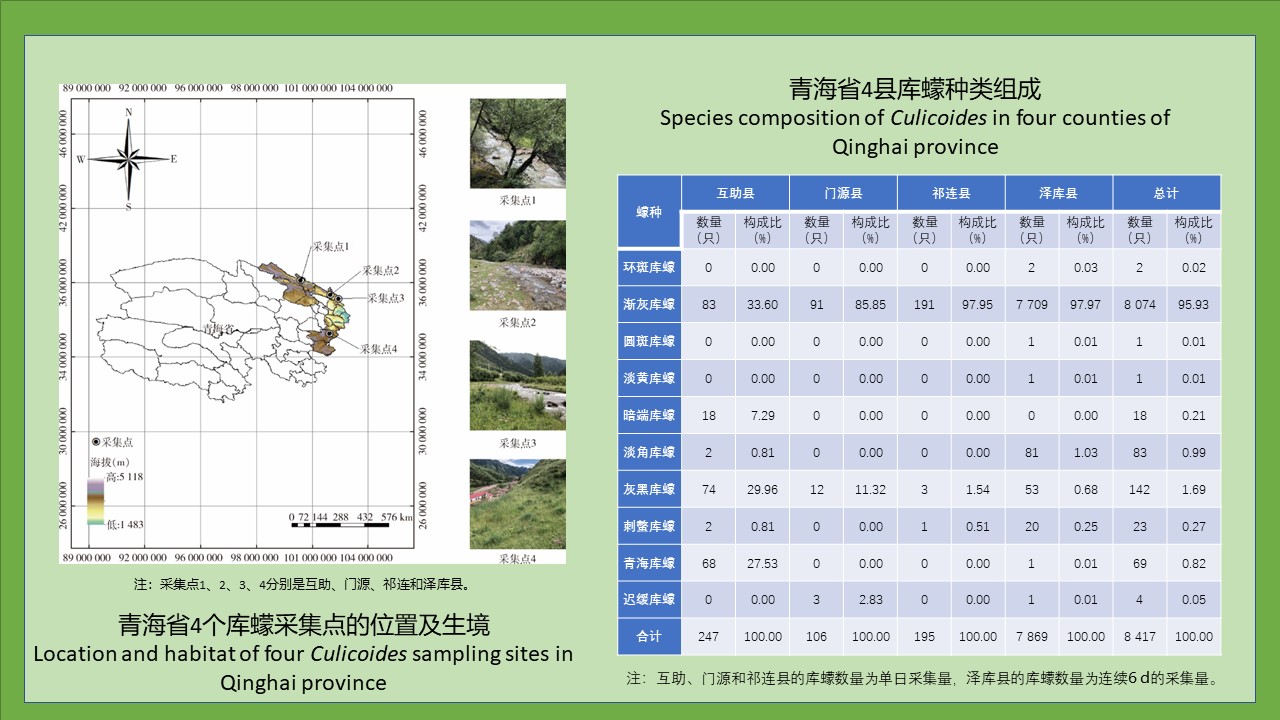
Objective To investigate the species distribution and species composition of Culicoides in Huzhu, Menyuan, Qilian, and Zeku county in Qilian Mountain National Park and Maixiu Nature Reserve in Qinghai province, China, and to discuss the influence of meteorological factors on the distribution of Culicoides in the above areas. Methods From July to August 2020, Culicoides midges were captured with light traps in the above four counties. After classification and identification, the Pearson correlation test and plotting of relationship between altitude, meteorological factors, and the number of collected Culicoides were performed using SPSS 25.0 and GraphPad Prism 8.2.1 softwares. Results A total of 8 417 Culicoides midges were collected, and 10 species from 5 subgenera were identified, including 6 newly recorded species in Qinghai province, namely C. grisescens, C. punctatus, C. segnis, C. nigritus, C. halonostictus, and C. pallidicornis. The dominant species in all four counties was C. grisescens, which accounted for 33.60%, 85.85%, 97.95%, and 97.97% of the total number of Culicoides midges at the four sampling sites, respectively. The blood sucking rates of C. grisescens, C. pallidicornis, and C. pulicaris were 2.23%, 1.23%, and 1.89% in Zeku county, respectively. The Pearson correlation test showed that the single-day number of captures of Culicoides had no correlation with altitude (R2=0.130, P=0.639) and wind speed (R2=0.059, P=0.641), but showed negative correlation with rainfall (R2=0.199, P=0.038) and average temperature (R2=0.838, P=0.010) in the survey area. Conclusion There are 10 species of Culicoides from 5 subgenera captured in the four counties of eastern Qinghai province. C. grisescens is the dominant species. The population density of Culicoides in this area is correlated with the rainfall and average temperature.
[1] 杨定, 李竹, 刘启飞, 等. 中国生物物种名录. 第2卷. 动物. 昆虫(V)双翅目(1)长角亚目[M]. 北京:科学出版社, 2020:119-220. Yang D, Li Z, Liu QF, et al. Species catalogue of China (volume 2), Animals Insecta (V). Diptera (1). Nematocera[M]. Beijing:Science Press, 2020:119-220. (in Chinese)
[2] 刘增加, 张继军, 宫占威, 等. 青海省双翅目蠓科昆虫研究[J]. 中华卫生杀虫药械, 2008, 14(5):357-361. DOI:10.3969/j.issn.1671-2781.2008.05.011. Liu ZJ, Zhang JJ, Gong ZW, et al. Study on Ceratopogonidae of Qinghai province[J]. Chin J Hyg Insectic Equip, 2008, 14(5):357-361. DOI:10.3969/j.issn.1671-2781.2008.05.011.(in Chinese)
[3] Borkent A, Dominiak P. Catalog of the biting midges of the world (Diptera:Ceratopogonidae)[J]. Zootaxa, 2020, 4787(1):1-377. DOI:10.11646/zootaxa.4787.1.1.
[4] Tago D, Hammitt JK, Thomas A, et al. Cost assessment of the movement restriction policy in France during the 2006 bluetongue virus episode (BTV-8)[J]. Prev Vet Med, 2014, 117(3/4):577-589. DOI:10.1016/j.prevetmed.2014.10.010.
[5] 刘增加, 宫占威, 石淑珍, 等. 青藏铁路格尔木至唐古拉山段的重要吸血双翅目昆虫的分布与活动规律[J]. 寄生虫与医学昆虫学报, 2007, 14(4):218-224. DOI:10.3969/j.issn.1005-0507.2007.04.006. Liu ZJ, Gong ZW, Shi SZ, et al. The distribution and activity rhythm of the important blood-sucking insects (diptera) along the Qinghai-Tibet railway line from Gerrmu to Tanggula mountain[J]. Acta Parasitol Med Entomol Sin, 2007, 14(4):218-224. DOI:10.3969/j.issn.1005-0507.2007.04.006.(in Chinese)
[6] 花群义, 花群俊, 陈兵, 等. 我国动物虫媒病毒媒介库蠓种类分布[J]. 上海畜牧兽医通讯, 2015(3):58-61. DOI:10.14170/j.cnki.cn31-1278/s.2015.03.026. Hua QY, Hua QJ, Chen B, et al. Distribution of Culicoides species as animal arbovirus vectors in China[J]. Shanghai J Anim Husb Vet Med, 2015(3):58-61. DOI:10.14170/j.cnki.cn31-1278/s.2015.03.026.(in Chinese)
[7] Häsler B, Howe KS, Di Labio E, et al. Economic evaluation of the surveillance and intervention programme for bluetongue virus serotype 8 in Switzerland[J]. Prev Vet Med, 2012, 103(2/3):93-111. DOI:10.1016/j.prevetmed.2011.09.013.
[8] Waret-Szkuta A, Alarcon P, Hasler B, et al. Economic assessment of an emerging disease:The case of Schmallenberg virus in France[J]. Rev Sci Tech, 2017, 36(1):265-277. DOI:10.20506/rst.36.1.2627.
[9] Endalew AD, Faburay B, Wilson WC, et al. Schmallenberg disease:A newly emerged Culicoides-borne viral disease of ruminants[J]. Viruses, 2019, 11(11):1065. DOI:10.3390/v11111065.
[10] Sick F, Beer M, Kampen H, et al. Culicoides biting midges:Underestimated vectors for arboviruses of public health and veterinary importance[J]. Viruses, 2019, 11(4):376. DOI:10.3390/v11040376.
[11] 虞以新, 刘金华, 刘国平, 等. 中国蠓科昆虫[M]. 北京:军事医学科学出版社, 2005:815-1323, 1618-1646, 1682-1683. Yu YX, Liu JH, Liu GP, et al. Ceratopogonidae of China[M]. Beijing:Military Medical Science Press, 2005:815-1323, 1618-1646, 1682-1683. (in Chinese)
[12] Carpenter S, Szmaragd C, Barber J, et al. An assessment of Culicoides surveillance techniques in northern Europe:Have we underestimated a potential bluetongue virus vector?[J]. J Appl Ecol, 2008, 45(4):1237-1245. DOI:10.1111/j.1365-2664. 2008.01511.x.
[13] Venter GJ, Boikanyo SNB, De Beer CJ. The influence of temperature and humidity on the flight activity of Culicoides imicola both under laboratory and field conditions[J]. Parasit Vectors, 2019, 12(1):4. DOI:10.1186/s13071-018-3272-z.
[14] Gao HY, Wang L, Ma J, et al. Modeling the current distribution suitability and future dynamics of Culicoides imicola under climate change scenarios[J]. PeerJ, 2021, 9:e12308. DOI:10.7717/peerj.12308.
[15] Barceló C, Miranda MA. Development and lifespan of Culicoides obsoletus s. s. (Meigen) and other livestock-associated species reared at different temperatures under laboratory conditions[J]. Med Vet Entomol, 2021, 35(2):187-201. DOI:10.1111/mve.12487.
[16] Cuéllar AC, Kjær LJ, Kirkeby C, et al. Spatial and temporal variation in the abundance of Culicoides biting midges (Diptera:Ceratopogonidae) in nine European countries[J]. Parasit Vectors, 2018, 11(1):112. DOI:10.1186/s13071-018-2706-y.
[17] Paslaru AI, Torgerson PR, Veronesi E. Summer seasonal prevalence of Culicoides species from pre-alpine areas in Switzerland[J]. Med Vet Entomol, 2021, 35(3):324-332. DOI:10.1111/mve.12500.
[18] Lysyk TJ, Couloigner I, Massolo A, et al. Relationship between weather and changes in annual and seasonal abundance of Culicoides sonorensis (Diptera:Ceratopogonidae) in Alberta[J]. J Med Entomol, 2023, 60(1):90-101. DOI:10.1093/jme/tjac157.
[19] Ander M, Meiswinkel R, Chirico J. Seasonal dynamics of biting midges (Diptera:Ceratopogonidae:Culicoides), the potential vectors of bluetongue virus, in Sweden[J]. Vet Parasitol, 2012, 184(1):59-67. DOI:10.1016/j.vetpar.2011.08.009.
[20] 贺晓龙. 青海省牛羊蓝舌病血清学调查[J]. 中国动物检疫, 2011, 28(3):62-63. DOI:10.3969/j.issn.1005-944X.2011.03.023. He XL. Serological investigation of bluetongue disease in bovine and ovine in Qinghai province[J]. China Anim Health Insp, 2011, 28(3):62-63. DOI:10.3969/j.issn.1005-944X.2011.03.023.(in Chinese)
[21] Sanders CJ, Shortall CR, England M, et al. Long-term shifts in the seasonal abundance of adult Culicoides biting midges and their impact on potential arbovirus outbreaks[J]. J Appl Ecol, 2019, 56(7):1649-1660. DOI:10.1111/1365-2664.13415.
[22] Mellor PS, Boorman J, Baylis M. Culicoides biting midges:Their role as arbovirus vectors[J]. Annu Rev Entomol, 2000, 45:307-340. DOI:10.1146/annurev.ento.45.1.307.
[23] Hassine TB, Sghaier S, Thabet S, et al. Role of eco-climatic factors in the distribution of bluetongue in endemic areas in Tunisia[J]. Open Vet J, 2022, 12(1):114-123. DOI:10.5455/OVJ.2022.v12.i1.14.


