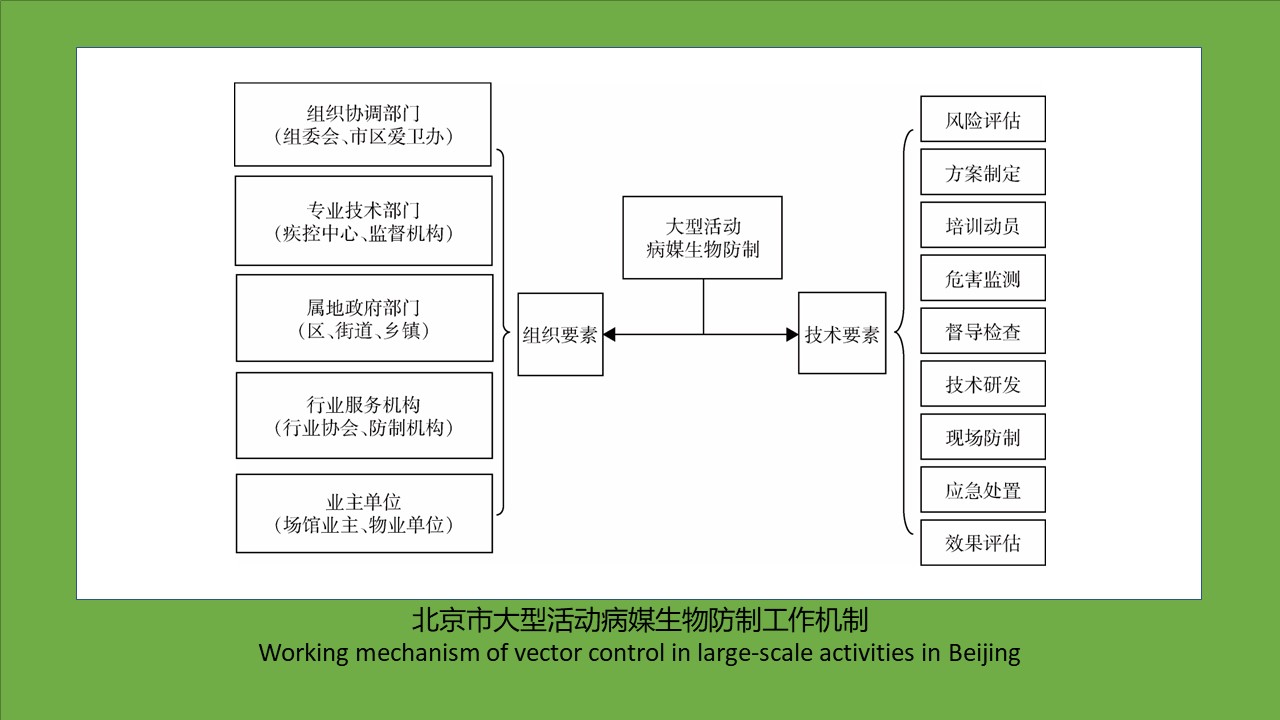
In 2022, the Winter Olympic Games was first held in Beijing, China. To ensure that the key areas of the Winter Olympic Games were not affected by vectors and to minimize the risk of vector-borne diseases, the density of vectors in the key areas of the Winter Olympic Games and the cities where they are located should be effectively controlled. This paper focuses on the vector control strategy and working mechanism during Beijing 2022 Winter Olympic Games, and discusses the control model, risk assessment, inter-sectoral coordination, publicity and training, hazard monitoring, control technology, supervision and inspection, and emergency response with Main Media Center as an example. The vector density was effectively controlled during the Winter Olympic Games, no plague and other vector-borne diseases occurred, and there were no incidents of vector-borne hazards. The vector control model, technical measures, and working mechanism formed during the Beijing 2008 Summer Olympic Games were verified and deepened in the Beijing 2022 Winter Olympic Games, which can be used as a guidance for vector control in similar large-scale activities in the future.
[1] 李军凯, 张婷, 罗希婧. 突发公共卫生事件背景下北京冬奥会风险防范与对策研究[J]. 科技智囊, 2021(1):43-47. DOI:10.19881/j.cnki.1006-3676.2021.01.03. Li JK, Zhang T, Luo XJ. Under the background of public health emergency, risk prevention and counter measure research of Beijing Winter Olympic Games[J]. Think Tank Sci Technol, 2021(1):43-47. DOI:10.19881/j.cnki.1006-3676.2021.01.03.(in Chinese)
[2] 姜丽. 从北京冬奥会看新冠肺炎疫情背景下的国家软实力建设[J]. 当代世界, 2022(2):26-31. DOI:10.3969/j.issn.1006-4206.2022.02.007. Jiang L. China's soft power construction amid the COVID-19 pandemic:A Beijing winter Olympics perspective[J]. Contemp World, 2022(2):26-31. DOI:10.3969/j.issn.1006-4206.2022. 02.007.(in Chinese)
[3] 刘韵. 公共卫生风险下体育赛事相关决策的根据及应对研究:基于奥运会的分析视角和利益主体的具体路径[J]. 北京体育大学学报, 2021, 44(7):123-131. DOI:10.19582/j.cnki.11-3785/g8.2021.07.012. Liu Y. Basis for decision-making and coping strategies for sporting events under public health risks:From an analytical perspective of the Olympic Games and the specific approach of stakeholders[J]. J Beijing Sport Univ, 2021, 44(7):123-131. DOI:10.19582/j.cnki.11-3785/g8.2021.07.012.(in Chinese)
[4] Rodriguez-Valero N, Borobia AM, Lago M, et al. Zika virus screening among Spanish team members after 2016 Rio de Janeiro, Brazil, Olympic Games[J]. Emerg Infect Dis, 2017, 23(8):1426-1428. DOI:10.3201/eid2308.170415.
[5] 曾晓芃, 钱坤, 马彦, 等. 2008年北京奥运会期间病媒生物控制效果分析与经验启示[J]. 中国媒介生物学及控制杂志, 2008, 19(6):526-530. DOI:10.3969/j.issn.1003-4692. 2008. 06.012. Zeng XP, Qian K, Ma Y, et al. Effect analysis and experience enlightenment from vector control during 2008 Beijing Olympic Games[J]. Chin J Vector Biol Control, 2008, 19(6):526-530. DOI:10.3969/j.issn.1003-4692.2008.06.012.(in Chinese)
[6] 张勇, 周小洁, 刘婷, 等. 2015年北京市病媒生物监测结果分析[J]. 首都公共卫生, 2017, 11(1):7-10. DOI:10.16760/j.cnki.sdggws.2017.01.003. Zhang Y, Zhou XJ, Liu T, et al. Analysis on the results of vector surveillance in Beijing, 2015[J]. Cap J Public Health, 2017, 11(1):7-10. DOI:10.16760/j.cnki.sdggws.2017.01.003.(in Chinese)
[7] 刘起勇. 2005-2020年我国媒介生物传染病报告病例:流行趋势、防控挑战及应对策略[J]. 中国媒介生物学及控制杂志, 2022, 33(1):1-7. DOI:10.11853/j.issn.1003.8280.2022.01.001. Liu QY. Reported cases of vector-borne diseases in China, 2005-2020:Epidemic trend, challenges in prevention and control, and related coping strategies[J]. Chin J Vector Biol Control, 2022, 33(1):1-7. DOI:10.11853/j.issn.1003.8280.2022.01.001.(in Chinese)
[8] 曾晓芃, 马彦, 佟颖, 等. 奥运会病媒生物控制保障主要策略及经验启示[J]. 中华卫生杀虫药械, 2010, 16(2):95-101. DOI:10.19821/j.1671-2781.2010.02.004. Zeng XP, Ma Y, Tong Y, et al. The main strategy and experience inspiration of vector control safeguard in Olympic Games[J]. Chin J Hyg Insectic Equip, 2010, 16(2):95-101. DOI:10.19821/j.1671-2781.2010.02.004.(in Chinese)
[9] 张勇, 马彦, 邓瑛, 等. 2008年北京奥运会开闭幕式病媒生物控制措施及其效果分析[J]. 中国媒介生物学及控制杂志, 2009, 20(1):34-37. Zhang Y, Ma Y, Deng Y, et al. Strategy and effect analysis of vector control for the opening and closing ceremony of 2008 Beijing Olympic Games[J]. Chin J Vector Biol Control, 2009, 20(1):34-37. (in Chinese)
[10] 徐爱玲, 栗冬梅, 刘起勇. "鼠源疾病"的概念与内涵的系统评价[J]. 中国媒介生物学及控制杂志, 2022, 33(2):161-170, 176. DOI:10.11853/j.issn.1003.8280.2022.02.001. Xu AL, Li DM, Liu QY. The concept and connotation of "rodent-borne diseases":A systematic study[J]. Chin J Vector Biol Control, 2022, 33(2):161-170, 176. DOI:10.11853/j.issn.1003. 8280.2022.02.001.(in Chinese)
[11] 陈永明, 康东梅, 杜国义, 等. 第24届冬奥会张家口赛区2018-2021年野外小兽类调查结果分析[J]. 中国媒介生物学及控制杂志, 2022, 33(2):293-296. DOI:10.11853/j.issn. 1003.8280.2022.02.024. Chen YM, Kang DM, Du GY, et al. Investigation of small mammals from 2018 to 2021 in the Zhangjiakou competition zone of the 24th Olympic Winter Games[J]. Chin J Vector Biol Control, 2022, 33(2):293-296. DOI:10.11853/j.issn.1003. 8280.2022.02.024.(in Chinese)
[12] 陈永明, 康东梅, 兰晓宇, 等. 第24届冬奥会崇礼赛区2019-2021年野鼠寄生蚤调查分析[J]. 中国媒介生物学及控制杂志, 2022, 33(3):414-417. DOI:10.11853/j.issn.1003.8280. 2022.03.019. Chen YM, Kang DM, Lan XY, et al. Investigation of parasitic fleas on wild rodents in Chongli competition zone of the 24th Olympic Winter Games[J]. Chin J Vector Biol Control, 2022, 33(3):414-417. DOI:10.11853/j.issn.1003.8280.2022.03.019.(in Chinese)
[13] 曾晓芃, 付学锋, 张勇, 等. 2008年北京奥运会病媒生物风险识别与评估方法研究[J]. 中国媒介生物学及控制杂志, 2009, 20(2):98-101, 113. Zeng XP, Fu XF, Zhang Y, et al. Study on the method of risk recognition and assessment of vector for 2008 Beijing Olympic Games[J]. Chin J Vector Biol Control, 2009, 20(2):98-101, 113. (in Chinese)
[14] 齐宏亮, 董言德, 梅扬, 等. 创建国家卫生城市对病媒生物防治效果的影响研究[J]. 中华卫生杀虫药械, 2016, 22(2):145-147, 152. DOI:10.19821/j.1671-2781.2016.02.013. Qi HL, Dong YD, Mei Y, et al. Impact of creating national healthy city on vector control effect[J]. Chin J Hyg Insectic Equip, 2016, 22(2):145-147, 152. DOI:10.19821/j.1671-2781.2016.02.013.(in Chinese)


