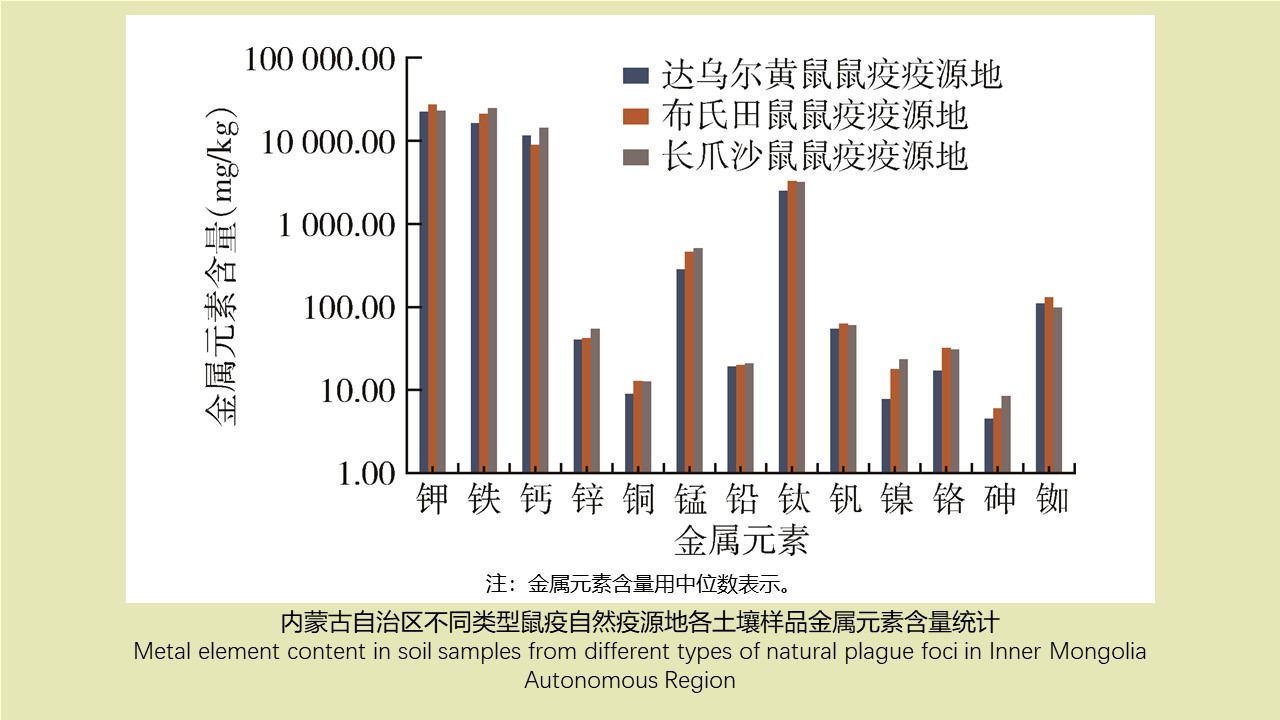
目的 调查2021年内蒙古自治区(内蒙古)不同类型鼠疫自然疫源地土壤金属元素含量,对比分析不同类型鼠疫自然疫源地土壤金属元素含量的差异。方法 对内蒙古达乌尔黄鼠、布氏田鼠和长爪沙鼠鼠疫自然疫源地进行土样采集。X射线荧光分析仪测量土壤中钾、铁、钙等13种金属元素含量,应用Excel 2021软件录入并整理数据,SPSS 20.0 软件进行独立样本t检验、Mann-Whitney U test和Pearson相关分析。结果 内蒙古达乌尔黄鼠与布氏田鼠鼠疫疫源地钾(t=-3.058,P=0.012)、铷(t=-2.717,P=0.007)元素含量,达乌尔黄鼠与长爪沙鼠鼠疫疫源地铁(Z=-4.416,P<0.001)、锌(t=-3.186,P=0.005)、锰(t=-4.471,P<0.001)、钛(Z=-2.598,P=0.017)、钒(Z=-2.184,P=0.029)和镍(t=-2.799,P=0.011)元素含量以及布氏田鼠与长爪沙鼠鼠疫疫源地钾(t=3.910,P=0.001)、钙(Z=-2.974,P=0.003)和铷(t=6.176,P<0.001)元素含量差异均有统计学意义。布氏田鼠鼠疫疫源地土壤中钾、铜、钛、钒、铬元素含量较达乌尔黄鼠、长爪沙鼠鼠疫疫源地高,长爪沙鼠鼠疫疫源地土壤中铁、钙、锌、锰、铅、镍、砷、铷元素含量较达乌尔黄鼠、布氏田鼠鼠疫疫源地高,除铬元素外,其余12种金属元素在3类鼠疫疫源地中存在相关性(均P<0.05)。结论 内蒙古3种类型鼠疫自然疫源地土壤中富含钾、铁、钙元素,但土壤中多数金属元素含量存在分布差异,并且金属元素含量之间存在相关性。
Objective To investigate the content of metal elements in soil of different types of natural plague foci in Inner Mongolia Autonomous Region in 2021, and to compare and analyze the differences in the content of metal elements in soil of different types of natural plague foci. Methods Soil samples were collected from the natural plague foci of Spermophilus dauricus, Microtus brandti, and Meriones unguiculatus in Inner Mongolia Autonomous Region. An X-ray fluorescence analyzer was used to measure the content of 13 metal elements such as potassium, iron, and calcium in soil. Excel 2021 software was used for data collection and analysis, and SPSS 20.0 software was used to conduct independent samples t-test, Mann-Whitney U test, and Pearson correlation analysis. Results Statistical differences were found in the contents of potassium (t=-3.058, P=0.012) and rubidium (t=-2.717, P=0.007) between the plague foci of S. dauricus and M. brandti, the contents of iron (Z=-4.416, P<0.001), zinc (t=-3.186, P=0.005), manganese (t=-4.471, P<0.001), titanium (Z=-2.598, P=0.017), vanadium (Z=-2.184, P=0.029), and nickel (t=-2.799, P=0.011) between the plague foci of S. dauricus and M. unguiculatus, and the contents of potassium (t=3.910, P=0.001), calcium (Z=-2.974, P=0.003), and rubidium (t=6.176, P<0.001) between the plague foci of M. brandti and M. unguiculatus. The contents of potassium, copper, titanium, vanadium, and chromium in the soil of M. brandti plague foci were higher than those in S. dauricus and M. unguiculatus plague foci. The contents of iron, calcium, zinc, manganese, lead, nickel, arsenic, and rubidium in the soil of M. unguiculatus plague foci were higher than those in S. dauricus and M. brandti plague foci. Apart from chromium, the other 12 metal elements were related in three types of plague foci (all P<0.05). Conclusion The soil of three types of plague natural foci in Inner Mongolia Autonomous Region is rich in potassium, iron, and calcium elements. There are differences in the distribution of most metal elements in the soil among the three types of plague natural foci, and there are correlations between the metal elements.
[1] 刘纪有,张万荣. 内蒙古鼠疫[M]. 呼和浩特:内蒙古人民出版社,1997:84. Liu JY,Zhang WR. Pestis in Inner Mongolia[M]. Hohhot:Inner Mongolia People's Publishing House,1997:84. (in Chinese)
[2] 方喜业. 中国鼠疫自然疫源地[M]. 北京:人民卫生出版社,1990:26. Fang XY. Natural focuses of plague in China[M]. Beijing:People's Medical Publishing House,1990:26. (in Chinese)
[3] 段天一. 1997-2016年内蒙古自治区长爪沙鼠鼠疫自然疫源地鼠疫监测流行病特征分析[D]. 长春:吉林大学,2018. Duan TY. Analysis on epidemic characteristics of plague monitoring in natural foci of Mongolian gerbil in Inner Mongolia Autonomous Region from 1997 to 2016[D]. Changchun:Jilin University,2018. (in Chinese)
[4] 贺兆锴. 旱獭、长爪沙鼠、齐氏姬鼠-大绒鼠鼠疫自然疫源地鼠疫流行特征研究[D]. 北京:中国疾病预防控制中心,2021. DOI:10.27511/d.cnki.gzyyy.2021.000082. He ZK. Research on plague epidemic characteristics of plague natural foci of marmota,Meriones unguiculatus and Apodemus chevrieri-Eothenomys miletus[D]. Beijing:Chinese Center for Disease Control and Prevention,2021. DOI:10.27511/d.cnki.gzyyy.2021.000082.(in Chinese)
[5] 邴琪,王照,关心. 鼠疫菌保存机理研究进展[J]. 中国地方病防治,2021,36(6):588-590. Bing Q,Wang Z,Guan X. Research progress on the preservation mechanism of Yersinia pestis[J]. Chin J Ctrl Endem Dis,2021,36(6):588-590. (in Chinese)
[6] 刘琦. 便携式X射线荧光仪分析土壤中重金属的方法研究[D]. 西安:西安科技大学,2017. Liu Q. Portable X-ray fluorescence analyzer test spectrometer analysis of heavy metals in soil[D]. Xi'an:Xi'an University of Science and Technology,2017. (in Chinese)
[7] 王秀芳,尹家祥. 鼠疫复燃因素的分析[J]. 中华地方病学杂志,2014,33(1):116-118. DOI:10.3760/cma.j.issn.2095-4255. 2014.01.038. Wang XF,Yin JX. Analysis on the factors of pestis resurgence[J]. Chin J Endemiol,2014,33(1):116-118. DOI:10.3760/cma.j.issn.2095-4255.2014.01.038.(in Chinese)
[8] 李瑞,尹家祥. 生态地理景观要素土壤与鼠疫的关系[J]. 中国人兽共患病学报,2020,36(10):876-880.DOI:10.3969/j.issn.1002-2694.2020.00.125. Li R,Yin JX. Relationship between the soil element in eco-geographical landscape and the occurrence of plague[J]. Chin J Zoonoses,2020,36(10):876-880.DOI:10.3969/j.issn.1002-2694.2020.00.125.(in Chinese)
[9] Barbieri R,Signoli M,Chevé D,et al. Yersinia pestis:The natural history of plague[J]. Clin Microbiol Rev,2020,34(1):e00044-19. DOI:10.1128/CMR.00044-19.
[10] 魏有文,陈洪舰,孟献亚,等. 青海青南地区鼠疫自然疫源地鼠疫高发区与静息区土壤中12种金属元素含量分析[J]. 中华地方病学杂志,2021,40(12):947-952. DOI:10.3760/cma.j.cn231583-20210203-00116. Wei YW,Chen HJ,Meng XY,et al. Contents of 12 soil metal elements in the plague high incidence area and resting area in the plague natural foci of Qingnan region of Qinghai province[J]. Chin J Endemiol,2021,40(12):947-952. DOI:10.3760/cma.j.cn231583-20210203-00116.(in Chinese)
[11] 李瑞. 云南家鼠鼠疫疫源地三县(市)地表土壤特性研究[D]. 大理:大理大学,2021. DOI:10.27811/d.cnki.gdixy.2021. 000235. Li R. Study on surface soil characteristics of commensal rodent plague foci in three counties of Yunnan province[D]. Dali:Dali University,2021. DOI:10.27811/d.cnki.gdixy.2021.000235.(in Chinese)
[12] 史书文,樊振亚. 铁对缺失外膜蛋白质(E.J)或Pst-鼠疫菌增强毒力的作用[J]. 中国地方病防治杂志,1991,6(3):162-163. Shi SW,Fan ZY. The role of iron in enhancing the virulence of absence of outer membrane protein (E. J) or Pst- pestis[J]. Chin J Ctrl Endem Dis,1991,6(3):162-163. (in Chinese)
[13] Chen YL,Song K,Chen X,et al. Attenuation of Yersinia pestis fyuA mutants caused by iron uptake inhibition and decreased survivability in macrophages[J]. Front Cell Infect Microbiol,2022,12:874773. DOI:10.3389/fcimb.2022.874773.
[14] 陈雨露,宋凯,焦扬,等. 鼠疫耶尔森菌铁转运系统研究进展[J]. 军事医学,2021,45(11):868-872. DOI:10.7644/j.issn. 1674-9960.2021.11.014. Chen YL,Song K,Jiao Y,et al. Research progress on iron transport system of Yersinia pestis[J]. Mil Med Sci,2021,45(11):868-872. DOI:10.7644/j.issn.1674-9960.2021.11.014.(in Chinese)
[15] Balderas D,Mettert E,Lam HN,et al. Genome scale analysis reveals IscR directly and indirectly regulates virulence factor genes in pathogenic Yersinia[J]. mBio,2021,12(3):e0063321. DOI:10.1128/mBio.00633-21.
[16] Hooker-Romero D,Mettert E,Schwiesow L,et al. Iron availability and oxygen tension regulate the Yersinia Ysc type Ⅲ secretion system to enable disseminated infection[J]. PLoS Pathog,2019,15(12):e1008001. DOI:10.1371/journal.ppat. 1008001.
[17] 廖何斌,刘马峰,程安春. 部分革兰氏阴性菌TonB蛋白的结构特点及作用机制[J]. 微生物学报,2015,55(5):529-536. DOI:10.13343/j.cnki.wsxb.20140530. Liao HB,Liu MF,Cheng AC. Structural features and functional mechanism of TonB in some Gram-negative bacteria:A review[J]. Acta Microbiol Sin,2015,55(5):529-536. DOI:10.13343/j.cnki.wsxb.20140530.(in Chinese)
[18] Price SL,Vadyvaloo V,DeMarco JK,et al. Yersiniabactin contributes to overcoming zinc restriction during Yersinia pestis infection of mammalian and insect hosts[J]. Proc Natl Acad Sci USA,2021,118(44):e2104073118. DOI:10.1073/pnas. 2104073118.
[19] Perry RD,Fetherston JD. Yersiniabactin iron uptake:Mechanisms and role in Yersinia pestis pathogenesis[J]. Microbes Infect,2011,13(10):808-817. DOI:10.1016/j.micinf. 2011.04.008.
[20] 浦清江,张春华. 鼠疫耶尔森氏菌外膜蛋白研究进展[J]. 中国地方病防治杂志,2005,20(5):276-278. Pu QJ,Zhang CH. Research progress of outer membrane protein of Yersinia pestis[J]. Chin J Ctrl Endem Dis,2005,20(5):276-278. (in Chinese)
[21] 周芸,尹家祥. 金属元素铁锌锰铜与传染性疾病的关系[J]. 职业与健康,2017,33(13):1869-1872. DOI:10.13329/j.cnki.zyyjk.2017.0564. Zhou Y,Yin JX. Relationship between infectious diseases and metal elements of iron,zinc,manganese and copper[J]. Occup Health,2017,33(13):1869-1872. DOI:10.13329/j.cnki.zyyjk. 2017.0564.(in Chinese)


