董利, 李贵昌, 王彬, 鲁亮, 赵宁, 宛新荣, 刘伟, 胡斌, 兴安, 李庆多, 李超, 王振旭, 张璐, 刘雨秋, 马德龙, 潘劲超, 何宏轩, 马伟, 刘起勇
. 内蒙古自治区东部草原鼠体寄生恙螨调查[J]. 中国媒介生物学及控制杂志, 2022
, 33(6)
: 873
-878
.
DOI: 10.11853/j.issn.1003.8280.2022.06.021
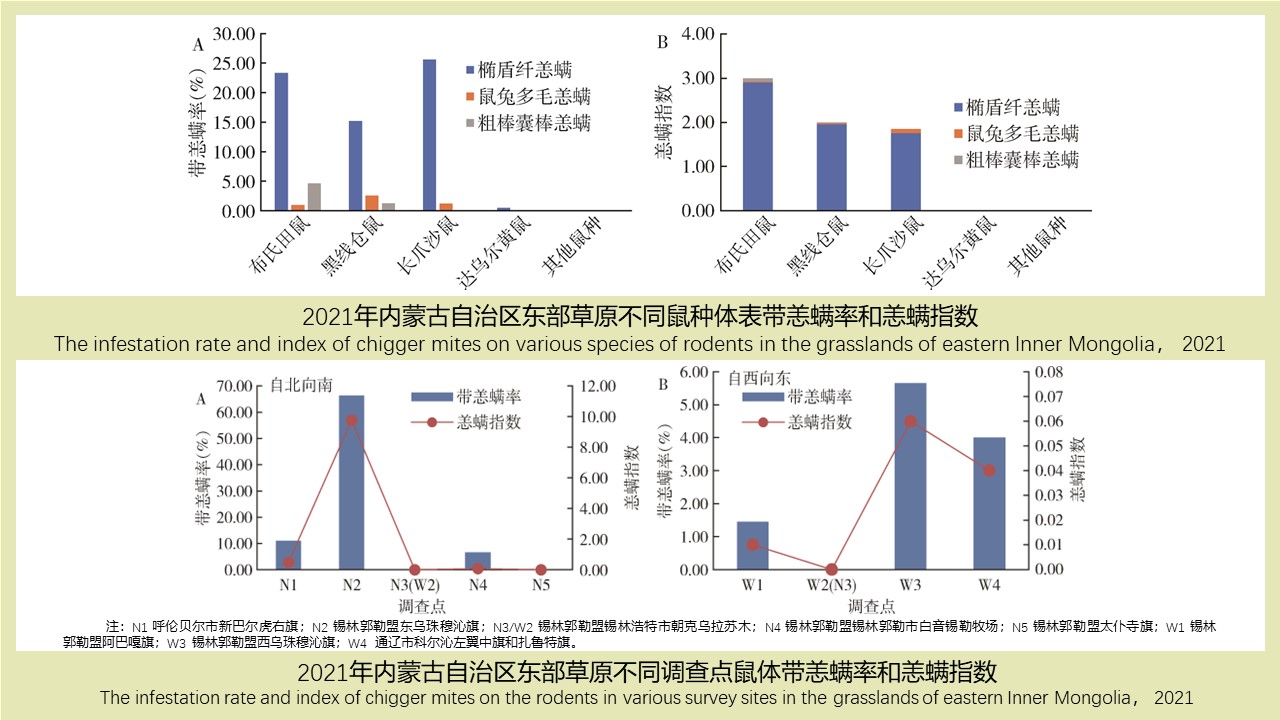
Objective To investigate the species composition and spatiotemporal distribution of chigger mites parasitized on the body surface of rodents in the grasslands of eastern Inner Mongolia Autonomous Region (Inner Mongolia), China. Methods The snap trap and cage trap methods were used to capture rodents in eight survey sites distributed in Xilin-Gol League, Hulun-Buir, and Tongliao of eastern Inner Mongolia in May, July, and September, 2021. Parasitic chiggers were collected from the body surface of the rodents. Then the specimens were made for morphological identification. The infestation rate (IR) and index of chigger mites (IC) were calculated for each survey site, month, and rodent species, and the statistical differences were analyzed using Chi-square test. Results A total of 1 232 chigger mites were collected from the bodies of 672 rodents, which belonged to three species of three genera of two families, namely, Leptotrombidium oblongatum, Multisetosa ochotonae, and Ascoschoengastia crassiclava. L. oblongatum was the dominant species, accounting for 97.02%. Their main hosts included Lasiopodomys brandtii, Meriones unguiculatus, and Cricetulus barabensis. These chigger mites were mainly distributed in two survey sites, i.e., New Barag Right Banner in Hulun-Buir and East Ujimqin Banner in Xilin-Gol League. They were active in May, July, and September, and showed an increasing trend with month. Conclusion There are few species of chigger mites on rodents in the grasslands of eastern Inner Mongolia. The dominant chigger species has a wide distribution, a long time of infestation, and diverse hosts.
[1] Xu G,Walker DH,Jupiter D,et al. A review of the global epidemiology of scrub typhus[J]. PLoS Negl Trop Dis,2017,11(11):e0006062. DOI:10.1371/journal.pntd.0006062.
[2] 李贵昌,刘起勇. 恙虫病的流行现状[J]. 疾病监测,2018,33(2):129-138. DOI:10.3784/j.issn.1003-9961.2018.02.006. Li GC,Liu QY. Epidemic trend of scrub typhus in the world[J]. Dis Surveill,2018,33(2):129-138. DOI:10.3784/j.issn.1003-9961.2018.02.006.(in Chinese)
[3] 李贵昌,栗冬梅,李焱,等. 2006-2016年我国恙虫病流行特征分析[J]. 疾病监测,2018,33(2):139-143. DOI:10.3784/j.issn.1003-9961.2018.02.007. Li GC,Li DM,Li Y,et al. Epidemiology of scrub typhus in China,2006-2016[J]. Dis Surveill,2018,33(2):139-143. DOI:10.3784/j.issn.1003-9961.2018.02.007.(in Chinese)
[4] Richards AL,Jiang J. Scrub typhus:Historic perspective and current status of the worldwide presence of Orientia species[J]. Trop Med Infect Dis,2020,5(2):49. DOI:10.3390/tropicalmed 5020049.
[5] Yue YJ,Ren DS,Liu XB,et al. Spatio-temporal patterns of scrub typhus in mainland China,2006-2017[J]. PLoS Negl Trop Dis,2019,13(12):e0007916. DOI:10.1371/journal.pntd.0007916.
[6] 相蓉,郭宪国. 云南省小板纤恙螨形态学研究[J]. 中国病原生物学杂志,2021,16(11):1312-1315. DOI:10.13350/j.cjpb. 211115. Xiang R,Guo XG. Morphological study of Leptotrombidium scutellare in Yunnan,China[J]. J Pathog Biol,2021,16(11):1312-1315. DOI:10.13350/j.cjpb.211115.(in Chinese)
[7] 韩效中,路瑾萍,赵钢,等. 内蒙古西部地区人兽血清斑疹伤寒和恙虫病抗体检测[J]. 内蒙古医学杂志,1996,16(1):16-17. DOI:10.16096/j.cnki.nmgyxzz.1996.01.011. Han XZ,Lu JP,Zhao G,et al. Detection of antibodies against typhus and scrub typhus in human and animal sera in western Inner Mongolia[J]. Inner Mongolia Med J,1996,16(1):16-17. DOI:10.16096/j.cnki.nmgyxzz.1996.01.011.(in Chinese)
[8] 张倩,刘运喜,吴晓明,等. 中国内蒙古、新疆部分地区鼠类自然感染恙虫病东方体的调查[J]. 中华流行病学杂志,2006,27(6):475-478. Zhang Q,Liu YX,Wu XM,et al. Investigation on rodents' natural infection of Orientia tsutsugamushi in some areas of Inner Mongolia and Xinjiang,China[J]. Chin J Epidemiol,2006,27(6):475-478. (in Chinese)
[9] 成广学. 哲里木盟螨类分布调查[J]. 内蒙古医学杂志,1987,7(1):68. DOI:10.16096/j.cnki.nmgyxzz.1987.01.045. Cheng GX. Survey on the distribution of mites in Jirem League[J]. Inner Mongolia Med J,1987,7(1):68. DOI:10.16096/j.cnki.nmgyxzz. 1987. 01. 045.(in Chinese)
[10] 温廷桓. 中国沙螨[恙螨] [M]. 上海:学林出版社,1984:49-51. Wen TH. Sand mites of China[M]. Shanghai:Xuelin Publishing House,1984:49-51. (in Chinese)
[11] 姚文炳,陈国定. 内蒙古地区恙螨幼虫的研究[J]. 内医学报,1981,3(1):31-44. DOI:10.16343/j.cnki.issn.2095-512x.1981.01.008. Yao WB,Chen GD. Study on the larvae of the chiggers mite in Inner Mongolia[J]. J Inner Mongolia Med Univ,1981,3(1):31-44. DOI:10.16343/j.cnki.issn.2095-512x.1981.01.008.(in Chinese)
[12] 黎家灿. 中国恙螨(恙虫病媒介和病原体研究)[M]. 广州:广东科技出版社,1997:59-60,181,371. Li JC. Trombiculid mites of China (Studies on vector and pathogen of Tsutsugamushi disease)[M]. Guangdong:Guangdong Science and Technology Publishing House,1997:59-60,181,371. (in Chinese)
[13] Stekolnikov AA. Leptotrombidium (Acari:Trombiculidae) of the world[J]. Zootaxa,2013,3728:1-173. DOI:10.11646/zootaxa.3728.1.1.
[14] Кудряшова НИ. Клещи краснотелки (Acariformes,Trombiculidae) восточной палеарктики[M]. Moscow:KMK Scientific Press,1998:122-124.
[15] 莫乘风. 恙螨一新种:青海恙螨[J]. 动物分类学报,1965,2(3):251-253. Mo CF. A new species of trombiculid mite from Tsinghai[J]. Acta Zoot Sin,1965,2(3):251-253. (in Chinese)
[16] 马英,杨锡正,李超. 青海恙螨区系调查研究[J]. 地方病通报,1999,14(2):46-48. DOI:10.3969/j.issn.1000-3711.1999. 02.016. Ma Y,Yang XZ,Li C. Studies on the trombiculid mite fauna of Qinghai province[J]. Endem Dis Bull,1999,14(2):46-48. DOI:10.3969/j.issn.1000-3711.1999.02.016.(in Chinese)
[17] 杨汉青,李海龙,王雪,等. 青海省恙螨聚类分析的探讨[J]. 中国地方病防治杂志,2014,29(4):241-243. Yang HQ,Li HL,Wang X,et al. Cluster analysis on chigger mites in Qinghai province[J]. Chin J Ctrl Endem Dis,2014,29(4):241-243. (in Chinese)
[18] 邵冠男,王天祥,马德新. 新疆的恙螨及其流行病学意义[J]. 中国媒介生物学及控制杂志,1994,5(2):110-112. Shao GN,Wang TX,Ma DX. A list of chigger mites in Xinjiang and their epidemiology[J]. Chin J Vector Biol Control,1994,5(2):110-112. (in Chinese)
[19] 白学礼,陈百芳,顾以铭. 宁夏医学蚤、蜱、螨、虱的区系分布[J]. 宁夏医学杂志,1995,17(1):1-8. Bai XL,Chen BF,Gu YM. Ningxia medical entomology & Acari (fleas,ticks,mites,lice) and their geographical distribution[J]. Ningxia Med J,1995,17(1):1-8. (in Chinese) 收稿日期:2022-08-18本文编辑:陈秀丽Liu QY. Impact of climate change on vector-borne diseases and related response strategies in China:Major research findings and recommendations for future research[J]. Chin J Vector Biol Control,2021,32(1):1-11. DOI:10.11853/j.issn.1003.8280. 2021.01.001.(in Chinese)


