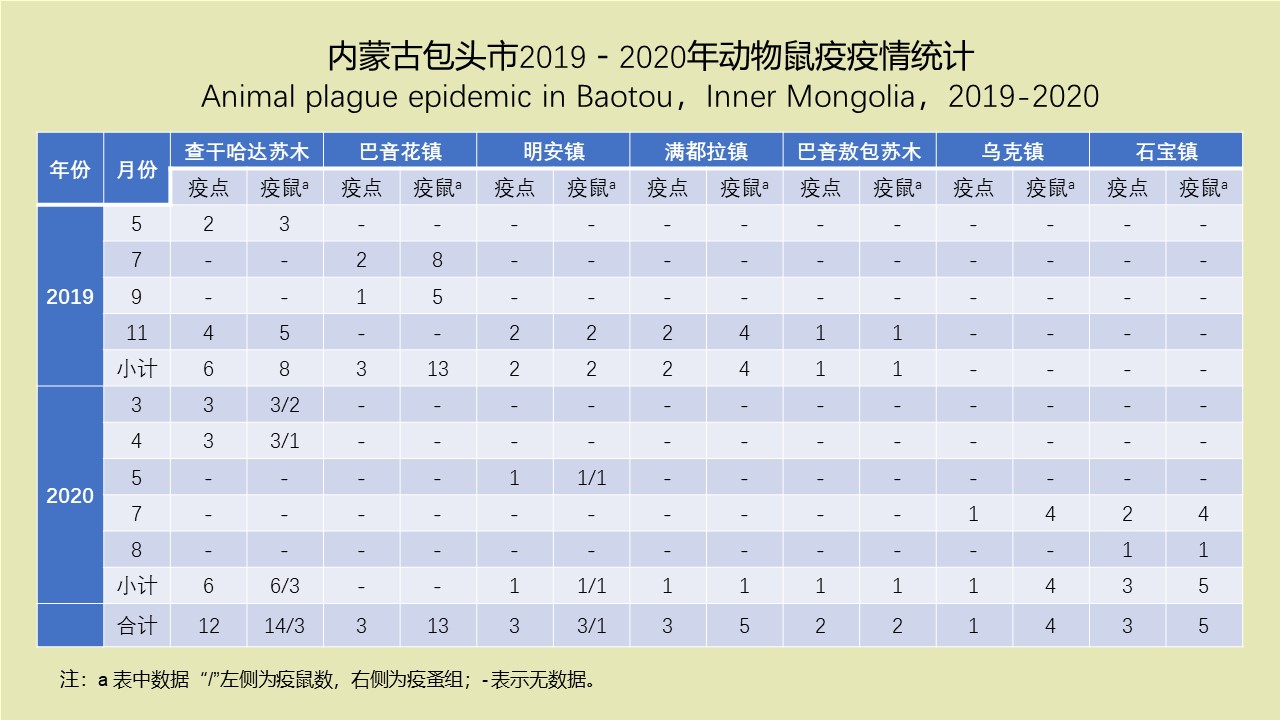
目的 分析2019-2020年内蒙古包头市动物鼠疫流行情况及发生人间鼠疫的风险因素,为制定鼠疫防控措施提供科学依据。方法 收集中国疾病预防控制信息系统应用门户鼠疫防治管理信息系统2019-2020年包头市动物及人间鼠疫疫情数据及疫情总结。采用描述流行病学方法,分析动物疫情疫点发生的时间分布、空间分布及地理景观分布情况和人间疫情流行情况。结果 2019-2020年内蒙古包头市共发生27起动物鼠疫疫情,检出鼠疫耶尔森菌50株。牧区草原动物鼠疫疫情无论是持续时间、流行范围及流行强度均明显超过农区疫情,由于牧区人口稀少(1人/㎞2),2019-2020年7月未发生人间疫情。2020年8月发生了2起人间鼠疫疫情,其中1起在人口相对密集(27人/㎞2)的农区发生1例本土鼠疫病例,另1起为输入性1例鼠疫病例,最终均死亡。结论 包头市动物间鼠疫流行猛烈,并波及人间。应汲取本轮疫情的经验教训,针对存在的风险因素坚持落实各项防控措施,杜绝再次发生人间鼠疫及疫情远距离传播。
关键词:
鼠疫; 自然疫源地; 疫情; 风险; 防控
Objective To analyze the epidemic situation of animal plague and the risk factors for human plague in Baotou, Inner Mongolia, China, 2019-2020, and to provide a scientific basis for formulating plague prevention and control measures. Methods The data and summary of animal and human plague epidemic in Baotou from 2019 to 2020 were collected from the Management Information System for Plague Control of Chinese Disease Prevention and Control Information System. The time distribution, spatial distribution, and geographical landscape distribution of animal epidemic foci and human epidemic situation were analyzed by the descriptive epidemiological method. Results A total of 27 animal plague epidemics occurred in Baotou in 2019-2020, and 50 strains of Yersinia pestis were detected. The duration, prevalence, and strength of animals plague in grassland of pastoral areas were significantly higher than those in agricultural areas. There was no human epidemic from 2019 to July 2020 because of the sparse population in pastoral areas (1 person/km2). Two human plague epidemics occurred in August 2020, including 1 local plague case in the relatively densely populated agricultural area (27 persons/km2) and 1 imported plague case, both of whom died. Conclusion The plague among animals in Baotou is prevalent violently and leads to human plague. Lessons should be learned from the epidemics. The prevention and control measures against the risk factors should be taken and be maintained to prevent the recurrence of human plague and long-distance transmission.
[1] 俞东征. 鼠疫动物流行病学[M]. 北京:科学出版社,2009:275-305. Yu DZ. Plague animal endemiology[M]. Beijing:Science Press,2009:275-305. (in Chinese)
[2] 刘伯熙,段然,王浩珲,等. 内蒙古自治区不同生态系鼠疫自然疫源地动物鼠疫流行现状及流行风险简析[J]. 中华预防医学杂志,2022,56(1):9-14. DOI:10.3760/cma.j.cn112150-20211101-01007. Liu BX,Duan R,Wang HH,et al. Analysis on prevalence and epidemic risk of animal plague in different ecological plague foci in Inner Mongolia Autonomous Region[J]. Chin J Prev Med,2022,56(1):9-14. DOI:10.3760/cma.j.cn112150-20211101-01007.(in Chinese)
[3] 丛显斌,鞠成. 中国人间鼠疫[M]. 北京:人民卫生出版社,2018:299-301. Cong XB,Ju C. Human plague in China[M]. Beijing:People's Medical Publishing House,2018:299-301. (in Chinese)
[4] 宋志忠. 自然灾害发生与鼠疫的关系[J]. 中华地方病学杂志,2016,35(5):313-315. DOI:10.3760/cma.j.issn.2095-4255. 2016.05.001. Song ZZ. The relationship between natural disasters and plague[J]. Chin J Endemiol,2016,35(5):313-315. DOI:10.3760/cma.j.issn.2095-4255.2016.05.001.(in Chinese)
[5] 张亚楠,赵钢,范明慧,等. 2010-2014年内蒙古长爪沙鼠鼠疫自然疫源地鼠疫监测结果分析[J]. 中华地方病学杂志,2016,35(5):357-360. DOI:10.3760/cma.j.issn.2095-4255. 2016.05.011. Zhang YN,Zhao G,Fan MH,et al. Analysis of monitoring results on animal plague in Meriones unguiculatus plague natural foci in Inner Mongolia from 2010 to 2014[J]. Chin J Endemiol,2016,35(5):357-360. DOI:10.3760/cma.j.issn.2095-4255.2016.05.011.(in Chinese)
[6] 崔百忠. 2001-2011年青海省人间鼠疫流行病学分析[J]. 中华地方病学杂志,2013,32(5):520-522. DOI:10.3760/cma.j.issn.2095-4255.2013.05.013. Cui BZ. Epidemiological analysis of the human plague from 2001 to 2011 in Qinghai province[J]. Chin J Endemiol,2013,32(5):520-522. DOI:10.3760/cma.j.issn.2095-4255.2013.05.013.(in Chinese)
[7] 王梅,唐新元,王祖郧. 青海省鼠疫远距离传播及其防控策略[J]. 中华地方病学杂志,2016,35(5):382-385. DOI:10.3760/cma.j.issn.2095-4255.2016.05.017. Wang M,Tang XY,Wang ZY. Long distance spreading of plague and control strategy in Qinghai province[J]. Chin J Endemiol,2016,35(5):382-385. DOI:10.3760/cma.j.issn.2095-4255. 2016.05.017.(in Chinese)
[8] 丛显斌,鞠成. 加强我国人间鼠疫防控策略的科学研究[J]. 中华地方病学杂志,2015,34(4):235-236. DOI:10.3760/cma.j.issn.2095-4255.2015.04.001. Cong XB,Ju C. Scientific research on strengthening the prevention and control strategy of human plague in China[J]. Chin J Endemiol,2015,34(4):235-236. DOI:10.3760/cma.j.issn.2095-4255.2015.04.001.(in Chinese)
[9] 张芳,李昊,田洁,等. 内蒙古高原长爪沙鼠鼠疫自然疫源地现状分析[J]. 中国地方病防治,2020,35(3):220-222. Zhang F,Li H,Tian J,et al. Analysis on the current situation of the natural foci of gerbil plague in Inner Mongolia plateau[J]. Chin J Ctrl Endem Dis,2020,35(3):220-222. (in Chinese)
[10] 孔进姣,王鹏,石丽媛. 1950-2018年云南省人间鼠疫流行病学特征分析[J]. 中华地方病学杂志,2020,39(8):593-597. DOI:10.3760/cma.j.cn231583-20190807-00213. Kong JJ,Wang P,Shi LY. Epidemiological analysis of human plague in Yunnan province from 1950 to 2018[J]. Chin J Endemiol,2020,39(8):593-597. DOI:10.3760/cma.j.cn231583-20190807-00213.(in Chinese)
[11] 胡艳红,王姝懿,李建云,等. 内蒙古自治区2020年鼠疫监测调查与分析[J]. 中国媒介生物学及控制杂志,2022,33(3):418-425. DOI:10.11853/j.issn.1003.8280.2022.03.020. Hu YH,Wang SY,Li JY,et al. Analysis of plague surveillance in Inner Mongolia Autonomous Region,China,2020[J]. Chin J Vector Biol Control,2022,33(3):418-425. DOI:10.11853/j.issn.1003.8280.2022.03.020.(in Chinese)


