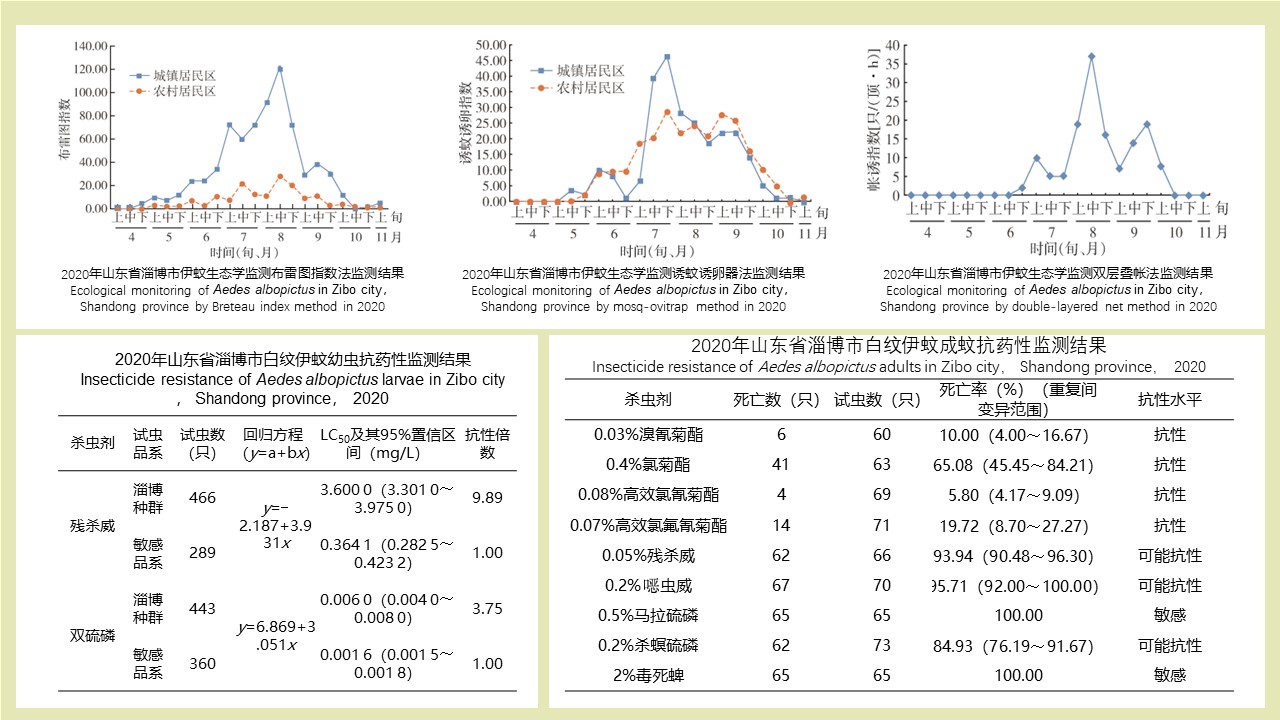
目的 了解山东省淄博市白纹伊蚊的种群分布、密度、季节消长规律以及幼蚊和成蚊对不同杀虫剂的抗药性现状,旨在为登革热风险评估、预测预警和有效防控提供科学依据,以及为科学合理使用杀虫剂提供依据。方法 幼蚊密度监测采用布雷图指数(BI)法和诱蚊诱卵器(MOT)法;成蚊密度监测采用双层叠帐法。抗药性监测采用世界卫生组织推荐的蚊虫抗药性生物学测定方法,即幼蚊采用浸渍法,成蚊采用接触筒法。结果 幼蚊孳生容器中盆景及水生植物的容器指数(CI)最高,为36.46%。BI法和MOT法分别在4月下旬和5月中旬监测到幼蚊,高峰期在8月中旬和7月下旬,10月下旬基本消失。幼蚊监测平均BI为19.98,8月BI最高,达75.00。成蚊6月下旬开始出现阳性,8月中旬达到高峰,10月中旬消失,季节性消长明显。淄博市白纹伊蚊幼虫对残杀威和双硫磷2种常用杀虫剂的半数致死浓度(LC50)分别为3.600 0和0.006 0 mg/L,为敏感品系的9.89和3.75倍。成蚊接触0.4%氯菊酯、0.03%溴氰菊酯、0.08%高效氯氰菊酯和0.07%高效氯氟氰菊酯药膜表现为抗性;而对0.05%残杀威、0.2%噁虫威和0.2%杀螟硫磷表现为可能抗性;对0.5%马拉硫磷和2%毒死蜱表现为敏感。结论 淄博市白纹伊蚊分布广泛且密度高,存在因输入性登革热病例引发本地流行的风险。淄博市白纹伊蚊幼虫对残杀威和双硫磷已产生抗性,成蚊对拟除虫菊酯类杀虫剂均表现为抗性。应加强白纹伊蚊密度和抗药性监测,科学合理地使用杀虫剂,有效预防登革热的传播流行。
Objective To understand the distribution, density, and seasonal fluctuation of Aedes albopictus and the resistance of larvae and adults to different insecticides in Zibo city, China, in order to provide a scientific basis for risk assessment, prediction, early warning, and effective prevention and control of dengue fever, and to provide a theoretical basis for scientific and rational use of insecticides. Methods The density of mosquito larvae was monitored by Breteau index (BI) and mosq-ovitrap (MOT) methods. The density of adult mosquitoes was monitored by double-layer net method. Insecticide resistance was detected by bioassays recommended by WHO, including dipping method for larvae and contact tube method for adults. Results Among mosquito larval breeding containers, bonsai and aquatic plants showed the highest container index (CI) of 36.46%. The larvae were detected by BI and MOT in late-April and mid-May, respectively, with the peaks in mid-August and late-July, and almost disappeared in late-October. The average BI of larvae was 19.98, and the highest BI was 75.00 in August. Adult mosquitoes were detected in late-June, peaked in mid-August, and disappeared in mid-October, with obvious seasonal fluctuation. The median lethal concentration (LC50) of Ae. albopictus larvae to propoxur and temephos were 3.600 0 mg/L and 0.006 0 mg/L, respectively, which were 9.89 and 3.75 times of the sensitive strain. Adult mosquitoes showed resistance to permethrin (0.4%), deltamethrin (0.03%), beta-cypermethrin (0.08%), and beta-cypermethrin (0.07%). They were suspected to be resistant to propoxur (0.05%), bendiocarb (0.2%), and fenitrothion (0.2%). They were sensitive to malathion (0.5%) and chlorpyrifos (2%). Conclusion Ae. albopictus is widely distributed and has a high density in Zibo city, which may lead to local epidemics due to imported dengue cases. In Zibo city, Ae. albopictus larvae had developed resistance to propoxur and disulphos, while adult mosquitoes showed resistance to pyrethroid insecticides. Surveillance on the density and drug resistance of Ae. albopictus should be strengthened, and insecticides should be used scientifically and reasonably to effectively prevent the spread of dengue fever.
[1] 孟凤霞,王义冠,冯磊,等. 我国登革热疫情防控与媒介伊蚊的综合治理[J]. 中国媒介生物学及控制杂志,2015,26(1):4-10. DOI:10.11853/j.issn.1003.4692.2015.01.002. Meng FX,Wang YG,Feng L,et al. Review on dengue prevention and control and integrated mosquito management in China[J]. Chin J Vector Biol Control,2015,26(1):4-10. DOI:10.11853/j.issn.1003.4692.2015.01.002.(in Chinese)
[2] 李晨颖,陈晓光. 媒介白纹伊蚊监测和控制技术研究及应用进展[J]. 中国热带医学,2018,18(7):732-736,739. DOI:10.13604/j.cnki.46-1064/r.2018.07.26. Li CY,Chen XG. Research and application progress of Aedes albopictus monitoring and control techniques[J]. China Trop Med,2018,18(7):732-736,739. DOI:10.13604/j.cnki.46-1064/r.2018.07.26.(in Chinese)
[3] 中国疾病预防控制中心. 全国病媒生物监测方案[Z]. 北京:中国疾病预防控制中心,2016. Chinese Center for Disease Control and Prevention. National vector surveillance implementation plan[Z]. Beijing:Chinese Center for Disease Control and Prevention,2016. (in Chinese)
[4] 中华人民共和国卫生部,中国国家标准化管理委员会. GB/T 26347-2010蚊虫抗药性检测方法生物测定法[S]. 北京:中国标准出版社, 2011. Ministry of Health of the People's Republic of China, Standardization Administration of China. GB/T 26347-2010 Test methods of mosquito resistance to insecticides-Bioassay methods[S]. Beijing:Standards Press of China, 2011. (in Chinese)
[5] World Health Organization. Instructions for determining the susceptibility or resistance of mosquito larvae to insecticides[R]. Geneva:WHO,1981:1-4.
[6] Zhang K,Zhang W,Zhang S,et al. Susceptibility of Sogatella furcifera and Laodelphax striatellus (Hemiptera:Delphacidae) to six insecticides in China[J]. J Econ Entomol,2014,107(5):1916-1922. DOI:10.1603/EC14156.
[7] 王义冠. 我国登革热媒介伊蚊抗药性监测及抗性数据分析[D]. 北京:中国疾病预防控制中心,2016. Wang YG. Insecticides resistance surveillance for dengue vector Aedes in China and data analyses[D]. Beijing:Chinese Center for Disease Control and Prevention,2016. (in Chinese)
[8] 安继尧,严格,张学文,等. 白纹伊蚊:登革热的重要媒介[J]. 医学动物防制,2003,17(8):449-452. DOI:10.3969/j.issn.1003-6245.2003.08.001. An JY,Yan G,Zhang XW,et al. Aedes albopictus:An important vector of dengue fever[J]. J Med Pest Control,2003,17(8):449-452. DOI:10.3969/j.issn.1003-6245.2003.08.001.(in Chinese)
[9] 刘辉,王海红,刘淼,等. 2019年东营市白纹伊蚊密度调查[J]. 中华卫生杀虫药械,2020,26(4):346-348. DOI:10.19821/j.1671-2781.2020.04.014. Liu H,Wang HH,Liu M,et al. Density investigation of Aedes albopictus in Dongying city in 2019[J]. Chin J Hyg Insect Equip,2020,26(4):346-348. DOI:10.19821/j.1671-2781.2020.04.014.(in Chinese)
[10] 王志光,王善青,小野雅司,等. 海南省埃及伊蚊与白纹伊蚊孳生习性与季节消长的调查[J]. 中国热带医学,2005,5(2):230-233. Wang ZG,Wang SQ,Ono M,et al. Investigaton on Aedes aegypti and Ae. albopictus in the north-western part of Hainan province[J]. China Trop Med,2005,5(2):230-233. (in Chinese)
[11] 郑能雄,林云钦,罗斌,等. 福州市登革热蚊媒种群生态学研究[J]. 海峡预防医学杂志,2003,9(2):8-11. DOI:10.3969/j.issn.1007-2705.2003.02.003. Zheng NX,Lin YQ,Luo B,et al. The ecological study on the mosquito species of dengue fever in Fuzhou[J]. Strait J Prev Med,2003,9(2):8-11. DOI:10.3969/j.issn.1007-2705.2003. 02.003.(in Chinese)
[12] 任飞林,沈建勇,刘婷,等. 布雷图指数法与诱蚊诱卵指数法监测白纹伊蚊幼虫密度相关性分析[J]. 疾病监测,2021,36(9):888-893. DOI:10.3784/jbjc.202105250294. Ren FL,Shen JY,Liu T,et al. Correlation between Breteau index and mosquito oviposition index in surveillance for Aedes albopictus larvae density[J]. Dis Surveill,2021,36(9):888-893. DOI:10.3784/jbjc.202105250294.(in Chinese)
[13] 王新国,甄天民,王怀位,等. 山东省蚊虫对化学杀虫剂的抗性状况分析[J]. 中国媒介生物学及控制杂志,2003,14(1):33-35. DOI:10.3969/j.issn.1003-4692.2003.01.010. Wang XG,Zhen TM,Wang HW,et al. Analysis of the chemical insecticide resistance of mosquitoes in Shandong province[J]. Chin J Vector Biol Control,2003,14(1):33-35. DOI:10.3969/j.issn.1003-4692.2003.01.010.(in Chinese)
[14] 顾剑龙,杨迎宇,王海健. 上海市宝山区白纹伊蚊幼虫对常用杀虫剂的抗药性研究[J]. 安徽预防医学杂志,2021,27(1):66-67,71. DOI:10.19837/j.cnki.ahyf.2021.01.017. Gu JL,Yang YY,Wang HJ. Study on the insecticides resistance of Aedes albopictus larvae,in Baoshan district,Shanghai[J]. Anhui J Prev Med,2021,27(1):66-67,71. DOI:10.19837/j.cnki.ahyf.2021.01.017.(in Chinese)


