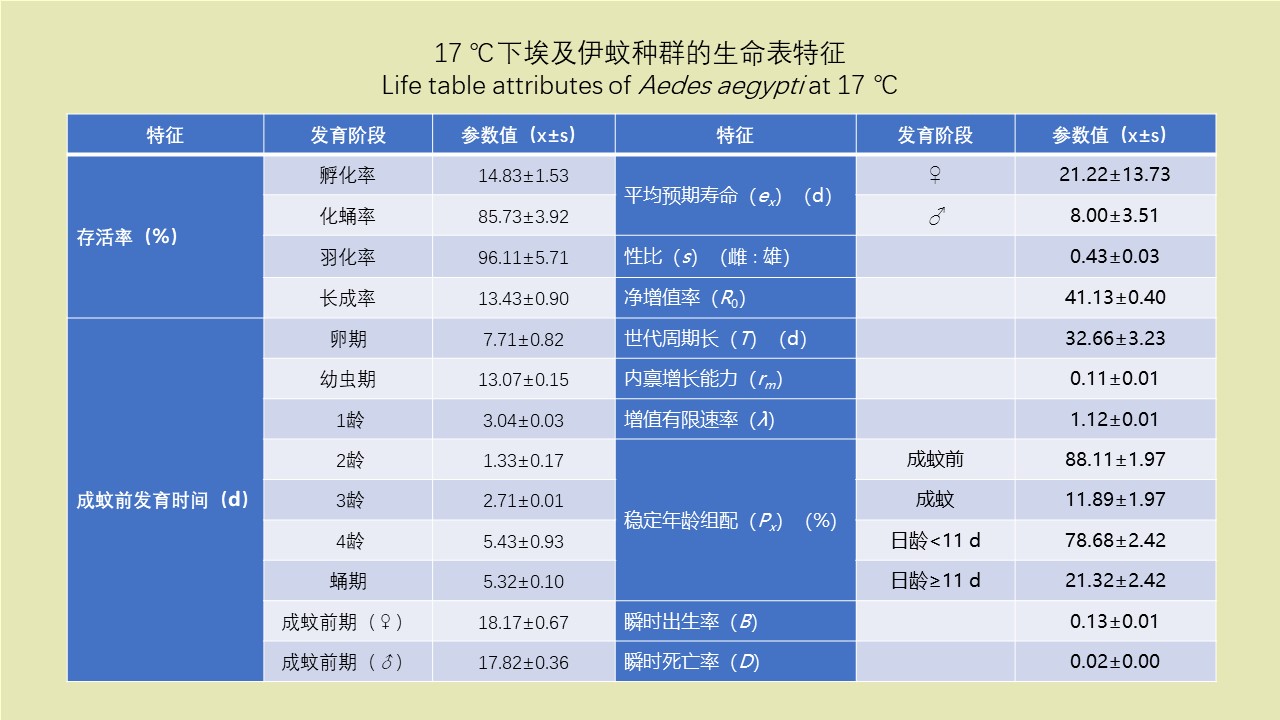
目的 通过模拟低温,对埃及伊蚊各发育阶段生命表各参数开展研究,了解其种群动态特征。方法 低温下饲养并记录海南省儋州市实验室品系埃及伊蚊的各生活期情况:发育时长、存活情况、产卵情况,计算各期存活率,依据结果绘制生命表,获得其种群动态特征。结果 17℃低温下,埃及伊蚊卵孵化率为(14.83±1.53)%,化蛹率为(85.73±3.92)%,羽化率为(96.11±5.71)%,长成率为(13.43±0.90)%。雌、雄埃及伊蚊成蚊前发育时间分别为(18.17±0.67)和(17.82±0.36)d。其中,1、4龄幼虫发育时间较2、3龄长,4龄幼虫发育时间最长,为(5.43±0.93)d。该埃及伊蚊种群羽化为成蚊性比(雌∶雄)为0.43±0.03,净增值率为41.13±0.40,内禀增长力为0.11±0.01,世代周期长为(32.66±3.23)d,增值有限速率为(1.12±0.01)/d。稳定年龄组配成蚊前期占比(88.11±1.97)%,成蚊期占比(11.89±1.97)%,成蚊期各日龄组稳定年龄组配寿命在11d以上的占比(21.32±2.42)%,寿命在11d以内的占比(78.68±2.42)%。瞬时出生率为0.13±0.01,瞬时死亡率为0.02±0.00。结论 17℃时埃及伊蚊能够完成生活史;卵孵化率低,说明卵期是低温下决定埃及伊蚊发育的关键阶段,是决定其向冷气候地区扩散分布的限定因素;该温度下埃及伊蚊活动能力低,各期发育时间延长,雌蚊寿命明显延长,可能增加病毒感染和传播的机会,应将其与生长潜力、活动和叮咬能力等结合进行媒介效能评价。
Objective By simulating low temperature, the parameters of the life table of Aedes aegypti mosquitoes at various developmental stages were studied to understand their population dynamics. Methods Laboratory Ae. aegypti from Danzhou city, Hainan province, China were reared at low temperature, and the development time and survival in all life stages and the oviposition of Ae. aegypti were recorded. The survival rate in all life stages was calculated, and the population dynamics was obtained by drawing a life table. Results At 17 °C, the hatching rate, pupation rate, eclosion rate, and maturation rate of Ae. aegypti were (14.83±1.53)%, (85.73±3.92)%, (96.11±5.71)%, and (13.43±0.90)%. The pre-adult development time of female and male Ae. aegypti was (18.17±0.67) and (17.82±0.36) d, respectively. The development time of the 1st and 4th instar larvae was longer than that of the 2nd and 3rd instar larvae, and the development time of the 4th instar larvae was the longest with (5.43±0.93) d. The adult sex ratio (female: male) was 0.43±0.03; the net productivity was 41.13±0.40; the intrinsic growth rate was 0.11±0.01; the generation span was (32.66±3.23) d; the finite rate of increase was (1.12±0.01)/d. The proportion of stable age was (88.11±1.97)% in the larval stage and (11.89±1.97)% in the adult stage. The proportion of stable age over 11 d for adult mosquitoes was (21.32±2.42)% and (78.68±2.42)% with stable age less than 11 d. The instantaneous birth rate was 0.13±0.01, and the instantaneous death rate was 0.02±0.00. Conclusion Ae. aegypti can complete its life cycle at 17 °C. The egg hatching rate is low, indicating that the egg stage may be a critical stage affecting the development of Ae. aegypti at low temperature, and it may be the key impact factor which limits spreading toward lower temperature areas for Ae. aegypti. At 17 °C, Ae. aegypti mosquito has low activity capacity, prolongs the development time of each stage. The longer adult stage may increase the chance of virus infection and transmission. The vector efficiency should be evaluated in combination with growth potential, activity, and biting ability
[1] 刘起勇. 我国登革热流行新趋势、防控挑战及策略分析[J]. 中国媒介生物学及控制杂志,2020,31(1):1-6. DOI:10.11853/j.issn.1003.8280.2020.01.001. Liu QY. Dengue fever in China:New epidemical trend,challenges and strategies for prevention and control[J]. Chin J Vector Biol Control,2020,31(1):1-6. DOI:10.11853/j.issn. 1003.8280.2020.01.001.(in Chinese)
[2] Jin YN,Yao JJ,Wang SY,et al. The effect of adding neoadjuvant chemotherapy to concurrent chemoradiotherapy in patients with locoregionally advanced nasopharyngeal carcinoma and undetectable pretreatment Epstein-Barr virus DNA[J]. Transl Oncol,2017,10(4):527-534. DOI:10.1016/j.tranon.2017. 03.007.
[3] Smith C,Khanna R. The development of prophylactic and therapeutic EBV vaccines[M]//Münz C. Epstein Barr Virus Volume 2. Cham:Springer,2015:455-473. DOI:10.1007/978-3-319-22834-1_16.
[4] Focks DA,Haile DG,Daniels E,et al. Dynamic life table model for Aedes aegypti (Diptera:Culicidae):Simulation results and validation[J]. J Med Entomol,1993,30(6):1018-1028. DOI:10.1093/jmedent/30.6.1018.
[5] Beserra EB,Castro FP Jr. Compared biology of populations of Aedes (Stegomyia) aegypti (L.) (Diptera:Culicidae) of Paraíba state,Brazil[J]. Neotrop Entomol,2008,37(1):81-85. DOI:10.1590/s1519-566x2008000100012.
[6] Sowilem MM,Kamal HA,Khater EI. Life table characteristics of Aedes aegypti (Diptera:Culicidae) from Saudi Arabia[J]. Trop Biomed,2013,30(2):301-314.
[7] Brady OJ,Johansson MA,Guerra CA,et al. Modelling adult Aedes aegypti and Ae. albopictus survival at different temperatures in laboratory and field settings[J]. Parasit Vectors,2013,6:351. DOI:10.1186/1756-3305-6-351.
[8] Rueda LM,Patel KJ,Axtell RC,et al. Temperature-dependent development and survival rates of Culex quinquefasciatus and Aedes aegypti (Diptera:Culicidae)[J]. J Med Entomol,1990,27(5):892-898. DOI:10.1093/jmedent/27.5.892.
[9] 王菊生,王宝鳞. 巴拉巴按蚊实验室种群的动力学一、寿命表[J]. 贵阳医学院学报,1981,1/2:112-119. DOI:10.19367/j.cnki.1000-2707.1981.z1.023. Wang JS,Wang BL. Kinetics of the laboratory population of Anopheles balabacensis mosquitoes. Ⅰ. Life table[J]. J Guiyang Med Coll,1981,1-2:112-119. (in Chinese)
[10] Walter NM,Hacker CS. Variation in life table characteristics among three geographic strains of Culex pipiens quinquefasciatus[J]. J Med Entomol,1974,11(5):541-550. DOI:10.1093/jmedent/11.5.541.
[11] 林昌善. 动物种群数量变动的理论与试验研究Ⅱ. 杂拟谷盗Tribolium confusum (H.) 的内禀增长能力(rm)的研究[J]. 动物学报,1964,16(3):323-338. Lin CS. The theoretical and laboratory studies of animal population dynamics II. A study of innate capacity for increase (rm) of Tribolium confusum (H.) under certain experimental conditions[J]. Acta Zool Sin,1964,16(3):323-338. (in Chinese)
[12] Bayoh MN,Lindsay SW. Effect of temperature on the development of the aquatic stages of Anopheles gambiae sensu stricto (Diptera:Culicidae)[J]. Bull Entomol Res,2003,93(5):375-381. DOI:10.1079/BER2003259.
[13] Lu L,Lin HL,Tian LW,et al. Time series analysis of dengue fever and weather in Guangzhou,China[J]. BMC Public Health,2009,9:395. DOI:10.1186/1471-2458-9-395.
[14] 胡好远. 种群内禀增长率精确值的简便求法[J]. 安徽农学通报,2010,16(3):173-174. DOI:10.3969/j.issn.1007-7731. 2010.03.089. Hu HY. A easy calculation for exact value of the innate rate of increase[J]. Anhui Agric Sci Bull,2010,16(3):173-174. DOI:10.3969/j.issn.1007-7731.2010.03.089.(in Chinese)
[15] Tun-Lin W,Burkot TR,Kay BH. Effects of temperature and larval diet on development rates and survival of the dengue vector Aedes aegypti in north Queensland,Australia[J]. Med Vet Entomol,2010,14(1):31-37. DOI:10.1046/j.1365-2915. 2000.00207.x.
[16] Kamimura K,Matsuse IT,Takahashi H,et al. Effect of temperature on the development of Aedes aegypti and Ae. albopictus[J]. Med Entomol Zool,2002,53(1):53-58. DOI:10.7601/mez.53.53_1.
[17] 刘凤梅,甄天民,王怀位,等. 光周期和温度对3种蚊虫寿命影响的观察[J]. 中国寄生虫病防治杂志,1998,11(1):58-61. Liu FM,Zhen TM,Wang HW,et al. Observation on the effect of temperature and photoperiod on the life span of three mosquito species[J]. Chin J Parasit Dis Control,1998,11(1):58-61. (in Chinese)
[18] Salazar MI,Richardson JH,Sánchez-Vargas I,et al. Dengue virus type 2:Replication and tropisms in orally infected Aedes aegypti mosquitoes[J]. BMC Microbiol,2007,7:9. DOI:10.1186/1471-2180-7-9.
[19] Chowell G,Diaz-Dueñas P,Miller JC,et al. Estimation of the reproduction number of dengue fever from spatial epidemic data[J]. Math Biosci,2007,208(2):571-589. DOI:10.1016/j.mbs.2006.11.011.


