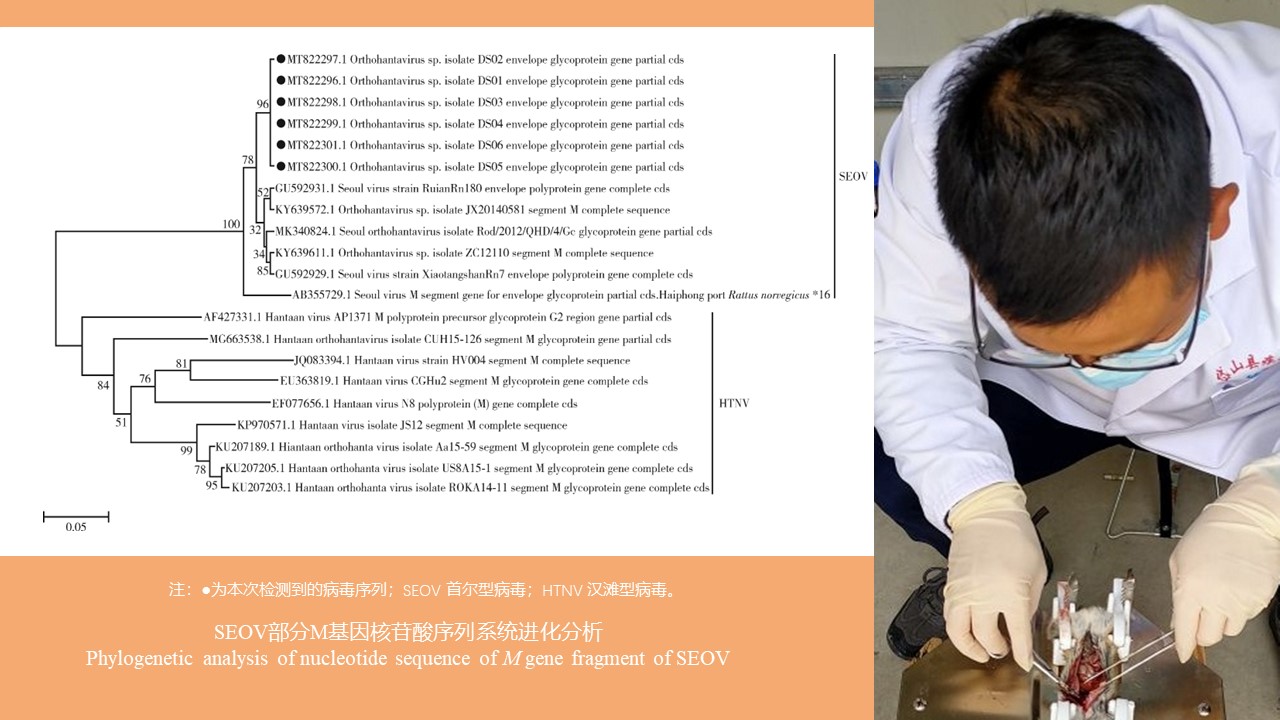
目的 检测分析2020年浙江省岱山县某海岛工业园肾综合征出血热(HFRS)聚集性疫情病例及宿主动物标本,以明确病例和宿主间的关联及病毒基因进化特点,为当地该病的防治提供参考依据。方法 采集病例与鼠血清,采用反转录聚合酶链式反应(RT-PCR)检测病毒核酸,巢式PCR扩增M基因并进行序列测定、基因分型和同源性分析。结果 2020年4-7月岱山县某海岛工业园区共报告4例HFRS确诊病例,抗汉坦病毒IgG和IgM均阳性。2例病例和4只褐家鼠血清标本检测到汉坦病毒RNA,均为首尔型病毒(SEOV)。6个M基因部分片段100%同源,与河北省分离株Rod/2012/QHD/4/Gc、浙江省瑞安分离株RuianRn180的亲缘关系最近。结论 此聚集性疫情经褐家鼠传播的汉坦病毒SEOV引起,病毒表现高度同源性和明显的地理聚集现象及对宿主的相对选择性。
Objective To analyze cases'and host animals'specimens in a cluster outbreak of hemorrhagic fever with renal syndrome (HFRS) in an island industrial park in Daishan county,Zhejiang province,China in 2020,clarify the relationship between the cases and hosts and the molecular phylogenetic characteristics of the virus,and to provide a reference for local prevention and treatment of HFRS.Methods Serum samples from the cases and rodents were collected.Reverse transcription PCR was used to detect the viral nucleic acid.Nested PCR was used to amplify the M gene,followed by sequencing,genotyping,and homology analysis.Results From April to July 2020,a total of four confirmed cases of HFRS were reported in the island industrial park in Daishan county,and all were positive for anti-hantavirus IgG and IgM antibodies.Hantavirus RNA was present in the serum samples of two cases and four Rattus norvegicus rodents,all being Seoul virus (SEOV).The six samples'M gene fragments were 100% homologous,and were most closely related to the isolates Rod/2012/QHD/4/Gc from Hebei province and RuianRn180 from Ruian,Zhejiang.Conclusion This cluster outbreak was caused by the transmission of SEOV hantavirus through R.norvegicus.The virus strains exhibited high homology,obvious geographic clustering,and relative selectivity for hosts.
[1] 梁小洁,严延生,张智芳,等.肾综合征出血热[J].中国人兽共患病学报,2020,36(10):858-863. DOI:10.3969/j.issn.1002-2694.2020.00.133. Liang XJ,Yan YS,Zhang ZF,et al. Hemorrhagic fever with renal syndrome[J]. Chin J Zoonoses,2020,36(10):858-863. DOI:10.3969/j.issn.1002-2694.2020.00.133.(in Chinese)
[2] 宋干.肾综合征出血热流行病学研究与防治[J].中国公共卫生,2004,20(6):766-768. DOI:10.3321/j.issn:1001-0580. 2004.06.078. Song G. Epidemiology research and prevention and treatment of hemorrhagic fever with renal syndrome[J]. China J Public Health,2004,20(6):766-768. DOI:10.3321/j.issn:1001-0580.2004.06.078.(in Chinese)
[3] Jiang H,Zheng XY,Wang LM,et al. Hantavirus infection:A global zoonotic challenge[J]. Virol Sin,2017,32(1):32-43.
[4] Avšič-Županc T,Saksida A,Korva M. Hantavirus infections[J]. Clin Microbiol Infect,2019,21:e6-e16.
[5] 中华预防医学会感染性疾病防控分会,中华医学会感染病学分会.肾综合征出血热防治专家共识[J].中国实用内科杂志,2021,41(10):845-854. DOI:10.19538/j.nk2021100106. Infectious Disease Branch of Chinese Preventive Medicine Association,Society of Infectious Diseases of Chinese Medical Association. Expert consensus on prevention and treatment of hemorrhagic fever with renal syndrome[J]. Chin J Pract Internal Med,2021,41(10):845-854. DOI:10.19538/j.nk2021100106.(in Chinese)
[6] 戴莹,刘力,胡兵.一起流行性出血热疫情的病原学检测与分析[J].国际检验医学杂志,2018,39(14):1775-1779. DOI:10.3969/j.issn.1673-4130.2018.14.033. Dai Y,Liu L,Hu B. Etiological detection and analysis of an outbreak of epidemic hemorrhagic fever[J]. Int J Lab Med,2018,39(14):1775-1779. DOI:10.3969/j.issn.1673-4130.2018. 14.033.(in Chinese)
[7] 吴守丽,严延生,颜苹苹,等.肾综合征出血热抗体快速诊断试剂盒的应用研究[J].海峡预防医学杂志,2009,15(3):1-4. Wu SL,Yan YS,Yan PP,et al. Application research on a rapid antibody diagnostic kit for hemorrhagic fever with renal syndrome[J]. Strait J Prev Med,2009,15(3):1-4.(in Chinese)
[8] 姚苹苹,朱函坪,徐芳,等.浙江省丽水地区2株汉坦病毒分离株的型别鉴定和基因差异研究[J].中华流行病学杂志,2009,30(2):175-178. DOI:10.3760/cma.j.issn.0254-6450.2009. 02.019. Yao PP,Zhu HP,Xu F,et al. Study on the difference of genes and the type identification of hantavirus from Lishui,Zhejiang province[J]. Chin J Epidemiol,2009,30(2):175-178. DOI:10.3760/cma.j.issn.0254-6450.2009.02.019.(in Chinese)
[9] 刘菁,陈阳,林代华,等.福建省2016-2018年肾综合征出血热流行特征和宿主动物监测分析[J].中国媒介生物学及控制杂志,2021,32(3):329-333. DOI:10.11853/j.issn.1003.8280. 2021.03.014. Liu J,Chen Y,Lin DH,et al. Epidemiological characteristics and host animal monitoring of hemorrhagic fever with renal syndrome in Fujian province,China,2016-2018[J]. Chin J Vector Biol Control,2021,32(3):329-333. DOI:10.11853/j.issn.1003.8280. 2021.03.014.(in Chinese)
[10] 罗学辉,黄邵军,陈立锋,等.余姚市鼠形动物携带汉坦病毒及M基因分析[J].预防医学,2016,28(8):789-791,795. DOI:10.19485/j.cnki.issn1007-0931.2016.08.008. Luo XH,Huang SJ,Chen LF,et al. An investigation on the infection status and genotype of Hantavirus carried by rodents in Yuyao city of Zhejiang province[J]. Prev Med,2016,28(8):789-791,795. DOI:10.19485/j.cnki.issn1007-0931.2016.08.008.(in Chinese)
[11] 陈胜林,王建跃.舟山市1985-2000年肾综合征出血热监测资料分析[J].预防医学文献信息,2002,8(1):102-103. DOI:10.3969/j.issn.1672-9153.2002.01.101. Chen SL,Wang JY. Analysis of surveillance data of hemorrhagic fever with renal syndrome in Zhoushan from 1985 to 2000[J]. Lit Inf Prev Med,2002,8(1):102-103. DOI:10.3969/j.issn. 1672-9153.2002.01.101.(in Chinese)
[12] 张连根,王忠发,蒋文雅.舟山港鼠类携带HFV与人群感染情况的调查[J].旅行医学科学,1997,3(1):19. Zhang LG,Wang ZF,Jiang WY. The investigation of situation of rats carried HFV and infected population at Zhoushan port area[J]. Sci Travel Med,1997,3(1):19.(in Chinese)
[13] 李茂中,刘家森,郭东春,等.汉坦病毒L基因的分段克隆及原核表达[J].中国预防兽医学报,2012,34(2):143-145. Li MZ,Liu JS,Guo DC,et al. Cloning and prokaryotic expression of Hantavirus L gene[J]. Chin J Prev Vet Med,2012,34(2):143-145.(in Chinese)


