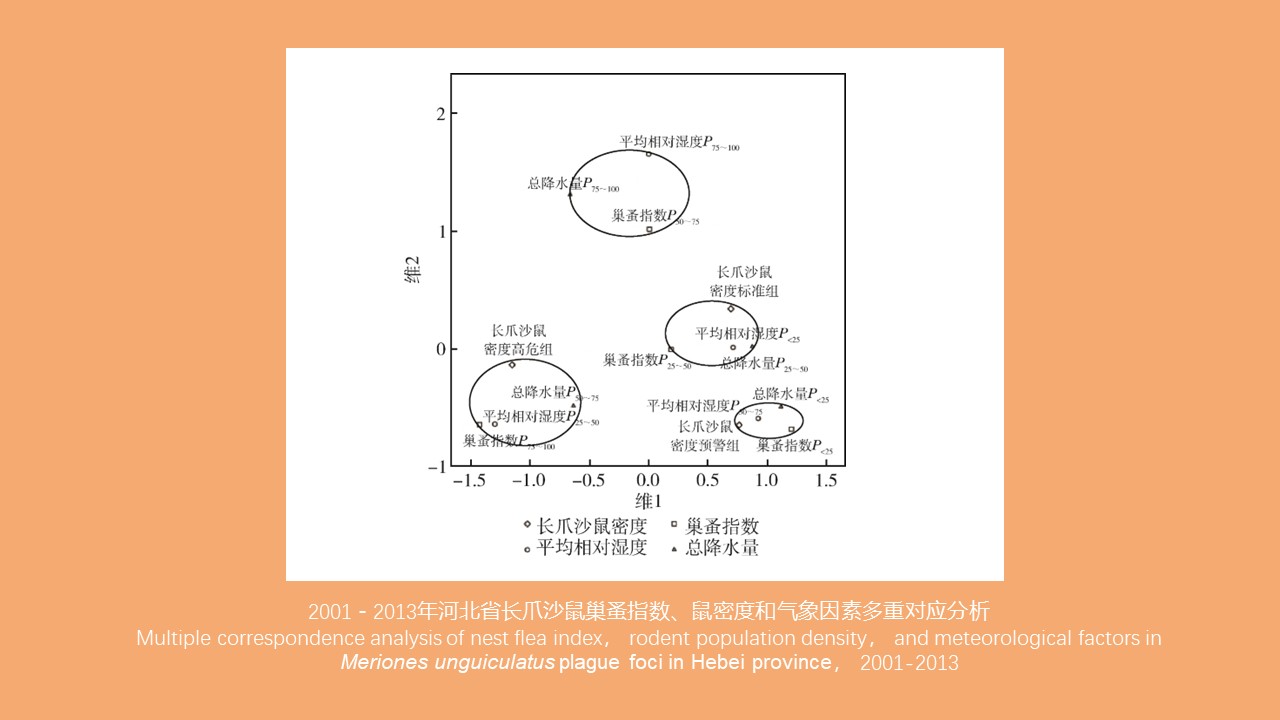
Objective To investigate the relationship between the population densities of Meriones unguiculatus and its nest fleas and meteorological factors in M.unguiculatus plague foci in Hebei province,China.Methods The monitoring data of M.unguiculatus and its nest fleas in M.unguiculatus plague foci in Hebei province from 2001 to 2013,as well as meteorological data such as precipitation,temperature and humidity during the same period were collected.The Kruskal-Wallis H test was used to compare the flea infestation rate and flea index of nest fleas among groups by the density of M.unguiculatus (≥ 1.00 rodents/hm2 as high-risk group,0.21-0.99 rodents/hm2 as warning group,≤ 0.20 rodents/hm2 as standard group).Nest flea index were also compared among groups by total precipitation,average temperature,and average relative humidity (four groups each according to their interquartile ranges).Multiple correspondence analysis was performed to analyze the relationship between the density of M.unguiculatus,nest flea index,and meteorological factors.Results The flea infestation rate distribution was statistically different between different groups by total precipitation (H=10.220,P=0.017),and when the precipitation was ≥ 426.00 mm,the flea infestation rate was highest.The nest flea index distribution statistically differed between those groups by total precipitation,average relative humidity,and M.unguiculatus density (H=27.807,12.685,7.130,all P<0.05).When the precipitation was ≥ 426.00 mm,average relative humidity was ≥ 58.71%,and M.unguiculatus density was ≥ 1.00 rodents/hm2,the nest flea index values were all highest,with statistical differences from those of the lowest groups (t=4.722,2.999,2.504,all P<0.05).The multiple correspondence analysis showed strong associations of the flea index P75-100 with the total precipitation P50-75,the average relative humidity P25-50,and M.unguiculatus density in the high-risk group,and strong associations of the flea index P50-75 with the total precipitation P75-100 and average relative humidity P75-100.Conclusion Precipitation and M.unguiculatus density are important factors affecting the rodent nest flea index in M.unguiculatus plague foci in Hebei province.When determining the site,extent,and time of flea control,host density and meteorological conditions should be considered for precise flea control to prevent plague among rodents.
[1] 李瑞,尹家祥.生态地理景观要素土壤与鼠疫的关系[J].中国人兽共患病学报,2020,36(10):876-880. DOI:10.3969/j.issn.1002-2694.2020.00.125. Li R,Yin JX. Relationship between the soil element in ecogeographical landscape and the occurrence of plague[J]. Chin J Zoonoses,2020,36(10):876-880. DOI:10.3969/j.issn. 1002-2694.2020.00.125.(in Chinese)
[2] 纪树立.鼠疫[M].北京:人民卫生出版社,1988:21. Ji SL. Plague[M]. Beijing:People's Medical Publishing House,1988:21.(in Chinese)
[3] 秦婧靓,杨瑞馥,崔玉军.动物鼠疫周期流行的生态位影响因素研究进展[J].中国人兽共患病学报,2021,37(6):556-562. DOI:10.3969/j.issn.1002-2694.2021.00.025. Qin JL,Yang RF,Cui YJ. Research progress on factors in affecting periodic plague epizootics in plague niche[J]. Chin J Zoonoses,2021,37(6):556-562. DOI:10.3969/j.issn.1002-2694.2021.00.025.(in Chinese)
[4] 牛艳芬,刘合智,张懿晖,等.河北省长爪沙鼠鼠疫疫源地鼠体蚤与气象因素关系分析[J].中国媒介生物学及控制杂志,2021,32(1):41-44. DOI:10.11853/j.issn.1003.8280.2021. 01.008. Niu YF,Liu HZ,Zhang YH,et al. An analysis of the relationship between rodent fleas and meteorological factors in Meriones unguiculatus plague foci in Hebei province,China[J]. Chin J Vector Biol Control,2021,32(1):41-44. DOI:10.11853/j.issn. 1003.8280.2021.01.008.(in Chinese)
[5] 牛艳芬.河北省长爪沙鼠疫源地动物鼠疫流行影响因素分析[D].北京:北京大学,2016. Niu YF. Analysis of influential factors of animal plague epidemics in Meriones unguiculatus foci in Hebei[D]. Beijing:Peking University,2016.(in Chinese)
[6] 许磊,李贵昌,司晓艳,等.长爪沙鼠鼠疫自然疫源地气候对鼠疫流行影响的非线性效应[J].中国媒介生物学及控制杂志,2016,27(4):321-325. DOI:10.11853/j.issn.1003.8280. 2016.04.002. Xu L,Li GC,Si XY,et al. Nonlinear effects of climate driven plague in Meriones unguiculatus natural foci in Inner Mongolia[J]. Chin J Vector Biol Control,2016,27(4):321-325. DOI:10.11853/j.issn.1003.8280.2016.04.002.(in Chinese)
[7] 卫生部卫生应急办公室,中国疾病预防控制中心.鼠疫防控应急手册[M].北京:北京大学医学出版社,2009:304-317. Health Emergency Office of the Ministry of Health,Chinese Center for Disease Control and Prevention. Emergency handbook for plague prevention and control[M]. Beijing:Peking University Medical Press,2009:304-317.(in Chinese)
[8] 孙养信,吕永杰,白江春,等.陕西省鼠疫疫区媒介蚤季节消长研究[J].中国媒介生物学及控制杂志,2005,16(6):442-445. DOI:10.3969/j.issn.1003-4692.2005.06.012. Sun YX,Lyu YJ,Bai JC,et al. Study on the seasonal variation of vector fleas in plague epidemic area,Shaanxi province[J]. Chin J Vector Biol Control,2005,16(6):442-445. DOI:10.3969/j.issn.1003-4692.2005.06.012.(in Chinese)
[9] 杨孔.蚤类生态特征与鼠疫传播[J].中国媒介生物学及控制杂志,2009,20(6):610-612. Yang K. Ecological characteristics of flea species and plague transmission[J]. Chin J Vector Biol Control,2009,20(6):610-612.(in Chinese)
[10] 张霖,董林玉,张祖仪,等.基于多重对应分析法的心血管病早期筛查试点区高危人群影响因素研究[J].医学与社会,2021,34(6):6-11,17. DOI:10.13723/j.yxysh.2021.06.002. Zhang L,Dong LY,Zhang ZY,et al. Study on the influencing factors of high risk population in cardiovascular disease early screening pilot area based on multiple correspondence analysis[J]. Med Soc,2021,34(6):6-11,17. DOI:10.13723/j.yxysh. 2021.06.002.(in Chinese)
[11] 刘海霞,陈帅,杜清,等.某市城乡居民对分级诊疗制度的认知、态度和就医行为调查[J].中国医院统计,2020,27(6):522-526. DOI:10.3969/j.issn.1006-5253.2020.06.012. Liu HX,Chen S,Du Q,et al. Survey of the cognition,attitude and medical treatment behavior of urban and rural residents on the hierarchical diag-nosis and treatment system in a city[J]. Chin J Hosp Statist,2020,27(6):522-526. DOI:10.3969/j.issn.1006-5253.2020.06.012.(in Chinese)
[12] 潘小满,李健健,张米,等.云南省1134例使用含EFV和NVP方案抗病毒治疗失败HIV/AIDS患者基因型耐药差异性分析[J].预防医学情报杂志,2019,35(12):1364-1369. Pan XM,Li JJ,Zhang M,et al. Analysis of the difference between genotype drug resistance among 1134 HIV/AIDS patients who failed antiviral treatment with EFV and NVP in Yunnan province[J]. J Prev Med Informat,2019,35(12):1364-1369.(in Chinese)
[13] 徐丹丹.玉龙县鼠疫自然疫源地地理景观特征与鼠疫发生关系的初探[D].大理:大理大学,2018. Xu DD. Study on the relationship between geographical landscape features and plague occurrence in Yulong plague natural focus[D]. Dali:Dali University,2018.(in Chinese)
[14] 张爱萍,魏荣杰,熊浩明,等.气候因素对鼠疫分布影响的研究进展[J].中华预防医学杂志,2016,50(5):459-462. DOI:10.3760/cma.j.issn.0253-9624.2016.05.015. Zhang AP,Wei RJ,Xiong HM,et al. Advance to the research of the climate factor effect on the distribution of plague[J]. Chin J Prev Med,2016,50(5):459-462. DOI:10.3760/cma.j.issn.0253-9624.2016.05.015.(in Chinese)
[15] Parmenter RR,Yadav EP,Parmenter CA,et al. Incidence of plague associated with increased winter-spring precipitation in New Mexico[J]. Am J Trop Med Hyg,1999,61(5):814-821. DOI:10.4269/ajtmh.1999.61.814.
[16] 李仲来,陈德.长爪沙鼠寄生蚤指数和气象因子关系的研究[J].昆虫学报,1999,42(3):284-290. DOI:10.3321/j.issn:0454-6296.1999.03.009. Li ZL,Chen D. Studies on relationships among parasitic flea index of Meriones unguiculatus and meteorological factors[J]. Acta Entomol Sin,1999,42(3):284-290. DOI:10.3321/j.issn:0454-6296.1999.03.009.(in Chinese)
[17] 王鼎盛,徐大琴,格鹏飞,等.阿拉善黄鼠寄生蚤数量与宿主数量和气象因素的关系[J].中华地方病学杂志,2018,37(12):965-968. DOI:10.3760/cma.j.issn.2095-4255.2018. 12.004. Wang DS,Xu DQ,Ge PF,et al. The relationship between fleas density of Spermophilus alaschanicue and host density and meteorological factors[J]. Chin J Endemiol,2018,37(12):965-968. DOI:10.3760/cma.j.issn.2095-4255.2018.12.004.(in Chinese)


