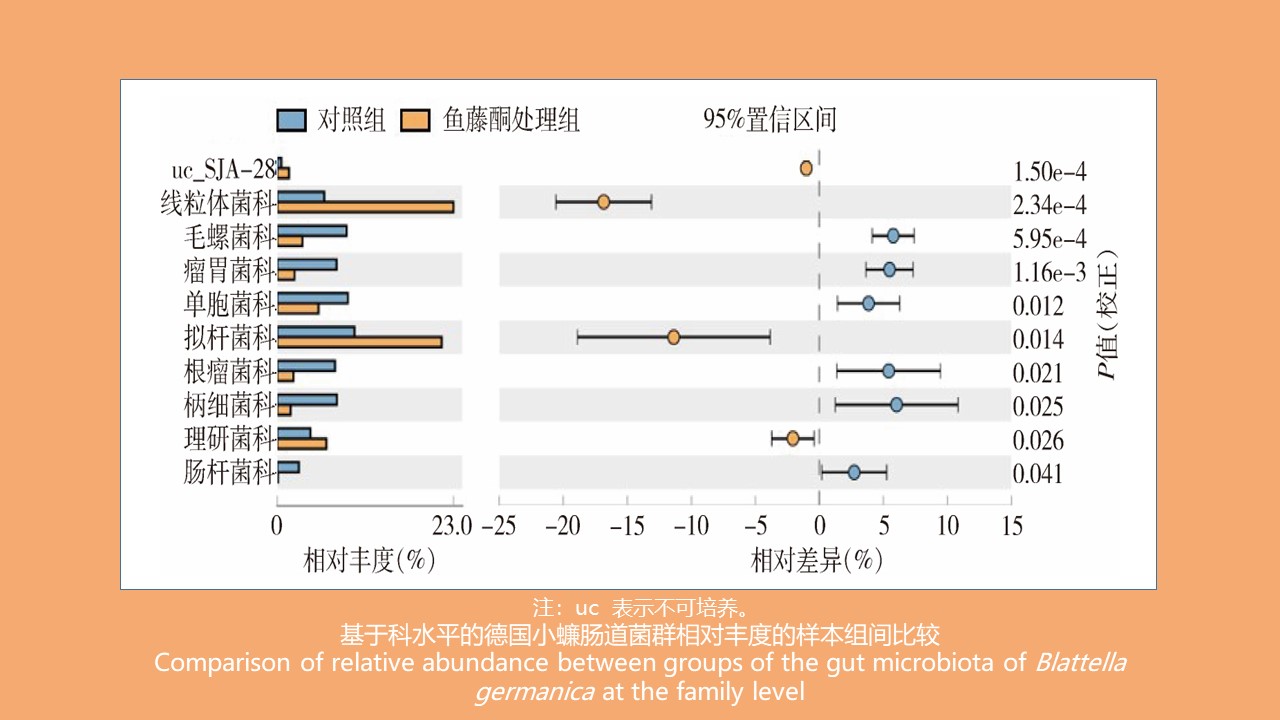
Objective To investigate the effect of rotenone on the gut microbiota of Blattella germanica and the reason for the low toxicity of rotenone against B.germanica.Methods The gut microbiota of B.germanica were eliminated by feeding antibiotics,and then normal B.germanica cockroaches and the B.germanica cockroaches with eliminated gut microbiota were fed with rotenone to observe the influence of gut microbiota on the insecticidal activity of rotenone.In addition,gut genomic DNA was extracted from normal B.germanica cockroaches after feeding rotenone,and normal B.germanica cockroaches not fed with rotenone were used as control.Illumina HiSeq high-throughput sequencing was used to determine the sequence of the V3-V4 variable region of 16S rRNA,and the number of sequences and operational taxonomic units were used to analyze the composition and abundance of microflora,the abundance and diversity of bacterial communities,and the changes in bacterial composition across different treatment methods.SPSS 22.0 software was used for data analysis,and the independent samples t-test was used for difference analysis.R language software was used for heatmap clustering analysis and principal component analysis.Results Compared with the normal B.germanica cockroaches,the B.germanica cockroaches with eliminated gut microbiota had a significant reduction in survival rate after treatment with rotenone (t=8.485,P<0.001).16S rRNA sequencing obtained 128 genera,78 families,and 19 phyla of bacteria.Diversity analysis showed that the B.germanica cockroaches treated with rotenone had significantly higher ACE and Chao1 indices than the normal cockroaches (t=-2.990,P=0.040;t=-4.227,P=0.013).The analysis of bacterial community abundance showed that compared with the normal B.germanica cockroaches,the B.germanica cockroaches treated with rotenone had significantly higher relative abundances of Mitochondria,Bacteroidaceae,and Rikenellaceae (t=-12.178,P<0.001;t=-4.087,P=0.014;t=-3.570,P=0.026) and significantly lower relative abundances of Lachnospiraceae,Ruminococcaceae,Syntrophomonadaceae,Caulobacteraceae,and Enterobacteriaceae (t=10.662,P<0.001;t=8.242,P=0.001;t=4.394,P=0.012;t=3.421,P=0.025;t=3.038,P=0.041).Heatmap clustering analysis showed that the rotenone treatment group and the control group were in different primary branches,and the principal component analysis showed similar bacterial diversity between the samples in the same treatment.Conclusion Gut microbiota may play an role in host resistance to rotenone toxicity,and rotenone has a great impact on the community structure of the gut microbiota of B.germanica.Improving insecticidal activity by destroying the community structure of the gut microbiota of insects may provide a new idea for the application of plant-derived pesticides in pest control.
[1] 都二霞,李胜.蟑螂为"小强"的分子奥秘[J].中国媒介生物学及控制杂志,2021,32(4):385-389. DOI:10.11853/j.issn.1003.8280.2021.04.001. Du EX,Li S. Molecular mystery of the"Little Mighty" cockroach[J]. Chin J Vector Biol Control,2021,32(4):385-389. DOI:10.11853/j.issn.1003.8280.2021.04.001.(in Chinese)
[2] Nasirian H. Infestation of cockroaches (Insecta:Blattaria) in the human dwelling environments:A systematic review and meta-analysis[J]. Acta Trop,2017,167:86-98. DOI:10.1016/j.actatropica.2016.12.019.
[3] Zhang F,Yang RA. Life history and functional capacity of the microbiome are altered in beta-cypermethrin-resistant cockroaches[J]. Int J Parasitol,2019,49(9):715-723. DOI:10.1016/j.ijpara.2019.04.006.
[4] 辛正,王东,张晓,等.植物源卫生杀虫剂开发利用与前景展望[J].首都公共卫生,2018,12(1):13-17. DOI:10.16760/j.cnki.sdggws.2018.01.005. Xin Z,Wang D,Zhang X,et al. Review on current development and prospect of botanical hygienic insecticides[J]. Cap J Public Health,2018,12(1):13-17. DOI:10.16760/j.cnki.sdggws.2018. 01.005.(in Chinese)
[5] Pan XY,Zhang F. Advances in biological control of the German cockroach,Blattella germanica(L.)[J]. Biol Control,2020,142:104104. DOI:10.1016/j.biocontrol.2019.104104.
[6] Isman MB. Botanical insecticides,deterrents,and repellents in modern agriculture and an increasingly regulated world[J]. Annu Rev Entomol,2006,51(1):45-66. DOI:10.1146/annurev.ento. 51.110104.151146.
[7] 倪玲,肖蕾,蔡祥海,等.植物成分防治蜚蠊研究进展[J].中国媒介生物学及控制杂志,2017,28(1):90-92,95. DOI:10.11853/j.issn.1003.8280.2017.01.027. Ni L,Xiao L,Cai XH,et al. Progress on botanical constituents against cockroaches[J]. Chin J Vector Biol Control,2017,28(1):90-92,95. DOI:10.11853/j.issn.1003.8280.2017.01.027.(in Chinese)
[8] 刘春华.一种生物源杀蟑胶饵的研制[D].广州:中山大学,2012. Liu CH. Research and development of a bio-insecticide gel against Blattella germanica[D]. Guangzhou:Sun Yat-sen University,2012.(in Chinese)
[9] Chakraborty A,Roy A. Microbial influence on plant-insect interaction[M]//Singh IK,Singh A. Plant-pest interactions:From molecular mechanisms to chemical ecology. Singapore:Springer,2021:337-363.
[10] Adams AS,Aylward FO,Adams SM,et al. Mountain pine beetles colonizing historical and naive host trees are associated with a bacterial community highly enriched in genes contributing to terpene metabolism[J]. Appl Environ Microbiol,2013,79(11):3468-3475. DOI:10.1128/AEM.00068-13.
[11] Welte CU,De Graaf RM,Van Den Bosch TJM,et al. Plasmids from the gut microbiome of cabbage root fly larvae encode SaxA that catalyses the conversion of the plant toxin 2-phenylethyl isothiocyanate[J]. Environ Microbiol,2016,18(5):1379-1390. DOI:10.1111/1462-2920.12997.
[12] Dodiya HB,Forsyth CB,Voigt RM,et al. Chronic stress-induced gut dysfunction exacerbates Parkinson's disease phenotype and pathology in a rotenone-induced mouse model of Parkinson's disease[J]. Neurobiol Dis,2020,135:104352. DOI:10.1016/j.nbd.2018.12.012.
[13] Ünalİ,ÜstündağÜV,Ateş PS,et al. Rotenone impairs oxidant/antioxidant balance both in brain and intestines in zebrafish[J]. Int J Neurosci,2019,129(4):363-368. DOI:10.1080/00207454. 2018.1538141.
[14] 施万里,杨繁,孙晓霞,等.多种抗生素对抗药性德国小蠊肠道菌去除效果的研究[J].内蒙古大学学报(自然科学版),2017,48(3):291-296. DOI:10.13484/j.nmgdxxbzk.20170311. Shi WL,Yang F,Sun XX,et al. Study on removal of intestinal flora in pesticide-resistant Blattella germanica using various antibiotics[J]. Acta Sci Nat Univ Neimongol,2017,48(3):291-296. DOI:10.13484/j.nmgdxxbzk.20170311.(in Chinese)
[15] Cai ZH,Yao ZC,Li YS,et al. Intestinal probiotics restore the ecological fitness decline of Bactrocera dorsalis by irradiation[J]. Evol Appl,2018,11(10):1946-1963. DOI:10.1111/eva.12698.
[16] Liu JL,Chang RR,Zhang XB,et al. Non-isoflavones diet incurred metabolic modifications induced by constipation in rats via targeting gut microbiota[J]. Front Microbiol,2018,9:3002. DOI:10.3389/fmicb.2018.03002.
[17] Carrasco P,Pérez-Cobas AE,Van De Pol C,et al. Succession of the gut microbiota in the cockroach Blattella germanica[J]. Int Microbiol,2014,17(2):99-109. DOI:10.2436/20.1501.01.212.
[18] Tinker KA,Ottesen EA. The core gut microbiome of the American cockroach,Periplaneta americana,is stable and resilient to dietary shifts[J]. Appl Environ Microbiol,2016,82(22):6603-6610. DOI:10.1128/AEM.01837-16.
[19] Schauer C,Thompson CL,Brune A. The bacterial community in the gut of the cockroach Shelfordella lateralis reflects the close evolutionary relatedness of cockroaches and termites[J]. Appl Environ Microbiol,2012,78(8):2758-2767. DOI:10.1128/AEM.07788-11.
[20] Khamis FM,Ombura FLO,Akutse KS,et al. Insights in the global genetics and gut microbiome of black soldier fly,Hermetia illucens:Implications for animal feed safety control[J]. Front Microbiol,2020,11:1538. DOI:10.3389/fmicb.2020.01538.
[21] Cui LX,Guo QY,Wang XX,et al. Midgut bacterial diversity of a leaf-mining beetle,Dactylispa xanthospila(Gestro)(Coleoptera:Chrysomelidae:Cassidinae)[J]. Biodivers Data J,2021,9:e62843. DOI:10.3897/BDJ.9.e62843.
[22] Cator LJ,Johnson LR,Mordecai EA,et al. The role of vector trait variation in vector-borne disease dynamics[J]. Front Ecol Evol,2020,8:189. DOI:10.3389/fevo.2020.00189.
[23] Backhed F,Ley RE,Sonnenburg JL,et al. Host-bacterial mutualism in the human intestine[J]. Science,2005,307(5717):1915-1920. DOI:10.1126/science.1104816.
[24] Kakumanu ML,Maritz JM,Carlton JM,et al. Overlapping community compositions of gut and fecal microbiomes in lab-reared and field-collected German cockroaches[J]. Appl Environ Microbiol,2018,84(17):e01037-18. DOI:10.1128/AEM. 01037-18.
[25] Degli Esposti M. Bioenergetic evolution in proteobacteria and mitochondria[J]. Genome Biol Evol,2014,6(12):3238-3251. DOI:10.1093/gbe/evu257.
[26] Akhtar Y,Yeoung YR,Isman MB. Comparative bioactivity of selected extracts from Meliaceae and some commercial botanical insecticides against two noctuid caterpillars,Trichoplusia ni and Pseudaletia unipuncta[J]. Phytochem Rev,2008,7(1):77-88. DOI:10.1007/s11101-006-9048-7.
[27] Chao Y,Wang MY,Dai W,et al. Synergism between hydramethylnon and Metarhizium anisopliae and their influence on the gut microbiome of Blattella germanica (L.)[J]. Insects,2020,11(8):538. DOI:10.3390/insects11080538.
[28] Yang RA,Zhang MJ,Schal C,et al. Boric acid enhances Metarhizium anisopliae virulence in Blattella germanica(L.) by disrupting the gut and altering its microbial community[J]. Biol Control,2021,152:104430. DOI:10.1016/j.biocontrol. 2020. 104430.


