目的 探索实验室内白纹伊蚊卵短期保存的适宜温度与方式。方法 实验室饲养的白纹伊蚊产卵,挑选形态完整饱满的蚊卵,在体视显微镜下计数。对照组计数后直接放入水中进行孵化,实验组按保存时间分为7、14、21、28 d共 4组,每组均设置3个重复,各组间蚊卵数目大致相等。分别放入湿度设置为75%,温度设置为5、10、12.5、15、20、25 ℃的恒温恒湿气候箱内进行保存。蚊卵保存至第7、14、21、28天时,分别取出对应组别蚊卵,用数码显微镜观察蚊卵状态及完整性并入水孵化。直至最早孵化的幼虫长至3龄时结束实验,进行计数并计算孵化率。应用Excel 2019软件对数据进行整理,采用SPSS 26.0软件进行统计学分析,计数资料以率表示,符合正态分布的计量资料以(x±s)表示,两组间比较采用单因素方差分析。结果 白纹伊蚊卵在5、15、25 ℃下分别保存7、14、21、28 d,其中15 ℃下保存蚊卵的孵化率第7天为67.80%,第14天为50.00%,至第28天仍维持在50.00%左右;5 ℃下保存蚊卵的孵化率在第7天即降低至21.88%,第14天为9.32%,第21天仅为0.26%,至第28天降为0;25 ℃下保存蚊卵的孵化率介于其他2组之间,除第14天出现明显下降外,其他时间均维持在30.00%左右。白纹伊蚊卵在保存7、14、21和28 d,5、15和25 ℃条件下蚊卵的孵化率差异有统计学意义(7 d:F=36.688,P<0.001;14 d:F=166.749,P<0.001;21 d:F=7.890,P=0.021;28 d:F=19.501,P=0.002),其中15和25 ℃均高于5 ℃保存的孵化率(除25 ℃保存14 d外)(7 d:P<0.001,P=0.033;14 d:P<0.001,P<0.001;21 d:P=0.008,P=0.033;28 d:P=0.001,P=0.007)。白纹伊蚊卵在10、12.5、20 ℃下分别保存7、14、21、28 d,其中12.5 ℃下保存蚊卵的孵化率至第28天为47.71%;10 ℃下保存蚊卵的孵化率从第7天开始逐渐降低,至第28天为17.56%;20 ℃下的孵化率介于其他2组之间,至第28天始终维持在40.00%左右。10、12.5和20 ℃保存14和28 d时的孵化率差异有统计学意义(14 d:F=23.700,P=0.001;28 d:F=9.429,P=0.014),12.5和20 ℃均高于10 ℃保存蚊卵的孵化率(14 d: P<0.001,P=0.017;28 d:P=0.008,P=0.011)。结论 在环境相对湿度为75%,载卵滤纸始终保持湿润的条件下,12.5和15 ℃为白纹伊蚊卵短期保存的相对适宜温度。
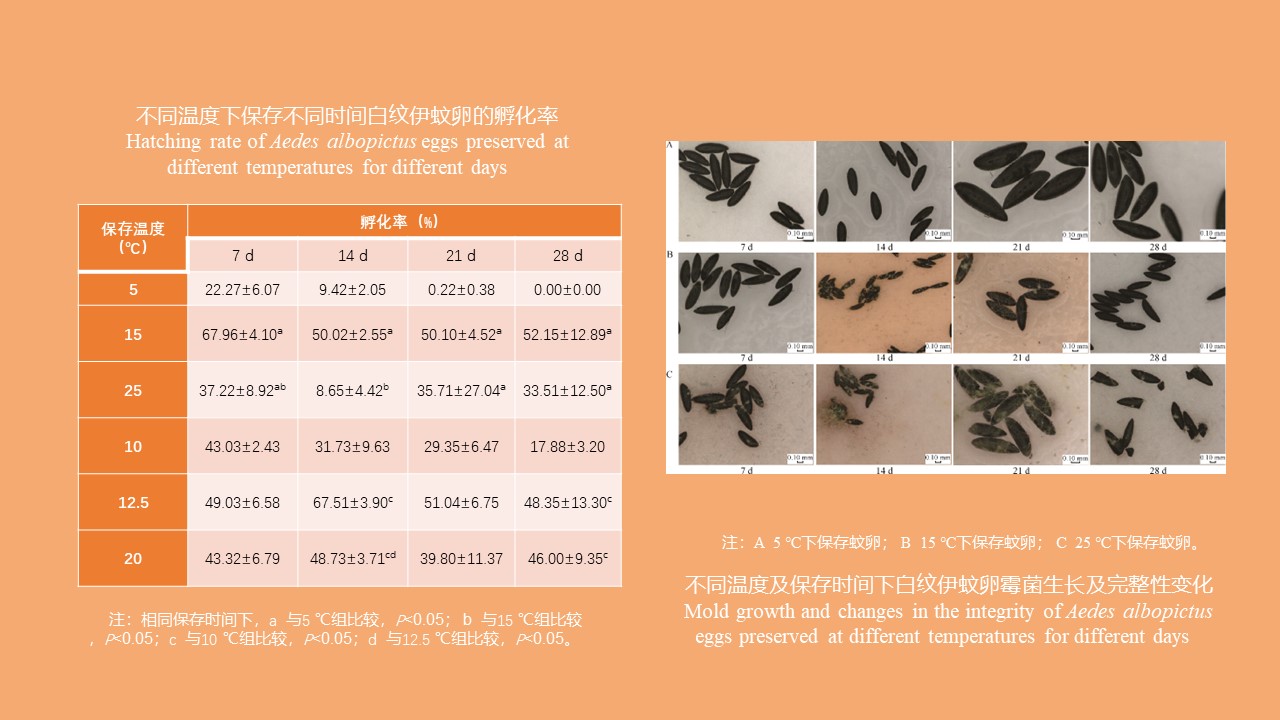
Objective To explore a suitable temperature and method for short-term preservation of Aedes albopictus eggs in laboratory.Methods Ae.albopictus reared in the laboratory laid eggs.The eggs with complete and plump form were selected and counted under a stereomicroscope.Eggs in the control group were directly put into water for hatching after counting;eggs in the experimental group were divided into four groups according to the preservation time:7,14,21,and 28 d groups.Three repetitions were set in each group,and the number of mosquito eggs in each group was roughly equal.Eggs were preserved in constant temperature and humidity climate boxes with the humidity of 75% and the temperature was set to 5,10,12.5,15,20,and 25℃.After preserved for 7,14,21,and 28 days,eggs in the corresponding groups were taken out,observed with a digital microscope for the status and integrity,and hatched in water.When the earliest hatched larvae reached the 3rd instar,the observation ended.The larvae were counted,and the hatching rate was calculated.Excel 2019 software was used to sort out the data and calculate the hatching rate;SPSS 26.0 software was used for statistical analysis.The enumeration data were expressed as rate,and the measurement data in line with normal distribution were expressed as x±s.One-way analysis of variance was used for the comparison between two groups.Results As for the eggs of Ae.albopictus preserved at 5,15,and 25℃ for 7,14,21,and 28 days,respectively,the hatching rate of eggs preserved at 15℃ was 67.80% on the 7th day,50.00% on the 14th day,and remained about 50.00% on the 28th day;the hatching rate of eggs preserved at 5℃ decreased to 21.88% on the 7th day,9.32% on the 14th day,only 0.26% on the 21st day,and 0 on the 28th day.The hatchability of mosquito eggs stored at 25℃ was between the other two groups,and maintained at about 30.00% except for a significant decrease on the 14th day.There were significant differences in hatching rates of Ae.albopictus eggs stored at 5,15,and 25℃ for 7,14,21,and 28 days (7 d:F=36.688,P<0.001;14 d:F=166.749,P<0.001;21 d:F=7.890,P=0.021;28 d:F=19.501,P=0.002),and the hatching rates at 15 and 25℃ were higher than that at 5℃(except for 14-day preservation at 25℃)(7 d:P<0.001,P=0.033;14 d:P<0.001,P<0.001;21 d:P=0.008,P=0.033;28 d:P=0.001,P=0.007).As for the eggs of Ae.albopictus preserved at 10,12.5,and 20℃ for 7,14,21,and 28 days,respectively,the hatching rate of eggs preserved at 12.5℃ was 47.71% on the 28th day;the hatching rate of eggs preserved at 10℃ decreased gradually from the 7th day to 17.56% on the 28th day;the hatching rate at 20℃ was between the other two groups,and remained at about 40.00% on the 28th day.There was a significant difference in the hatching rate of eggs preserved at 10℃,12.5℃,and 20℃ for 14 and 28 days (14 d:F=23.700,P=0.001;28 d:F=9.429,P=0.014).The hatching rate at 12.5℃ and 20℃ were higher than that at 10℃(14 d:P<0.001,P=0.017;28 d:P=0.008,P=0.011).Conclusion When the environmental relative humidity is 75% and the egg-loading filter paper is always wet,12.5℃ and 15℃ are appropriate temperatures for short-term preservation of Ae.albopictus eggs.
[1] 刘起勇.气候变化对中国媒介生物传染病的影响及应对:重大研究发现及未来研究建议[J].中国媒介生物学及控制杂志,2021,32(1):1-11. DOI:10.11853/j.issn.1003.8280.2021. 01.001. Liu QY. Impact of climate change on vector-borne diseases and related response strategies in China:Major research findings and recommendations for future research[J]. Chin J Vector Biol Control,2021,32(1):1-11. DOI:10.11853/j.issn.1003.8280. 2021.01.001.(in Chinese)
[2] 刘起勇. 2005-2020年我国媒介生物传染病报告病例:流行趋势、防控挑战及应对策略[J].中国媒介生物学及控制杂志,2022,33(1):1-7. DOI:10.11853/j.issn.1003.8280.2022.01.001. Liu QY. Reported cases of vector-borne diseases in China,2005-2020:Epidemic trend,challenges in prevention and control,and related coping strategies[J]. Chin J Vector Biol Control,2022,33(1):1-7. DOI:10.11853/j.issn.1003.8280.2022.01.001.(in Chinese)
[3] 刘小波,岳玉娟,贾清臣,等. 2020-2021年我国12省份媒介伊蚊生态学调查[J].中国媒介生物学及控制杂志,2022,33(1):8-15. DOI:10.11853/j.issn.1003.8280.2022.01.002. Liu XB,Yue YJ,Jia QC,et al. Ecological investigation of Aedes vector in 12 provinces of China in 2020-2021[J]. Chin J Vector Biol Control,2022,33(1):8-15. DOI:10.11853/j.issn.1003. 8280.2022.01.002.(in Chinese)
[4] 岳秋娟,姚淑敏,刘洋洋,等.一个致倦库蚊杀虫剂敏感品系的筛选[J].昆虫学报,2013,56(4):379-384. DOI:10.16380/j.kcxb.2013.04.003. Yue QJ,Yao SM,Liu YY,et al. Screening of an insecticide-susceptible strain of Culex pipiens quinquefasciatus(Diptera:Culicidae)[J]. Acta Entomol Sin,2013,56(4):379-384. DOI:10.16380/j.kcxb.2013.04.003.(in Chinese)
[5] 柳忠婉,张跃进,杨亚钊.白纹伊蚊实验种群动态的研究[J].昆虫学报,1985(3):274-280. DOI:10.16380/j.kcxb.1985. 03.006. Liu ZW,Zhang YJ,Yang YZ. Population dynamics of Aedes(Stegomyia)albopictus(Skuse) under laboratory conditions[J]. Acta Entomol Sin,1985(3):274-280. DOI:10.16380/j.kcxb. 1985.03.006.(in Chinese)
[6] 王丕玉,董利民.白纹伊蚊(Aedes albopictus)卵的储存研究[J].医学动物防制,2003,19(1):6-7. DOI:10.3969/j.issn. 1003-6245.2003.01.003. Wang PY,Dong LM. Study on egg storage of Aedes albopictus[J]. J Med Pest Control,2003,19(1):6-7. DOI:10.3969/j.issn.1003-6245.2003.01.003.(in Chinese)
[7] 孙传红,江洪涛,李怀菊,等.白纹伊蚊卵储存方法探讨[J].中国寄生虫病防治杂志,2004,17(4):76. DOI:10.3969/j.issn.1673-5234.2004.04.035. Sun CH,Jiang HT,Li HJ,et al. Study on the storage methods of Aedes albopictus eggs[J]. Chin J Parasit Dis Control,2004,17(4):76. DOI:10.3969/j.issn.1673-5234.2004.04.035.(in Chinese)
[8] Kliewer JW. Weight and hatchability of Aedes aegypti eggs (Diptera:Culicidae)[J]. Ann Entomol Soc Am,1961,54(6):912-917.
[9] 杨振洲,陆宝麟.湿度对白纹伊蚊卵存活的影响[J].医学动物防制,1985(4):1-3. Yang ZZ,Lu BL. Effects of humidity on egg survival of Aedes albopictus[J]. Chin J Pest Control,1985(4):1-3.(in Chinese)
[10] 杨翠,奚志勇,胡志勇.温湿度对携带沃尔巴克氏体白纹伊蚊卵孵化率的影响[J].热带医学杂志,2020,20(3):346-349. DOI:10.3969/j.issn.1672-3619.2020.03.017. Yang C,Xi ZY,Hu ZY. Effect of temperature and humidity on egg hatch rate of triple-Wolbachia-infected Aedes albopictus[J]. J Trop Med,2020,20(3):346-349. DOI:10.3969/j.issn.1672-3619.2020.03.017.(in Chinese)
[11] Soares-Pinheiro VC,Dasso-Pinheiro W,Trindade-Bezerra JM,et al. Eggs viability of Aedes aegypti linnaeus (Diptera,Culicidae) under different environmental and storage conditions in Manaus,Amazonas,Brazil[J]. Braz J Biol,2017,77(2):396-401.
[12] 陈小杰.不同湿度条件对不同胚胎发育期的白纹伊蚊卵孵化率的影响[J].韶关学院学报,1986(4):172-183. Chen XJ. Effects of different humidity conditions on egg hatchability of Aedes albopictus at different embryonic stages[J]. J Shaoguan Univ,1986(4):172-183.(in Chinese)
[13] 李广宏,陈其津,庞义,等.昆虫卵的超低温冷冻保存[J].昆虫知识,2000,37(5):318-320,298. DOI:10.3969/j.issn.0452-8255.2000.05.022. Li GH,Chen QJ,Pang Y,et al. Cryopreservation of insect embryos in liquid nitrogen[J]. Entomol Knowl,2000,37(5):318-320,298. DOI:10.3969/j.issn.0452-8255.2000.05.022.(in Chinese)


