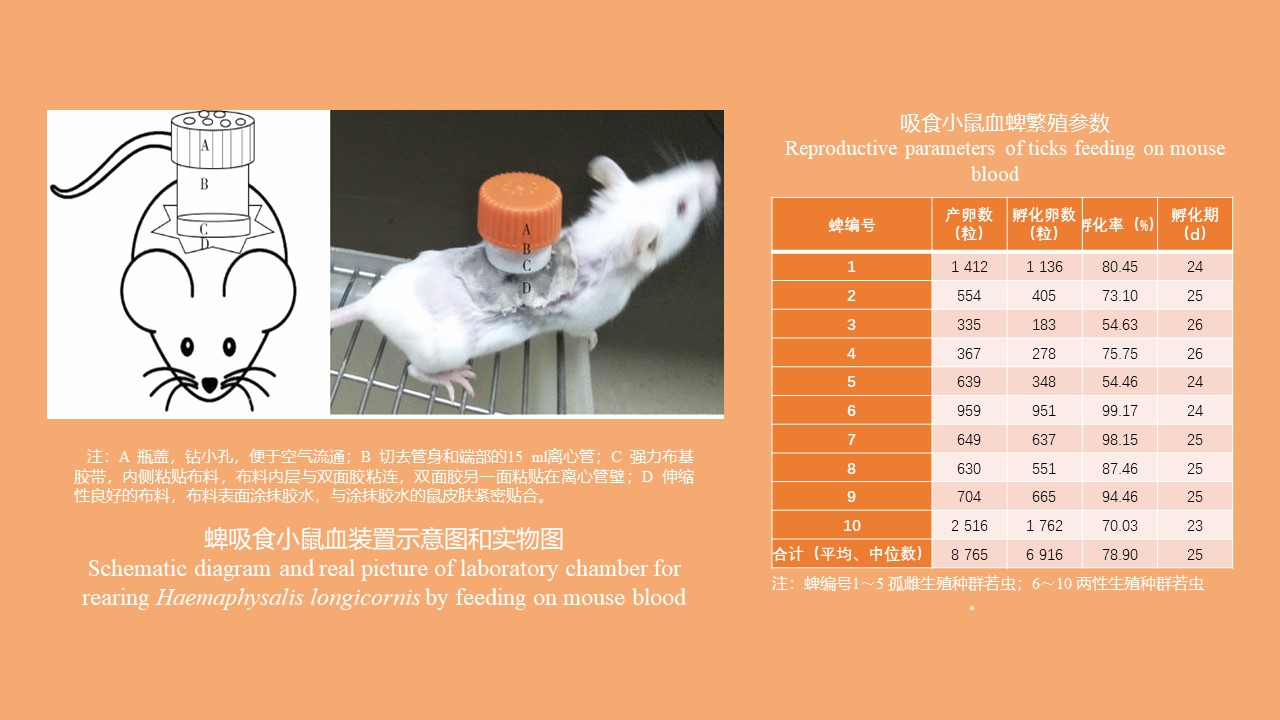
目的 研发蜱实验室吸食小鼠血的方法。方法 使用市售材料制备蜱吸血小室,评价吸食鼠血后的长角血蜱附着时长、饱血、生长和繁殖情况。结果 通过蜱吸血小室供长角血蜱吸血,若蜱平均叮咬成功率为80.00%,叮咬时长1~4 d,吸血期4~6 d,平均饱血率为98.21%,蜕皮率为97.85%。成蜱饱血率为66.67%,吸血期中位数为6.5 d,饱血体质量比饥饿蜱增加了150多倍,每只雌蜱平均产卵数876粒,卵平均孵化率为78.90%,孵化期中位数为25 d。结论 研制的蜱吸血小室可用于长角血蜱实验室饲养。
Objective To develop the method for ticks to feed on mouse blood under laboratory conditions.Methods The blood feeding chamber for ticks was prepared with commercially available materials.The attachment,engorgement,growth,and reproduction of Haemaphysalis longicornis were evaluated after feeding on mouse blood.Results The chambers were used to feed H.longicornis.Nymphs used 1-4 d to attach themselves to mice and had a mean biting success rate of 80.00%,an engorgement duration of 4-6 d and a mean engorgement rate of 98.21%.On the average,97.85% nymphs molted to adults.Adult ticks spent 6.5 d (M) to engorge with an engorgement rate of 66.67%,and the body weight of engorged ticks increased>150-fold versus unfed ticks.Each female tick laid an average of 876 eggs.On the average,78.90% eggs hatched with the duration of 25 d (M).Conclusion The blood feeding chamber for ticks developed by the authors is suitable for rearing H.longicornis under laboratory conditions.
[1] Commins SP,Platts-Mills TAE. Tick bites and red meat allergy[J]. Curr Opin Allergy Clin Immunol,2013,13(4):354-359. DOI:10.1097/ACI.0b013e3283624560.
[2] Hall-Mendelin S,Craig SB,Hall RA,et al. Tick paralysis in Australia caused by Ixodes holocyclus Neumann[J]. Ann Trop Med Parasitol,2011,105(2):95-106. DOI:10.1179/136485911X12899838413628.
[3] Goodman JL,Dennis DT,Sonenshine DE. Tick-borne diseases of humans[M]. Washington,DC:ASM Press,2005:3-11.
[4] Yu XJ,Liang MF,Zhang SY,et al. Fever with thrombocytopenia associated with a novel Bunyavirus in China[J]. N Engl J Med,2011,364(16):1523-1532. DOI:10.1056/NEJMoa1010095.
[5] 危芙蓉,兰勤娴,朱丹,等.中国部分地区警犬体表寄生蜱的巴贝虫感染情况调查[J].中国寄生虫学与寄生虫病杂志,2012,30(5):390-392. Wei FR,Lan QX,Zhu D,et al. Investigation on Babesia in ticks infested on police dogs in selected areas of China[J]. Chin J Parasitol Parasit Dis,2012,30(5):390-392.(in Chinese)
[6] Zhang LJ,Liu H,Xu BL,et al. Anaplasma phagocytophilum infection in domestic animals in ten provinces/cities of China[J]. Am J Trop Med Hyg,2012,87(1):185-189. DOI:10.4269/ajtmh.2012.12-0005.
[7] Chen Y,Chen YY,Liu G,et al. Prevalence of Theileria in cattle in China:A systematic review and meta-analysis[J]. Microb Pathog,2022,162:105369. DOI:10.1016/j.micpath.2021. 105369.
[8] Andrade JJ,Xu G,Rich SM. A silicone membrane for in vitro feeding of Ixodes scapularis(Ixodida:Ixodidae)[J]. J Med Entomol,2014,51(4):878-879. DOI:10.1603/ME13180.
[9] Kröber T,Guerin PM. In vitro feeding assays for hard ticks[J]. Trends Parasitol,2007,23(9):445-449. DOI:10.1016/j.pt. 2007.07.010.
[10] Antunes S,Rosa C,Couto J,et al. Deciphering Babesia-vector interactions[J]. Front Cell Infect Microbiol,2017,7:419. DOI:10.3389/fcimb.2017.00429.
[11] Liao M,Zhou JL,Gong HY,et al. Hemalin,a thrombin inhibitor isolated from a midgut cDNA library from the hard tick Haemaphysalis longicornis[J]. J Insect Physiol,2009,55(2):165-174. DOI:10.1016/j.jinsphys.2008.11.004.
[12] Patrick CD,Hair JA. Laboratory rearing procedures and equipment for multi-host ticks (Acarina:Ixodidae)[J]. J Med Entomol,1975,12(3):389-390. DOI:10.1093/jmedent/12.3.389.
[13] Nuss AB,Mathew MG,Gulia-Nuss M. Rearing Ixodes scapularis,the black-legged tick:Feeding immature stages on mice[J]. J Vis Exp,2017(123):55286. DOI:10.3791/55286.
[14] Chen Z,Yang XJ,Bu FJ,et al. Morphological,biological and molecular characteristics of bisexual and parthenogenetic Haemaphysalis longicornis[J]. Vet Parasitol,2012,189(2/4):344-352. DOI:10.1016/j.vetpar.2012.04.021.
[15] Anderson JF,Magnarelli LA. Biology of ticks[J]. Infect Dis Clin North Am,2008,22(2):195-215. DOI:10.1016/j.idc.2007. 12.006.
[16] Zheng WQ,Umemiya-Shirafuji R,Chen SE,et al. Identification of Haemaphysalis longicornis genes differentially expressed in response to Babesia microti infection[J]. Pathogens,2020,9(5):378. DOI:10.3390/pathogens9050378.
[17] Zheng WQ,Umemiya-Shirafuji R,Zhang Q,et al. Porin expression profiles in Haemaphysalis longicornis infected with Babesia microti[J]. Front Physiol,2020,11:502. DOI:10.3389/fphys.2020.00502.
[18] 刘敬泽,姜在阶.实验室条件下长角血蜱的生物学特性研究[J].昆虫学报,1998,41(3):280-283. DOI:10.3321/j.issn:0454-6296.1998.03.010. Liu JZ,Jiang ZJ. Studies on the bionomics of Haemaphysalis longicornis Neumann (Acari:Ixodidae) under laboratory conditions[J]. Acta Entomol Sin,1998,41(3):280-283. DOI:10.3321/j.issn:0454-6296.1998.03.010.(in Chinese)