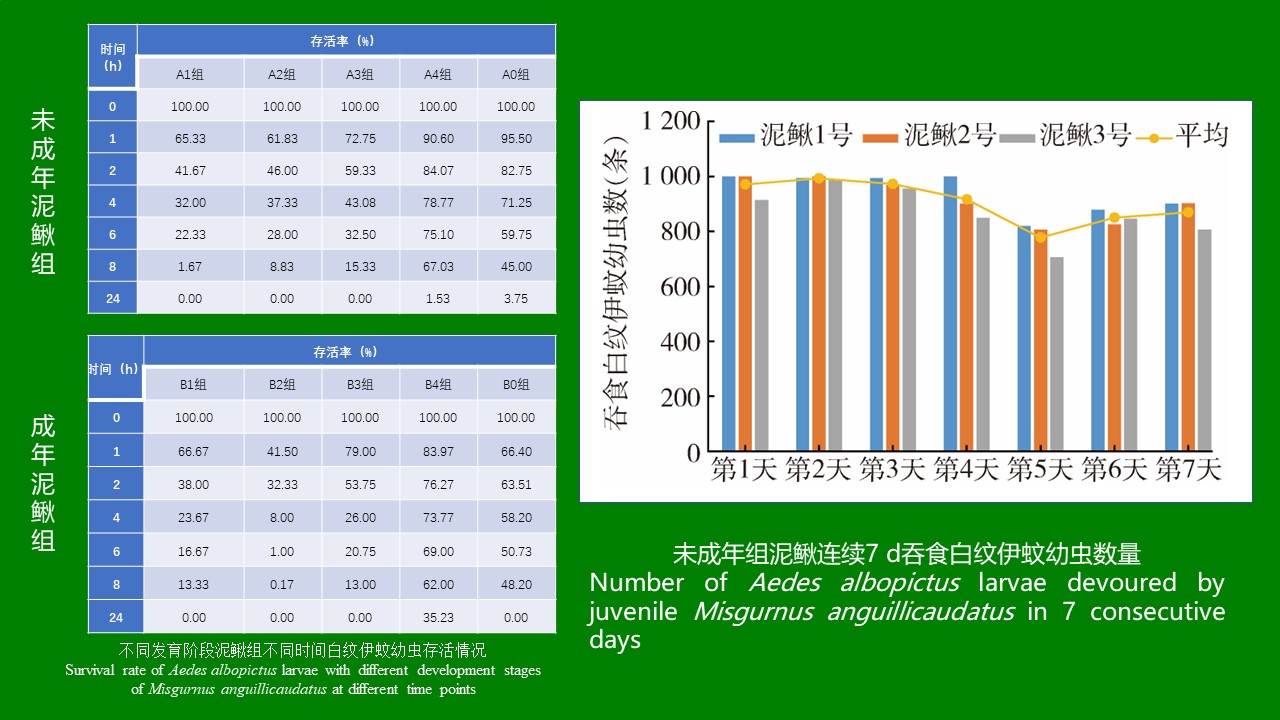
目的 探讨我国本地鱼种——泥鳅对白纹伊蚊幼虫的控制效果,为生物防蚊提供新思路。方法 将泥鳅分为未成年组和成年组,称重,24 h禁食后分别放入幼蚊密度为100、200、400和1 000条/缸的鱼缸内,以同等体质量的柳条鱼作为对照组(选择多条柳条鱼使其分别与未成年组和成年组泥鳅的平均体质量相等),观察1、2、4、6、8和24 h每缸幼蚊的存活数及化蛹数,比较不同生长状态的泥鳅间及泥鳅与柳条鱼间的吞食幼蚊能力差异。结果 未成年组每条泥鳅吞食白纹伊蚊幼虫数平均为984条/(鱼·d);成年组每条泥鳅吞食白纹伊蚊幼虫数平均为647条/(鱼·d)。在相同白纹伊蚊幼虫密度下,同等体质量的未成年组泥鳅吞食幼蚊的效果优于柳条鱼(F=58.051,P<0.001);而同等体质量的成年组泥鳅吞食幼蚊的效果不及柳条鱼(F=23.162,P<0.001)。未成年组泥鳅做7 d连续吞食幼蚊实验,结果显示,中短期内泥鳅每日吞食幼蚊的水平较为稳定,日吞食幼蚊数量差异无统计学意义(χ2=2.650,P=0.266),且显著高于同等体质量的柳条鱼(χ2=16.758,P=0.001)。结论 泥鳅具有较强的吞食白纹伊蚊幼虫的能力,或可成为居家周围小型水体内幼蚊控制的新方式。
Objective To investigate the effect of Misgurnus anguillicaudatus endemic to China in controlling the larvae of Aedes albopictus, and to provide new ideas for biological control of mosquitos. Methods M. anguillicaudatus individuals were divided into two juvenile and adult groups. After weighing and fasting for 24 h, they were put into tanks with 100, 200, 400, and 1 000 larvae/basin. Gambusia affinis with the same weight was used as control group (multiple G. affinis fish with the same average weight as the two groups of M. anguillicaudatus were used). The numbers of larvae and pupa were counted at 1, 2, 4, 6, 8, and 24 h to compare the ability to devour the larvae of Ae. albopictus between M. anguillicaudatus at different growth stages and between M. anguillicaudatus and G. affinis. Results Each juvenile M. anguillicaudatus devoured 984 larvae per day on average, while each adult M. anguillicaudatus devoured 647 larvae per day on average. With the same density of Ae. albopictus larvae, juvenile M. anguillicaudatus devoured more larvae than G. affinis of the same weight (F=58.051, P<0.001), whereas adult M. anguillicaudatus devoured fewer larvae than G. affinis of the same weight (F=23.162, P<0.001). A 7-day experiment was conducted with juvenile M. anguillicaudatus for continuous devouring of larvae. The results showed stable daily devouring of larvae in the short and medium term. There were no significant differences in the number of mosquito larvae devoured per day (χ2=2.650, P=0.266), and the number was significantly higher than that of G. affinis of the same weight (χ2=16.758, P=0.001). Conclusion M. anguillicaudatus has good ability to devour Ae. albopictus larvae, and can be used as a new method to control mosquito larvae in small water bodies in residential areas.
[1] Kampango A, Abílio AP. The Asian tiger hunts in Maputo city-the first confirmed report of Aedes (Stegomyia) albopictus (Skuse, 1895) in Mozambique[J]. Parasit Vectors, 2016, 9:76. DOI:10.1186/S13071-016-1361-4.
[2] 龚道方, 周红宁. 中国登革热重要媒介白纹伊蚊的研究进展[J]. 中国媒介生物学及控制杂志, 2009, 20(6):607-610. Gong DF, Zhou HN. Progress in dengue fever important vector Aedes albopictus in China[J]. Chin J Vetor Biol Control, 2009, 20(6):607-610. (in Chinese)
[3] Luo QC, Hao YJ, Meng FX, et al. The mitochondrial genomes of Culex tritaeniorhynchus and Cx. pipiens pallens (Diptera:Culicidae) and comparison analysis with two other Culex species[J]. Parasit Vectors, 2016, 9:406. DOI:10.1186/s13071-016-1694-z.
[4] Rašić G, Schama R, Powell R, et al. Contrasting genetic structure between mitochondrial and nuclear markers in the dengue fever mosquito from Rio de Janeiro:Implications for vector control[J]. Evol Appl, 2015, 8(9):901-915. DOI:10.1111/eva.12301.
[5] 刘起勇. 新时代媒介生物传染病形势及防控对策[J]. 中国媒介生物学及控制杂志, 2019, 30(1):1-6, 11. DOI:10.11853/j.issn.1003.8280.2019.01.001. Liu QY. Epidemic profile of vector-borne diseases and vector control strategies in the new era[J]. Chin J Vetor Biol Control, 2019, 30(1):1-6, 11. DOI:10.11853/j.issn.1003.8280.2019. 01.001.(in Chinese)
[6] Hou J, Liu QM, Wang JN, et al. Insecticide resistance of Aedes albopictus in Zhejiang province, China[J]. Biosci Trends, 2020, 14(4):248-254. DOI:10.5582/bst.2020.03194.
[7] Alavanja MCR, Hoppin JA, Kamel F. Health effects of chronic pesticide exposure:Cancer and neurotoxicity[J]. Annu Rev Public Health, 2004, 25:155-197. DOI:10.1146/annurev.publhealth.25.101802.123020.
[8] Daniels JL, Olshan AF, Savitz DA. Pesticides and childhood cancers[J]. Environ Health Perspect, 1997, 105(10):1068-1077. DOI:10.1289/ehp.971051068.
[9] Rosas LG, Eskenazi B. Pesticides and child neurodevelopment[J]. Curr Opin Pediatr, 2008, 20(2):191-197. DOI:10.1097/MOP.0b013e3282f60a7 d.
[10] 郑闽泉. 泥鳅繁殖习性的观察[J]. 四川动物, 1992, 11(2):35-36. Zheng MQ. Observation on the reproductive habits of Misgurnus anguillicaudatus[J]. Sichuan J Zool, 1992, 11(2):35-36. (in Chinese)
[11] 李鸿宝, 徐宏, 张爱凤. 居民小区设置柳条鱼诱蚊缸实验效果观察[J]. 上海预防医学杂志, 2011, 23(2):75-76. DOI:10.3969/j.issn.1004-9231.2011.02.014. Li HB, Xu H, Zhang AF. Observation on the experimental effect of setting up wicker-fish tank mosquito traps in residential quarters[J]. Shanghai J Prev Med, 2011, 23(2):75-76. DOI:10.3969/j.issn.1004-9231.2011.02.014.(in Chinese)
[12] 王敏, 王卫民, 鄢建龙. 泥鳅和大鳞副泥鳅年龄与生长的比较研究[J]. 水利渔业, 2001, 21(1):7-9. DOI:10.3969/j.issn. 1003-1278.2001.01.003. Wang M, Wang WM, Yan JL. Comparative studies on the age and growth of Misgurnus anguillicaudatus and Paramisgurnus dabryanus[J]. Rreservoir Fisheries, 2001, 21(1):7-9. DOI:10.3969/j.issn.1003-1278.2001.01.003.(in Chinese)
[13] 王坤, 凌去非, 李倩, 等. 苏州地区泥鳅和大鳞副泥鳅年龄与生长的初步研究[J]. 上海海洋大学学报, 2009, 18(5):553-558. Wang K, Ling QF, Li Q, et al. Primary study on the age and growth of Misgurnus anguillicaudatus and Paramisgurnus dabryanus in the area of Suzhou[J]. J Shanghai Ocean Univ, 2009, 18(5):553-558. (in Chinese)
[14] 陈恩富, 郭颂, 黄文忠, 等. 农村蚊虫防制和"无蚊村"建设评价指标体系[J]. 预防医学, 2019, 31(3):217-220. DOI:10.19485/j.cnki.issn2096-5087.2019.03.001. Chen EF, Guo S, Huang WZ, et al. The mosquito control and evaluation system of "mosquito-free village" construction in rural areas[J]. Prev Med, 2019, 31(3):217-220. DOI:10.19485/j.cnki.issn2096-5087.2019.03.001.(in Chinese)
[15] 朱海博, 叶慧锋, 陈明, 等. 浙江省青田县"无蚊村"建设的效果评价[J]. 中国媒介生物学及控制杂志, 2021, 32(3):365-368. DOI:10.11853/j.issn.1003.8280.2021.03.021. Zhu HB, Ye HF, Chen M, et al. Effectiveness evaluation of "mosquito-free village" construction in Qingtian county, Zhejiang province, China[J]. Chin J Vector Biol Control, 2021, 32(3):365-368. DOI:10.11853/j.issn.1003.8280.2021.03.021.(in Chinese)
[16] 张莲姬. 泥鳅鱼黑色素抗氧化作用[J]. 食品研究与开发, 2010, 31(8):11-14. DOI:10.3969/j.issn.1005-6521.2010.08.004. Zhang LJ. Study on the antioxidant of the loach melanin[J]. Food Res Dev, 2010, 31(8):11-14. DOI:10.3969/j.issn.1005-6521. 2010.08.004.(in Chinese)
[17] 钦传光, 陈泽宪, 周军, 等. 泥鳅及其提取物中微量元素的含量分析[J]. 微量元素与健康研究, 2001, 18(1):49-50. DOI:10.3969/j.issn.1005-5320.2001.01.025. Qin CG, Chen ZX, Zhou J, et al. Analysis of trace elements in the loach, Misgurnus angillicaudatus, and its extractives[J]. Stud Trace Elem Health, 2001, 18(1):49-50. DOI:10.3969/j.issn. 1005-5320.2001.01.025.(in Chinese)
[18] 冯大庆. 泥鳅实验杂谈[J]. 生物学通报, 1992, 37(1):39. Feng DQ. Talking about loach experiment[J]. Bull Biol, 1992, 37(1):39. (in Chinese)


