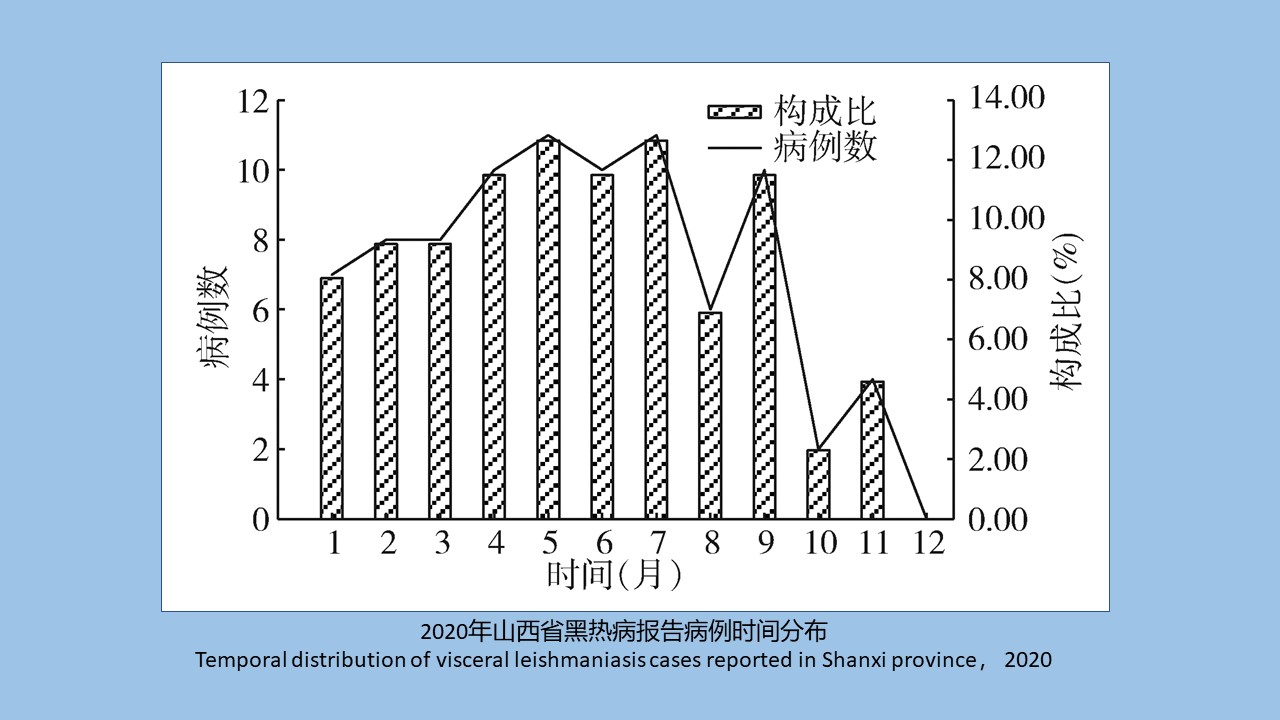
Objective To analyze the epidemiological characteristics of visceral leishmaniasis (VL) in Shanxi province, China in 2020, and to provide a reference for the effective prevention and control of VL. Methods The data of VL cases reported in Shanxi province in 2020 were collected from the National Disease Reporting Information System and were collated. Excel 2010 software was used to process and plot the data, and SPSS 18.0 software was used to perform one-way analysis of variance for comparison of the number of reported cases between different age groups in different regions. Results In 2020, a total of 87 VL cases were reported in 18 counties of 6 prefectures in Shanxi province, which increased by 85.11% compared with the year 2019, with an annual incidence rate of 0.23/100 000. The cases were mainly distributed in Yangquan (68 cases), Changzhi (7 cases), and Linfen (6 cases). The counties/districts with an annual incidence rate of >1/100 000 included Pingding county, suburban, urban, and mining districts of Yangquan, Xiangyuan county, and Daning county, and 80.46% of the total reported cases happened in these counties/districts. The peaks of reported cases were in May and July, respectively, and no cases were reported in December. Among the reported cases, 57 were males and 30 were females; 25.29% of them were aged <5 years, 32.18% aged 60 and older, and 26.44% aged 40-59; farmers (43.68%) were the main susceptible population, followed by scattered children (26.44%) and unemployed persons (12.64%). Conclusion In 2020, the prevalence of VL increased and the epidemic area became wider in Shanxi province. It is a serious situation and awareness, prevention, and control should be strengthened.
[1] Alvar J, Yactayo S, Bern C. Leishmaniasis and poverty[J]. Trends Parasitol, 2006, 22(12):552-557. DOI:10.1016/j.pt.2006.09.004.
[2] World Health Organization. Control of the leishmaniasis[R]. Geneva:WHO, 2010:5-12.
[3] Desjeux P. Leishmaniasis:Public health aspects and control[J]. Clin Dermatol, 1996, 14(5):417-423.DOI:10.1016/0738-081X(96)00057-0.
[4] Bates PA. Transmission of Leishmania metacyclic promastigotes by phlebotomine sand flies[J]. Int J Parasitol, 2007, 37(10):1097-1106. DOI:10.1016/j.ijpara.2007.04.003.
[5] 管立人, 瞿靖琦, 柴君杰. 中国利什曼病的现状和对开展防治工作的若干建议[J]. 地方病通报, 2000, 15(3):49-53. DOI:10.13215/j.cnki.jbyfkztb.2000.03.023. Guan LR, Qu JQ, Chai JJ. Leishmaniasis in China-present status of prevalence and some suggestions on its control[J]. Endem Dis Bull, 2000, 15(3):49-53. DOI:10.13215/j.cnki.jbyfkztb.2000. 03.023.(in Chinese)
[6] 王兆俊, 吴征鉴, 何凯增. 1960年来我国黑热病防治研究工作的进展[J]. 中国寄生虫学与寄生虫病杂志, 1983, 1(2):65-73. Wang ZJ, Wu ZJ, He KZ. Advances in investigations and studies on Kala-azar in China since 1960[J]. Chin J Parasitol Parasit Dis, 1983, 1(2):65-73. (in Chinese)
[7] 郑灿军, 薛垂召, 伍卫平, 等. 我国2005-2015年黑热病报告病例流行特征分析[J]. 中华流行病学杂志, 2017, 38(4):431-434. DOI:10.3760/cma.j.issn.0254-6450.2017.04.004. Zheng CJ, Xue CZ, Wu WP, et al. Epidemiological characteristics of Kala-azar disease in China, during 2005-2015[J]. Chin J Epidemiol, 2017, 38(4):431-434. DOI:10.3760/cma.j.issn.0254-6450.2017.04.004.(in Chinese)
[8] 韩帅, 伍卫平, 薛垂召, 等. 2004-2016年中国内脏利什曼病疫情分析[J]. 中国寄生虫学与寄生虫病杂志, 2019, 37(2):189-195. DOI:10.12140/j.issn.1000-7423.2019.02.013. Han S, Wu WP, Xue CZ, et al. Endemic status of visceral leishmaniasis in China from 2004 to 2016[J]. Chin J Parasitol Parasit Dis, 2019, 37(2):189-195. DOI:10.12140/j.issn.1000-7423.2019.02.013.(in Chinese)
[9] 郑玉华, 白永飞, 帖萍, 等. 2010-2019年山西省人群内脏利什曼病流行特征分析[J]. 中国寄生虫学与寄生虫病杂志, 2021, 39(3):352-358. DOI:10.12140/j.issn.1000-7423.2021. 03.009. Zheng YH, Bai YF, Tie P, et al. Epidemiological characteristics of visceral leishmaniasis in Shanxi province, 2010-2019[J]. Chin J Parasitol Parasit Dis, 2021, 39(3):352-358. DOI:10.12140/j.issn.1000-7423.2021.03.009.(in Chinese)
[10] 周正斌, 李元元, 张仪, 等. 2019年我国内脏利什曼病疫情分析[J]. 中国寄生虫学与寄生虫病杂志, 2020, 38(5):602-607. DOI:10.12140/j.issn.1000-7423.2020.05.012. Zhou ZB, Li YY, Zhang Y, et al. Prevalence of visceral leishmaniasis in China in 2019[J]. Chin J Parasitol Parasit Dis, 2020, 38(5):602-607. DOI:10.12140/j.issn.1000-7423.2020. 05.012.(in Chinese)
[11] 周正斌, 李元元, 张仪, 等. 2015-2018年我国内脏利什曼病疫情分析[J]. 中国寄生虫学与寄生虫病杂志, 2020, 38(3):339-345. DOI:10.12140/j.issn.1000-7423.2020.03.013. Zhou ZB, Li YY, Zhang Y, et al. Prevalence of visceral leishmaniasis in China during 2015-2018[J]. Chin J Parasitol Parasit Dis, 2020, 38(3):339-345. DOI:10.12140/j.issn.1000-7423.2020.03.013.(in Chinese)
[12] 周正斌, 李元元, 张仪, 等. 2018年全国内脏利什曼病疫情分析[J]. 中国寄生虫学与寄生虫病杂志, 2020, 38(2):175-180, 187. DOI:10.12140/j.issn.1000-7423.2020.02.007. Zhou ZB, Li YY, Zhang Y, et al. Prevalence of visceral leishmaniasis in China in 2018[J]. Chin J Parasitol Parasit Dis, 2020, 38(2):175-180, 187. DOI:10.12140/j.issn.1000-7423.2020.02.007.(in Chinese)
[13] 余大为, 丁国武, 格鹏飞, 等. 2005-2014年甘肃省内脏利什曼病流行情况的回顾性分析[J]. 中国寄生虫学与寄生虫病杂志, 2015, 33(3):208-211. Yu DW, Ding GW, Ge PF, et al. A retrospective analysis on the prevalence of visceral leishmaniasis in Gansu province during 2005-2014[J]. Chin J Parasitol Parasit Dis, 2015, 33(3):208-211. (in Chinese)
[14] 张富南, 李国茹, 雷杨, 等. 四川省1984-2005年黑热病发病情况分析[J]. 中国病原生物学杂志, 2007, 2(1):79-80. DOI:10.13350/j.cjpb.2007.01.031. Zhang FN, Li GR, Lei Y, et al. Analysis on leishmaniasis in Sichuan province from 1984 to 2005[J]. J Pathogen Biol, 2007, 2(1):79-80. DOI:10.13350/j.cjpb.2007.01.031.(in Chinese)
[15] 陈闯, 丁岚利, 张富南. 四川省山丘型黑热病的人群分布[J]. 预防医学情报杂志, 2013, 29(7):553-557. Chen C, Ding LL, Zhang FN. Population distribution of leishmaniasis in mountainous areas of Sichuan province[J]. J Prev Med Inf, 2013, 29(7):553-557. (in Chinese)
[16] 马琳, 曹磊, 邱琳, 等. 陕西省黑热病流行病学特征及时空聚类分析[J]. 中国公共卫生, 2018, 34(7):1021-1025. DOI:10.11847/zgggws1115469. Ma L, Cao L, Qiu L, et al. Prevalence characteristics and space-time clustering of leishmaniasis in Shaanxi province[J]. Chin J Public Health, 2018, 37(7):1021-1025. DOI:10.11847/zgggws 1115469.(in Chinese)
[17] 赵树青, 李中杰, 张倩, 等. 2005-2012年全国不同年龄组人群内脏利什曼病流行特征[J]. 中华传染病杂志, 2014, 32(8):492-495. DOI:10.3760/cma.j.issn.1000-6680.2014.08.011. Zhao SQ, Li ZJ, Zhang Q, et al. Analysis of epidemiologic features of visceral leishmaniasis in different age groups in China from 2005 to 2012[J]. Chin Infect Dis, 2014, 32(8):492-495. DOI:10.3760/cma.j.issn.1000-6680.2014.08.011.(in Chinese)


