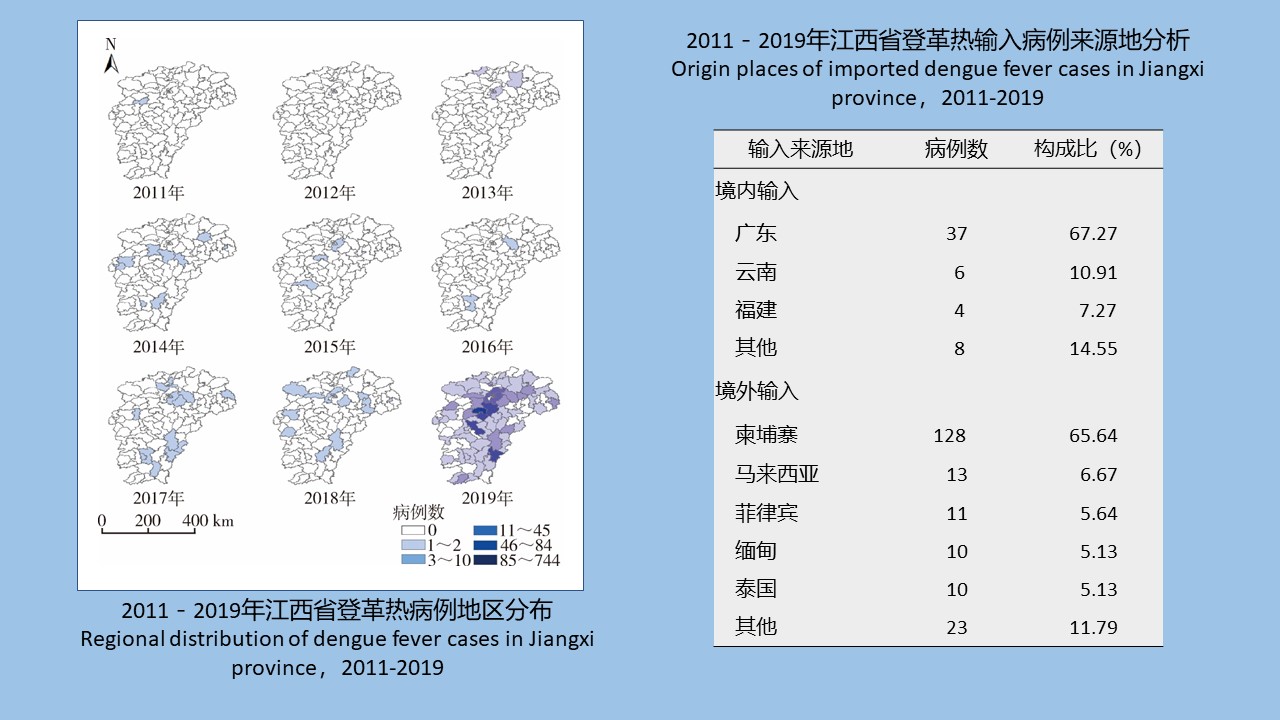
目的 分析江西省2011-2019年登革热流行特征,为江西省制定登革热防控策略提供理论依据。方法 收集江西省2011-2019年登革热病例监测资料进行描述性流行病学分析,数据差异采用χ2和Mann-Whitney等检验。用Joinpoint软件进行趋势分析。结果 2011-2019年,江西省累计报告1 352例登革热病例,其中输入病例250例(18.49%),本地病例1 102例(81.51%),输入病例主要发生在6-10月,本地病例发生在8-10月。所有病例中男性707例,女性645例,男女性别比为1.09:1,输入病例的男女性别比(3.24:1)高于本地病例的性别比(0.88:1)(χ2=25.927,P<0.001);年龄中位数为45岁,主要集中在30~69岁,输入病例的年龄中位数(35岁)低于本地病例的年龄中位数(48岁),差异有统计学意义(Z=-10.304,P<0.001);职业分布以农民、家务及待业、商业服务为主,占全部病例的71.97%,输入病例与本地病例的职业分布差异有统计学意义(χ2=716.261,P<0.001)。病例涉及全省11个设区市的84个县(区),其中7个设区市的23个县(区)报告过本地病例。发病至确诊时间间隔中位数为5 d,四分位数间距为3~7 d,最短为发病当天确诊,最长为71 d,输入病例发病到就诊的时间长于本地病例。250例输入病例中,境内输入55例,以广东省输入病例最多(67.27%);境外输入195例,柬埔寨(65.64%)是输入病例最多的国家。结论 江西省登革热疫情整体呈上升趋势,防控形势愈发严峻,应加强各项防控措施,防止更大范围的暴发流行。
Objective To analyze the epidemiological characteristics of dengue fever in Jiangxi province,China from 2011 to 2019, and to provide a theoretical basis for formulating prevention and control strategies against dengue fever in Jiangxi province. Methods Descriptive epidemiological method was used to analyze the monitoring data of dengue fever in Jiangxi province from 2011 to 2019. The Chi-square test and Mann-Whitney U test were used to compare data differences. Joinpoint software was employed to perform trend analysis. Results From 2011 to 2019, a total of 1 352 cases of dengue fever were reported in Jiangxi province,including 250 (18.49%) imported cases and 1 102 (81.51%) local cases. The imported cases were reported mainly from June to October, while the local cases from August to October. Among all patients,there were 707 male and 645 female patients, with a male-to-female ratio of 1.09:1. The male-to-female ratio in the imported cases (3.24:1) was significantly higher than that in the local cases (0.88:1) (χ2=25.927, P<0.001). The patients were mostly aged between 30 and 69 years, with a median age of 45 years. The imported cases had a significantly younger median age than the local cases (35 vs. 48 years, Z=-10.304, P<0.001). Most of the cases were engaged in farming,housework or unemployment,and commercial service,accounting for 71.97% of the total cases. The difference in occupational distribution between the imported cases and local cases was statistically significant (χ2=716.261, P<0.001). The total cases involved 84 counties or districts in 11 cities with subordinate districts across Jiangxi province,and local cases were reported in 23 counties or districts in 7 cities with subordinate districts. The median time interval from onset to diagnosis was 5 days (interquartile range:3 to 7 days;range:the day of onset to 71 days). The time from onset to diagnosis was longer in the imported cases than in the local cases. Of the 250 imported cases,55 were imported from within China,with the most cases from Guangdong province (67.27%);and 195 were imported from abroad,with the most cases from Cambodia (65.64%). Conclusion The epidemic trend of dengue fever in Jiangxi province is on the rise, imposing an increasing challenge to the prevention and control of dengue fever. Relevant control measures should be strengthened to prevent a wider outbreak.
[1] 杜建伟, 潘先海. 中国登革热流行概况与流行特征[J]. 中华流行病学杂志, 2010, 31(12):1429-1433. DOI:10.3760/cma.j.issn.0254-6450.2010.12.025. Du JW, Pan XH. Prevalent status and features of dengue fever in China[J]. Chin J Epidemiol, 2010, 31(12):1429-1433. DOI:10.3760/cma.j.issn.0254-6450.2010.12.025.(in Chinese)
[2] Bhatt S, Gething PW, Brady OJ, et al. The global distribution and burden of dengue[J]. Nature, 2013, 496(7446):504-507. DOI:10.1038/nature12060.
[3] 刘起勇. 我国登革热流行新趋势、防控挑战及策略分析[J]. 中国媒介生物学及控制杂志, 2020, 31(1):1-6. DOI:10.11853/j.issn.1003.8280.2020.01.001. Liu QY. Dengue fever in China:New epidemical trend, challenges and strategies for prevention and control[J]. Chin J Vector Biol Control, 2020, 31(1):1-6. DOI:10.11853/j.issn. 1003.8280.2020.01.001.(in Chinese)
[4] Lai SJ, Huang ZJ, Zhou H, et al. The changing epidemiology of dengue in China, 1990-2014:A descriptive analysis of 25 years of nationwide surveillance data[J]. BMC Med, 2015, 13:100. DOI:10.1186/s12916-015-0336-1.
[5] 杨富强, 夏光辉, 曾志笠, 等. 2019年江西省新干县一起登革热暴发疫情调查分析[J]. 应用预防医学, 2021, 27(1):79-82. DOI:10.3969/j.issn.1673-758X.2021.01.028. Yang FQ, Xia GH, Zeng ZL, et al. Investigation and analysis of an outbreak of dengue fever in Xin'gan county, Jiangxi province in 2019[J]. J Appl Prev Med, 2021, 27(1):79-82. DOI:10.3969/j.issn.1673-758X.2021.01.028.(in Chinese)
[6] 刘仰青, 柳小青, 宋文涛, 等. 江西省南昌市2011-2019年登革热流行病学特征分析[J]. 现代预防医学, 2021, 48(12):2135-2138, 2154. Liu YQ, Liu XQ, Song WT, et al. Epidemiological analysis of dengue fever in Nanchang city, Jiangxi province from 2011 to 2019[J]. Mod Prev Med, 2021, 48(12):2135-2138, 2154. (in Chinese)
[7] 李煜姗, 汪如良, 刘晓青, 等. 气温对亚热带季风气候内陆城市登革热传播的影响[J]. 中国热带医学, 2021, 21(10):932-938. DOI:10.13604/j.cnki.46-1064/r.2021.10.04. Li YS, Wang RL, Liu XQ, et al. Effects of temperature on dengue fever transmission in inland city with subtropical monsoon climate[J]. China Trop Med, 2021, 21(10):932-938. DOI:10.13604/j.cnki.46-1064/r.2021.10.04.(in Chinese)
[8] 王桢, 凌锋, 刘营, 等. 浙江省2015-2019年登革热流行特征分析[J]. 中国媒介生物学及控制杂志, 2020, 31(6):643-647. DOI:10.11853/j.issn.1003.8280.2020.06.003. Wang Z, Ling F, Liu Y, et al. Epidemiological characteristics of dengue fever in Zhejiang province, China, 2015-2019[J]. Chin J Vector Biol Control, 2020, 31(6):643-647. DOI:10.11853/j.issn.1003.8280.2020.06.003.(in Chinese)
[9] 牟笛, 何泱霓, 陈秋兰, 等. 我国2016年登革热输入和本地病例流行病学特征比较[J]. 疾病监测, 2017, 32(3):184-189. DOI:10.3784/j.issn.1003-9961.2017.03.004. Mu D, He YN, Chen QL, et al. Comparison of epidemiological features between imported and indigenous dengue fever cases in China[J]. Dis Surveill, 2017, 32(3):184-189. DOI:10.3784/j.issn.1003-9961.2017.03.004.(in Chinese)
[10] 徐朦, 刘小波, 宋秀平, 等. 基于伤残调整寿命年的2010-2019年中国登革热疾病负担评估研究[J]. 中国媒介生物学及控制杂志, 2020, 31(5):509-512. DOI:10.11853/j.issn.1003. 8280.2020.05.001. Xu M, Liu XB, Song XP, et al. Assessment research on the disease burden of dengue fever in China from 2010 to 2019 based on disability-adjusted life years[J]. Chin J Vector Biol Control, 2020, 31(5):509-512. DOI:10.11853/j.issn.1003.8280.2020. 05.001.(in Chinese)
[11] 肖东楼. 登革热防治手册[M]. 2版. 北京:人民卫生出版社, 2008:3-4. Xiao DL. The manuals for dengue fever prevention and treatment[M]. 2nd ed. Beijing:People's Medical Publishing House, 2008:3-4. (in Chinese)
[12] 刘杨. 中国与柬埔寨签署政府间共建"一带一路"合作文件[EB/OL]. (2016-10-14)[2021-12-01]. http://www.gov.cn/xinwen/2016-10/14/content_5119051.htm. Liu Y. China and Cambodia signed an intergovernmental cooperation document on jointly building the Belt and Road Initiative[EB/OL]. (2016-10-14)[2021-12-01]. http://www.gov.cn/xinwen/2016-10/14/content_5119051.htm.(in Chinese)
[13] 伦辛畅, 赵春春, 朱彩英, 等. 2011-2019年柬埔寨登革热疫情及赴柬旅游对我国输入登革热的影响分析[J]. 中国媒介生物学及控制杂志, 2021, 32(3):312-317. DOI:10.11853/j.issn.1003.8280.2021.03.011. Lun XC, Zhao CC, Zhu CY, et al. Impact analysis of dengue fever epidemic in Cambodia and tourism to Cambodia on imported dengue fever in China from 2011 to 2019[J]. Chin J Vector Biol Control, 2021, 32(3):312-317. DOI:10.11853/j.issn.1003. 8280.2021.03.011.(in Chinese)


