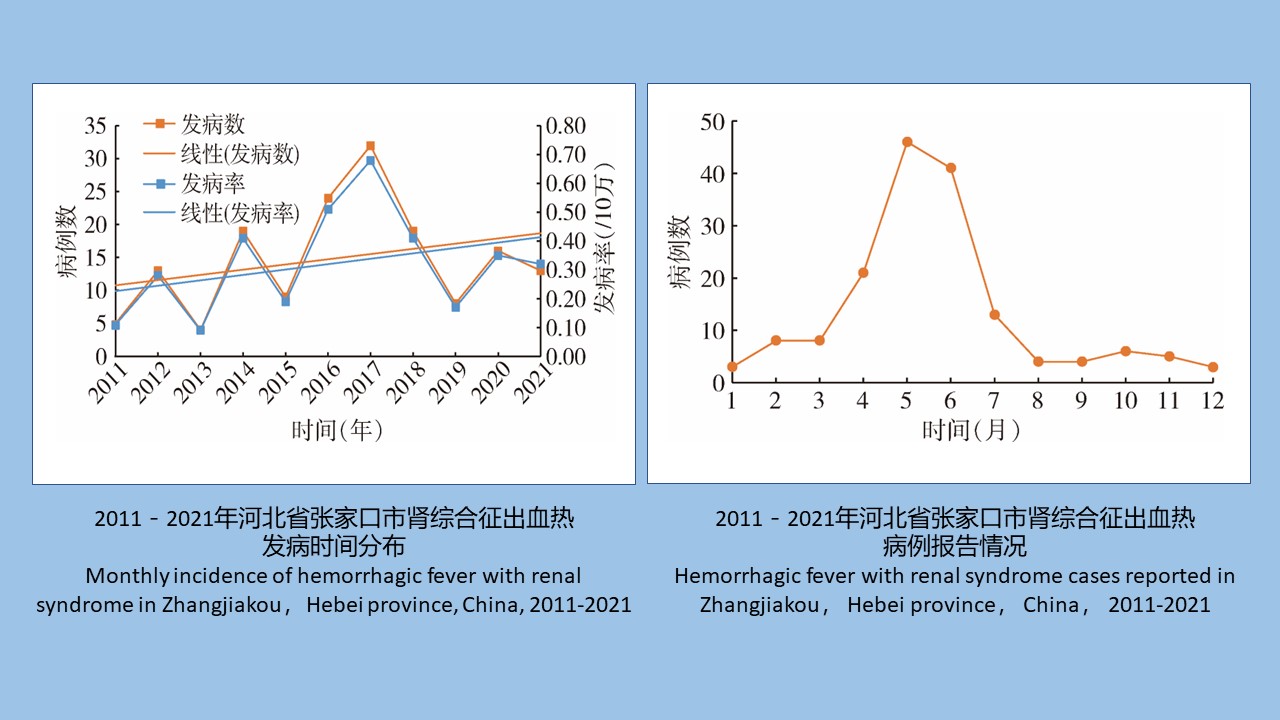
目的 分析2011-2021年河北省张家口市肾综合征出血热(HFRS)流行特征,为该病预防控制提供科学依据。方法 应用描述性流行病学方法对张家口市2011-2021年HFRS病例及宿主动物监测资料进行分析。结果 2011-2021年张家口市共报告HFRS病例162例,年平均发病率为0.29/10万,平均死亡率为0.005/10万。全年各月份均有病例报告,4-6月为发病高峰。患者男女性别比为3.26:1,20~60岁是发病的主要人群,职业分布中农民占58.64%(95例)。HFRS的报告病例集中分布在宣化区和赤城县(52.47%)。相关暴露因素调查发现,90例(55.56%)有明确的暴露因素。2013-2017年的年鼠密度较高,平均鼠密度为3.65只/100夹。鼠肺送检样本436份,检测阳性1份,带病毒率为0.23%。结论 2011-2021年张家口市HFRS疫情略呈上升趋势,但总体处于一个较低的水平。对病例高发区域应积极开展鼠类带病毒率监测,同时落实防鼠灭鼠与疫苗接种并重的防控策略,降低HFRS发病率。
Objective To analyze the epidemiological characteristics of hemorrhagic fever with renal syndrome (HFRS) in Zhangjiakou, Hebei province, China, 2011-2021, and to provide a scientific basis for HFRS prevention and control. Methods Descriptive epidemiological methods were used to analyze the monitoring data of HFRS cases and host animals in Zhangjiakou from 2011 to 2021. Results A total of 162 HFRS cases were reported in Zhangjiakou from 2011 to 2021, with an average annual incidence rate of 0.29/100 000 and an average mortality rate of 0.005/100 000. Cases were reported in every month of the year, and the incidence peaked from April to June. The male-female ratio of the patients was 3.26:1, and the disease mainly affected people 20-60 years of age and farmers (95 cases, 58.64%). The reported cases of HFRS were concentrated in Xuanhua district and Chicheng county (52.47%). Exposure factors were identified in 90 cases (55.56%). From 2013 to 2017, the annual rodent density was high and averaged at 3.65 individuals/100 traps. One of the 436 rodent samples tested positive, with an infection rate of 0.23%. Conclusion From 2011 to 2021, the HFRS epidemic in Zhangjiakou increased slightly but was generally low. In areas with high HFRS incidence, it is necessary to actively monitor rodent infection rate, and at the same time implement the strategy based on both rodent control and vaccination to reduce the incidence of HFRS.
[1] 梁小洁, 严延生, 张智芳, 等. 肾综合征出血热[J]. 中国人兽共患病学报, 2020, 36(10):858-863. DOI:10.3969/j.issn.1002-2694.2020.00.133. Liang XJ, Yan YS, Zhang ZF, et al. Hemorrhagic fever with renal syndrome[J]. Chin J Zoonoses, 2020, 36(10):858-863. DOI:10.3969/j.issn.1002-2694.2020.00.133.(in Chinese)
[2] 宋干. 肾综合征出血热的诊断治疗[J]. 预防医学论坛, 2005, 11(5):637-640. DOI:10.3969/j.issn.1672-9153.2005.05.080. Song G. Diagnosis and treatment of hemorrhagic fever with renal syndrome[J]. Prev Med Trib, 2005, 11(5):637-640. DOI:10.3969/j.issn.1672-9153.2005.05.080.(in Chinese)
[3] 韩旭, 魏亚梅, 许永刚, 等. 2013-2015年河北省肾综合征出血热流行特征分析[J]. 中国病原生物学杂志, 2018, 13(1):76-78, 82. DOI:10.13350/j.cjpb.180116. Han X, Wei YM, Xu YG, et al. Epidemiology of hemorrhagic fever with renal syndrome in Hebei province from 2013-2015[J]. J Path Biol, 2018, 13(1):76-78, 82. DOI:10.13350/j.cjpb. 180116.(in Chinese)
[4] 王芹, 曲靖, 张全福, 等. 2013年全国肾综合征出血热疫情及监测分析[J]. 疾病监测, 2015, 30(6):440-447. DOI:10.3784/j.issn.1003-9961.2015.06.004. Wang Q, Qu J, Zhang QF, et al. Surveillance for hemorrhagic fever with renal syndrome in China, 2013[J]. Dis Surveill, 2015, 30(6):440-447. DOI:10.3784/j.issn.1003-9961.2015.06.004.(in Chinese)
[5] 王芹, 李建东, 张全福, 等. 2014年全国肾综合征出血热监测总结和疫情分析[J]. 疾病监测, 2016, 31(3):192-199. DOI:10.3784/j.issn.1003-9961.2016.03.005. Wang Q, Li JD, Zhang QF, et al. Surveillance for hemorrhagic fever with renal syndrome in China, 2014[J]. Dis Surveill, 2016, 31(3):192-199. DOI:10.3784/j.issn.1003-9961.2016.03.005.(in Chinese)
[6] 陈化新, 罗成旺. 中国肾综合征出血热监测[J]. 中华流行病学杂志, 2002, 23(1):63-66. DOI:10.3760/j.issn:0254-6450. 2002.01.018. Chen HX, Luo CW. Surveillance of hemorrhagic fever with renal syndrome in China[J]. Chin J Epidemiol, 2002, 23(1):63-66. DOI:10.3760/j.issn:0254-6450.2002.01.018.(in Chinese)
[7] 项东, 杨梅, 张利焱, 等. 唐山市2005-2014年肾综合征出血热流行特征分析[J]. 医学动物防制, 2016, 32(5):497-499. DOI:10.7629/yxdwfz201605009. Xiang D, Yang M, Zhang LY, et al. Epidemiological characteristics of hemorrhagic fever with renal syndrome in Tangshan city from 2005 to 2014[J]. J Med Pest Control, 2016, 32(5):497-499. DOI:10.7629/yxdwfz201605009.(in Chinese)
[8] 任敏. 2004-2012年河北省秦皇岛市肾综合征出血热流行特征分析[J]. 山西医药杂志, 2013, 42(9):999-1001. DOI:10.3969/j.issn.0253-9926.2013.18.018. Ren M. Epidemiological characteristics of hemorrhagic fever with renal syndrome in Qinhuangdao city, Hebei province from 2004 to 2012[J]. Shanxi Med J, 2013, 42(9):999-1001. DOI:10.3969/j.issn.0253-9926.2013.18.018.(in Chinese)
[9] 孙倩莱, 张苏蕾, 曾舸, 等. 2009-2019年湖南省肾综合征出血热病例及宿主动物监测分析[J]. 中国人兽共患病学报, 2021, 37(4):351-355. DOI:10.3969/j.issn.1002-2694.2021. 00.047. Sun QL, Zhang SL, Zeng G, et al. Surveillance results of cases of hemorrhagic fever with renal syndrome and host animals in Hunan province, 2009-2019[J]. Chin J Zoonoses, 2021, 37(4):351-355. DOI:10.3969/j.issn.1002-2694.2021.00.047.(in Chinese)
[10] 魏亚梅, 韩占英, 蔡亚男, 等. 河北省2018-2019年肾综合征出血热流行特征分析[J]. 中国国境卫生检疫杂志, 2020, 43(5):333-336. DOI:10.16408/j.1004-9770.2020.05.010. Wei YM, Han ZY, Cai YN, et al. Epidemic characteristics of hemorrhagic fever with renal syndrome in Hebei province from 2018 to 2019[J]. Chin J Front Health Quarant, 2020, 43(5):333-336. DOI:10.16408/j.1004-9770.2020.05.010.(in Chinese)
[11] 刘世友, 蔡亚男, 魏亚梅, 等. 2009-2018年河北省病毒性出血热流行态势分析[J]. 中国国境卫生检疫杂志, 2020, 43(2):109-112. DOI:10.16408/J.1004-9770.2020.02.009. Liu SY, Cai YN, Wei YM, et al. Epidemiological analysis of viral hemorrhagic fever in Hebei province, 2009-2018[J]. Chin J Front Health Quarant, 2020, 43(2):109-112. DOI:10.16408/J.1004-9770.2020.02.009.(in Chinese)
[12] 陈俊江, 国天赐, 宋姝璇, 等. 中国肾综合征出血热流行特征及时空分析模型进展[J]. 中华流行病学杂志, 2020, 41(10):1735-1740. DOI:10.3760/cma.j.cn112338-20191108-00794. Chen JJ, Guo TC, Song SX, et al. Epidemiological characteristics and the development of spatiotemporal analysis models on hemorrhagic fever with renal syndrome in China[J]. Chin J Epidemiol, 2020, 41(10):1735-1740. DOI:10.3760/cma.j.cn112338-20191108-00794.(in Chinese)


