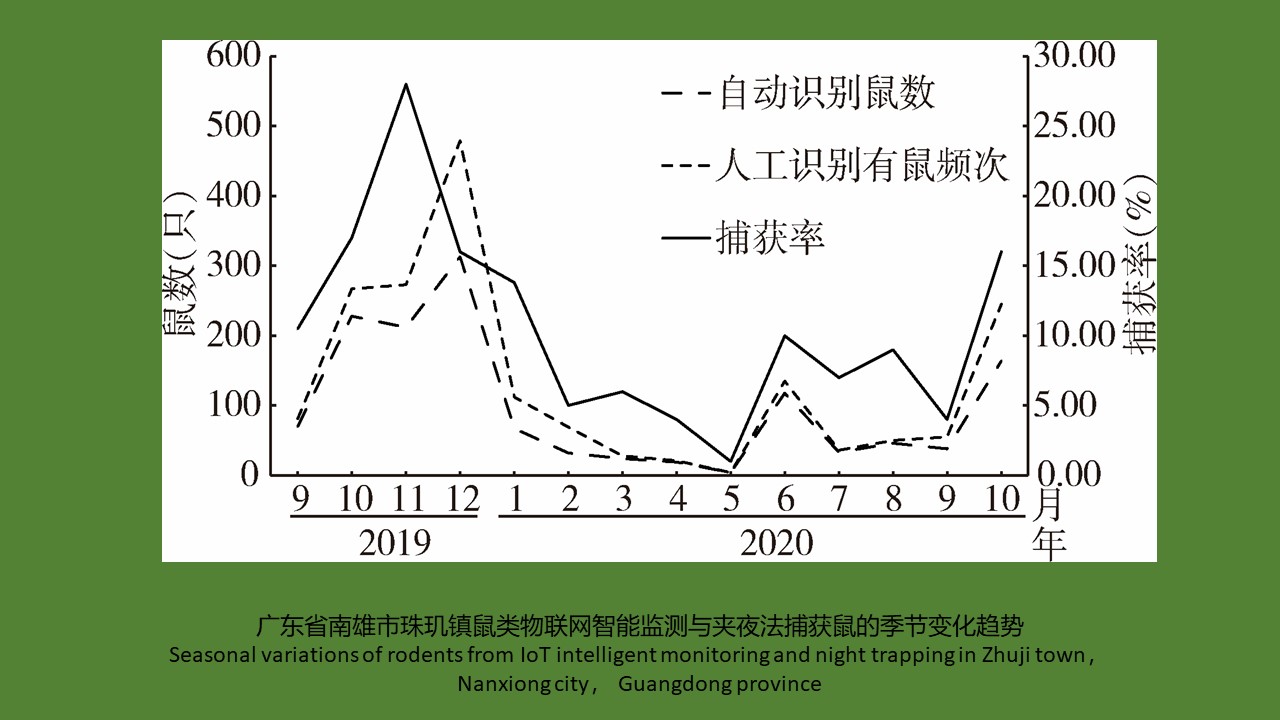
目的 初步探索鼠类物联网智能监测系统在广东省农区鼠害监测中应用的可行性,为精准防控鼠害提供科学依据。方法 将物联网智能监测终端布放在广东省南雄市珠玑镇监测点内进行实时监测,同时每月定期采用夹夜法调查鼠类种群密度并进行对比分析,采用SPSS 19.0软件进行回归和相关分析。结果 2019年9月-2020年10月鼠类物联网智能监测系统共监测到清晰的鼠形动物1 457只,智能识别的准确率达到95.26%;对比夹夜法与鼠类物联网智能监测,两者所获鼠密度的季节变化趋势基本吻合,但鼠类群落结构差异较大,主要是黄毛鼠和板齿鼠的数量比例差异较大,在夹夜法捕获的鼠类中,黄毛鼠所占比例高达71.69%,板齿鼠仅占4.22%;而鼠类物联网智能监测到的黄毛鼠占监测鼠数的50.41%,板齿鼠占21.97%;物联网智能监测结果显示,不同鼠种的空间分布具有一定的竞争性,数量高峰出现交错分布。结论 鼠类物联网智能监测方法可替代繁重的人工捕鼠作业,克服传统的夹夜法监测结果不稳定、准确率不高的弊端,可用于广东省农区鼠害监测,但其应用技术还有待进一步完善。
Objective To perform a preliminary study on the applicability of intelligent monitoring system based on internet of things (IoT) for agricultural rodent pests in Guangdong province, China, and to provide a scientific basis for accurate prevention and control of rodents. Methods Intelligent monitoring terminals were set up in Zhuji town, Nanxiong city of Guangdong province for real-time monitoring. Rodent population density was investigated using the night snap-trapping method every month for comparative analysis. SPSS 19.0 software was used for regression and correlation analyses. Results From September 2019 to October 2020, 1 457 rodents were detected by the IoT intelligent monitoring system, and the accuracy of intelligent recognition was 95.26%. The night snap-trap and the IoT intelligent monitoring showed a similar seasonal trend of rodent density but different community structures of rodents, mainly in the proportions of Rattus losea and Bandicota indica. Among the rodents captured by the night snap-trapping method, the proportion of R. losea was as high as 71.69% and the proportion of B. indica was only 4.22%. In contrast, the proportion of R. losea and B. indica monitored by IoT intelligent monitoring system was 50.41% and 21.97%, respectively. The IoT intelligent monitoring system showed that rodent species competed for distribution spaces and the maximum numbers appeared at different time points. Conclusion IoT intelligent monitoring can be used to replace manual rodent capture and overcome the low stability and accuracy associated with traditional night snap-trapping method. Although it can be used for rodent monitoring in agricultural areas of Guangdong province, the technology of IoT intelligent monitoring needs to be further improved.
[1] 姚丹丹, 梁文立, 隋晶晶, 等. 广东省农区鼠情调查及两种调查方法的比较研究[J]. 中国媒介生物学及控制杂志, 2013, 24(6):509-511. DOI:10.11853/j.issn.1003.4692.2013.06.009. Yao DD, Liang WL, Sui JJ, et al. Survey of rodents in farmlands in Guangdong province, China and comparative study on two sampling methods[J]. Chin J Vector Biol Control, 2013, 24(6):509-511. DOI:10.11853/j.issn.1003.4692.2013.06.009.(in Chinese)
[2] 付学峰, 田彦林, 张洪江, 等. 对食饵法、鼠夹法监测结果影响因子的初步探讨[J]. 中国媒介生物学及控制杂志, 2009, 20(6):519-521. Fu XF, Tian YL, Zhang HJ, et al. A primary discussion about effect factors of bait methods and trap methods[J]. Chin J Vector Biol Control, 2009, 20(6):519-521. (in Chinese)
[3] 任东升, 刘起勇. 红外感应相机在鼠密度监测中的应用[J]. 中国媒介生物学及控制杂志, 2014, 25(2):142-144. DOI:10.11853/j.issn.1003.4692.2014.02.014. Ren DS, Liu QY. Infrared-triggered cameras in the application of rodent density surveillance[J]. Chin J Vector Biol Control, 2014, 25(2):142-144. DOI:10.11853/j.issn.1003.4692.2014.02.014.(in Chinese)
[4] 高强, 曹晖, 周毅彬, 等. 红外线鼠密度监测仪在鼠侵害监测中的应用研究[J]. 中华卫生杀虫药械, 2013, 19(5):395-398. DOI:10.19821/j.1671-2781.2013.05.011. Gao Q, Cao H, Zhou YB, et al. Application effect of a new infrared rat density monitor[J]. Chin J Hyg Insect Equip, 2013, 19(5):395-398. DOI:10.19821/j.1671-2781.2013.05.011.(in Chinese)
[5] 高娟婷, 孙飞达, 霍霏, 等. 无人机遥感技术在草地动植物调查监测中的应用与评价[J]. 草地学报, 2021, 29(1):1-9. DOI:10.11733/j.issn.1007-0435.2021.01.001. Gao JT, Sun FD, Huo F, et al. Application and evaluation of unmanned aerial vehicle remote sensing in grassland animal and plant monitoring[J]. Acta Agrestia Sin, 2021, 29(1):1-9. DOI:10.11733/j.issn.1007-0435.2021.01.001.(in Chinese)
[6] 岳学军, 蔡雨霖, 王林惠, 等. 农情信息智能感知及解析的研究进展[J]. 华南农业大学学报, 2020, 41(6):14-28. DOI:10.7671/j.issn.1001-411X.202008044. Yue XJ, Cai YL, Wang LH, et al. Research progress of intelligent perception and analytics of agricultural information[J]. J South China Agric Univ, 2020, 41(6):14-28. DOI:10.7671/j.issn. 1001-411X.202008044.(in Chinese)
[7] 陈嘉. 基于物联网的智能农业监测系统的设计与实现[J]. 数字通信世界, 2020(1):48. Chen J. Design and implementation of intelligent agricultural monitoring system based on IoT[J]. Digit CW, 2020(1):48. (in Chinese)
[8] 曾娟, 韩立亮, 郭永旺, 等. 基于大数据的物联网智能监测系统在农区鼠害监测中的应用效果初报[J]. 中国植保导刊, 2019, 39(7):28-35. DOI:10.3969/j.issn.1672-6820.2019. 07.005. Zeng J, Han LL, Guo YW, et al. Preliminary report on the application effect of IoT intelligent monitoring system based on big data technology for rodent monitoring in agricultural areas in China[J]. China Plant Protect, 2019, 39(7):28-35. DOI:10.3969/j.issn.1672-6820.2019.07.005.(in Chinese)
[9] Kavermann MJ, Paterson AM, Ross JG. Sensitivity of audio-lured versus silent chew-track-cards and WaxTags to the presence of brushtail possums (Trichosurus vulpecula)[J]. New Zealand Nat Sci, 2013, 38:1-8.
[10] Burge OR, Kelly D, Wilmshurst JM. Interspecies interference and monitoring duration affect detection rates in chew cards[J]. Austral Ecol, 2017, 42(5):522-532. DOI:10.1111/aec.12471.
[11] 黄秀清, 冯志勇, 颜世祥, 等. 珠江三角洲作物结构变动对害鼠种群动态的影响[J]. 广东农业科学, 2002(4):36-39. DOI:10.3969/j.issn.1004-874X.2002.04.014. Huang XQ, Feng ZY, Yan SX, et al. Influence of crop composing evolvement on the population dynamics of rodent pests in the Pearl River Delta[J]. Guangdong Agric Sci, 2002(4):36-39. DOI:10.3969/j.issn.1004-874X.2002.04.014.(in Chinese)
[12] 冯志勇, 黄秀清, 颜世祥. 珠江三角洲稻区鼠类群落结构及演替研究[J]. 中山大学学报论丛, 1995(1):91-97. Feng ZY, Huang XQ, Yan SX. Study on the structure and succession of farmland rodent community in Pearl River Delta[J]. Suppl J Sun Yatsen Univ, 1995(1):91-97. (in Chinese)
[13] 黄清臻, 贾瑞忠, 王旭, 等. 便携智能鼠情监测系统箱的研制与应用[J]. 中国媒介生物学及控制杂志, 2021, 32(3):344-347. DOI:10.11853/j.issn.1003.8280.2021.03.017. Huang QZ, Jia RZ, Wang X, et al. Development and application of a portable intelligent rodent tele-monitoring system[J]. Chin J Vector Biol Control, 2021, 32(3):344-347. DOI:10.11853/j.issn.1003.8280.2021.03.017.(in Chinese)
[14] 黄清臻, 贾瑞忠, 田志博, 等. 基于物联网的鼠情智能远程监测系统的研制与应用[J]. 中华卫生杀虫药械, 2019, 25(6):519-522. DOI:10.19821/j.1671-2781.2019.06.004. Huang QZ, Jia RZ, Tian ZB, et al. Development and application of an IoT-based rodent tele-monitoring system[J]. Chin J Hyg Insect Equip, 2019, 25(6):519-522. DOI:10.19821/j.1671-2781.2019.06.004.(in Chinese)


