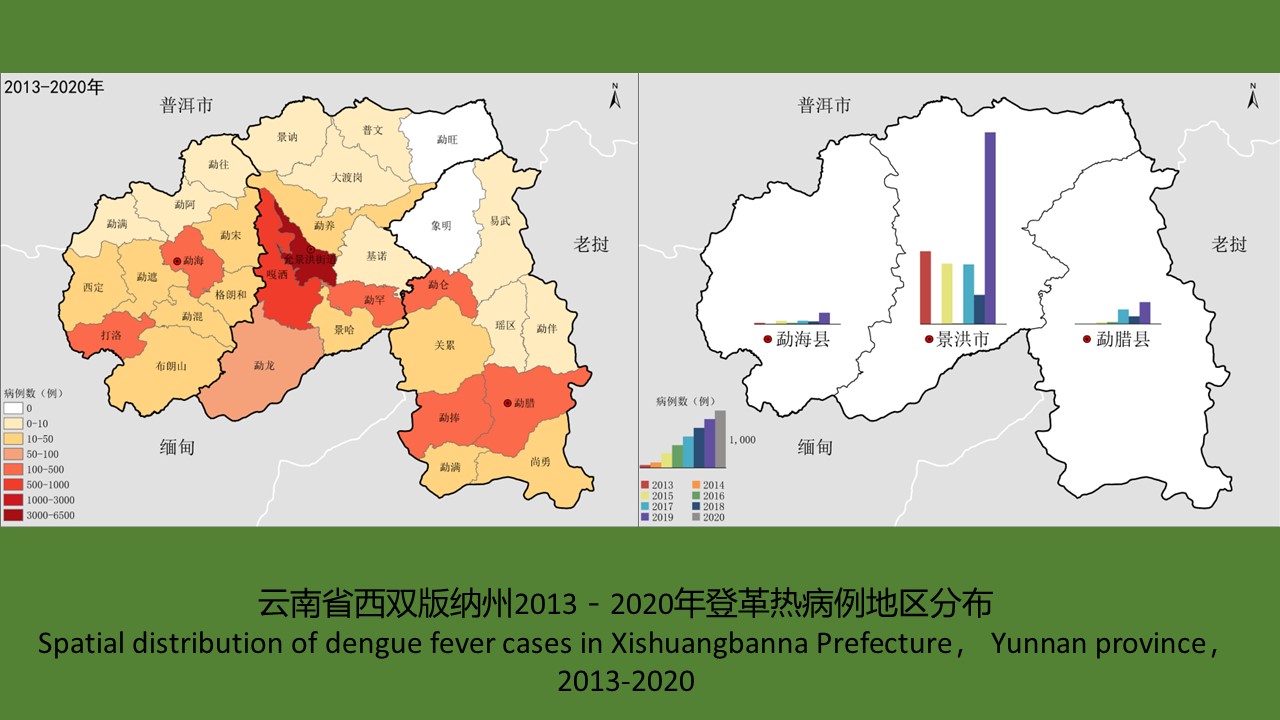
Objective To investigate the epidemiological characteristics of dengue fever and the distribution characteristics of the vector Aedes mosquitoes in Xishuangbanna Dai Autonomous Prefecture (Xishuangbanna Prefecture) of Yunnan province, China, 2006-2020. Methods The descriptive epidemiological method was used to analyze the data of cases of dengue fever. The Breteau index (BI) method was used to monitor the density of Aedes larvae. Species identification was performed for some mosquitoes collected. Excel 2010 and ArcGIS 10.2 softwares were used for database construction and plotting. SPSS 17.0 software was used to perform correlation analysis. Results A total of 8 583 confirmed cases of dengue fever were reported in Xishuangbanna Prefecture, 2006-2020, with 767 (8.94%) imported cases and 7 816 (91.06%) local cases. The mean annual incidence rate was 118.77/100 000, with the highest incidence of 327.44/100 000 in 2019. Dengue fever epidemics occurred almost every year in Jinghong city, Mengla county, and Menghai county of Xishuangbanna Prefecture, with the number of cases in the three regions accounting for 84.97% (7 293/8 583), 10.42% (894/8 583), and 4.61% (396/8 583), respectively. In Jinghong city, the annual incidence rate averaged 223.74/100 000, and reached as high as 614.02/100 000 in 2019. Cases of dengue fever were reported in 93.75% (30/32) of all townships in the prefecture, and 10 townships in Jinghong city and Mengla county had local epidemics. Imported cases were reported in each month through a year, while local cases were distributed from June to December, with a peak from August to October. The patients were aged from 5 months to 93 years, mainly between 20 and 59 years. The male-to-female ratio was 1.01:1. Most patients were commercial workers and service providers, farmers, retirees, household workers and unemployed persons. The BI was 10-50 from June to October and BI<10 in the other months, at four larval density surveillance sites of Xishuangbanna Prefecture, 2013-2020. The BI was higher in Jinghong city than in other counties in all months through the years. Ae. albopictus was found in all townships in Jinghong city, Mengla county and Menghai county, and Ae. aegypti was found in 21 townships. Among the 9 066 larvae and adult mosquitoes collected, Ae. albopictus accounted for 35.24% (3 195/9 066), Ae. aegypti accounted for 33.65% (3 051/9 066), and other mosquito species accounted for 31.11% (2 820/9 066). Conclusion There were only imported cases of dengue fever in 2006-2012 and 2020, and both imported and local epidemics occurred in 2013 and 2015-2019 in Xishuangbanna Prefecture. Imported cases from Laos and Myanmar were the main cause of local epidemics in Xishuangbanna Prefecture. The seasonal distribution of dengue fever was closely associated with the increase in mosquito density. There was no year-round transmission or cross-year transmission of dengue fever in the prefecture, and dengue fever in this area is still an imported disease. Surveillance and management of imported cases and regular mosquito control are important measures to prevent dengue epidemics in the region.
[1] Messina JP, Brady OJ, Golding N, et al. The current and future global distribution and population at risk of dengue[J]. Nat Microbiol, 2019, 4(9):1508-1515. DOI:10.1038/s41564-019-0476-8.
[2] Hung TM, Shepard DS, Bettis AA, et al. Productivity costs from a dengue episode in Asia:A systematic literature review[J]. BMC Infect Dis, 2020, 20(1):393. DOI:10.1186/s12879-020-05109-0.
[3] 刘起勇. 我国登革热流行新趋势、防控挑战及策略分析[J]. 中国媒介生物学及控制杂志, 2020, 31(1):1-6. DOI:10.11853/j.issn.1003.8280.2020.01.001. Liu QY. Dengue fever in China:New epidemical trend, challenges and strategies for prevention and control[J]. Chin J Vector Biol Control, 2020, 31(1):1-6. DOI:10.11853/j.issn.1003.8280. 2020.01.001.(in Chinese)
[4] 张海林. 云南省登革热和基孔肯雅热跨境传播、本地流行、发展趋势及对策[J]. 中国媒介生物学及控制杂志, 2021, 32(1):12-20. DOI:10.11853/j.issn.1003.8280.2021.01.002. Zhang HL. Cross-border spread, indigenous transmission, development trend, and control strategy for dengue fever and chikungunya fever in Yunnan province, China[J]. Chin J Vector Biol Control, 2021, 32(1):12-20. DOI:10.11853/j.issn.1003. 8280.2021.01.002.(in Chinese)
[5] 刘永华, 尹小雄, 张海林, 等. 云南省德宏州2013-2019年登革热流行特征及媒介伊蚊监测分析[J]. 中国媒介生物学及控制杂志, 2021, 32(2):173-180. DOI:10.11853/j.issn.1003. 8280.2021.02.011. Liu YH, Yin XX, Zhang HL, et al. Epidemiological characteristics of dengue fever and monitoring of Aedes vector mosquitoes in Dehong Dai and Jingpo Autonomous Prefecture of Yunnan province, China, 2013-2019[J]. Chin J Vector Biol Control, 2021, 32(2):173-180. DOI:10.11853/j.issn.1003. 8280.2021.02.011.(in Chinese)
[6] 冯云, 范建华, 朱进, 等. 云南省景洪市2013年登革热暴发的分子流行病学研究[J]. 中华流行病学杂志, 2014, 35(12):1409-1411. DOI:10.3760/cma.j.issn.0254-6450.2014.12.022. Feng Y, Fan JH, Zhu J, et al. Molecular epidemiology of an outbreak of dengue fever in Jinghong city, Yunnan province, China, 2013[J]. Chin J Epidemiol, 2014, 35(12):1409-1411. DOI:10.3760/cma.j.issn.0254-6450.2014.12.022.(in Chinese)
[7] 李园园, 冯云, 范建华, 等. 2015年云南省西双版纳州登革2型病毒暴发疫情的调查研究[J]. 中华实验和临床病毒学杂志, 2016, 30(4):340-345. DOI:10.3760/cma.j.issn.1003-9279. 2016.04.002. Li YY, Feng Y, Fan JH, et al. Investigation on an outbreak of dengue serotype 2 virus in Xishuangbanna Prefecture of Yunnan province in 2015[J]. Chin J Exp Clin Virol, 2016, 30(4):340-345. DOI:10.3760/cma.j.issn.1003-9279.2016.04.002.(in Chinese)
[8] 范建华, 冯云, 朱进, 等. 2017年云南省西双版纳州登革1型病毒暴发疫情的调查研究[J]. 疾病监测, 2019, 34(5):427-434. DOI:10.3784/j.issn.1003-9961.2019.05.013. Fan JH, Feng Y, Zhu J, et al. An outbreak of dengue serotype 1 virus in Xishuangbanna Prefecture of Yunnan province, China, 2017[J]. Dis Surveill, 2019, 34(5):427-434. DOI:10.3784/j.issn.1003-9961.2019.05.013.(in Chinese)
[9] Kraemer MUG, Sinka ME, Duda KA, et al. The global distribution of the arbovirus vectors Aedes aegypti and Ae. albopictus[J]. eLife, 2015, 4:e08347. DOI:10.7554/eLife. 08347.001.
[10] 李园园, 朱进, 李鸿斌. 云南西双版纳州登革热传播媒介分布调查[J]. 中国热带医学, 2016, 16(3):237-239, 265. DOI:10.13604/j.cnki.46-1064/r.2016.03.10. Li YY, Zhu J, Li HB. Distribution of the dengue fever vector in Xishuangbanna Prefecture of Yunnan[J]. Chin Trop Med, 2016, 16(3):237-239, 265. DOI:10.13604/j.cnki.46-1064/r.2016. 03.10.(in Chinese)
[11] 刘小波, 吴海霞, 郭玉红, 等. 2019年全国媒介伊蚊监测报告[J]. 中国媒介生物学及控制杂志, 2020, 31(4):401-406. DOI:10.11853/j.issn.1003.8280.2020.04.004. Liu XB, Wu HX, Guo YH, et al. Annual report on Aedes vector surveillance in China, 2019[J]. Chin J Vector Biol Control, 2020, 31(4):401-406. DOI:10.11853/j.issn.1003.8280.2020. 04.004.(in Chinese)
[12] 冯云, 张海林, 潘虹, 等. 云南省登革病毒血清型和基因型多样性及溯源研究[J]. 中华实验和临床病毒学杂志, 2017, 31(1):24-30. DOI:10.3760/cma.j.issn.1003-9279.2017.01.005. Feng Y, Zhang HL, Pan H, et al. Diversity of serotypes and genotypes and molecular tracing of dengue viruses isolated from dengue fever cases in Yunnan[J]. Chin J Exp Clin Virol, 2017, 31(1):24-30. DOI:10.3760/cma.j.issn.1003-9279.2017.01.005.(in Chinese)
[13] Hu TS, Zhang HL, Feng Y, et al. Epidemiological and molecular characteristics of emergent dengue virus in Yunnan province near the China-Myanmar-Laos border, 2013-2015[J]. BMC Infect Dis, 2017, 17(1):331. DOI:10.1186/s12879-017-2401-1.
[14] Li NZ, Feng Y, Vrancken B, et al. Assessing the impact of COVID-19 border restrictions on dengue transmission in Yunnan province, China:An observational epidemiological and phylogenetic analysis[J]. Lancet Reg Health West Pac, 2021, 14:100259. DOI:10.1016/j.lanwpc.2021.100259.
[15] 尹小雄, 刘永华, 张海林, 等. 2019年云南中缅边境基孔肯雅热暴发疫情的流行病学特征[J]. 中华实验和临床病毒学杂志, 2020, 34(6):600-604. DOI:10.3760/cma.j.cn112866-20200609-00185. Yin XX, Liu YH, Zhang HL, et al. An outbreak of chikungunya fever in Yunnan province near the China-Myanmar border in 2019[J]. Chin J Exp Clin Virol, 2020, 34(6):600-604. DOI:10.3760/cma.j.cn112866-20200609-00185.(in Chinese)
[16] Yin XX, Hu TS, Zhang HL, et al. Emergent chikungunya fever and vertical transmission in Yunnan province, China, 2019[J]. Arch Virol, 2021, 166:1455-1462. DOI:10.1007/s00705-021-05005-1.


