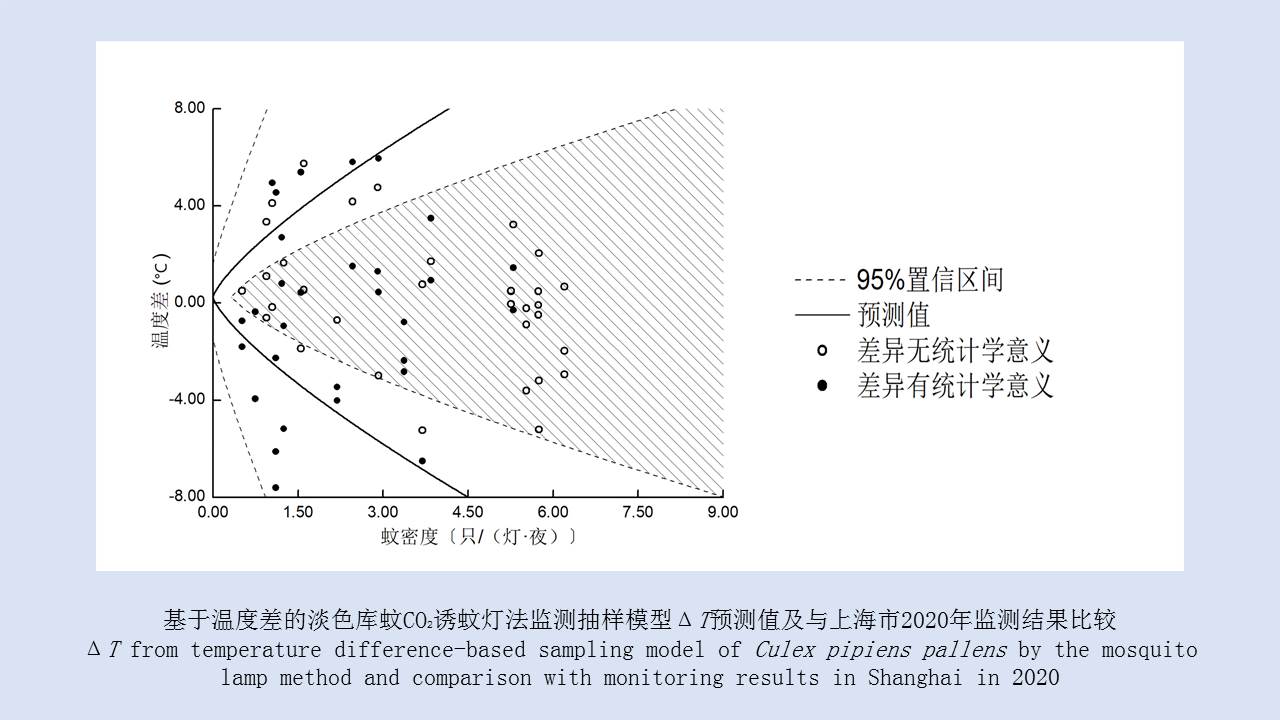
目的 建立基于温度差的CO2诱蚊灯抽样模型,为CO2诱蚊灯监测频次的确定提供科学依据。方法 在上海市15个区,于2019和2020年的4-11月每旬设置229个CO2诱蚊灯监测1次淡色库蚊密度。以2019年的监测数据为训练集,2020年的监测数据为测试集。通过泰勒幂法则建立均数与标准差间的函数,代入两样本均数比较的样本量公式,建立基于密度差的抽样模型。使用线性回归模型建立临近2次CO2诱蚊灯监测结果密度差和该2次监测前1旬的温度差的回归方程,代入基于密度差的抽样模型,建立基于温度差的抽样模型。两样本均数比较使用Wilcoxon秩和检验,模型验证使用准确率、召回率和调和平均值(F-measure)进行评价。结果 2019年相邻2旬、间隔1旬、间隔2旬淡色库蚊监测密度比较,均值差异均有统计学意义(Wilcoxon秩和检验,均P<0.05),占比分别为34.78%、59.09%和76.19%;2020年相邻2旬、间隔1旬和间隔2旬密度比较,均值的差异有统计学意义(均P<0.05),占比分别为21.74%、59.09%和66.67%。以2020年数据验证基于温度差的抽样模型,准确率为0.563,召回率为0.720,F-measure为0.632。结论 基于温度差的抽样模型具备实用意义,可以根据温度差估算CO2诱蚊灯监测的最佳监测频次。目前上海市的CO2诱蚊灯监测每年4-11月每旬监测1次,建议间隔1旬开展监测,并根据温度变化适当增加频次。
Objective To build a temperature difference-based CO2 mosquito lamp sampling model, and to provide evidence for CO2 mosquito lamp monitoring frequency. Methods A total of 229 CO2mosquito lamps were set to monitor the density of Culex pipiens pallens every ten days (defined as one period) from April to November in 15 districts of Shanghai, China. The monitoring data of 2019 were used as the training set, and those of 2020 were used as the test set. A function of mean and standard deviation was established based on Taylor’s power law, and the sample size formula for mean comparison between two samples was substituted into the function to establish a sampling model based on density difference. A linear regression model was used to establish a regression equation of the density difference between two adjacent monitoring activities and the temperature difference (during 10 days before monitoring) between two monitoring activities. The density difference-based sampling model was substituted to construct a temperature difference-based sampling model. The Wilcoxon rank-sum test was used for mean comparison between two samples. The model was validated using accuracy, recall, and F-measure. Results In the density difference-based sampling model, for both 2019 and 2020, the difference in mean mosquito density was significant between two adjacent periods(all P<0.05), between two periods with an interval of one period(all P<0.05), and between two periods with an interval of two periods(all P<0.05), accounting for 34.78%, 59.09%, and 76.19% in 2019, respectively, and 21.74%,59.09%, and 66.67% in 2020, respectively. In the validation of the temperature difference-based sampling model with the data of 2020, the accuracy was 0.563, the recall was 0.720, and the F-measure was 0.632. Conclusion The temperature difference-based sampling model is practical, which can estimate the optimal frequency of CO2 mosquito lamp monitoring based on temperature difference. CO2 mosquito lamp monitoring frequency in Shanghai from April to November can be adjusted from once every 10 days at present to once every 20 days, and can be increased based on temperature changes.
[1] 王亚丽,王煊,任瑞琦,等. 中国2013-2016年境外输入传染病的流行病学特征[J]. 中华流行病学杂志,2017,38(11):1499-1503. DOI:10.3760/cma.j.issn.0254-6450.2017.11.012. Wang YL,Wang X,Ren RQ,et al. Epidemiology of imported infectious diseases in China,2013-2016[J]. Chin J Epidemiol,2017,38(11):1499-1503. DOI:10.3760/cma.j.issn.0254-6450.2017.11.012.(in Chinese)
[2] 冯云,张海林,梁国栋. 我国从节肢动物中新分离的虫媒病毒[J]. 中国媒介生物学及控制杂志,2009,20(2):178-181. DOI:CNKI:SUN:ZMSK.0.2009-02-038. Feng Y,Zhang HL,Liang GD. Newly arbovirus isolated from arthropod in China[J]. Chin J Vector Biol Control,2009,20(2):178-181. DOI:CNKI:SUN:ZMSK.0.2009-02-038.(in Chinese)
[3] 郭玉红,吴海霞,刘小波,等. 2018年全国媒介蚊虫监测报告[J]. 中国媒介生物学及控制杂志,2019,30(2):128-133. DOI:10.11853/j.issn.1003.8280.2019.02.003. Guo YH,Wu HX,Liu XB,et al. National vectors surveillance report on mosquitoes in China,2018[J]. Chin J Vector Biol Control,2019,30(2):128-133. DOI:10.11853/j.issn.1003. 8280.2019.02.003.(in Chinese)
[4] 周毅彬,朱江,冷培恩,等. 基于泰勒幂法则的诱蚊灯抽样模型研究[J]. 中国媒介生物学及控制杂志,2021,32(1):21-25. DOI:10.11853/j.issn.1003.8280.2021.01.003. Zhou YB,Zhu J,Leng PE,et al. A study of mosquito lamp sampling model based on Taylor's power law[J]. Chin J Vector Biol Control,2021,32(1):21-25. DOI:10.11853/j.issn.1003. 8280.2021.01.003.(in Chinese)
[5] 孙振球. 医学统计学[M]. 3版. 北京:人民卫生出版社,2002:540-542. Sun ZQ. Medical statistics[M]. 3rd ed. Beijing:People's Health Publishing House,2002:540-542. (in Chinese)
[6] 奚国良. 气象因素对蚊虫密度的影响研究[J]. 中国媒介生物学及控制杂志,2000,11(1):24-26. DOI:10.3969/j.issn.1003-4692.2000.01.007. Xi GL. Study on the influence of meteorological factors upon density of mosquito[J]. Chin J Vector Biol Control,2000,11(1):24-26. DOI:10.3969/j.issn.1003-4692.2000.01.007.(in Chinese)
[7] 奚国良. 不同季节蚊虫密度之间的关系分析[J]. 中国媒介生物学及控制杂志,1999,10(5):347-348. DOI:10.3969/j.issn.1003-4692.1999.05.009. Xi GL. Analysis of the relations among the density of mosquitoes in the different seasons[J]. Chin J Vector Biol Control,1999,10(5):347-348. DOI:10.3969/j.issn.1003-4692.1999.05.009.(in Chinese)
[8] 周志华. 机器学习[M]. 北京:清华大学出版社,2016:30. Zhou ZH. Machine learning[M]. Beijing:Tsinghua University Press,2016:30. (in Chinese)
[9] 刘起勇. 我国病媒生物监测与控制现状分析及展望[J]. 中国媒介生物学及控制杂志,2015,26(2):109-113,126. DOI:10.11853/j.issn.1003.4692.2015.02.001. Liu QY. State-of-art analysis and perspectives on vector surveillance and control in China[J]. Chin J Vector Biol Control,2015,26(2):109-113,126. DOI:10.11853/j.issn.1003.4692. 2015.02.001.(in Chinese)
[10] 刘俊,顾盈培,冯磊,等. CO2诱捕法与人工小时法在淡色库蚊监测中的比较研究[J]. 中华卫生杀虫药械,2018,24(1):53-55. DOI:10.19821/j.1671-2781.2018.01.015. Liu J,Gu YP,Feng L,et al. Comparison on CO2 trap and labor hour method in Culex pipiens pallens surveillance[J]. Chin J Hyg Insect Equip,2018,24(1):53-55. DOI:10.19821/j.1671-2781. 2018.01.015.(in Chinese)
[11] 刘洁,曲波,何钦成. 应用时间序列模型对全国2004-2009年疟疾疫情分析及预测[J]. 中国媒介生物学及控制杂志,2011,22(2):134-136,140. DOI:CNKI:SUN:ZMSK.0.2011-02-012. Liu J,Qu B,He QC. Epidemiological analysis on malaria incidence in China from 2004 to 2009 by time series model[J]. Chin J Vector Biol Control,2011,22(2):134-136,140. DOI:CNKI:SUN:ZMSK.0.2011-02-012.(in Chinese)
[12] 谢旭,任金马,牟瑾,等. 深圳市肠道传染病与气象及媒介因素的贝叶斯正规化BP神经网络模型[J]. 医学动物防制,2007,23(7):485-488. DOI:10.3969/j.issn.1003-6245.2007.07.002. Xie X,Ren JM,Mu J,et al. The model of Bayesian-regularization back-propagation neural network about meteorological factors,vector factors and intestinal communicable disease in Shenzhen[J]. Chin J Pest Control,2007,23(7):485-488. DOI:10.3969/j.issn.1003-6245.2007.07.002.(in Chinese)
[13] 于德宪,林立丰,罗雷,等. 人工神经网络模型用于分析气候因素对白纹伊蚊密度影响的初步探讨[J]. 南方医科大学学报,2010,30(7):1604-1605,1609. DOI:10.12122/j.issn.1673-4254.2010.07.030. Yu DX,Lin LF,Luo L,et al. Establishment of an artificial neural network model for analysis of the influence of climate factors on the density of Aedes albopictus[J]. J South Med Univ,2010,30(7):1604-1605,1609. DOI:10.12122/j.issn.1673-4254.2010. 07.030.(in Chinese)


