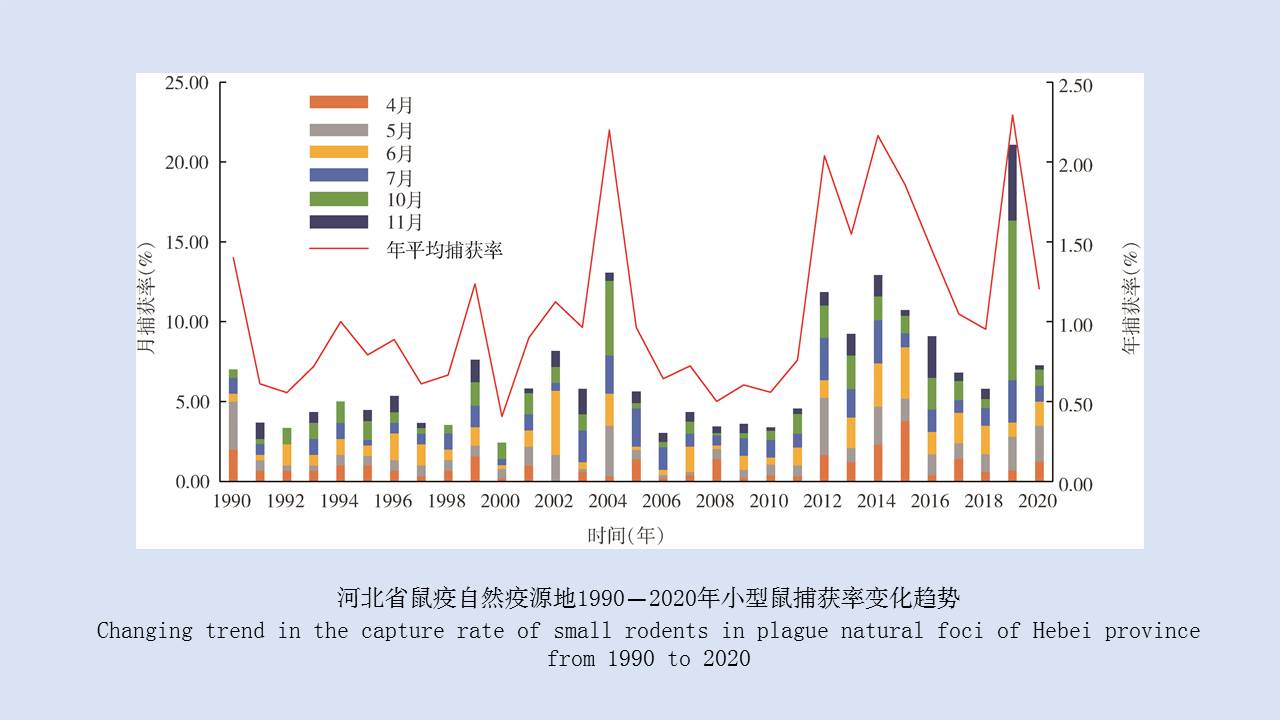
目的 了解河北省鼠疫自然疫源地1990-2020年小型鼠种类构成和数量变化规律,为疫源地动物疫情的预测预警提供依据。方法 应用Excel 2010软件对小型鼠调查数据进行总结和逐年逐月统计,运用集中度法对小型鼠季节分布特征进行分析。结果 1990-2020年共计布夹112 205夹次,捕鼠1 322只,平均捕获率为1.18%,其中2019年捕获率最高(2.30%),其次是2004年(2.20%),2000年捕获率最低(0.41%),高于平均捕获率的有9个年份,即1990、1999、2004、2012-2016和2019年;共捕获11种鼠类,隶属于4科8属,其中以黑线仓鼠最多,占63.31%,为优势鼠种;2014年捕获小型鼠的种类最多,为8种,1991年最少,仅有1种。小型鼠数量在全年分布较均匀(M=0.13),相对数量较多的是6月(247/1 322,18.68%)、7月(259/1 322,19.59%)和10月(250/1 322,18.91%);优势鼠种黑线仓鼠数量年际分布与小型鼠分布基本一致,最高年份均为2019年,数量分布有一定的季节性(M=0.30),捕获率夏秋季相对较高,最高的月份是10月(0.98%),其次是7月(0.82%),再次是6月(0.71%)和11月(0.71%)。结论 小型鼠的种类数量有上升趋势,种类构成丰富,应警惕其种类变化对鼠间疫情流行和传播带来的重要影响。
陈永明, 康东梅, 闫萍, 杨顺林, 白雪薇, 周松, 王海峰, 郑楠, 杜国义, 陈凯乐
. 河北省鼠疫自然疫源地1990-2020年小型鼠监测结果分析[J]. 中国媒介生物学及控制杂志, 2022
, 33(1)
: 89
-93
.
DOI: 10.11853/j.issn.1003.8280.2022.01.016
Objective To investigate the changes in species composition and number of small rodents in natural plague foci of Hebei province, China, from 1990 to 2020, and to provide a basis for the prediction and early warning of animal epidemics in the plague foci. Methods Excel 2010 software was used to summarize and count the monthly and annual surveillance data on small rodents, and the concentration degree method was used to analyze the seasonal distribution of small rodents. Results From 1990 to 2020, a total of 112 205 clamps were placed and 1 322 rodents were caught, with a mean capture rate of 1.18%. The highest capture rate (2.30%) occurred in the year 2019, followed by the year 2004 (2.20%), and the lowest capture rate (0.41%) occurred in the year 2000. There were 9 years (1990, 1999, 2004, 2012-2016, and 2019) when the capture rate was higher than the mean value. A total of 11 species of rodents were captured, belonging to 8 genera and 4 families, among which Cricetulus barabensis (63.31%) was the dominant species. The highest number of small rodent species (8 species) was observed in 2014, and the fewest (1 species) in 1991. The number of small rodents were distributed evenly throughout the year (M=0.13), and the months with relative high numbers were June (247/1 322, 18.68%), July (259/1 322, 19.59%), and October (250/1 322, 18.91%). The interannual distribution of the number of the dominant species, C. barabensis, had been consistent with that of small rodents, with the highest number seen in 2019. The number distribution of C. barabensis showed seasonality (M=0.30) and the number was relatively high in summer and autumn, with the highest number in October (0.98%), followed by July (0.82%), June (0.71%), and November (0.71%). Conclusion The species number of small rodents has a rising tendency, with rich species composition. The significant influence of the changing trend in the small rodent species on rodent epidemic outbreaks and spread should be highlighted.
[1] 史献明,杜国义,尤殿平. 河北省鼠疫自然疫源地宿主耶尔森菌存在形式初步调查[J]. 中国媒介生物学及控制杂志,2017,28(6):586-588. DOI:10.11853/j.issn.1003.8280.2017.06.017. Shi XM,Du GY,You DP. Study on Yersinia-like bacteria in the plague natural foci of Hebei province[J]. Chin J Vector Biol Control,2017,28(6):586-588. DOI:10.11853/j.issn.1003. 8280.2017.06.017.(in Chinese)
[2] 刘合智,刘满福,李玉贵,等. 河北省鼠疫自然疫源地内染疫动物及染疫媒介的研究[J]. 医学动物防制,2004,20(12):724-728. DOI:10.3969/j.issn.1003-6245.2004.12.003. Liu HZ,Liu MF,Li YG,et al. Study on infected plague animals and vectors in the nature in the plague natural focus of Hebei province[J]. Chin J Pest Control,2004,20(12):724-728. DOI:10.3969/j.issn.1003-6245.2004.12.003.(in Chinese)
[3] 王玉山,刘起勇,丛显斌,等. 中国鼠疫自然疫源地宿主动物名称与分类地位[J]. 中国媒介生物学及控制杂志,2007,18(2):127-133. DOI:10.3969/j.issn.1003-4692.2007.02.015. Wang YS,Liu QY,Cong XB,et al. Plague reservoirs and their classification in natural foci of China[J]. Chin J Vector Biol Control,2007,18(2):127-133. DOI:10.3969/j.issn.1003-4692. 2007.02.015.(in Chinese)
[4] 秦长育,许磊,张荣祖,等. 中国鼠疫自然疫源地分型研究Ⅴ. 鼠疫宿主生物学特征[J]. 中华流行病学杂志,2012,33(7):692-697. DOI:10.3760/cma.j.issn.0254-6450.2012.07.011. Qin CY,Xu L,Zhang RZ,et al. Ecological-geographic landscapes of natural plague foci in China Ⅴ. Biological characteristics of major natural reservoirs of Yesinia pestis[J]. Chin J Epidemiol,2012,33(7):692-697. DOI:10.3760/cma.j.issn.0254-6450.2012.07.011.(in Chinese)
[5] 丛显斌,刘振才,李群. 中国鼠疫自然疫源地(1950-2014)[M]. 北京:人民卫生出版社,2020:36-333. Cong XB,Liu ZC,Li Q. Natural foci of rodents in China (1950-2014)[M]. Beijing:People's Medical Publishing House,2020:36-333.(in Chinese)
[6] 张芳, 李昊, 田洁, 等.内蒙古高原长爪沙鼠鼠疫自然疫源地现状分析[J].中国地方病防治,2020,35(3):220-222. Zhang F, Li H,Tian J, et al. Analysis on the present situation of natural foci of Meriones unguiculatus plague in Inner Mongolia plateau[J].Chin J Ctrl Endem Dis,2020,35(3):220-222. (in Chinese)
[7] 内蒙古流行病防治研究所. 内蒙古荒漠草原鼠疫自然疫源地[M]. 呼和浩特:内蒙古流行病防治研究所,1986:1-20. Inner Mongolia Institute of Epidemic Prevention and Control. Natural foci of plague in desert steppe of Inner Mongolia[M]. Hohhot:Inner Mongolia Institute of Epidemic Prevention and Control,1986:1-20.(in Chinese)
[8] 安君胜. 甘宁1962-2019年阿拉善黄鼠疫源地疫情监测结果分析[J]. 中国地方病防治,2021,36(1):41-42,44. An JS. Analysis of the surveillance results of the Alashan ground squirrel foci in Ganning from 1962 to 2019[J]. Chin J Control Endem Dis,2021,36(1):41-42,44.(in Chinese)
[9] 周晓磊,李长华,陈磊,等. 吉林省乾安县鼠疫自然疫源地环境改变对宿主种群变化的影响[J]. 中国地方病防治,2020,35(5):504-505,508. Zhou XL,Li CH,Chen L,et al. Effect of environment change on population of host animals in plague foci in Qian'an county of Jilin province[J]. Chin J Control Endem Dis,2020,35(5):504-505,508.(in Chinese)
[10] 闫东,史献明,崔耀仁,等. 河北省鼠疫疫源地小型夜行鼠调查[J]. 中国媒介生物学及控制杂志,2011,22(4):375-377. Yan D,Shi XM,Cui YR,et al. Investigation of small nocturnal rodents in a natural plague focus in Hebei province[J]. Chin J Vector Biol Control,2011,22(4):375-377.(in Chinese)
[11] 闫东,史献明,王再山,等. 河北省鼠疫疫源地宿主动物种群结构研究[J]. 中华卫生杀虫药械,2016,22(4):381-384. Yan D,Shi XM,Wang ZS,et al. Research on the population structure of plague host animals in plague foci in Hebei province[J]. Chin J Hyg Insect Equip,2016,22(4):381-384.(in Chinese)


