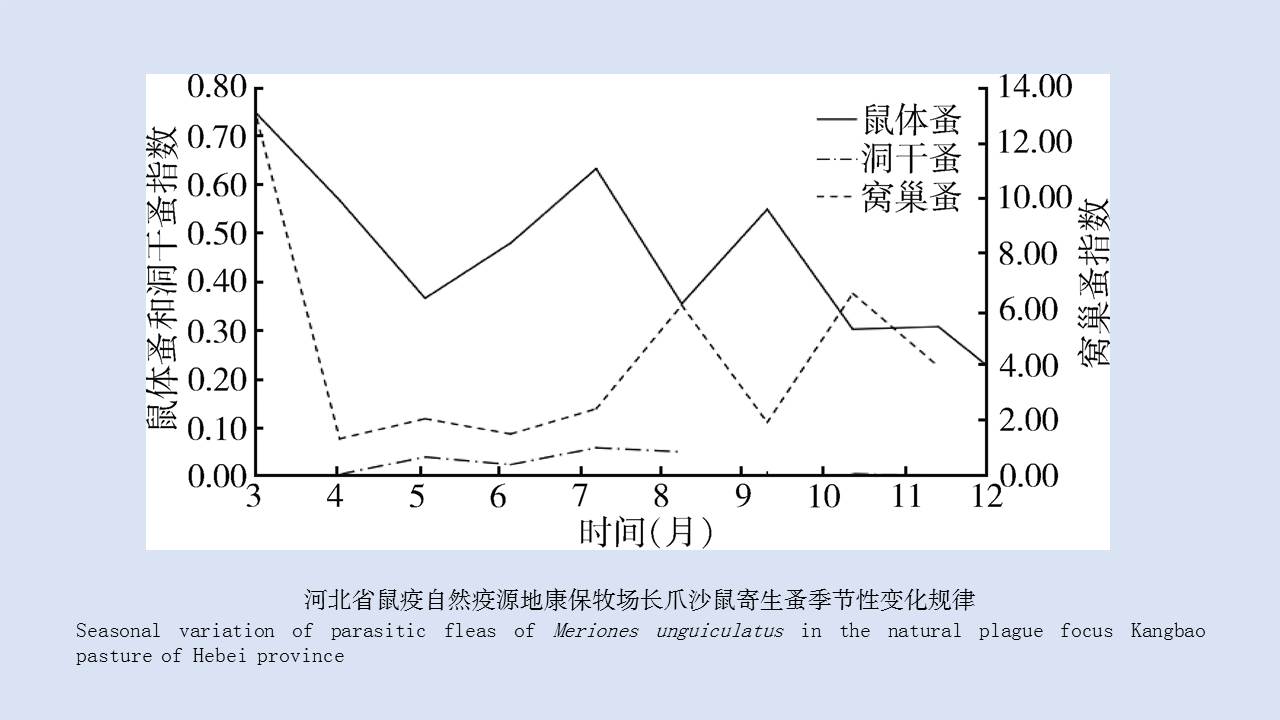
目的 了解河北省鼠疫自然疫源地康保牧场1981-2020年长爪沙鼠寄生蚤种群数量和结构变化规律,为该疫源地动物疫情的预测预警提供依据。方法 应用Excel 2010软件对长爪沙鼠鼠体蚤、洞干蚤及窝巢蚤调查数据进行总结和逐年逐月统计,运用集中度法对寄生蚤季节分布特征进行分析,采用配伍组方差分析对不同类型长爪沙鼠寄生蚤蚤指数进行分析。结果 1981-2020年共计获蚤4 046匹,隶属于3科11属17种,其中2018-2020年长爪沙鼠鼠体捡获同形客蚤122匹,占比7.24%(122/1 684);鼠体蚤、洞干蚤和窝巢蚤的染蚤率变化没有一定的规律性,但1995、2002-2003、2005、2017-2018年有动物间鼠疫疫情发生,鼠体蚤和窝巢蚤染蚤率均高于平均染蚤率;应用集中度法研究发现长爪沙鼠体蚤(M=0.3)和巢蚤(M=0.3)均有一定的季节性,且二者呈现“此起彼伏”的变化趋势;长爪沙鼠洞干蚤有很强的季节性(M=0.7),蚤密度夏秋较高,冬春较低;经配伍组方差分析,不同类型的长爪沙鼠寄生蚤蚤指数差异有统计学意义(F=3.515,P=0.023),鼠体蚤、洞干蚤和窝巢蚤的蚤指数分别进行两两比较,差异均有统计学意义(均P<0.05)。结论 1981-2020年河北省鼠疫自然疫源地康保牧场动物间鼠疫流行与长爪沙鼠寄生蚤染蚤率存在一定的相关性,为有针对性地开展该疫源地灭蚤防控鼠疫提供了理论依据。
康东梅, 闫东, 候芝林, 任兴宇, 牛艳芬, 兰晓宇, 刘冠纯, 杜国义, 陈永明, 刘晓林, 张锐, 马洁琼
. 河北省鼠疫自然疫源地康保牧场长爪沙鼠寄生蚤动态分析[J]. 中国媒介生物学及控制杂志, 2022
, 33(1)
: 72
-75
.
DOI: 10.11853/j.issn.1003.8280.2022.01.013
Objective To investigate the changes in population number and structure of parasitic fleas of Meriones unguiculatus in the natural plague focus Kangbao pasture in Hebei province, China from 1981 to 2020, and to provide a basis for early warning of epizootics in this focus. Methods Excel 2010 software was used to perform year-by-year and month-by-month analyses on the data of rat body fleas, burrow fleas, and nest fleas of M. unguiculatus. The concentration degree method was used to analyze the seasonal distribution of parasitic fleas. Randomized block analysis of variance was used to analyze the flea index of different types of parasitic fleas of M. unguiculatus. Results From 1981 to 2020, a total of 4 046 fleas were collected, belonging to 17 species of 11 genera under 3 families. A total of 122 Xenopsylla conformis conformis fleas were collected from M. unguiculatus bodies from 2018 to 2020, accounting for 7.24% (122/1 684). There was no significant regularity in the infestation rate changes of body fleas, burrow fleas, and nest fleas, but the infestation rates of body fleas and nest fleas were higher than the average level in 1995, 2002-2003, 2005, and 2017-2018 when epizootics occurred. The concentration degree method found that both body fleas (M=0.3) and nest fleas (M=0.3) of M. unguiculatus had certain seasonality, and they tended to change inversely-one rose as another fell; M. unguiculatus burrow fleas had strong seasonality (M=0.7), with flea density higher in summer and autumn and lower in winter and spring. The randomized block analysis of variance showed a significant difference in the flea index between different types of parasitic fleas of M. unguiculatus (F=3.515, P=0.023), and multiple comparison showed significant differences in the flea index between any two types of body fleas, burrow fleas, and nest fleas (all P<0.05). Conclusion Plague epizootics were associated with the parasitic flea infestation rate of M. unguiculatus in the natural plague focus Kangbao pasture of Hebei province from 1981 to 2020, which provides a theoretical basis for targeted flea control measures to prevent plague.
[1] 史献明,杜国义,尤殿平. 河北省鼠疫自然疫源地宿主耶尔森菌存在形式初步调查[J]. 中国媒介生物学及控制杂志,2017,28(6):586-588. DOI:10.11853/J.ISSN.1003.8280.2017.06.017. Shi XM,Du GY,You DP. Study on Yersinia-like bacteria in the plague natural foci of Hebei province[J]. Chin J Vector Biol Control,2017,28(6):586-588. DOI:10.11853/J.ISSN.1003. 8280.2017.06.017.(in Chinese)
[2] 白雪薇,陈永明,牛艳芬,等. 河北省鼠疫自然疫源地动物鼠疫流行分布特征分析[J]. 中国媒介生物学及控制杂志,2021,32(3):324-328. DOI:10.11853/J.ISSN.1003.8280.2021.03.013. Bai XW,Chen YM,Niu YF,et al. Distribution characteristics of plague epidemics in animals in natural plague foci of Hebei province,China[J]. Chin J Vector Biol Control,2021,32(3):324-328. DOI:10.11853/J.ISSN.1003.8280.2021.03.013.(in Chinese)
[3] 闫东,史献明,王再山,等. 河北省鼠疫疫源地宿主动物种群结构研究[J]. 中华卫生杀虫药械,2016,22(4):381-384. DOI:10.19821/J.1671-2781.2016.04.024. Yan D,Shi XM,Wang ZS,et al. Research on the population structure of plague host animals in plague foci in Hebei province[J]. Chin J Hyg Insect Equip,2016,22(4):381-384. DOI:10.19821/J.1671-2781.2016.04.024.(in Chinese)
[4] 刘合智,刘满福,李玉贵,等. 河北省鼠疫自然疫源地内染疫动物及染疫媒介的研究[J]. 医学动物防制,2004,20(12):724-728. DOI:10.3969/J.ISSN.1003-6245.2004.12.003. Liu HZ,Liu MF,Li YG,et al. Study on infected plague animals and vectors in the nature in the plague natural focus of Hebei province[J]. J Med Pest Control,2004,20(12):724-728. DOI:10.3969/J.ISSN.1003-6245.2004.12.003.(in Chinese)
[5] 刘满福,王治宇,张雪冬,等. 河北省鼠疫自然疫源地内长爪沙鼠寄生蚤的研究[J]. 中国媒介生物学及控制杂志,2003,14(5):370-371. DOI:10.3969/j.issn.1003-4692.2003.05.018. Liu MF,Wang ZY,Zhang XD,et al. Study on parasitical fleas of Meriones unguiculatus in Hebei province[J]. Chin J Vector Biol Control,2003,14(5):370-371. DOI:10.3969/j.issn.1003-4692. 2003.05.018.(in Chinese)
[6] 康东梅,牛艳芬,闫东,等. 河北省鼠疫自然疫源地康保牧场长爪沙鼠巢蚤季节性分布研究[J]. 中国媒介生物学及控制杂志,2021,32(3):276-281. DOI:10.11853/J.ISSN.1003.8280. 2021.03.004. Kang DM,Niu YF,Yan D,et al. Seasonal distribution of Meriones unguiculatus nest fleas in Kangbao pasture,a natural plague focus of Hebei province,China[J]. Chin J Vector Biol Control,2021,32(3):276-281. DOI:10.11853/J.ISSN.1003.8280.2021. 03.004.(in Chinese)
[7] 刘满福,刘合智,史献明,等. 河北省长爪沙鼠寄生蚤的研究[J]. 地方病通报,2002,17(4):47-50. DOI:10.13215/J.CNKI.JBYFKZTB.2002.04.018. Liu MF,Liu HZ,Shi XM,et al. Studies on parasitical fleas of Meriones unguiculatus in Hebei province[J]. Endem Dis Bull,2002,17(4):47-50. DOI:10.13215/J.CNKI.JBYFKZTB.2002. 04.018.(in Chinese)
[8] 刘纪有,张万荣. 内蒙古鼠疫[M]. 呼和浩特:内蒙古人民出版社,1997:106-107. Liu JY,Zhang WR. Plague of Inner Mongolia[M]. Huhhot:Inner Mongolia People's Publishing House,1997:106-107. (in Chinese)


