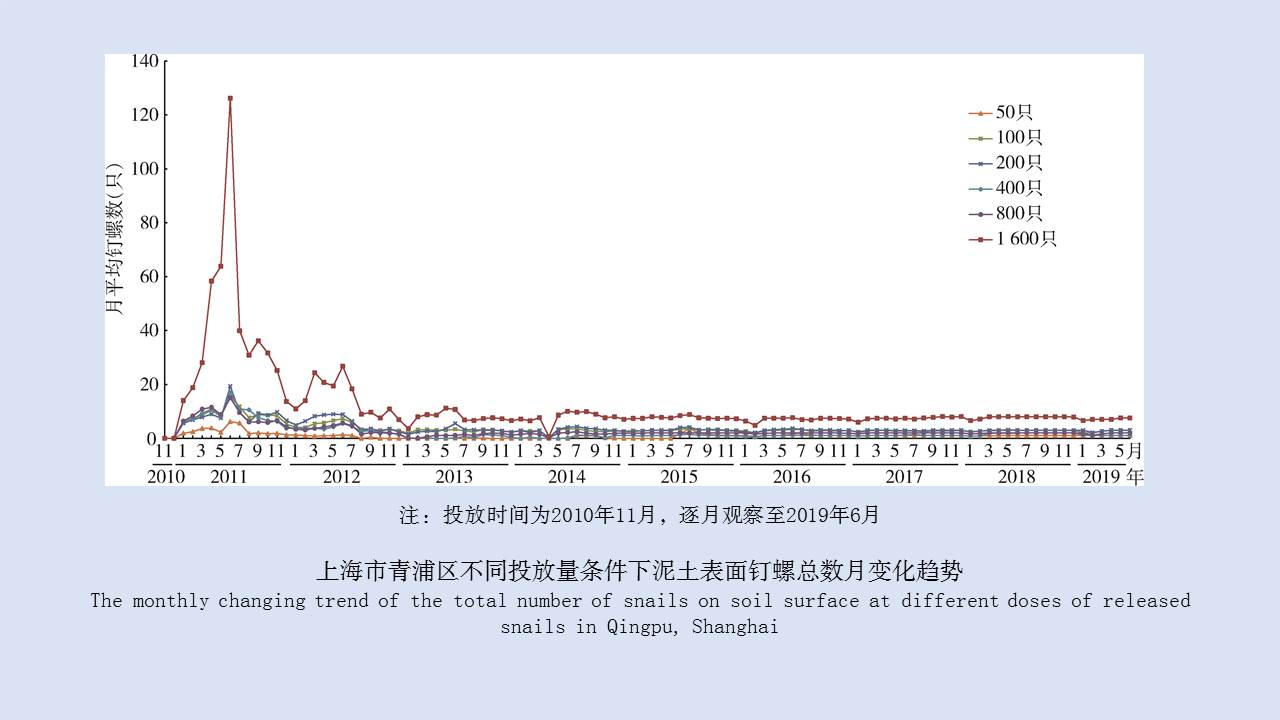
Objective To investigate the survival and reproduction of wild imported Oncomelania snails from lakes in water network regions by the capture-mark-recapture method, and to provide a scientific basis for the survival possibility of the long-distance migration of Oncomelania snails. Methods On November 25 of 2010, 50, 100, 200, 400, 800, and 1 600 of wild Oncomelania snails (at a male/female ratio of 1∶1) from Guichi district of Chizhou city in Anhui, China, were randomly put into 6 ponds after marked by non-fading markers in Rentun Schistosomiasis Memorial Hall and were observed for 3 828 consecutive days. On May 19 of 2021, the double-layer-mesh was used to screen and wash out the snails from the ponds for classifying and counting. Excel 2007 and SPSS 10.0 softwares were used to perform a statistical analysis of continuous monitoring data and calculate the number of recapture and recapture rate. The Kruskal-Wallis H test was used to compare the difference in recovery rate between different doses of snails, and the logarithmic linear regression analysis was used to investigate the correlation between the dose of snails and the number of second-birth snails. Results A total of 1 167 snails were captured from the 6 ponds, all of which were found empty by water immersion and microscopy, and no living snail was observed. Among these snails, 366 were marked experimental snails, with a recapture rate of 11.62%, and there were 694 second-birth snails (including young snails) and 107 incomplete snails. The Kruskal-Wallis H test showed a statistical difference in recovery rate between different doses of snails (χ2=75.743, P<0.001). No linear regression relationship was observed between the dose of snails and the number of second-birth snails recycled [y=211.84lgx-403.68, F=6.543, P=0.063]. Conclusion Oncomelania snails from lakes can survive and reproduce in water network regions, but they do not have the ability for continuous survival and reproduction. The surveillance of Oncomelania snails should focus on the spread of Oncomelania snails of the same subtype in neighborhood, rather than the spread of Oncomelania snails of different subtypes from a great distance.
[1] 张光明,操治国,汪天平. 三峡水利工程对中国血吸虫病流行的影响:工程运行前后预测与实证的比较[J]. 热带病与寄生虫学,2018,16(1):45-50. DOI:10.3969/j.issn.1672-2302. 2018.01.014. Zhang GM,Cao ZG,Wang TP. The impact of the Three Gorges Project on the prevalence of schistosomiasis in China:The comparing with the forcasting before the project and the real evidence after the project[J]. J Trop Dis Parasitol,2018,16(1):45-50. DOI:10.3969/j.issn.1672-2302.2018.01.014.(in Chinese)
[2] 汪天平,张世清. 南水北调与钉螺扩散和血吸虫病蔓延[J]. 中华流行病学杂志,2002,23(2):87-89. DOI:10.3760/j.issn:0254-6450.2002.02.003. Wang TP,Zhang SQ. The relation of the South-to-North Water Diversion Project with Oncomelania snails spreading and schistosomiasis extensioin[J]. Chin J Epidemiol,2002,23(2):87-89. DOI:10.3760/j.issn:0254-6450.2002.02.003.(in Chinese)
[3] 吕大兵,姜庆五. 钉螺生态学研究及其应用[J]. 中国血吸虫病防治杂志,2003,15(2):154-156. DOI:10.16250/j.32.1374. 2003.02.031. Lyu DB,Jiang QW. Study on the ecology of Oncomelania snails and its application[J]. Chin J Schistos Control,2003,15(2):154-156. DOI:10.16250/j.32.1374.2003.02.031.(in Chinese)
[4] 田建国,仲文江,黎桂福,等. 水网地区模拟输入性钉螺生存繁殖情况初步观察[J]. 中国血吸虫病防治杂志,2011,23(2):204-206. DOI:10.16250/j.32.1374.2011.02.004. Tian JG,Zhong WJ,Li GF,et al. Preliminary observation on survival and reproduction of imported Oncomelania snails in water network regions:a simulated experiment[J]. Chin J Schisto Control,2011,23(2):204-206. DOI:10.16250/j.32.1374. 2011.02.004.(in Chinese)
[5] 田建国,仲文江,黎桂福,等. 上海市青浦区钉螺再生性研究[J]. 中国媒介生物学及控制杂志,2011,22(2):162-164. Tian JG,Zhong WJ,Li GF,et al. Study on the reproducibility of Oncomelania snails in Qingpu district of Shanghai[J]. Chin J Vector Biol Control,2011,22(2):162-164.(in Chinese)
[6] 田建国,黎桂福,彭丽霞,等. 模拟湖沼钉螺迁徙水网地区生长繁殖的适应性研究[J]. 中国媒介生物学及控制杂志,2015,26(4):414-417. DOI:10.11853/j.issn.1003.4692.2015.04.023. Tian JG,Li GF,Peng LX,et al. A research on the surviving and reproducing status of the imported Oncomelania snails from marshland areas to water network regions[J]. Chin J Vector Biol Control,2015,26(4):414-417. DOI:10.11853/j.issn.1003. 4692.2015.04.023.(in Chinese)
[7] 田建国,黎桂福,李俊,等. 上海市青浦区人工输入性钉螺生存模拟实验[J]. 中国血吸虫病防治杂志,2013,25(3):322-323. DOI:10.3969/j.issn.1005-6661.2013.03.028. Tian JG,Li GF,Li J,et al. Simulation experiment of survival and reproduction of artificially imported Oncomelania snails in Qingpu district,Shanghai[J]. Chin J Schisto Control,2013,25(3):322-323. DOI:10.3969/j.issn.1005-6661.2013.03.028.(in Chinese)
[8] 闻礼永. 血吸虫病监测手册[M]. 北京:人民卫生出版社,2014:38. Wen LY. Schistosomiasis surveillance manual[M]. Beijing:People's Medical Publishing House,2014:38.(in Chinese)
[9] 中华人民共和国卫生部疾病控制司. 血吸虫病防治手册[M]. 3版. 上海:上海科学技术出版社,2000:13-19. Department of Disease Control,Ministry of Health of the People's Republic of China. Handbook of schistosomiasis control[M]. 3rd ed. Shanghai:Shanghai Scientific & Technical Publishers,2000:13-19.(in Chinese)
[10] 周晓农. 实用钉螺学[M]. 北京:科学技术出版社,2005:21-88. Zhou XN. Science on Oncomelania snail[M]. Beijing:Science and Technology of China Press,2005:21-88.(in Chinese)
[11] 张垒. 湖北钉螺(Oncomelania hupensis)的生态学研究[D]. 武汉:湖北大学,2008. Zhang L. The ecological study of Oncomelania hupensis in Hubei[D]. Wuhan:Hubei University,2008.(in Chinese)
[12] 孙振球. 医学统计学[M]. 3版. 北京:人民卫生出版社,2011:103-108. Sun ZQ. Medical statistics[M]. 3rd ed. Beijing:People's Medical Publishing House,2011:103-108.(in Chinese)
[13] 黄玲玲. 山丘区钉螺分布特征及其与环境因子的关系[D]. 北京:中国林业科学研究院,2006. Huang LL. Oncomelania distribution characteristic and relationship with environment factors in the hilly and mountains district[D]. Beijing:Chinese Academy of Forestry,2006.(in Chinese)
[14] 苏德隆. 钉螺对光之反应(钉螺生态学研究之二)[J]. 中华卫生杂志,1957,5(3):139-143. Su DL. The reaction of Oncomelania snails to light[J]. Chin Med J,1957,5(3):139-143.(in Chinese)
[15] 谢娟,闻礼永. 生态环境改变新态势对钉螺生长繁殖和扩散的影响[J]. 中国血吸虫病防治杂志,2016,28(2):225-228. DOI:10.16250/j.32.1374.2015206. Xie J,Wen LY. Impact of new trend of ecological environment changes on growth,reproduction and diffusion of Oncomelania hupensis[J]. Chin J Schisto Control 2016,28(2):225-228. DOI:10.16250/j.32.1374.2015206.(in Chinese)
[16] 梁幼生,戴建荣,宋鸿焘,等. 北移传代钉螺在北方生存的纵向观察及其对血吸虫的易感性[J]. 中国寄生虫病防治杂志,2002,15(1):39-41. DOI:10.3969/j.issn.1673-5234.2002. 01.013. Liang YS,Dai JR,Song HT,et al. Survival of Oncomelania hupensis snails in the north of China and their susceptibility to Schistosoma japonicum[J]. Chin J Parasit Dis Con,2002,15(1):39-41. DOI:10.3969/j.issn.1673-5234.2002.01.013.(in Chinese)
[17] 黄重峰,邹节新,朱春潮,等. 标记重捕技术对湖北钉螺滇川亚种在湖沼水网地区种群动态的实验研究[J]. 中国人兽共患病学报,2012,28(2):139-143. DOI:10.3969/j.issn.1002-2694.2012.02.011. Huang CF,Zou JX,Zhu CC,et al. Population dynamics of Oncomelania hupensis robertsoni in lake marshland and water network regions by mark-recapture method[J]. Chin J Zoonoses,2012,28(2):139-143. DOI:10.3969/j.issn.1002-2694.2012. 02.011.(in Chinese)
[18] 黄殷殷,张世清,操治国,等. 南水北调工程对血吸虫病传播影响研究进展[J]. 热带病与寄生虫学,2019,17(3):181-186. DOI:10.3969/j.issn.1672-2302.2019.03.015. Huang YY,Zhang SQ,Cao ZG,et al. The impact of the South-to-North Water Diversion Project on the extensioin of schistosomiasis[J]. J Trop Dis Parasitol,2019,17(3):181-186. DOI:10.3969/j.issn.1672-2302.2019.03.015.(in Chinese)
[19] 田建国,黎桂福,张小萍,等. 剂量投螺条件下泥土中活性螺卵检测方法研究[J]. 中国媒介生物学及控制杂志,2014,25(6):558-560. DOI:10.11853/j.issn.1003.4692.2014.06.019. Tian JG,Li GF,Zhang XP,et al. A comparative detections for active eggs of Oncomelania hupensis Gredler in soils with varying densities[J] Chin J Vector Biol Control,2014,25(6):558-560. DOI:10.11853/j.issn.1003.4692.2014.06.019.(in Chinese)
[20] 田建国,黎桂福,彭丽霞,等. 采用3种钉螺孵化方法检测有螺土壤中活性螺卵的比较研究[J]. 中国媒介生物学及控制杂志,2017,28(6):600-602. DOI:10.11853/j.issn.1003.8280. 2017.06.022. Tian JG,Li GF,Peng LX,et al. A comparative study on hatching active eggs of Oncomelania hupensis in soil by three methods[J]. Chin J Vector Biol Control,2017,28(6):600-602. DOI:10.11853/j.issn.1003.8280.2017.06.022.(in Chinese)


