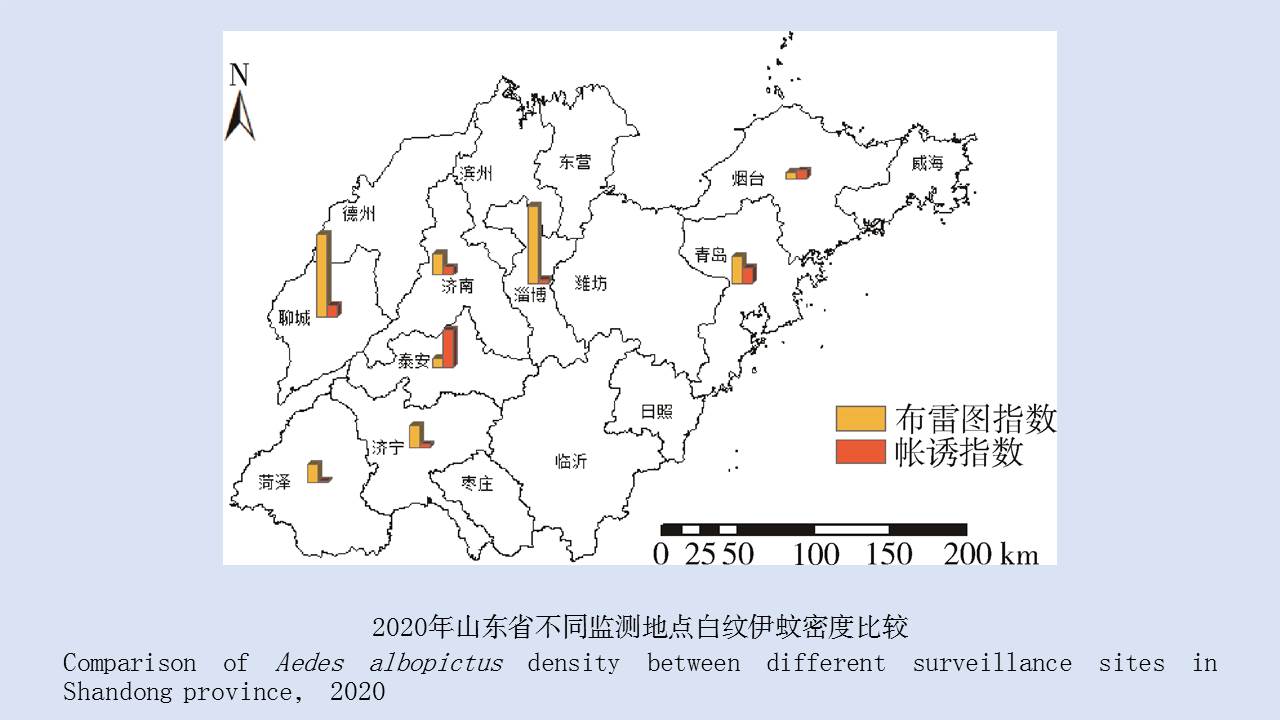
目的 分析2020年山东省登革热媒介白纹伊蚊生态学监测数据,为登革热有效防控提供科学依据。方法 2020年4-11月在全省选择济南、青岛、淄博、烟台、济宁、泰安、聊城、菏泽市为监测点,幼蚊采用布雷图指数(BI)法、成蚊采用双层叠帐法开展媒介伊蚊监测。采用Excel 2010软件进行数据整理,SPSS 19.0软件进行数据分析;采用χ2检验,分析不同生境、积水类型媒介伊蚊孳生情况的差异。结果 2020年山东省白纹伊蚊平均BI为9.64,平均帐诱指数为2.58只/(顶·h)。不同生境类型,以城镇居民区BI最高(12.22),旧轮胎堆放地/废品站/工地帐诱指数最高[3.59只/(顶·h)]。不同的蚊虫监测方法均显示7月上旬-9月下旬白纹伊蚊密度较高。BI法阳性结果最早出现于4月下旬,8月中旬达最高值(27.17),11月下旬BI为0。双层叠帐法监测阳性结果最早出现于5月中旬,8月上旬达最高值,11月上旬帐诱指数为0。在各种积水类型中,地下室及停车场和绿化带垃圾/小积水伊蚊阳性率较高。山东省8个监测点的白纹伊蚊密度不一致,BI最高为聊城市(19.60),最低为烟台市(1.47);帐诱指数最高为泰安市[8.91只/(顶·h)],最低为菏泽市[0.29只/(顶·h)]。结论 7月上旬-9月下旬山东省白纹伊蚊密度较高,需要重点加强居民区和旧轮胎堆放地/废品站/工地的灭蚊工作,地下室及停车场和绿化带垃圾/小积水是白纹伊蚊的重要孳生地,白纹伊蚊监测密度较高地区要提高认识,及时采取措施,降低登革热本地暴发的风险。
Objective To analyze the ecological surveillance data of Aedes albopictus, the dengue vector, in Shandong province, China in 2020, and to provide a scientific basis for effective prevention and control of dengue fever. Methods From April to November 2020, Ji’nan, Qingdao, Zibo, Yantai, Jining, Tai’an, Liaocheng, and Heze were selected from the whole province as surveillance sites. The Breteau index (BI) method was used to monitor mosquito larvae, and the double-layered mosquito net method was used to monitor adult mosquitoes. Excel 2010 software was used for data colletion, and SPSS 19.0 software was used for data analysis. The Chi-square test was used to analyze the differences in Aedes vector breeding among various habitats and standing water types. Results In 2020, the mean BI of Ae. albopictus in Shandong province was 9.64, and the mean net trap index was 2.58 mosquitoes/net·hour. In terms of habitat types, urban residential areas had the highest BI (12.22), and used tire dumping grounds/waste stations/construction sites had the highest net trap index (3.59 mosquitoes/net·hour). Both mosquito surveillance methods showed that the density of Ae. albopictus was relatively high from early July to late September. The positive results of the BI method first appeared in late April; BI reached the highest value (27.17) in mid-August and became 0 in late November. The positive results of the double-layered mosquito net method first appeared in mid-May; the net trap index reached the highest value in early August and became 0 in early November. In terms of standing water types, basements/garbage in parking lots and green belts/small puddles had the highest positive rate of Aedes mosquitoes. The eight monitoring sites in Shandong province had different Ae. albopictus densities. Liaocheng had the highest BI (19.60) and Yantai had the lowest BI (1.47). Tai’an had the highest net trap index (8.91 mosquitoes/net·hour) and Heze had the lowest value (0.29 mosquitoes/net·hour). Conclusion The density of Ae. albopictus is high in Shandong province from early July to late September. It is necessary to strengthen the mosquito control in residential areas and used tire dumping grounds/waste stations/construction sites. Basements/garbage in parking lots and green belts/small puddles are important breeding sites for Ae. albopictus. People in areas with high surveillance density of Ae. albopictus should raise awareness and take timely measures to reduce the risk of local dengue outbreak.
[1] Liu HM,Liu LH,Cheng P,et al. Bionomics and insecticide resistance of Aedes albopictus in Shandong,a high latitude and high-risk dengue transmission area in China[J]. Parasit Vectors,2020,13(1):11. DOI:10.1186/s13071-020-3880-2.
[2] 中国疾病预防控制中心传染病预防控制所. 登革热媒介伊蚊专项调查实施方案[Z]. 北京:中国疾病预防控制中心传染病预防控制所,2019. National Institute for Communicable Disease Control and Prevention,Chinese Center for Disease Control and Prevention. Implementation plan of special investigation on Aedes aegypti[Z]. Beijing:National Institute for Communicable Disease Control and Prevention,Chinese Center for Disease Control and Prevention,2019. (in Chinese)
[3] 孟凤霞,王义冠,冯磊,等. 我国登革热疫情防控与媒介伊蚊的综合治理[J]. 中国媒介生物学及控制杂志,2015,26(1):4-10. DOI:10.11853/j.issn.1003.4692.2015.01.002. Meng FX,Wang YG,Feng L,et al. Review on dengue prevention and control and integrated mosquito management in China[J]. Chin J Vector Biol Control,2015,26(1):4-10. DOI:10.11853/j.issn.1003.4692.2015.01.002.(in Chinese)
[4] 刘小波,吴海霞,郭玉红,等. 2019年全国媒介伊蚊监测报告[J]. 中国媒介生物学及控制杂志,2020,31(4):401-406. DOI:10.11853/j.issn.1003.8280.2020.04.004. Liu XB,Wu HX,Guo YH,et al. Annual report on Aedes vector surveillance in China,2019[J]. Chin J Vector Biol Control,2020,31(4):401-406. DOI:10.11853/j.issn.1003.8280.2020. 04.004.(in Chinese)
[5] 章灿明,李玉伟,陈斌,等. 福建省2019年国家级监测点白纹伊蚊密度与抗药性监测分析[J]. 中国媒介生物学及控制杂志,2021,32(1):65-69. DOI:10.11853/j.issn.1003.8280.2021. 01.013. Zhang CM,Li YW,Chen B,et al. An analysis of the surveillance data on density and insecticide resistance of Aedes albopictus in three national surveillance sites in Fujian province,China,2019[J]. Chin J Vector Biol Control,2021,32(1):65-69. DOI:10.11853/j.issn.1003.8280.2021.01.013.(in Chinese)
[6] 丁俊,王纯玉,白玉银,等. 辽宁省2014-2018年蚊虫密度与季节消长监测分析[J]. 中国媒介生物学及控制杂志,2021,32(2):169-172. DOI:10.11853/j.issn.1003.8280.2021.02.010. Ding J,Wang CY,Bai YY,et al. Surveillance and analysis of mosquito density and seasonal fluctuation in Liaoning province,China,2014-2018[J]. Chin J Vector Biol Control,2021,32(2):169-172. DOI:10.11853/j.issn.1003.8280.2021.02.010.(in Chinese)
[7] 中国疾病预防控制中心. 登革热媒介伊蚊监测指南[Z]. 北京:中国疾病预防控制中心,2014. Chinese Center for Disease Control and Prevention. Guidelines for surveillance of dengue vector Aedes mosquitoes[Z]. Beijing:Chinese Center for Disease Control and Prevention,2014. (in Chinese)
[8] 景晓,辛正,张世水. 山东地区蚊虫管理概论[M]. 长春:吉林科学技术出版社,2005:73-75. Jing X,Xin Z,Zhang SS. Introduction to mosquito management in Shandong province[M]. Changchun:Jilin Science and Technology Press,2005:73-75. (in Chinese)
[9] 陆宝麟. 中国动物志.昆虫纲.第8卷.双翅目:蚊科(上卷)[M]. 北京:科学出版社,1997:38-55,432-434. Lu BL. Fauna Sinica. Insecta volume 8. Diptera:Culicidae 1[M]. Beijing:Science Press,1997:38-55,432-434. (in Chinese)
[10] 刘钦梅,侯娟,韦凌娅,等. 浙江省4个地区2018年登革热媒介白纹伊蚊密度及抗药性监测[J]. 中国媒介生物学及控制杂志,2020,31(3):263-267. DOI:10.11853/j.issn.1003.8280. 2020.03.004. Liu QM,Hou J,Wei LY,et al. Surveillance of insecticide resistance and density of the dengue vector Aedes albopictus in four prefectures of Zhejiang province,China,2018[J]. Chin J Vector Biol Control,2020,31(3):263-267. DOI:10.11853/j.issn.1003.8280.2020.03.004.(in Chinese)
[11] 刘起勇. 媒介伊蚊可持续控制策略及关键技术[J]. 新发传染病电子杂志,2018,3(2):75-79. DOI:10.3877/j.issn.2096-2738.2018.02.005. Liu QY. Sustainable control strategy and key technologies of Aedes vector[J]. Electronic J Emerg Infect Dis,2018,3(2):75-79. DOI:10.3877/j.issn.2096-2738.2018.02.005.(in Chinese)
[12] 刘起勇. 我国登革热流行新趋势、防控挑战及策略分析[J]. 中国媒介生物学及控制杂志,2020,31(1):1-6. DOI:10.11853/j.issn.1003.8280.2020.01.001. Liu QY. Dengue fever in China:new epidemical trend,challenges and strategies for prevention and control[J]. Chin J Vector Biol Control,2020,31(1):1-6. DOI:10.11853/j.issn.1003.8280. 2020.01.001.(in Chinese)
[13] 周克梅,杨明东,兰学梅,等. 云南省129个县(市、区)主城区登革热媒介伊蚊分布调查[J]. 中国媒介生物学及控制杂志,2021,32(2):150-157. DOI:10.11853/j.issn.1003.8280.2021. 02.006. Zhou KM,Yang MD,Lan XM,et al. An investigation of the distribution of dengue vector Aedes in the main urban areas of 129 counties (cities,districts) of Yunnan province,China[J]. Chin J Vector Biol Control,2021,32(2):150-157. DOI:10.11853/j.issn.1003.8280.2021.02.006.(in Chinese)


