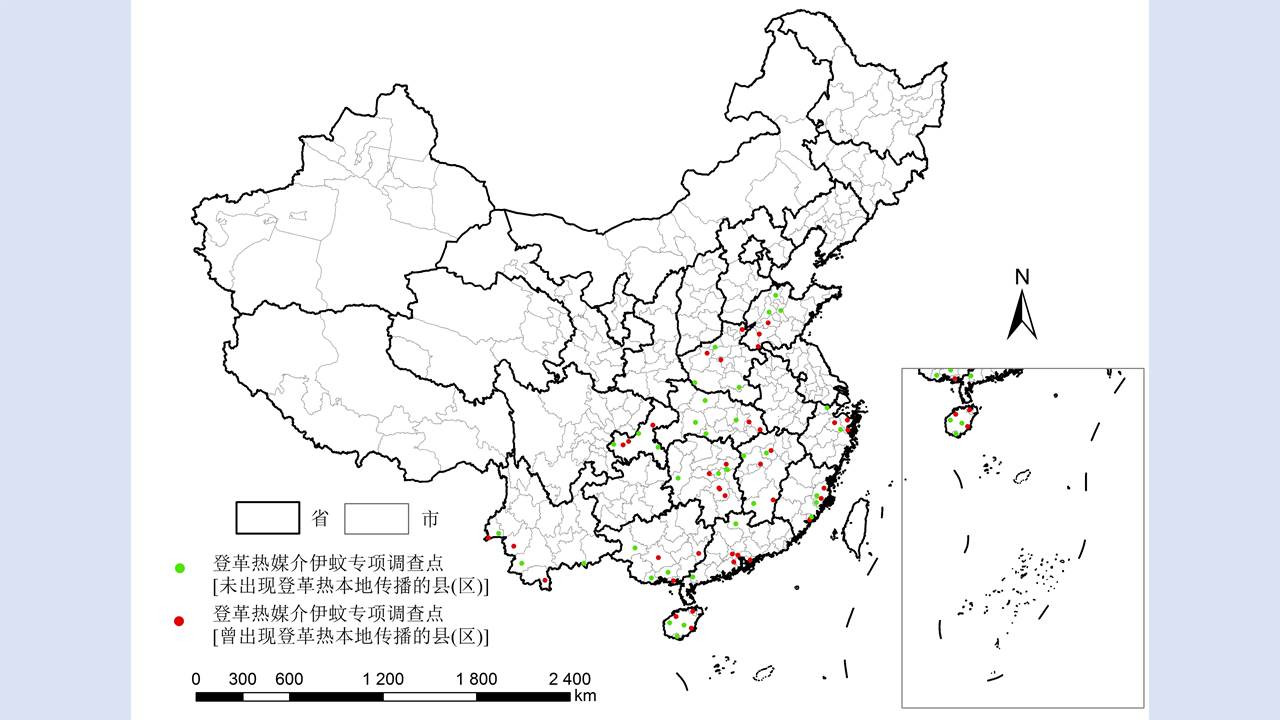
Objective To analyze the ecological surveillance results of Aedes vector in 12 provinces (autonomous regions or municipalities) in China in 2020-2021, and to provide a scientific basis for risk assessment, prediction, early warning, and control of Aedes-borne diseases. Methods The surveillance data of larval and adult Aedes densities at the special investigation sites of Aedes vector in 12 provinces (autonomous regions or municipalities) in China were collected and statistically analyzed by SPSS 18.0 software. Results In 2020-2021, the mean Breteau index (BI) was >10.00 in Hainan, Zhejiang, and Hunan provinces and >5.00 in Guangxi Zhuang Autonomous Region (Guangxi) and Yunnan, Henan, and Shandong provinces. The mean mosq-ovitrap index (MOI) was >5.00 in Guangxi, Guangdong, Hainan, and Shandong. The mean net trap index was ≥2.00 mosquitoes/net·hour in Henan, Hubei, and Shandong and >1.00 mosquito/net·hour in Guangxi, Guangdong, Hainan, Yunnan, Fujian, and Hunan. There were no statistical differences in BI, MOI, and net trap index between class I provinces (Guangdong, Hainan, Guangxi, Fujian, Yunnan, and Zhejiang) and other classes of provinces (t=0.766, 1.030, and -0.745, all P>0.05). The mean BI in 2020-2021 was higher than that in 2017-2019 in Guangdong, Guangxi, Yunnan, and Shandong, but lower than that in the three years in other provinces. The Aedes vector was found to be active throughout the year at the investigation sites in Guangdong, Hainan, Guangxi and Yunnan, from March to December in Fujian, Zhejiang, and Hubei, and from April to November in Chongqing municipality, Shandong and Henan, and from April to December in Jiangxi. The results of BI and MOI were inconsistent in Yunnan, Guangxi, and Hubei. During the study period, the BI of Aedes vector was >5.00 in areas where dengue outbreaks and local cases occurred, and >10.00 in Ruili city in Yunnan, Cenxi city of Wuzhou in Guangxi, and Sanjiao town of Zhongshan in Guangdong; the net trap index in Cenxi city of Guangxi was >2.00 mosquitoes/net·hour. Conclusion In 2020-2021, the mean Aedes density in the provinces with local cases of dengue fever in China was high, with spatio-temporal heterogeneity among different regions. It is suggested that in the local transmission areas of dengue in China, it is necessary to adjust moderately annual surveillance periods, to continuously strengthen Aedes vector surveillance and risk assessment, and to systematically sort out the ecological investigation results of Aedes vector, so as to provide a scientific basis for the revision and improvement of Aedes vector surveillance scheme and the outbreak control of Aedes-borne diseases in China.
[1] Li CL,Lu YM,Liu JN,et al. Climate change and dengue fever transmission in China:Evidences and challenges[J]. Sci Total Environ,2018,622-623:493-501. DOI:10.1016/j.scitotenv. 2017.11.326.
[2] Gao PJ,Pilot E,Rehbock C,et al. Land use and land cover change and its impacts on dengue dynamics in China:A systematic review[J]. PLoS Negl Trop Dis,2021,15(10):e0009879. DOI:10.1371/journal.pntd.0009879.
[3] Liu XB,Liu KK,Yue YJ,et al. Determination of factors affecting dengue occurrence in representative areas of China:A principal component regression analysis[J]. Front Public Health,2021,8:603872. DOI:10.3389/fpubh.2020.603872.
[4] Chen B,Liu QY. Dengue fever in China[J]. Lancet,2015,385(9978):1621-1622. DOI:10.1016/S0140-6736(15)60793-0.
[5] 徐朦,刘小波,宋秀平,等. 基于伤残调整寿命年的2010-2019年中国登革热疾病负担评估研究[J]. 中国媒介生物学及控制杂志,2020,31(5):509-512. DOI:10.11853/j.issn.1003. 8280.2020.05.001. Xu M,Liu XB,Song XP,et al. Assessment research on the disease burden of dengue fever in China from 2010 to 2019 based on disability-adjusted life years[J]. Chin J Vector Biol Control,2020,31(5):509-512. DOI:10.11853/j.issn.1003.8280.2020. 05.001.(in Chinese)
[6] 杨富强,夏光辉,曾志笠,等. 2019年江西省新干县一起登革热暴发疫情调查分析[J]. 应用预防医学,2021,27(1):79-82. DOI:10.3969/j.issn.1673-758X.2021.01.028. Yang FQ,Xia GH,Zeng ZL,et al. Investigation and analysis of an outbreak of dengue fever in Xin'gan county,Jiangxi province in 2019[J]. Appl Prev Med,2021,27(1):79-82. DOI:10.3969/j.issn.1673-758X.2021.01.028.(in Chinese)
[7] 陈宏义,张怡,艾静文,等. 2019年江西省登革热暴发疫情的流行病学及临床特征分析[J]. 中华传染病杂志,2019,37(11):641-645. DOI:10.3760/cma.j.issn.1000-6680.2019. 11.001. Chen HY,Zhang Y,Ai JW,et al. Epidemiological and clinical features of dengue fever outbreak in Jiangxi province in 2019[J]. Chin J Infect Dis,2019,37(11):641-645. DOI:10.3760/cma.j.issn.1000-6680.2019.11.001.(in Chinese)
[8] 罗超,陈琼,谭仕碧,等. 重庆市万州区2019年登革热暴发疫情流行特征及相关因素[J]. 中国热带医学,2021,21(7):654-657,662. DOI:10.13604/j.cnki.46-1064/r.2021.07.08. Luo C,Chen Q,Tan SB,et al. Epidemic characteristics and influential factors of dengue fever in Wanzhou,Chongqing,2019[J]. China Trop Med,2021,21(7):654-657,662. DOI:10. 13604/j.cnki.46-1064/r.2021.07.08.(in Chinese)
[9] 刘起勇. 我国登革热流行新趋势、防控挑战及策略分析[J]. 中国媒介生物学及控制杂志,2020,31(1):1-6. DOI:10.11853/j.issn.1003.8280.2020.01.001. Liu QY. Dengue fever in China:new epidemical trend,challenges and strategies for prevention and control[J]. Chin J Vector Biol Control,2020,31(1):1-6. DOI:10.11853/j.issn.1003.8280. 2020.01.001.(in Chinese)
[10] 余向华,陈坤. 蚊媒传染病监测研究进展[J]. 浙江预防医学,2007,19(4):59-61. DOI:10.3969/j.issn.1007-0931.2007.04.039. Yu XH,Chen K. Research progress on surveillance of mosquito-borne diseases[J]. Zhejiang J Prev Med,2007,19(4):59-61. DOI:10.3969/j.issn.1007-0931.2007.04.039.(in Chinese)
[11] Li YJ,Zhou GF,Zhong DB,et al. Widespread multiple insecticide resistance in the major dengue vector Aedes albopictus in Hainan province,China[J]. Pest Manage Sci,2021,77(4):1945-1953. DOI:10.1002/ps.6222.
[12] Su XH,Guo YJ,Deng JL,et al. Fast emerging insecticide resistance in Aedes albopictus in Guangzhou,China:Alarm to the dengue epidemic[J]. PLoS Negl Trop Dis,2019,13(9):e0007665. DOI:10.1371/journal.pntd.0007665.
[13] 刘小波,吴海霞,郭玉红,等. 2019年全国媒介伊蚊监测报告[J]. 中国媒介生物学及控制杂志,2020,31(4):401-406. DOI:10.11853/j.issn.1003.8280.2020.04.004. Liu XB,Wu HX,Guo YH,et al. Annual report on Aedes vector surveillance in China,2019[J]. Chin J Vector Biol Control,2020,31(4):401-406. DOI:10.11853/j.issn.1003.8280.2020. 04.004.(in Chinese)
[14] 刘永华,尹小雄,张海林,等. 云南省德宏州2013-2019年登革热流行特征及媒介伊蚊监测分析[J]. 中国媒介生物学及控制杂志,2021,32(2):173-180. DOI:10.11853/j.issn.1003.8280. 2021.02.011. Liu YH,Yin XX,Zhang HL,et al. Epidemiological characteristics of dengue fever and monitoring of Aedes vector mosquitoes in Dehong Dai and Jingpo Autonomous Prefecture of Yunnan province,China,2013-2019[J]. Chin J Vector Biol Control,2021,32(2):173-180. DOI:10.11853/j.issn.1003.8280. 2021.02.011.(in Chinese)
[15] Liu XB,Liu QY. Aedes surveillance and risk warnings for dengue-China,2016-2019[J]. China CDC Weekly,2020,2(24):431-437. DOI:10.46234/ccdcw2020.111.
[16] 黄坤,孙文锴,郭玉红,等. 中国南方5省媒介伊蚊幼蚊密度回归模型的建立与预测研究[J]. 中华卫生杀虫药械,2019,25(6):549-554. Huang K,Sun WK,Guo YH,et al. Establishment and prediction of regression models of Aedes larvae density in five provinces of the southern China[J]. Chin J Hyg Insect Equip,2019,25(6):549-554. (in Chinese)
[17] 黄坤,郭玉红,吴海霞,等. 我国重点省份媒介伊蚊幼蚊密度指数相关性研究[J]. 中国媒介生物学及控制杂志,2019,30(4):395-399. DOI:10.11853/j.issn.1003.8280.2019.04.009. Huang K,Guo YH,Wu HX,et al. A study of the correlation between density indices of Aedes vector larvae in key provinces of China[J]. Chin J Vector Biol Control,2019,30(4):395-399. DOI:10.11853/j.issn.1003.8280.2019.04.009.(in Chinese)
[18] 马敏,徐明,易波,等. 登革热暴发后媒介伊蚊的应急监测[J]. 中国媒介生物学及控制杂志,2019,30(4):374-378. DOI:10.11853/j.issn.1003.8280.2019.04.004. Ma M,Xu M,Yi B,et al. Emergency surveillance of vector Aedes after a dengue outbreak[J]. Chin J Vector Biol Control,2019,30(4):374-378. DOI:10.11853/j.issn.1003.8280.2019.04.004.(in Chinese)


