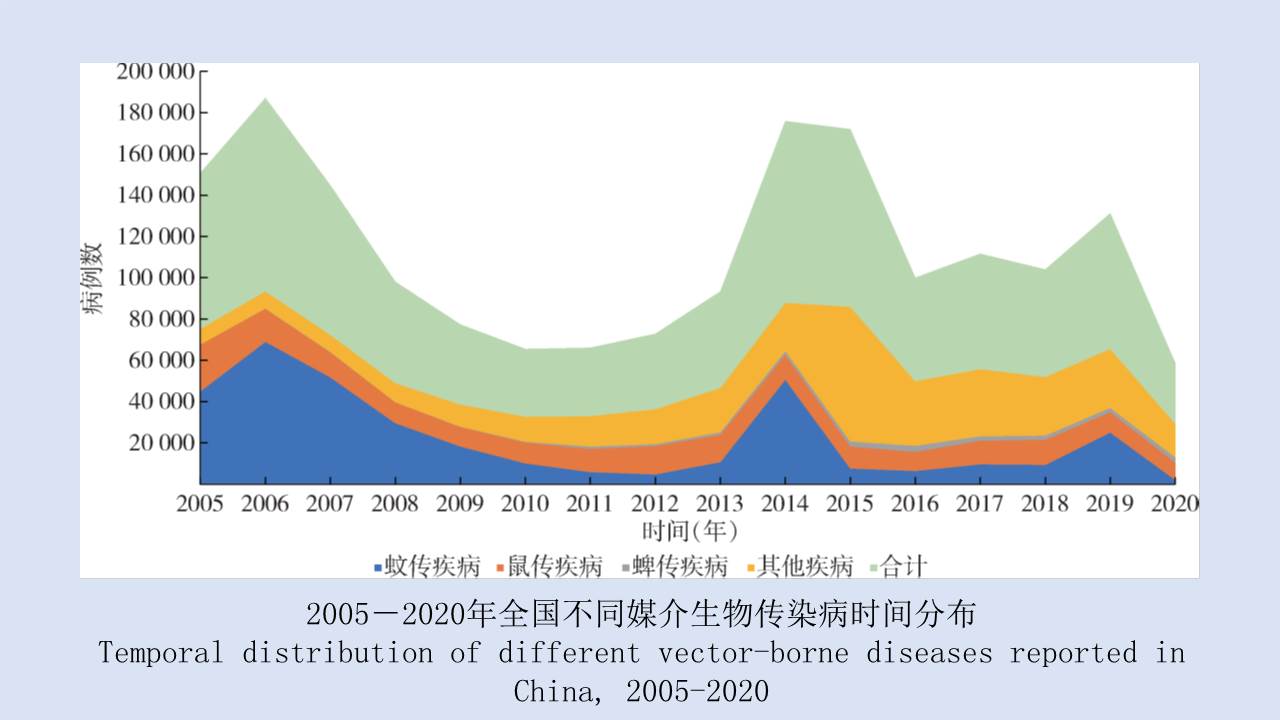
目的 对我国2005-2020年媒介生物传染病报告病例等数据进行分析研究,明确我国媒介生物传染病流行特点、趋势,探讨其防控挑战,提出应对策略。方法 使用描述性流行病学研究方法分析我国2005-2020年媒介生物传染病报告病例数据,基于媒介生物传染病流行特点,结合现有政策及国内外文献确定我国媒介生物传染病防控面临的挑战,探索应对策略及措施。结果 2005-2020年我国14种媒介生物传染病报告病例总数为905 092例,其中疟疾、恙虫病和肾综合征出血热(HFRS)占66.94%,10种法定报告媒介生物传染病占76.01%(687 970/905 092)。报告死亡病例总数为5 076例,其中流行性乙型脑炎(乙脑)、HFRS、发热伴血小板减少综合征(SFTS)以及疟疾的死亡病例占93.26%。2005-2020年间,全国媒介生物传染病发病呈波动下降趋势。在2006和2014-2015年发病数出现2个明显高峰。经Mann-Kendall趋势检验,乙脑、疟疾、斑疹伤寒和钩体病的发病率下降趋势明显,差异有统计学意义(P<0.01),SFTS和恙虫病的上升趋势明显,差异亦有统计学意义(P<0.01)。同时,媒介生物传染病的发生有明显的季节性,总体发病高峰出现在10月。全国媒介生物传染病年均病例报告区(县)约2 165个,主要分布在黑河-腾冲线以东。经Mann-Kendall趋势检验,病例报告区(县)数呈上升趋势,但差异无统计学意义(P=0.367)。16年来,东北地区媒介生物传染病病例数呈下降趋势,而西南地区的病例数则有所增加。不同疾病的主要发病年龄段不同,总体来看,媒介生物传染病的总发病高峰年龄段在20~44岁,发病率男性高于女性。结论 我国媒介生物传染病报告发病数整体呈波动下降趋势,但仍处于较高水平,且流行区有扩大趋势,尚有疾病发病率或死亡率呈持续上升。针对媒介生物传染病防控新挑战,应切实落实媒介生物综合治理和可持续控制等策略和措施,进一步降低媒介生物传染病发病及死亡,努力实现健康中国和全球病媒控制对策阶段性指标和总体目标。
Objective To analyze the data of reported cases of vector-borne diseases (VBDs) in China in 2005-2020, and to investigate the epidemic characteristics and trend of VBDs, challenges in prevention and control, and related coping strategies. Methods The descriptive epidemiological method was used to analyze the data of reported cases of VBDs in China in 2005-2020, and the challenges in prevention and control and related coping strategies were determined based on the epidemic characteristics of VBDs, current policies, and related literature domestic and abroad. Results A total of 905 092 cases of 14 VBDs were reported in China in 2005-2020, among which malaria, scrub typhus, and hemorrhagic fever with renal syndrome (HFRS) accounted for 66.94%, the ten notifiable VBDs accounted for 76.01%. A total of 5 076 death cases were reported, among which the death cases due to Japanese encephalitis (JE), HFRS, severe fever with thrombocytopenia Syndrome (SFTS), and malaria accounted for 93.26%. The incidence of VBDs fluctuated and decreased in 2005-2020. The number of cases showed two significant peaks in 2006 and 2014-2015. The Mann-Kendall trend test showed a significant trend of reduction in JE, malaria, typhus, and leptospirosis (P<0.01) and a significant trend of increase in SFTS and scrub typhus (P<0.01). At the same time, the incidence of VBDs showed marked seasonality with a peak in October. About 2 165 districts/counties reported VBDs annually, mainly in the east of the Heihe-Tengchong line. The Mann-Kendall trend test showed that the number of districts/counties reporting such cases tended to increase with no significance (P=0.367). Over the past 16 years, the number of cases of vector-borne diseases tended to decrease in northeast China, while this number tended to increase in southwest China. Different diseases had different ages of onset, and the peak age of onset of VBDs was 20-44 years. The male population tended to have a higher incidence rate than the female population. Conclusion The number of cases of VBDs tends to decrease with fluctuation in China, but it still remains at a relatively high level, and the epidemic area tends to expand, with continuous increases in the incidence rate or mortality rate of some VBDs. As for the new challenges in the control of VBDs, it is necessary to implement related strategies and measures including the integrated vector management and sustainable vector management, so as to further reduce the morbidity and mortality of VBDs and achieve the targets and goals of Health China and Global Vector Control Strategies.
[1] World Health Organization. Global vector control response 2017-2030:A strategic approach to tackle vector-borne diseases[R]. Geneva:WHO,2017.
[2] 刘起勇. 气候变化对中国媒介生物传染病的影响及应对:重大研究发现及未来研究建议[J]. 中国媒介生物学及控制杂志,2021,32(1):1-11. DOI:10.11853/j.issn.1003.8280.2021. 01.001. Liu QY. Impact of climate change on vector-borne diseases and related response strategies in China:Major research findings and recommendations for future research[J]. Chin J Vect Biol Control,2021,32(1):1-11. DOI:10.11853/j.issn.1003.8280. 2021.01.001.(in Chinese)
[3] 刘起勇. 新时代媒介生物传染病形势及防控对策[J]. 中国媒介生物学及控制杂志,2019,30(1):1-6,11. DOI:10.11853/j.issn.1003.8280.2019.01.001. Liu QY. Epidemic profile of vector-borne diseases and vector control strategies in the new era[J]. Chin J Vect Biol Control,2019,30(1):1-6,11. DOI:10.11853/j.issn.1003.8280.2019. 01.001.(in Chinese)
[4] 徐建国. 未来传染病[J]. 首都公共卫生,2016,10(1):5-6. DOI:10.16760/j.cnki.sdggws.2016.01.002. Xu JG. Future infectious diseases[J]. Cap J Public Health,2016,10(1):5-6. DOI:10.16760/j.cnki.sdggws.2016.01.002.(in Chinese)
[5] Liu QY,Gao Y. Reported vector-borne diseases-China,2018[J]. China CDC Weekly,2020,2(14):219-224. DOI:10.46234/ccdcw2020.057.
[6] 陈琳,曹淳力,刘阳,等. 迈向消除阶段我国血吸虫病突发疫情应急响应[J/OL]. 中国血吸虫病防治杂志,2022,33:1-5[2022-01-12]. https://kns.cnki.net/KCMS/detail/detail.aspx?dbcode=CJFQ&dbname=CAPJLAST&filename=XXCB20220111000. Chen L,Cao CL,Liu Y,et al. Emergency responses to schistosomiasis outbreak during the stage moving towards elimination in China[J/OL]. Chin J Schisto Control,2022,33:1-5[2022-01-12]. https://kns.cnki.net/KCMS/detail/detail.aspx?dbcode=CJFQ&dbname=CAPJLAST&filename=XXCB20220111000. (in Chinese)
[7] Yue YJ,Ren DS,Liu XB,et al. Spatio-temporal patterns of scrub typhus in mainland China,2006-2017[J]. PLoS Negl Trop Dis,2019,13(12):e0007916. DOI:10.1371/journal.pntd.0007916.
[8] 刘起勇. 我国登革热流行新趋势、防控挑战及策略分析[J]. 中国媒介生物学及控制杂志,2020,31(1):1-6. DOI:10.11853/j.issn.1003.8280.2020.01.001. Liu QY. Dengue fever in China:new epidemical trend,challenges and strategies for prevention and control[J]. Chin J Vect Biol Control,2020,31(1):1-6. DOI:10.11853/j.issn.1003.8280. 2020.01.001.(in Chinese)
[9] 吴丹,尹遵栋,李军宏,等. 中国2014-2018年流行性乙型脑炎流行病学特征[J]. 中国疫苗和免疫,2020,26(1):1-4. Wu D,Yin ZD,Li JH,et al. Epidemiology of Japanese encephalitis in China,2014-2018[J]. Chin J Vaccin Immun,2020,26(1):1-4. (in Chinese)
[10] Liu QY,Xu WB,Lu S,et al. Landscape of emerging and re-emerging infectious diseases in China:Impact of ecology,climate,and behavior[J]. Front Med,2018,12(1):3-22. DOI:10.1007/s11684-017-0605-9.
[11] Cao J,Newby G,Cotter C,et al. Achieving malaria elimination in China[J]. Lancet Public Health,2021,6(12):E871-872. DOI:10.1016/S2468-2667(21)00201-2.
[12] 刘起勇,刘小波. 中国消除疟疾媒介按蚊控制策略和技术[J]. 中国媒介生物学及控制杂志,2021,32(5):513-518. DOI:10.11853/j.issn.1003.8280.2021.05.002. Liu QY,Liu XB. Anopheles vector control strategy and technology for eliminating the malaria in China[J]. Chin J Vect Biol Control,2021,32(5):513-518. DOI:10.11853/j.issn.1003. 8280.2021. 05.002.(in Chinese)
[13] Atoni E,Zhao L,Hu C,et al. A dataset of distribution and diversity of mosquito-associated viruses and their mosquito vectors in China[J]. Sci Data,2020,7(1):342. DOI:10.1038/s41597-020-00687-9.
[14] 梁国栋. 虫媒病毒:重要的被忽略的热带传染病病原体[J]. 中国热带医学,2018,18(1):1-5. DOI:10.13604/j.cnki.46-1064/r.2018.01. Liang GD. Arbovirus:The very important pathogen of neglected tropical infectious disease in the world[J]. China Trop Med,2018,18(1):1-5. DOI:10.13604/j.cnki.46-1064/r.2018.01.(in Chinese)


