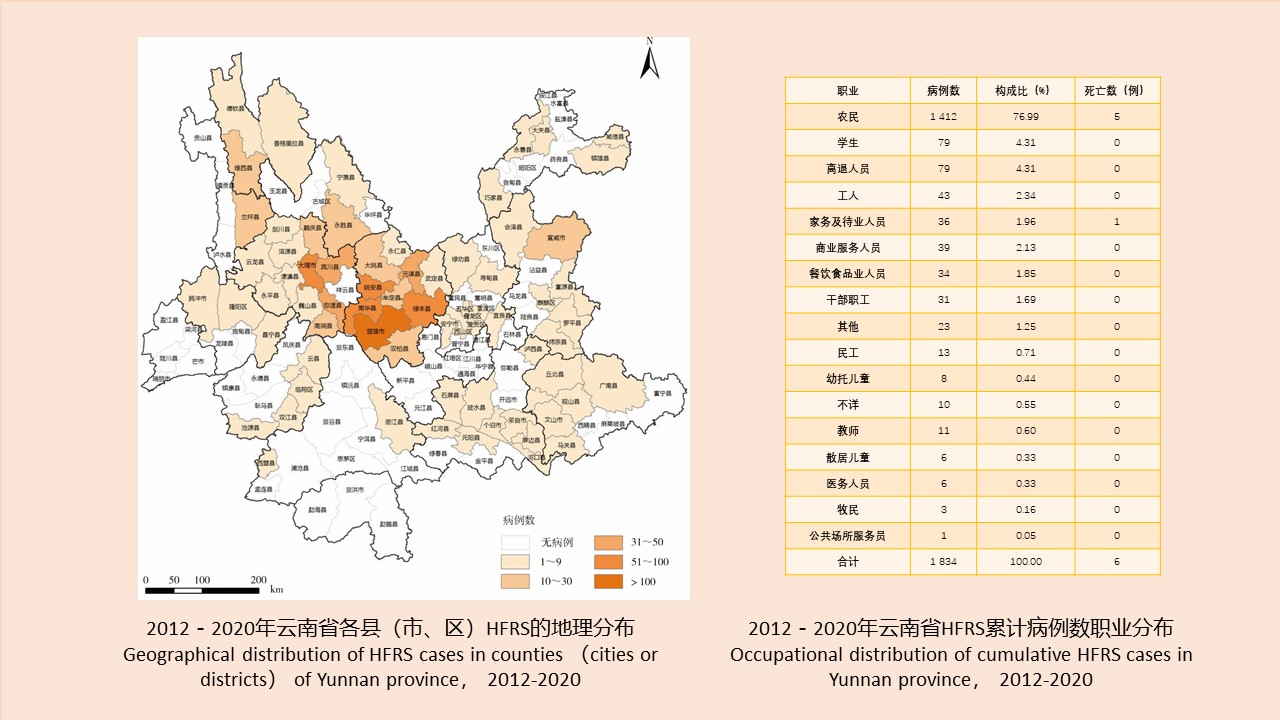
Objective To analyze the epidemiological characteristics of hemorrhagic fever with renal syndrome (HFRS) in Yunnan province, China, 2012-2020 and understand the epidemic situation, and to provide a scientific basis for the prevention and control of HFRS. Methods HFRS case data and epidemiological data were collected and analyzed by the descriptive epidemiological method. Excel 2013 software was used to create the database, and SPSS 20.0 software was used for data analysis. Results From 2012 to 2020, a total of 1 834 cases of HFRS were reported, with 6 death cases. The mean annual incidence was 0.43/100 000, and the fatality rate was 0.33%. The incidence was lowest in 2012 (0.10/100 000) and highest in 2015 (0.56/100 000). Between 2014 and 2020, HFRS was in a high incidence state in Yunnan province, with 200 to 300 cases per year. Cases were reported in 71 counties (county-level cities or districts) of 13 prefectures (prefecture-level cities) of Yunnan province, mainly distributed in Dali Bai Autonomous Prefecture (999/1 834, 54.47%) and Chuxiong Yi Autonomous Prefecture (670/1 834, 36.53%) in mid-western Yunnan province, and the combined number of cases in this two prefectures accounted for 91.00% (1 669 cases) of the total cases in Yunnan province. HFRS could occur in every month throughout the year, mainly from April to June. All age groups could be affected, mostly those aged between 20 and 60 years. The male-to-female ratio was 2.36:1, and the majority of cases were farmers (76.99%). Conclusion In recent years, HFRS in Yunnan province has been on the rise and at a high incidence. It is urgent to strengthen comprehensive control measures including health education, rodent control, and vaccination in the high-risk areas of mid-western Yunnan province.
[1] 卫生部疾病控制司《流行性出血热防治手册》编写组. 流行性出血热防治手册[M]. 2版. 北京:人民卫生出版社,1998:30-46,138-147. Compilation Group of Epidemic Hemorrhagic Fever Prevention and Control Manual of Disease Control Department of the Ministry of Health. Handbook of prevention and control for the epidemic hemorrhagic fever[M]. 2nd ed. Beijing:People's Medical Publishing House,1998:30-46,138-147.
[2] He JY,Wang Y,Mu D,et al. The impacts of climatic factors and vegetation on hemorrhagic fever with renal syndrome transmission in China:a study of 109 counties[J]. Int J Environ Res Public Health,2019,16(18):3434. DOI:10.3390/ijerph16183434.
[3] 陈俊江,国天赐,宋姝璇,等. 中国肾综合征出血热流行特征及时空分析模型进展[J]. 中华流行病学杂志,2020,41(10):1735-1740. DOI:10.3760/cma.j.cn112338-20191108-00794. Chen JJ,Guo TC,Song SX,et al. Epidemiological characteristics and the development of spatiotemporal analysis models on hemorrhagic fever with renal syndrome in China[J]. Chin J Epidemiol,2020,41(10):1735-1740. DOI:10.3760/cma.j.cn112338-20191108-00794.
[4] Jiang H,Zheng XY,Wang LM,et al. Hantavirus infection:a global zoonotic challenge[J]. Virol Sin,2017,32(1):32-43. DOI:10.1007/s12250-016-3899-x.
[5] 张海林,张云智. 中国汉坦病毒基因型及分布[J]. 中国媒介生物学及控制杂志,2011,22(5):417-420. Zhang HL,Zhang YZ. Distribution and gene-typing of Hantaviruses in China[J]. Chin J Vector Biol Control,2011,22(5):417-420.
[6] 张海林,何建华,张云智. 云南省流行性出血热流行病学分析[J]. 云南预防医学杂志,2003,8(1):4-7. Zhang HL,He JH,Zhang YZ. Epidemiological analysis of the epidemic hemorrhagic fever in Yunnan province[J]. Yunnan J Prev Med,2003,8(1):4-7.
[7] 李金梅,张海林,刘晓强. 云南省肾综合征出血热流行病学特征分析[J]. 疾病监测,2009,24(4):266-268. DOI:10.3784/j.issn.1003-9961.2009.04.015. Li JM,Zhang HL,Liu XQ. An analysis on the epidemiological characteristics of hemorrhagic fever with renal syndrome in Yunnan province[J]. Dis Surveill,2009,24(4):266-268. DOI:10.3784/j.issn.1003-9961.2009.04.015.
[8] 靳寿华,张海林,杨卫红,等. 云南省1976-2012年肾综合征出血热流行特征分析[J]. 中国媒介生物学及控制杂志,2013,24(6):498-502. DOI:10.11853/j.issn.1003.4692.2013.06.006. Jin SH,Zhang HL,Yang WH,et al. Epidemiological analysis of hemorrhagic fever with renal syndrome during 1976 to 2012 in Yunnan province,China[J]. Chin J Vector Biol Control,2013,24(6):498-502. DOI:10.11853/j.issn.1003.4692.2013.06.006.
[9] 张海林,杨卫红,张云智,等. 云南省2001-2002年肾综合征出血热监测研究[J]. 地方病通报,2004,19(4):42-47. DOI:10.13215/j.cnki.jbyfkztb.2004.04.013. Zhang HL,Yang WH,Zhang YZ,et al. Surveillance of hemorrhagic fever with renal syndrome in Yunnan province,China, 2001-2002[J]. Endem Dis Bull,2004,19(4):42-47. DOI:10.13215/j.cnki.jbyfkztb.2004.04.013.
[10] Arai S,Yanagihara R. Genetic diversity and geographic distribution of bat-borne hantaviruses[J]. Curr Issues Mol Biol,2020,39:1-28. DOI:10.21775/cimb.039.001.
[11] Zhang YZ,Zou Y,Fu ZF,et al. Hantavirus infections in humans and animals,China[J]. Emerg Infect Dis,2010,16(8):1195-1203. DOI:10.3201/eid1608.090470.
[12] 刘天,夏世国,梅芳盛,等. 湖北省荆州市2017-2018年肾综合征出血热宿主动物监测结果分析[J]. 中国媒介生物学及控制杂志,2020,31(4):469-473. DOI:10.11853/j.issn.1003. 8280.2020.04.019. Liu T,Xia SG,Mei FS,et al. Surveillance results of host animals of hemorrhagic fever with renal syndrome in Jingzhou,Hubei province,China from 2017 to 2018[J]. Chin J Vector Biol Control,2020,31(4):469-473. DOI:10.11853/j.issn.1003.8280. 2020.04.019.
[13] 邹洋,张海林,张云智,等. 云南省褐家鼠与黄胸鼠中汉坦病毒的流行病学研究[J]. 中国媒介生物学及控制杂志,2006,17(5):399-403. DOI:10.3969/j.issn.1003-4692.2006.05.017. Zou Y,Zhang HL,Zhang YZ,et al. The epidemiologic investigation and characterization of hantavirus carried by Rattus in Yunnan[J]. Chin J Vector Biol Control,2006,17(5):399-403. DOI:10.3969/j.issn.1003-4692.2006.05.017.
[14] 周济华,张海林,王静林,等. 云南省楚雄州汉坦病毒宿主动物及分子流行病学研究[J]. 中华流行病学杂志,2009,30(3):239-242. DOI:10.3760/cma.j.issn.0254-6450.2009.03.009. Zhou JH,Zhang HL,Wang JL,et al. Survey on host animal and molecular epidemiology of hantavirus in Chuxiong Prefecture,Yunnan province[J]. Chin J Epidemiol,2009,30(3):239-242. DOI:10.3760/cma.j.issn.0254-6450.2009.03.009.
[15] 李金梅,张海林,杨卫红,等. 2007年云南省汉坦病毒宿主动物及其基因分型研究[J]. 地方病通报,2009,24(6):1-7,11. DOI:10.13215/j.cnki.jbyfkztb.2009.06.033. Li JM,Zhang HL,Yang WH,et al. Study on host animals and their genotyping of hantavirus in Yunnan province of China in 2007[J]. Endem Dis Bull,2009,24(6):1-7,11. DOI:10.13215/j.cnki.jbyfkztb.2009.06.033.
[16] 李文娟,张海林,张云智,等. 云南省祥云县肾综合征出血热流行特征分析[J]. 中国热带医学,2013,13(11):1319-1322. DOI:10.13604/j.cnki.46-1064/r.2013.11.016. Li WJ,Zhang HL,Zhang YZ,et al. Epidemiological characteristics of hemorrhagic fever with renal syndrome in Xiangyun county,Yunnan province[J]. China Trop Med,2013,13(11):1319-1322. DOI:10.13604/j.cnki.46-1064/r.2013. 11.016.
[17] 胡挺松,胡秋凌,李绍雄,等. 云南省楚雄市2015-2018年肾综合征出血热流行特征及宿主动物调查[J]. 中国媒介生物学及控制杂志,2020,31(2):152-157,163. DOI:10.11853/j.issn.1003.8280.2020.02.007. Hu TS,Hu QL,Li SX,et al. Epidemiological features of hemorrhagic fever with renal syndrome and the host animals in Chuxiong,Yunnan province,China,2015-2018[J]. Chin J Vector Biol Control,2020,31(2):152-157,163. DOI:10.11853/j.issn.1003.8280.2020.02.007.


