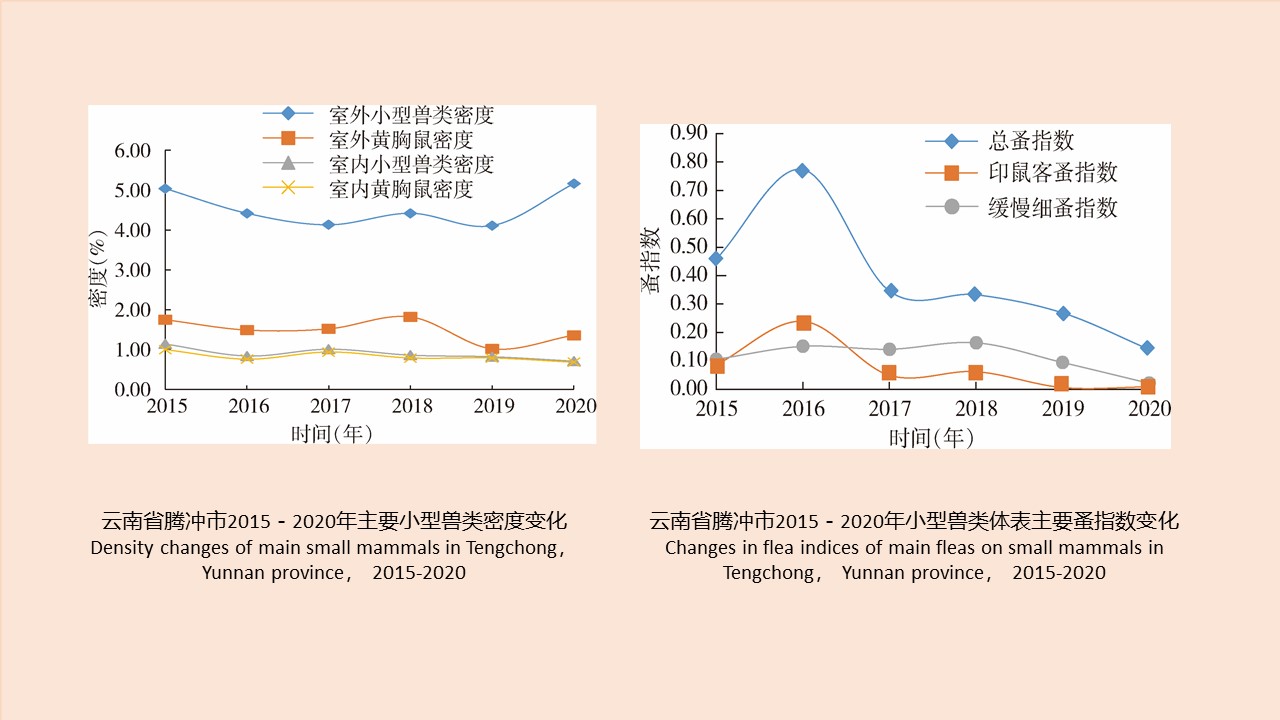
目的 分析腾冲市2015-2020年鼠疫监测资料,掌握鼠疫疫情动态和鼠疫宿主媒介变化,为鼠疫防控对策提供科学依据。方法 按《云南省鼠疫监测方案》和《云南省鼠疫监测实施细则》要求,开展鼠疫宿主动物、媒介、病原学及血清学监测,使用Wilcoxon秩和检验和χ2检验对监测资料进行分析。结果 捕获小型兽类共2 357只,隶属3目6科15属20种,室内黄胸鼠平均密度为0.83%,占捕获总数的92.27%;室外黄胸鼠平均密度为1.49%,占捕获总数的32.91%。捕获鼠体检蚤1 180匹,隶属于1目5科15属23种,其中缓慢细蚤占捕获总数的29.24%,印鼠客蚤占19.15%。地面游离蚤印鼠客蚤检出1匹,缓慢细蚤检出5匹。缓慢细蚤及印鼠客蚤指数呈逐年下降趋势,室外黄胸鼠密度高于室内。小型兽类肝、脾鼠疫耶尔森菌(鼠疫菌)培养3 071份,蚤鼠疫菌培养894组,鼠疫血清F1抗体检测8 436份,均为阴性。结论 腾冲市鼠疫主要宿主、媒介控制较好,疫源地当前处于静息期,鼠疫传播风险较大,需加强监测,提高监测质量及应急储备能力。
李希尚, 蔡文斌, 杨雁鸣, 董祖平, 王兴娟, 杨东海, 王加志, 尹授钦, 李胜国
. 云南省腾冲市2015-2020年鼠疫监测结果分析[J]. 中国媒介生物学及控制杂志, 2021
, 32(6)
: 710
-714
.
DOI: 10.11853/j.issn.1003.8280.2021.06.011
Objective To analyze plague surveillance data in Tengchong, Yunnan province, China, 2015-2020, investigate the epidemic situation and host and vector changes of plague, and to provide a scientific basis for plague prevention and control. Methods According to "Yunnan Provincial Plague Surveillance Program" and "Detailed Rules for the Implementation of Plague Surveillance in Yunnan Province", plague host, vector, pathogen, and serology monitoring were carried out, and the surveillance data were analyzed using the Wilcoxon rank-sum test and Chi-square test. Results A total of 2 357 small mammals were captured, belonging to 20 species of 15 genera in 6 families under 3 orders. Indoor Rattus tanezumi accounted for 92.27% of the total catch, with a mean density of 0.83%, while outdoor R. tanezumi accounted for 32.91% of the total catch, with a mean density of 1.49%. A total of 1 180 fleas were collected from rodents, belonging to 23 species of 15 genera in 5 families under 1 order. Leptopsylla segnis accounted for 29.24% of the total catch, and Xenopsylla cheopis accounted for 19.15% of the total catch. Only one free X. cheopis flea and five L. segnis fleas were captured. The flea indices of L. segnis and X. cheopis tended to decrease year by year. The density of R. tanezumi outdoors was higher than that indoors. A total of 3 071 liver or spleen specimens of small mammals and 894 specimens of fleas were collected for culture for plague bacteria (Yersina pestis), and 8 436 samples were detected for plague serum F1 antibody. All the samples tested negative. Conclusion In Tengchong, the main hosts and vectors of plague are well controlled, and plague is in a resting period in 2015-2020, but with a relatively high risk of transmission. It is necessary to strengthen surveillance, improve monitoring quality, and raise the emergency response reserve capacity.
[1] 赵秋芳,尹家祥. 我国鼠疫流行形势分析及其防治策略探讨[J]. 中国热带医学,2016,16(7):733-735. DOI:10.13604/j.cnki.46-1064/r.2016.07.29. Zhao QF,Yin JX. Plague epidemic situation and discussion on plague prevention and control strategy in China[J]. China Trop Med,2016,16(7):733-735. DOI:10.13604/j.cnki.46-1064/r.2016.07.29.
[2] 向锁玉,孙希,吴忠道. 中国鼠疫的疫情及防治进展[J]. 中国热带医学,2020,20(5):486-490. DOI:10.13604/j.cnki.46-1064/r.2020.05.20. Xiang SY,Sun X,Wu ZD. Epidemic situation and control progress of plague in China[J]. China Trop Med,2020,20(5):486-490. DOI:10.13604/j.cnki.46-1064/r.2020.05.20.
[3] 李成胜,寸待启,杨雁鸣,等. 腾冲市2011-2015年鼠疫监测结果分析[J]. 中国媒介生物学及控制杂志,2016,27(6):587-590. DOI:10.11853/j.issn.1003.8280.2016.06.017. Li CS,Cun DQ,Yang YM,et al. Plague surveillance analysis in Tengchong city,2011-2015[J]. Chin J Vector Biol Control,2016,27(6):587-590. DOI:10.11853/j.issn.1003.8280.2016. 06.017.
[4] 李艳萍,黄东升,赵明,等. 云南省保山市2008-2015年鼠疫监测结果分析[J]. 中国媒介生物学及控制杂志,2018,29(3):298-302. DOI:10.11853/j.issn.1003.8280.2018.03.021. Li YP,Huang DS,Zhao M,et al. Surveillance on plague in Baoshan city,Yunnan,China,2018-2015[J]. Chin J Vector Biol Control,2018,29(3):298-302. DOI:10.11853/j.issn.1003.8280. 2018.03.021.
[5] 苏丽琼,段彪,梁云,等. 云南省2018年动物间鼠疫监测调查与分析[J]. 中国人兽共患病学报,2020,36(12):1000-1005. DOI:10.3969/j.issn.1002-2694.2020.00.164. Su LQ,Duan B,Liang Y,et al. Investigation and analysis of animal plague surveillance in Yunnan province,China,in 2018[J]. Chin J Zoonoses,2020,36(12):1000-1005. DOI:10.3969/j.issn.1002-2694.2020.00.164.
[6] 孔进姣,王鹏,梁云,等. 云南省德宏傣族景颇族自治州1950-2019年鼠疫流行病学分析[J]. 中华流行病学杂志,2020,41(9):1504-1508. DOI:10.3760/cma.j.cn112338-20191128-00842. Kong JJ,Wang P,Liang Y,et al. Epidemiological analysis of plague in Dehong Dai and Jingpo Autonomous Prefecture of Yunnan province,1950-2019[J]. Chin J Epidemiol,2020,41(9):1504-1508. DOI:10.3760/cma.j.cn112338-20191128-00842.
[7] 高子厚,宋志忠,董兴齐,等. 云南省自然感染鼠疫媒介生物的研究[J]. 中国媒介生物学及控制杂志,2008,19(3):216-219. DOI:10.3969/j.issn.1003-4692.2008.03.014. Gao ZH,Song ZZ,Dong XQ,et al. Study on the vectors naturally infected by plague in Yunnan province[J]. Chin J Vector Biol Control,2008,19(3):216-219. DOI:10.3969/j.issn.1003-4692.2008.03.014.
[8] 刘美琪,邵宗体,刘正祥,等. 云南野鼠鼠疫自然疫源地应急处置措施研究概述[J]. 医学动物防制,2021,37(2):157-159,163. DOI:10.7629/yxdwfz202102015. Liu MQ,Shao ZT,Liu ZX,et al. Overviews of the study on emergency treatment measures in the natural foci of wild rodent plague in Yunnan province[J]. J Med Pest Control,2021,37(2):157-159,163. DOI:10.7629/yxdwfz202102015.
[9] 刘正祥,蔡文凤,王国良,等. 3种方法测定地面游离蚤的效果观察[J]. 中国热带医学,2014,14(5):556-558,580. DOI:10.13604/j.cnki.46-1064/r.2014.05.006. Liu ZX,Cai WF,Wang GL,et al. Effect of capturing floor flea with three methods[J]. China Trop Med,2014,14(5):556-558,580. DOI:10.13604/j.cnki.46-1064/r.2014.05.006.


